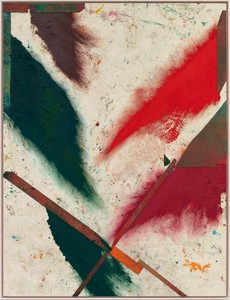
Sterling Ruby: The Frenetic Beat
Ester Coen meditates on the dynamism of Sterling Ruby’s recent projects, tracing parallels between these works and the histories of Futurism, Constructivism, and the avant-garde.
Installation view
Artwork © Sterling Ruby. Photo: Thomas Lannes
Installation view
Artwork © Sterling Ruby. Photo: Thomas Lannes
Installation view
Artwork © Sterling Ruby. Photo: Thomas Lannes
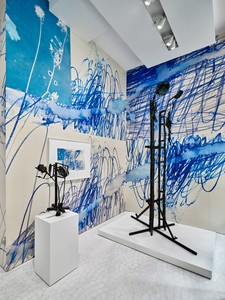
Installation view
Artwork © Sterling Ruby. Photo: Thomas Lannes
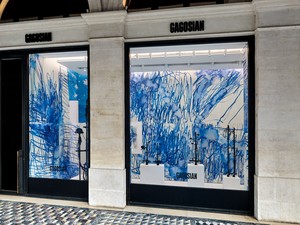
Installation view
Artwork © Sterling Ruby. Photo: Thomas Lannes
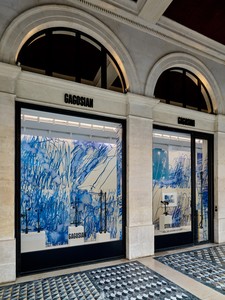
Installation view
Artwork © Sterling Ruby. Photo: Thomas Lannes
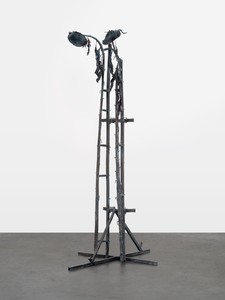
Sterling Ruby
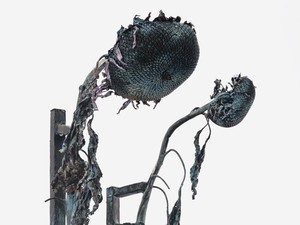
Bound Flowers. Couple. (9195), 2026
Bronze, 107 ¼ × 46 × 67 inches (272.4 × 116.8 × 170.2 cm)
© Sterling Ruby. Photo: Sterling Ruby Studio
Sterling Ruby
Bound Flowers. Couple. (9195), 2026 (detail)
Bronze, 107 ¼ × 46 × 67 inches (272.4 × 116.8 × 170.2 cm)
© Sterling Ruby. Photo: Sterling Ruby Studio
Sterling Ruby
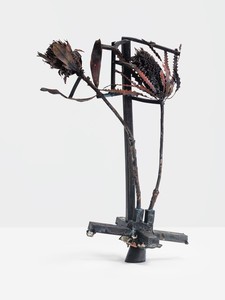
Bound Flowers. Couple. (9188), 2026
Bronze, 28 ¾ × 19 ¼ × 11 inches (73 × 48.9 × 27.9 cm)
© Sterling Ruby
Sterling Ruby
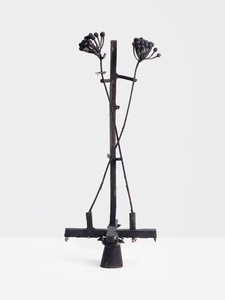
Bound Flowers. Couple. (9189), 2026
Bronze, 29 ¼ × 12 ⅛ × 11 ¾ inches (74.3 × 30.8 × 29.8 cm)
© Sterling Ruby
Sterling Ruby
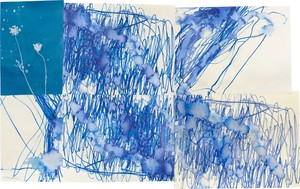
GHOSTS (9180), 2026
Watercolor, cyanotype, and mixed-media collage on paper, 16 ¼ × 26 inches (41.3 × 66 cm)
© Sterling Ruby
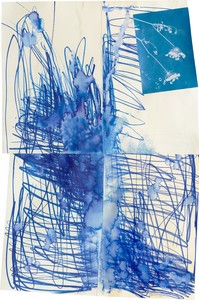
Sterling Ruby
GHOSTS (9181), 2026
Watercolor, cyanotype, and mixed-media collage on paper, 30 × 20 inches (76.2 × 50.8 cm)
© Sterling Ruby
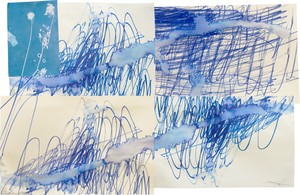
Sterling Ruby
GHOSTS (9182), 2026
Watercolor, cyanotype, and mixed-media collage on paper, 21 ½ × 33 inches (54.6 × 83.8 cm)
© Sterling Ruby
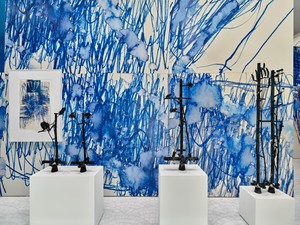
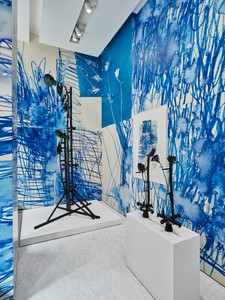
Gagosian is pleased to announce TILL DEATH DO US PART, an exhibition of new works by Sterling Ruby opening at the rue de Castiglione gallery in Paris on June 12. This suite of collages and cast bronze sculptures continues Ruby’s use of flowers as both raw and iconographic material. Derived from his expanding studio garden in Vernon, California, and extended time spent in the Eastern Sierras, the installation envelops visitors in an elegy to the floral.
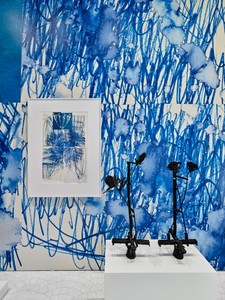
Visible through the gallery’s storefront windows, prints of the GHOSTS series (2026) are architecturally scaled and papered across the gallery walls, filling them with deep blue linear marks distinguished by a dense texture reminiscent of pastures undulating on a windy day. The works’ source collages, which combine traditional cyanotypes with washy drawn elements, hang on the walls over the field of blues. Occupying the space itself are several unique cast bronze sculptures from the series Bound Flowers. Couple. (2025–), which represent pairs of flowers bound in an embrace. This coupling provides a framework for the entire exhibition, each element functioning in relation to another, then another. These relationships are presented as a tandem dance, with forms mimicking, overlapping, intertwining, and even appearing to look at one another.
The most evocative examples of this tête-à-tête are the subtly emotive gestures of the bound flowers, which imply a more complex relationship: marriage. Flowers have been positioned in distinctive stances mimicking those of wedding portraits in which two bodies are posed together in a rigid commitment—“till death do us part.” Relationships remain central as Ruby refers to seventeenth-century Flemish and Dutch still-life painting, in which domestic arrangements carry a wide range of symbolism. Akin to these intricate historical works, the details of Ruby’s floral representations—the sculptures in particular—convey painstaking labor to which the unified naturalness of the specimens stands in contrast. Flowers are portrayed in various stages of decay, returning to their symbolism for the impermanence of life.
9 rue de Castiglione
75001 Paris
+33 1 42 36 30 07
paris@gagosian.com
Hours: Tuesday–Saturday 10:30–6:30
Gagosian
press@gagosian.com
Toby Kidd
tkidd@gagosian.com
+44 7551 562067
Laura Callendar
lcallendar@gagosian.com
+44 7393 464636
Joonam Partners
gagosian@joonampartners.com
Roya Nasser
+33 6 20 26 33 28
Pierre-Édouard Moutin
+33 6 26 25 51 57
Request more information
about this exhibition
Ester Coen meditates on the dynamism of Sterling Ruby’s recent projects, tracing parallels between these works and the histories of Futurism, Constructivism, and the avant-garde.
Join Sterling Ruby in his Los Angeles studio as he works on new abstract paintings ahead of his exhibition TURBINES at Gagosian in New York.
As spring approaches in the Northern Hemisphere, Sydney Stutterheim reflects on the iconography and symbolism of the season in art both past and present.
Alessandro Rabottini investigates the theoretical and formal underpinnings of Sterling Ruby’s career through the lens of the artist’s series ACTS.
The Fall 2019 issue of Gagosian Quarterly is now available, featuring a detail from Sinking (2019) by Nathaniel Mary Quinn on its cover.
An exhibition at Gagosian, Paris, is raising funds to aid in the reconstruction of the Cathédrale Notre-Dame de Paris following the devastating fire of April 2019. Gagosian directors Serena Cattaneo Adorno and Jean-Olivier Després spoke to Jennifer Knox White about the generous response of artists and others, and what the restoration of this iconic structure means across the world.
Ceramics expert Garth Clark explores Sterling Ruby’s practice in the medium, addressing the work’s allegiances and divergences from tradition.
The Winter 2018 issue of Gagosian Quarterly is now available. Our cover this issue comes from High Times, a new body of work by Richard Prince.
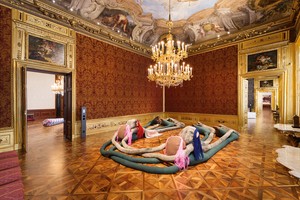
Mario Codognato, curator of the exhibition, discusses Sterling Ruby’s first-ever European survey, at the Belvedere’s Winterpalais galleries.


