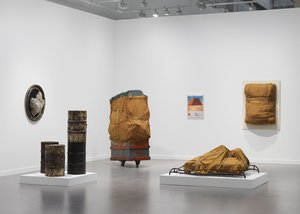
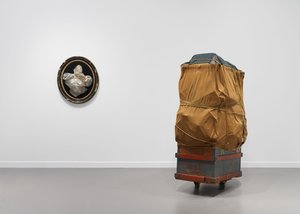
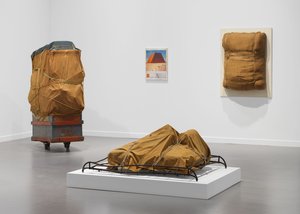
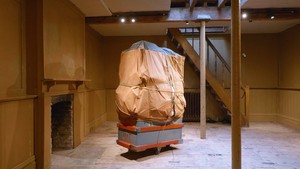
For the inaugural edition of Art Basel Qatar, Gagosian is presenting early sculptural works by Christo from the late 1950s and early ’60s. The selection features notable works from his foundational Package and Wrapped Objects series that anticipate the large-scale projects produced in collaboration with Jeanne-Claude, which the couple would develop for the rest of their lives.

#ArtBaselQatar

Inspired by encounters with the era’s burgeoning avant-garde, Christo transformed the contours and surfaces of these ordinary objects, alternately obscuring and revealing their identities with fabric or plastic often bound with rope or twine. Responding to domestic and urban environments, they disrupt our practical relationship with everyday artifacts, drawing attention to overlooked details through acts of concealment.

These works take on further meaning given Christo’s story of escaping Stalinist Bulgaria before settling in Paris, where he lived from 1958 before ultimately relocating to New York in 1964. In their focus on containment and displacement, they parallel the artist’s own circumscribed life at the time of their production. Alluding to impermanence and the safeguarding of personal belongings, they address themes of migration and adaptation. In a Middle Eastern setting, they reference the capacity of architecture, textiles, and daily life to accommodate movement. Wrapped Painting also reminds us that Christo began his career as a painter but was already rejecting the discipline’s restrictions, while Dolly, made immediately after his arrival in New York, reflects his experience of transit.

Gagosian’s booth at Art Basel Qatar 2026. Artwork © Christo and Jeanne-Claude Foundation. Photos: Erin Brady

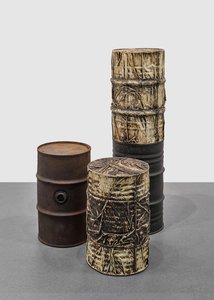
Wrapped Oil Barrels, 1958–61

Three oil barrels with two wrapped in fabric

Christo

Wrapped Oil Barrels, 1958–61

Metal barrels, fabric, glue, resin, and steel wire, in 4 parts

Overall dimensions variable

The oil barrel is among the most consistent elements in Christo’s revolutionary body of work. Wrapped Oil Barrels (1958–61) includes four such objects, two of which remain in their original conditions while the other two are wrapped in resin-soaked canvas. Oil barrels were crucial to Christo’s artistic development. Their ability to alter the environments in which they were grouped and stacked broadened the scope of his imagination and paved the way for his later large-scale projects. As one of his first forays into using a material that would recur in his long and remarkably dedicated practice, Wrapped Oil Barrels is a significant work in Christo’s historic artistic campaign.

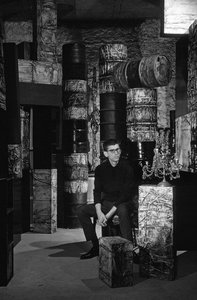
Christo in his storeroom in the basement of Jeanne-Claude’s apartment on avenue Raymond Poincaré, Paris, 1960. Artwork © Christo and Jeanne-Claude Foundation. Photo: René Bertholo

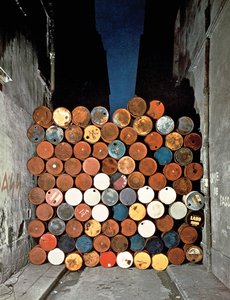
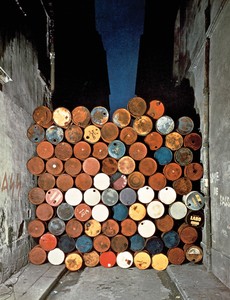
Christo and Jeanne-Claude’s Wall of Oil Barrels—The Iron Curtain (1961–62) on rue Visconti, Paris, June 27, 1962. Artwork © Christo and Jeanne-Claude Foundation. Photo: Jean-Dominique Lajoux

Christo first showed his barrel creations in 1961 at Galerie Haro Lauhus in Cologne, Germany; a column of stacked barrels welcomed people at the gallery’s entrance, and a whole room was filled with groups of barrels. The following year, Christo and Jeanne-Claude surreptitiously erected Wall of Oil Barrels—essentially a blockade of barrels across rue Visconti in Paris. The pair referred to this work as The Iron Curtain; Christo drafted the project a month after the Berlin Wall was constructed. These barrel constructions were among Christo’s earliest temporary artworks. Their interventions in landscapes and their probing of the relationship between art and public space were milestones in the artist’s creative development.

Today, the Mastaba Foundation was established to continue working on The Mastaba, a gargantuan work that the artists first proposed in 1977. Constructed of an estimated 410,000 barrels of varying colors and located in an as-yet-undisclosed location in the Middle East, the work will be the largest contemporary sculpture (in terms of volume) in the world and, notably, the artists’ only permanent monumental artwork.

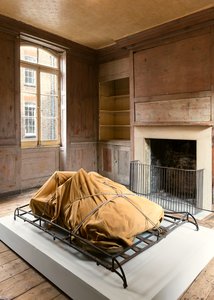
Package on a Luggage Rack, 1962

Package wrapped in tarp with rope around it on top of a metal luggage rack

Christo

Package on a Luggage Rack, 1962

Tarpaulin, rubber-coated rope, and metal luggage rack

24 ⅞ × 59 ⅛ × 42 ⅛ inches (63 × 150 × 107 cm)

Christo was constantly in transit throughout the late 1950s and early ’60s. From escaping his native Bulgaria to finding avant-garde art and a life partner in Paris and a final home in New York, with numerous stops in between to make and show his art, Christo had to repeatedly travel from one location to another. These years, however, also coincided with a surge of creative inspiration. Package on a Luggage Rack (1962) is imbued with both the sense of mobility and the spirit of innovation that marked these years of Christo’s life. Indeed, when Christo brought similar works with him to exhibitions around Europe, attached to the roof of his car, few could have recognized his cargo as art.

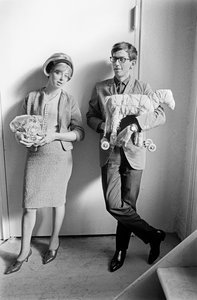
Christo with some of his recent works in the courtyard of Jeanne-Claude's apartment on avenue Raymond Poincaré, Paris, 1963. Artwork © Christo and Jeanne-Claude Foundation. Photo: Shunk-Kender © J. Paul Getty Trust

“I will be a displaced person all of my life,” Christo asserted. “To be a displaced person can be disorienting, but it can also be inspiring.” Officially, Christo was stateless for seventeen years; upon arriving in New York in 1964, he and Jeanne-Claude lived as undocumented immigrants before gaining US citizenship in 1973. His background as a refugee greatly influenced his work, much of which was intended to be temporary, unbuyable, and free for everyone to experience. Works for intended for sale, such as Package on a Luggage Rack, remain materially humble but contextually rich, speaking to not only the artist’s personal journey of migration and adaptation, but also those experienced by people the world over.

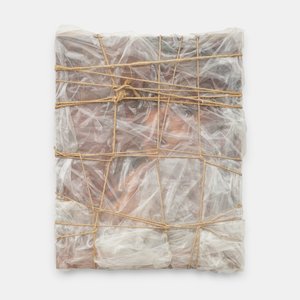
Wrapped Painting, 1962

Painting wrapped in plastic with twine

Christo

Wrapped Painting, 1962

Oil on canvas, polyethylene, and twine

20 ½ × 16 ⅛ × 3 ⅜ inches (52 × 41 × 8.5 cm)

Christo began his artistic career as a painter, first as an art student in Bulgaria learning the tenets of state-imposed Social Realism and then as a penniless refugee in Paris painting portraits to earn a living. He signed these paintings as Javacheff—his given last name—and considered them a means of survival. Though he never denied that his portraits were works of art, he thought of them as entirely separate from his true art, which was becoming increasingly innovative as he grew more intertwined with the city’s thriving avant-garde circles, which included the likes of Arman, Joseph Beuys, John Cage, Nam June Paik, and Daniel Spoerri. Namely, Christo began to wrap—barrels and cans in resin-soaked canvas, and objects of all shapes, sizes, and materials in fabric or plastic—transforming the contours and surfaces of these found items and alternately obscuring and revealing their identities. A select few of Christo’s portrait paintings received this now-revolutionary treatment, among them Wrapped Painting from 1962.

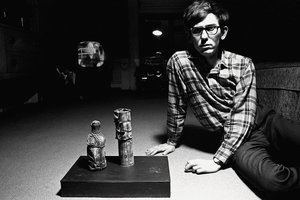
Christo with Wrapped Can and Bottle (1958) in his and Jeanne-Claude’s one-room apartment at the Chelsea Hotel, New York, 1964. Artwork © Christo and Jeanne-Claude Foundation. Photo: Ugo Mulas

Sheathed in layers of semitransparent polyethylene, Wrapped Painting denies the most basic purpose for a painting’s existence: to be seen. Rather, this work teases at seeing, with only hints of its painted image revealed through its diaphanous folds. Instead, the work spotlights a rich, tactile surface—anticipating Christo’s increasingly monumental wrappings that covered the world’s most notable sites and landscapes in rippling fabric, re-imbuing the once familiar forms with a renewed visual energy.

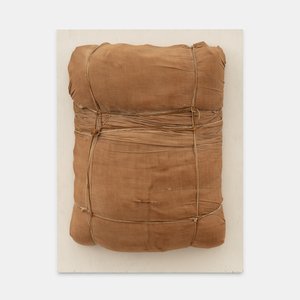
Package, 1963

Wrapped fabric with rope and twine mounted on a wood board

Christo

Package, 1963

Fabric, gauze, rope and twine, mounted on painted wood board

42 ⅛ × 33 ⅜ × 12 ⅛ inches (107 × 84.8 × 30.6 cm)

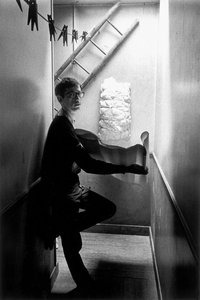
Package (1963), a nondescript parcel enveloped in fabric secured with rope, is among the first of Christo’s now-iconic wrapped artworks. This work is grounded in the mundanity of everyday life, yet what it contains remains entirely unknown—it exists in an ambiguous state whose intrigue is nearly impossible to ignore. Crucially, Package also speaks to Christo’s early life—a time rife with travel, done not for pleasure, but out of necessity, when luggage was not merely a few belongings brought on holiday but, rather, the contents of a life wrapped and secured with twine.

Christo in his seventh-floor studio on rue de Saint-Sénoch, Paris, 1962. Artwork © Christo and Jeanne-Claude Foundation. Photo: Enzo Sellerio © Heirs of Enzo Sellerio

Christo began wrapping objects in 1958 after he moved to Paris. Empty paint cans and bottles were among the first objects he covered. He wrapped them in resin-soaked canvas, tied them up with string or twine, and then covered them in lacquer. Empty industrial oil barrels also received the same treatment, as did other objects around his apartment and studio that he “appropriated” for his wrapping. Sometimes the objects beneath the wrappings were identifiable, either due to Christo’s use of semitransparent polyethylene, as in the works in which he wrapped magazines or even his early painted portraits, or due to his preservation of the objects’ general forms, as in Wrapped Toy Horse (1963).

Jeanne-Claude and Christo with Wrapped Telephone (1964) and Wrapped Toy Horse (1963), respectively, in Christo’s studio, New York, 1965. Artwork © Christo and Jeanne-Claude Foundation. Photo: Yves Debraine © Archives Yves Debraine

At other times, the wrapped objects remained a mystery—an enigmatic element that became a major part of the works. In 1966, Christo sent a hundred wrapped boxes to members of the Contemporary Arts Group associated with the Walker Art Center in Minneapolis; those who opened the boxes discovered a signed and numbered certificate that simply stated: “You have just destroyed a work of art.”

Christo sold many of his early Packages to help fund his and Jeanne-Claude’s increasingly grander—and costlier—projects, many of which have altered the landscape of art history as much as the physical landscapes in which they were created. Accordingly, works like Package, along with the collages and drawings Christo completed in advance of his large-scale projects, are held in the collections of numerous institutions worldwide, and represent the only lasting objects of the artist’s largely ephemeral practice.

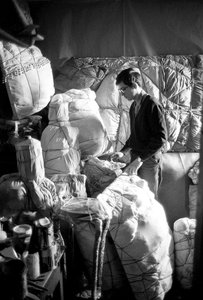
Christo with Package (1960) in the corridor leading to his seventh-floor studio on rue de Saint-Sénoch, Paris, 1962. Artwork © Christo and Jeanne-Claude Foundation. Photo: Enzo Sellerio © Heirs of Enzo Sellerio

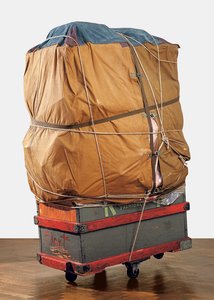
Dolly, 1964

Luggage wrapped in canvas with ropes and straps placed on top of a blue and red dolly

Christo

Dolly, 1964

Tarpaulin, polyethylene, fabric, straps, rope, and wood crate with metal and rubber wheels

72 ⅛ × 40 × 32 ⅜ inches (183 × 101.5 × 82 cm)

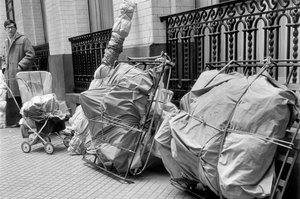
While Christo and Jeanne-Claude settled into the Chelsea Hotel during their first months in New York City in early 1964—a sort of try-on of the city before the couple officially decided to pull up their roots in Paris to move across the Atlantic—the artist continued his practice of wrapping found objects in fabric or plastic. The discarded detritus that now became his working material, however, reflected the city around him, as he plucked items from the bustling streets and turned them into his now-iconic wrapped bundles—Dolly (1964) among them. Here, a scavenged wooden dolly cart is transformed into a pedestal for one of Christo’s wrapped packages, a bulky yet dignified presence that is at once humble in its materials and imposing in its size.

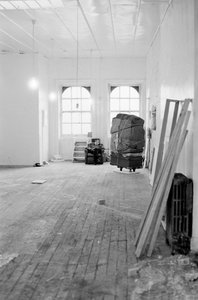
Christo stored Dolly, along with other artworks he had completed while at the Chelsea, in the hotel’s basement when he and Jeanne-Claude returned to Paris to tie up loose ends before they permanently moved to the United States. Upon their return to New York in September of ’64, the couple, along with their son, Cyril, checked back into the Chelsea, and then a few months later, in December, moved into the top two floors of 48 Howard Street, bringing the stored artworks—including Dolly—with them.

Christo with Dolly (1964) his studio, New York, 1965. Artwork © Christo and Jeanne-Claude Foundation. Photo: Christo and Jeanne-Claude Foundation Archives

During the next two years, Christo made significant headway into both New York and international art circles. A small monograph was published on the artist in 1966, with essay contributions by esteemed critics Pierre Restany and David Bourdon––and, notably, Dolly was showcased on the book’s cover. That year also saw Christo’s first solo museum exhibition, at the Stedelijk van Abbemuseum in Eindhoven, Netherlands, as well as his participation in a major group show, Eight Sculptures: The Ambitious Image, at Minneapolis’s Walker Art Center, for which Christo contributed Dolly.

Dolly began as a functional tool created to move objects from one location to another, and was then transformed into an artwork that, in this new role, was shuttled all over the world. In this way, Dolly reveals how, in Christo’s work, reality is not just a part, but the very essence of the work itself.

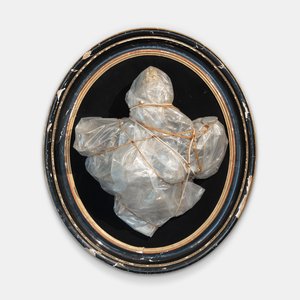
Applique Empaquetée, 1963–81

Black circular frame with a package inside wrapped in plastic and twine

Christo

Applique Empaquetée, 1963–81

Brass candelabra, polyethylene, rope, and twine, mounted on velvet, in painted and gilded wood frame

34 ⅛ × 29 ⅛ × 7 ⅛ inches (86.5 × 74 × 18 cm)

Christo created Applique Empaquetée (1963–81) on the floor of Venice’s Galleria del Leone—a practice the artist had taken to as he found galleries unwilling to cover shipping expenses. The gallery—the only venue in the city that showed contemporary art at the time—was run by partners Giovanni Camuffo and Attilio Codognato; both were surprised when Christo arrived with only a few finished works fastened to the roof of his car and a bag of tools in hand that contained a hammer, chisel, and nails and “no art materials,” as Camuffo recalled. Camuffo continued: “He and I went to buy books, canvas, furniture, and other items. He tied magazines in clear plastic, then he wrapped a metal wall sconce and put it into a large black oval frame we found.”

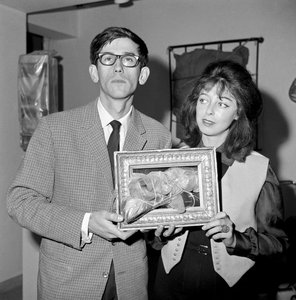
Christo and Jeanne-Claude with Wrapped Shoes (1963) at Galleria La Salita, Rome, November 29, 1963. Artwork © Christo and Jeanne-Claude Foundation. Photo: Bettmann Archive

Still wrapped in polyethylene and bound with twine—though evidence suggests Christo rewrapped the work in 1981, a common practice for the artist—and mounted on black velvet in a black-and-gilded oval frame, Applique Empaquetée continues to draw attention to its intricate domestic form by obscuring its surface details from view. Instead, Christo’s thoughtful knots and twists at once enrich and transform the sconce’s shape while removing it from its original function to forever preserve it as a work of art.

Related Drawings

Christo working on a preparatory drawing for The Mastaba in his studio, New York, 2012. Artwork © Christo and Jeanne-Claude Foundation. Photo: Wolfgang Volz

The abstract nature of the works on view at Art Basel Qatar resonate with a region in which, historically, architecture and textiles have taken precedence over pictorial art. The artists worked on projects for the Middle East beginning with their proposal in 1977 for The Mastaba, including unrealized works for Qatar such as 2017’s The Walk (Project for Doha).

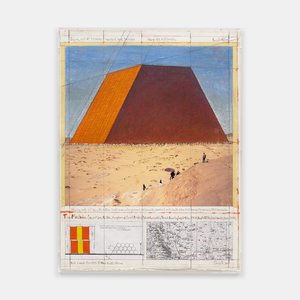
The Mastaba is a gargantuan structure comprised of an estimated 410,000 oil barrels in a mosaic of colors, arranged in the trapezoidal shape of low benches or platforms that are often built—typically out of mud brick or stone—along the exterior or interior of houses in parts of the Middle East and Northern Africa. As sites for rest and socializing, usually in places of shade away from the arid region’s intense sun, the mastaba’s functions reflect those of Christo and Jeanne-Claude’s other monumental interventions, namely bringing people together for a moment’s respite amid antagonistic conditions. This work, slated to be the pair’s only permanent monumental installation, would also be the largest artwork by volume in the world and would be situated in a desert environment in the Middle East.

<p data-block-key="xmvb5"><i>The Mastaba (Project for Al Ula, Kingdom of Saudi Arabia)</i>, 2018</p>

Christo

The Mastaba (Project for Al Ula, Kingdom of Saudi Arabia), 2018

Pencil, charcoal, pastel, wax crayon, photograph by Wolfgang Volz, enamel paint, map, technical data, and tape on paper

18 ¼ × 24 ⅜ inches (46.3 × 61.9 cm)

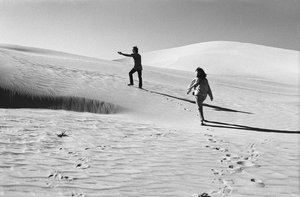
Christo and Jeanne-Claude looking for a site for The Mastaba, United Arab Emirates, February 1979. Photo: Wolfgang Volz

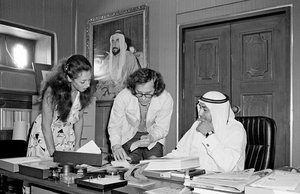
Christo and Jeanne-Claude discussing their proposal for The Mastaba with Ali Al Bedoor, United Arab Emirates minister of education and director of cultural affairs, United Arab Emirates, May 1980. Photo: Wolfgang Volz

The Mastaba was not Christo and Jeanne-Claude’s first engagement with the Middle East; indeed, Jeanne-Claude was born in Morocco in 1935. In 1967, they proposed The Wall in Suez Canal—Ten Million Oil Barrels Wall, a never-realized installation of an oil-barrel blockade to physically close the inland waterway. They began to conceive of The Mastaba as early as 1972, writing, “Nothing comparable has ever existed in any other country. Hundreds of bright colors, as enchanting as the Islamic mosaics, will give a constantly changing visual experience according to the time of day and the quality of light. The grandeur and vastness of the land will be reflected in the majesty of the Mastaba.”

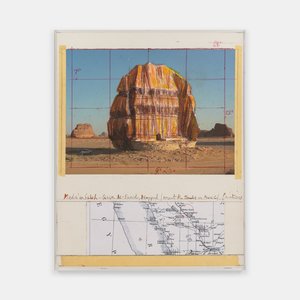
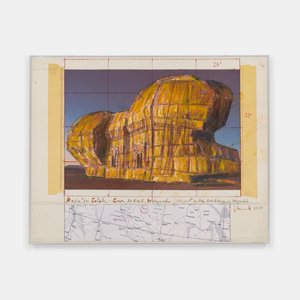
Though Christo and Jeanne-Claude did not realize The Mastaba during their lifetimes, the Mastaba Foundation was established to continue the project, with the intention of building the work in an as-yet-undisclosed Middle Eastern desert location. Notably, the pair visited the Middle East at least seven times. These trips seem to have ignited their creative imaginations beyond The Mastaba project; they imagined wrapping projects for Qasr al-Bint and Qasr al-Farid, World Heritage sites in Saudi Arabia, among other projects conceived for the region.

<p data-block-key="a7bug"><i>Mada’In Saleh—Qasr Al-Farid, Wrapped (Project for the Tombes in Area C)</i>, 2017</p>

Christo

Mada’In Saleh—Qasr Al-Farid, Wrapped (Project for the Tombes in Area C), 2017

Pencil, wax crayon, enamel paint, color photograph, map, and tape on paper

11 × 14 inches (28 × 35.6 cm)

<p data-block-key="0dkng"><i>Mada’In Saleh—Qasr Al-Bint, Wrapped (Project in the Great Rock in Area C)</i>, 2017</p>

Christo

Mada’In Saleh—Qasr Al-Bint, Wrapped (Project in the Great Rock in Area C), 2017

Pencil, wax crayon, enamel paint, color photograph, map, and tape on paper

11 × 14 inches (28 × 35.6 cm)

Christo at the proposed site for The Mastaba, United Arab Emirates, March 2017. Photo: Wolfgang Volz

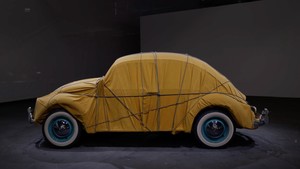
Christo: Wrapped 1961 Volkswagen Beetle Saloon (1963–2014)

Christo: Wrapped 1961 Volkswagen Beetle Saloon (1963–2014)

Join Vladimir Yavachev, director of operations for the Christo and Jeanne-Claude Foundation, as he discusses the genesis of the artist’s work Wrapped 1961 Volkswagen Beetle Saloon (1963–2014), which Gagosian presented at Art Basel Unlimited 2024.

Christo: Early Works

Christo: Early Works

Christo: Early Works, curated by Elena Geuna, is the inaugural exhibition in the Gagosian Open series of off-site projects. In this video, Geuna explores the connection between Christo’s sculptural works and their setting in the historic Georgian house at 4 Princelet Street, London.

The Iron Curtain: Christo & Jeanne-Claude

The Iron Curtain: Christo & Jeanne-Claude

To mark the sixtieth anniversary of Christo and Jeanne-Claude’s seminal installation The Iron Curtain, author William Middleton addresses the radicality of this work and its enduring relevance to the artists’ subsequent projects.

Gagosian Quarterly Summer 2026

Now available
Gagosian Quarterly Summer 2026

The Summer 2026 issue of Gagosian Quarterly is now available, featuring Ellen Gallagher’s Fast-Fish and Loose-Fish (2026) on the cover.

Jenny Saville a Ca’ Pesaro

Jenny Saville a Ca’ Pesaro

In this video, Jenny Saville sits down inside her first major exhibition in Venice to discuss how the great Venetian artists of the past and the city’s heritage influence her work. The show brings together more than thirty canvases and works on paper from the 1990s to the present, tracing the development of her practice, which is deeply rooted in the history of painting.

Francis Bacon: Reinventing Realism

Francis Bacon: Reinventing Realism

Francis Bacon lived and worked in Paris for a decade starting in the mid-1970s. The city and the art he encountered there provided a profound backdrop for his austere late style, which often brings together smooth, colorful backgrounds, spare architectural signifiers, and sculptural human forms. Here, three striking paintings from that period are considered by Sebastian Smee.

James Turrell: Lifting the Veil

James Turrell: Lifting the Veil

An exhibition at Gagosian, Hong Kong, brings together three of James Turrell’s Glasswork pieces along with site plans, photographs, and models of his Skyspaces and Roden Crater. Here, Alice Godwin explores the history of the Glassworks and their relationship to the artist’s wider practice.

Divine Emanations: Nymphs, Poets, and the Painter’s Palette

Divine Emanations: Nymphs, Poets, and the Painter’s Palette

Janne Sirén considers Anselm Kiefer’s new paintings, the subject of an exhibition at Gagosian, New York, entitled Seal My Ears Shut and I Shall Hear You Still.

Derrick Adams: View Master

Derrick Adams: View Master

On April 16, the Institute of Contemporary Art, Boston, opened the first midcareer survey of Derrick Adams’s multidisciplinary practice. Covering over twenty years of work, the exhibition, titled View Master, brings together the artist’s painting, sculpture, collage, performance, and video, as well as a vibrant new commission created for the museum’s façade. Ahead of the opening, Adams met with Tessa Bachi Haas, cocurator of the survey, to discuss his formative experiences with television, the impact of his work in arts education on his practice, and the importance of taking a more complex, more joyful, and more expansive approach to Black American life and culture.
Giuseppe Penone: The Reflection of Bronze

Giuseppe Penone: The Reflection of Bronze

Adam D. Weinberg has been working with Giuseppe Penone on an exhibition of the artist’s new sculptures, The Reflection of Bronze, that opens at Gagosian, New York, on April 22. The works explore the character and possibilities of bronze. Here, Weinberg considers Penone’s enduring engagement with the alloy and addresses the conceptual underpinnings of the exhibition’s three-room structure.

Engaging with the Past: An Interview with Jenny Saville

Engaging with the Past: An Interview with Jenny Saville

On March 28, a major exhibition of Jenny Saville’s work opened at Ca’ Pesaro–Galleria Internazionale d’Arte Moderna in Venice, bringing together nearly thirty paintings from the 1990s to the present. The exhibition is curated by Elisabetta Barisoni, head of the museums division at Venice’s Ca’ Pesaro, Museo Fortuny, and head of MUVE in Mestre. Saville’s monumental canvases are set in dialogue with the great Venetian artists of the past, creating a unique encounter between contemporary painting and the city’s artistic heritage. Here, the artist speaks with Stefania Ventra, professor with Ca’ Foscari University of Venice, about her early trips to Venice, the radicality of Titian’s painting, and depicting emotional truth.

A Tremendous Generosity: Jeff Koons on Marcel Duchamp

A Tremendous Generosity: Jeff Koons on Marcel Duchamp

Jeff Koons tells Alison McDonald about his appreciation for the pioneering artist and thinker Marcel Duchamp.