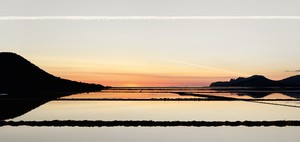
Comprising a selection of film, moving image, and video art works, ART SG FILM showcases emergent practices and highlights groundbreaking artists. This year’s program, By Artists, On Artists, features film and video works by artists, shown along with a series of films focusing on the lives and careers of well-known artists. The program is divided into three sections—Constructing Landscapes, Voices and Whispers, and Ruins and Prophecies—and grants new insights into a range of histories and disciplines.

Gagosian is participating with screenings of Andreas Gursky (dir. Ralph Goertz, 2024); Cy Dear (dir. Andrea Bettinetti, 2018), on Cy Twombly’s life and work; Nam June Paik and John Godfrey’s Global Groove (1973); and Arte Povera: Appunti per la storia (dir. Andrea Bettinetti, 2023). Curated by Stefano Rabolli Pansera, artistic director of the St. Moritz Art Film Festival and founding director of Bangkok Kunsthalle and Khao Yao Art Forest in rural Thailand, ART SG FILM is hosted in collaboration with cultural partner Bangkok Kunsthalle and presented at ArtScience Museum’s cinema.

#ARTSG2025

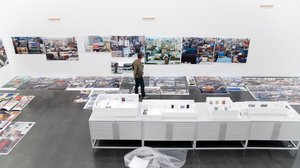
Andreas Gursky

Andreas Gursky in his studio surrounded by photographs

Artwork © Andreas Gursky, VG Bild-Kunst, Bonn, Germany. Photo: © IKS-Medienarchiv

Friday, January 17, 10:30am

Andreas Gursky (2024)
Directed by Ralph Goertz
Running time: 50 minutes

Andreas Gursky produces large-scale, high-definition photographic tableaux rooted in methodical observation, constructing images of modern cities, teeming crowds, commercial products, and the natural world. In Andreas Gursky, filmmaker Ralph Goertz accompanies his subject for eight years, following him as he takes photographs, works in his studio, teaches at the Kunstakademie Düsseldorf, and prepares for major exhibitions at the Kunstsammlung Nordrhein-Westfalen, Düsseldorf, and Hayward Gallery, London. The film details Gursky’s process and traces the development of his practice from its beginnings at the Folkwang-Hochschule, Essen, and Kunstakademie Düsseldorf through his work in analog and digital photography since the 1980s. Gursky and Goertz also discuss the artist’s approach to the photographic medium and its complex relationship to painting. Goertz’s highly personal documentary portrait provides deep insights into Gursky’s artistic project while maintaining a distance from the cult of the artist and the machinations of the market.

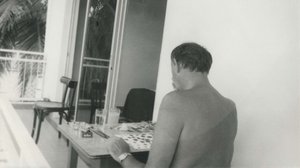
Cy Twombly

Cy Twombly sitting at a table outside with a drawing and drawing materials

Photo © Fondazione Nicola Del Roscio, courtesy Archives Nicola Del Roscio

Saturday, January 18, 11:30am

Cy Dear (2018)
Directed by Andrea Bettinetti
Running time: 92 minutes

Produced by Good Day Films and Sky Arte, Cy Dear traces Cy Twombly’s life and career. Born in Lexington, Virginia, Twombly emerged as an artist in the mid-1950s and remains known for a painterly and graphic vocabulary in which every gesture is infused with spiritual energy. Drawing on ancient, classical, and modern poetic traditions, he also produced sculptures, photographs, and prints. Important figures who appear in Andrea Bettinetti’s documentary include Alessandro Twombly, the artist’s son; Jonas Storsve, the curator of Twombly’s 2016 retrospective at the Centre Pompidou, Paris; and Renzo Piano, the architect of the Cy Twombly Gallery at Houston’s Menil Collection. These testimonials lead viewers to a detailed understanding of Twombly and his oeuvre. Cy Dear takes us from Lexington to the artist’s second home in Gaeta, Italy, passing through Paris, Munich, New York, and Houston.

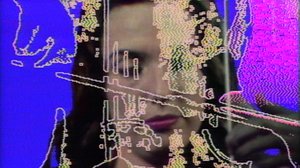
Nam June Paik

Close-up of a woman’s face with her eyes closed combined with a blue, pink, and yellow digital drawing of a violin outline

Artwork © Nam June Paik Estate. Photo: courtesy Electronic Arts Intermix (EAI), New York

Sunday, January 19, 4:30pm

Nam June Paik in collaboration with John Godfrey
Global Groove (1973)
Directed by Merrily Mossman
Running time: 28 minutes, 30 seconds

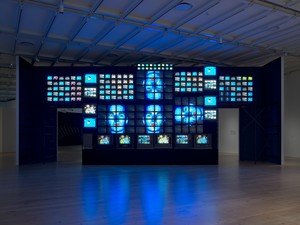
Global Groove by artist Nam June Paik in collaboration with TV engineer John Godfrey, presents what it calls “a glimpse of the video landscape of tomorrow, when you will be able to switch to any TV station on the earth, and TV Guide will be as fat as the Manhattan telephone book.” This postmodern statement on mediated international communications is rendered as a hallucinatory electronic collage of cross-cultural elements, art-world figures, and Pop iconography. Japanese Pepsi commercials are juxtaposed with performances by John Cage, Merce Cunningham, and Allen Ginsberg and the Living Theatre, while footage of dancers moving to Mitch Ryder & the Detroit Wheels’s “Devil with a Blue Dress On” is intercut with that of traditional Korean performers. In an ironic form of interactive television, Paik also presents “Participation TV,” in which he instructs viewers to open or close their eyes. Subjecting his content to disruptive colorization, temporal shifts, ironic juxtapositions, and audiovisual synthesis and layering, he orchestrates a wild romp through the landscape of global TV.

A clip of Global Groove features at the top of the page.

Arte Povera

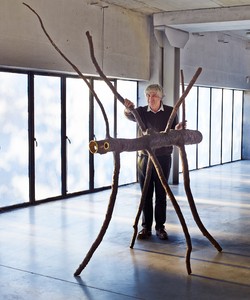
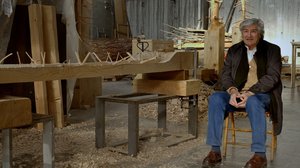
Giuseppe Penone sitting in a chair in his studio next to a wood sculpture in progress

Artwork © Giuseppe Penone/2025 Artists Rights Society (ARS), New York/ADAGP, Paris. Photo: courtesy Good Day Films

Sunday, January 19, 5pm

Arte Povera: Appunti per la storia (2023)
Directed by Andrea Bettinetti
Running time: 90 minutes

In Arte Povera: Appunti per la storia, Andrea Bettinetti turns his attention to the “movement/non-movement” of Arte Povera, describing it as “perhaps the last true avant-garde of the twentieth century.” Revisiting the cultural innovation that exploded between Turin and Rome in the 1960s, he explores the significance of gallerists such as Gian Enzo Sperone and Fabio Sargentini, and of other key figures such as critic Germano Celant. Centering his study on living testimonies, Bettinetti gathers the movement’s surviving artists—among them Giulio Paolini, Giuseppe Penone, and Michelangelo Pistoletto—as well as gallerists Tucci Russo and Lia Rumma and various colleagues and friends, to tell Arte Povera’s story. Moving from the publication of Celant’s defining essay “Arte Povera: Notes on a guerrilla war” in 1967, through the Amalfi exhibition/event Arte Povera più Azioni Povere in 1968 and the movement’s formal disbanding in 1972, the film explores an outwardly fleeting tendency with lasting reverberations.

Andreas Gursky

Andreas Gursky

On the occasion of an exhibition at Gagosian, New York, Max Dax met with Andreas Gursky to speak with the photographer about his new work. Here, they discuss the consequences of the pandemic on certain works, the roles of techno music and art history in Gursky’s art process, and the necessary balance of beauty and honesty in the contemporary.
Twombly and the Poets

Twombly and the Poets

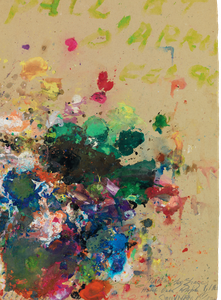
Anne Boyer, the inaugural winner of the Cy Twombly Award in Poetry, composes a poem in response to TwomblyAristaeus Mourning the Loss of His Bees (1973) and introduces a portfolio of the painters works accompanied by the poems that inspired them.

Time by Dance by Paik

Time by Dance by Paik

Gillian Jakab considers the role of choreography in Nam June Paik’s 1989 video installation Fin de Siècle II.

The Inner Life of Forms

The Inner Life of Forms

Giuseppe Penone speaks with Carlos Basualdo and Pepi Marchetti Franchi about his monograph.

Giuseppe Penone: The Reflection of Bronze

Giuseppe Penone: The Reflection of Bronze

Adam D. Weinberg has been working with Giuseppe Penone on an exhibition of the artist’s new sculptures, The Reflection of Bronze, that opens at Gagosian, New York, on April 22. The works explore the character and possibilities of bronze. Here, Weinberg considers Penone’s enduring engagement with the alloy and addresses the conceptual underpinnings of the exhibition’s three-room structure.

Andreas Gursky: Paris, Montparnasse II

Andreas Gursky: Paris, Montparnasse II

At the center of Andreas Gursky’s new exhibition in Paris at Gagosian’s rue de Castiglione gallery is Paris, Montparnasse II (2025), a reengagement with his celebrated photograph from 1993 of the architect Jean Dubuisson’s iconic building in the capital city. In the new work, Gursky reexamines the subject, tracing the changes time has inscribed on the architecture and its occupants. Here, in conversation with the Quarterly’s Wyatt Allgeier and shown alongside behind-the-scenes images from the artwork’s making, the artist addresses his motivations and interests in this long-term project.

Gagosian Quarterly Spring 2025

Now available
Gagosian Quarterly Spring 2025

The Spring 2025 issue of Gagosian Quarterly is now available, featuring Cy Twombly’s Paesaggio (1986) on the cover. 

The World as Playground

The World as Playground

Bartolomeo Sala considers the brief yet revolutionary dreams of Arte Povera. On the occasion of a retrospective at the Bourse de Commerce, Paris, he explores the historical conditions that gave rise to the radical midcentury movement and the warnings we might glean today from its legacy.

Cy Twombly by Jenny Saville: To Lift the Veil

Cy Twombly by Jenny Saville: To Lift the Veil

Jenny Saville reflects on Cy Twombly’s poetic engagement with the world, with time and tension, and with growth in this excerpt from her Marion Barthelme Lecture, presented at the Menil Collection, Houston, in 2024.

Gagosian Quarterly Fall 2022

Now available
Gagosian Quarterly Fall 2022

The Fall 2022 issue of Gagosian Quarterly is now available, featuring Jordan Wolfson’s House with Face (2017) on its cover.

Cy Twombly: Imperfect Paradise

Cy Twombly: Imperfect Paradise

Eleonora Di Erasmo, cocurator of Un/veiled: Cy Twombly, Music, Inspirations, a program of concerts, video screenings, and works by Cy Twombly at the Fondazione Nicola Del Roscio, Rome, reflects on the resonances and networks of inspiration between the artist and music. The program was the result of an extensive three-year study, done at the behest of Nicola Del Roscio in the Rome and Gaeta offices of the Cy Twombly Foundation, intended to collect, document, and preserve compositions by musicians around the world who have been inspired by Twombly’s work, or to establish an artistic dialogue with them.

Giuseppe Penone À La Tourette

Giuseppe Penone À La Tourette

Le Couvent Sainte-Marie de La Tourette, in Éveux, France, is both an active Dominican priory and the last building designed by Le Corbusier. As a result, the priory, completed in 1961, is a center both religious and architectural, a site of spiritual significance and a magnetic draw for artists, writers, architects, and others. This fall, at the invitation of Frère Marc Chauveau, Giuseppe Penone will be exhibiting a selection of existing sculptures at La Tourette alongside new work directly inspired by the context and materials of the building. Here, Penone and Frère Chauveau discuss the power and peculiarities of the space, as well as the artwork that will be exhibited there.