Bartolomeo Sala considers the brief yet revolutionary dreams of Arte Povera. On the occasion of a retrospective at the Bourse de Commerce, Paris, he explores the historical conditions that gave rise to the radical midcentury movement and the warnings we might glean today from its legacy.
Bartolomeo Sala is an Italian freelance writer and editor based in London. His writing has appeared in the FT Magazine, the New Statesman, the Brooklyn Rail, and elsewhere. He works as a coeditor for the magazine Translator Mag.
We are used to thinking of Arte Povera as a movement defined by everyday, earthly materials like trees, live animals, and potatoes or by cheap industrial ones like neon tubes, metal scaffoldings, and wooden beams. The term itself, “povera,” which translates as “poor,” invites such a reading by evoking an idea of humbleness, a vow of poverty and austerity along the lines of the one made by Italian mystic and poet Saint Francis 800-odd years ago. However, even a cursory look at the 1967 essay manifesto “Arte Povera. Appunti per una guerriglia” (“Arte Povera. Notes on a Guerrilla War”) should suggest that there is much more than meets the eye. In the first paragraphs, Germano Celant—the curator who was responsible for turning a disparate set of artists into a movement with international reverberations—disparages the alienating, crippling effects of technology in modern society and compares the artist to a “guerrigliero” (guerrilla fighter) engaged in a surreptitious war to regain his creative powers.1
A perfect storm that fed off the turmoil and effervescence of those years, Arte Povera came at a very special juncture in Italian history, as well as a special moment in the history of anti-capitalist struggle. On the home front, the country in fact had been radically remade, and not always for the better, by what had come to be known as the “economic miracle”—that cycle of spectacular growth that, beginning in the early 1950s, doubled Italy’s GDP in roughly ten years and turned a hitherto agrarian backwater into an industrial powerhouse and advanced consumer society. On the international front, the news cycle was dominated by the United States’ unlawful invasion of Vietnam, carried out in open defiance of the Geneva accords, as well as the subsequent dissent that would reach its climax during the student protests of May ’68.
Seen through the lens of these rapid changes and increasing political mobilization, Arte Povera’s programmatic asceticism was not just a principled response to the shock of industrial capitalism—from the alienating nature of factory labor, to the rise of consumerism, to the deterioration of nature and the overbearing influence of information technology and mass media. It was also the byproduct of a loose, countercultural poetics whose utopian impetus and youthful thrust were no less than to remake humankind’s way of interacting with the world—or “taking possession of reality,” to use Celant’s own formulation.2
In its defiant embrace of everyday materials and production of eminently “useless” objects . . . [Arte Povera] represented a revolt of the imagination, a poetic attempt to adumbrate a different way of living.
Influenced by the likes of French philosopher Maurice Merleau-Ponty and Italian semiotician Umberto Eco, and well-versed in the most sophisticated theories of its day, this poetics took first and foremost the shape of a radical empiricism, at once open-ended and playful. At the same time, it must be noted how this “scientifically inspired” approach was never meant to be taken literally. Rather—in its defiant embrace of everyday materials and production of eminently “useless” objects best exemplified by Alighiero Boetti’s impossible furnishingsSedia (Chair) (1966) and Scala (Ladder) (1966)—it represented a revolt of the imagination, a poetic attempt to adumbrate a different way of living: one in which the contradictions of the industrial mode of production described by thinkers like Herbert Marcuse, author of such staples of the counterculture as Eros and Civilization (1955) and One-Dimensional Man (1964), would be superseded by what Celant describes as “libero progettarsi dell’uomo,” that is, people’s inherent ability to self-fashion; and the cosmos in its manifestations—nature and culture, organic matter and technology—would all become tools in the hands of the artists, the building blocks of their endless and freewheeling inquiry.3
On view until the end of last month and curated by Carolyn Christov-Bakargiev, the critic who has championed the movement since the 1980s, the recent retrospective Arte Povera at the Bourse de Commerce feels like a great occasion to ponder the movement’s legacy, its ability to still inspire and affect, as well as the evident limitations inherent to the utopian enthusiasm that fed its aesthetic project.
In the catalogue that accompanied the show, Christov-Bakargiev writes that Arte Povera most of all consisted of a stance vis-à-vis reality. (The term “povera” bears with it the idea of “impoverimento,” that is, the reduction of experience by stripping the world to its essentials). She also stresses how this “empirical and practical understanding” embraced the whole web of life “from the micro scale of subjective experience . . . to the macro scale of the fundamental forces of physics that move the universe and make it live.”4 And indeed, the exhibition featured two installations that—by impishly spilling outside the gallery space and discombobulating the tidy layout of Paris’s urban landscape—perfectly illustrate Arte Povera’s subversive élan as well as the essence of its aesthetic project.
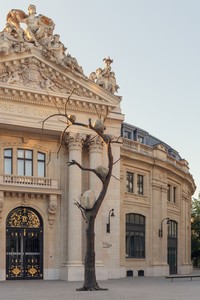
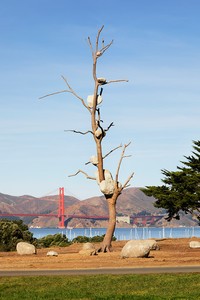
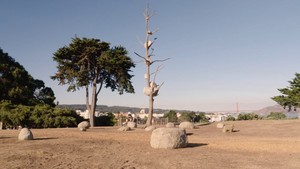
The first one, Idee di pietra – 1532 kg di luce (Ideas of Stone – 1532 Kg of Light, 2010) by Giuseppe Penone, consists of a bronze-cast tree holding river rocks at the intersections of its branches and conspicuously drew a contrast with the neoclassical façade and cast-iron dome of the Bourse de Commerce. The second one, Fibonacci Sequence (1984) by Mario Merz, is made of red neon numbers that were placed around the dome at precise, increasing intervals and was almost impossible to spot.
Penone’s pointed to the material and the organic, Merz’s to the immaterial and conceptual. However, both installations betrayed a common preoccupation with the forces that make the world go round, as well as an underlying monist, almost Spinozan outlook: The architecture of trees and rocks resembled the workings of the mind, mimicking the way thoughts branch out every time they meet a stumbling block. Likewise, the famous numerical sequence in which each number is the sum of the preceding two—an early prefiguration of the golden section—symbolized exponential growth. As such, it embodied a different—at once organic and magical—way of understanding the universe that stands in sharp contrast with the arithmetic, utilitarian ontology of capitalist accumulation, where everything is seen in terms of buying and selling, extracting and profiting.
Open-ended experimentalism and an Aristotelian sense of wonder continued inside the space. In his 1969 monograph, Arte Povera, commenting on the sudden cropping up of “animals, vegetables, and minerals . . . in the art world,” Celant compares the artist to an alchemist who “is renewing his acquaintance with the process of change in nature, not only as a living being, but as a producer of magical, wonderful things, too.”5 And of the thirteen artists to whom the retrospective paid homage with dedicated rooms across the four floors of the Bourse de Commerce, a good majority showcased not just an interest for things “in themselves” but also as catalysts for those natural processes that hold the key to the secret grammar of things and make nature a continuum of “physical, chemical and biological possibilities.”6
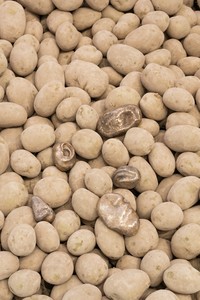
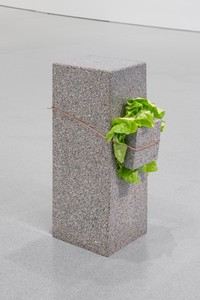
After walking past a series of archive photos that document the collaborative, rowdy atmosphere of the group, the visitor was greeted by Pier Paolo Calzolari’s Senza titolo (Materassi) (Untitled [Mattresses]) (1970), featuring six mattresses crushed in the cold embrace of refrigerating metal tubes. On the same ground floor, makeshift “canvases” of metallic bed frames, burlap sacks, and wool by Greek-born Jannis Kounellis gave way to nylon Scarpette (Little Shoes) and other hand-knitted artworks in copper-wire mesh by Marisa Merz and spirals and igloos by her husband, Mario Merz. Likewise, on the second floor, beautiful canvases and natural “sculptures” comprising perishable, organic materials like tree trunks, potatoes, boxwood leaves, and thorns by Penone alternated with works again by Calzolari and Giovanni Anselmo. The latter’s iconic Struttura che mangia (Structure That Eats) (1967)—a “still life” for the industrial age in which the slow wilting of a head of lettuce tied to a granite block causes the fall of a small stone—illustrated in its purposely odd appearance the movement’s fascination with understanding basic phenomena such as gravity and entropy.
This investigation by means of eminently industrial materials into energy flows and chemical reactions, such as evaporation and oxidation, continued in the basement with the works of Gilberto Zorio. However, an equal number of artists displayed a thrust toward the conceptual and abstract, thus expanding the narrow definition of Arte Povera as a movement merely concerned with the world as a phenomenon.
Some of the exhibition’s artists straddled the line by injecting the movement’s poetic minimalism with highly personal elements. This is true of Pino Pascali, whose zoomorphic “toys”—especially the series Bachi da setola (Silk/Bristle Worms) (1968), whose childlike genius relies on an untranslatable pun—showcased a uniquely tongue-in-cheek sensibility. Same goes for Alighiero Boetti, whose early “architectural” sculptures Catasta (Pile) (1967) and the aforementioned Sedia and Scala are all about the appreciation of materials for their own sake, but whose latter-day production—including his famous Mappe (Maps)—betrayed an interest in abstract signs, language, serialization, as well as craft and collective labor. And the same can be said of Luciano Fabro, whose deconstructions of the Italian boot and giant chicken feet made of Murano glass and pure shantung silk, while still showing an interest in materials, felt almost Jeff Koons-esque.
Still others—such as Giulio Paolini; Emilio Prini; and Michelangelo Pistoletto, who got his own gallery on the first floor—sat at the other more cerebral end of the spectrum by investigating apparently more arcane subjects such as perspective, perception, and artistic representation. Indeed, if it wasn’t for a certain penchant for what used to be called “denaturare”—i.e., stripping experience of all ideological presuppositions and filters so as to be able to consider it concretely and directly—one would struggle to understand what these more self-conscious practitioners had in common with the rest of the group.
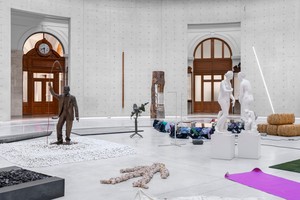
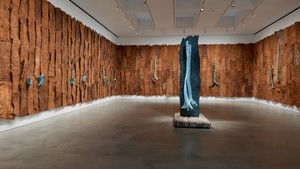
In the rotunda, a concrete cylinder carved out from the main hall during the renovation by Pritzker Prize–winning Japanese architect Tadao Ando, the exhibition compiled a sort of “greatest hits” of the most representative and iconic pieces of Arte Povera. It was here—below the vault and its breathtaking frescoes portraying a deeply imperialist vision of the five continents and world trade—that the contradiction between Arte Povera’s stated objectives and its end results were most apparent. From “amulets” for another way of life, these unplaceable, foreign artifacts were turned into objets précieux signaling the prestige of an art institution like the Bourse de Commerce.
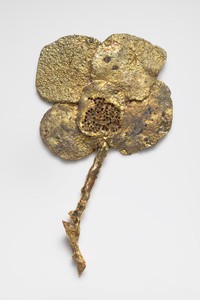
Perhaps it is an inevitable paradox of art historical appreciation that once disruptive avant-garde artworks become subsumed by the establishment and elevated onto pedestals. Still, the exhibition’s layout, which lumped together several of these iconic artworks behind a circular fence, highlighted this contradiction to a level that was impossible to ignore. Indeed, it is easy to forget now, but these objects were never meant to be seen as discrete entities and admired in isolation. On the contrary, as concrete and material as they now feel, they were always part of a collegial effort that had as much to do with performance and whose aim was to turn the gallery into a total social environment. This was especially apparent in Pistoletto’s series of silkscreen-printed mirrors, and in particular the Sacra conversazione (Penone, Zorio, Anselmo) (Sacred Conservation [Penone, Zorio, Anselmo]), in which the spectator is almost asked to join the three artists deeply absorbed in discussion. However, the show was dotted with works that—perhaps by virtue of now lying “dormant,” such as Kounellis’s Margherita di fuoco (Fire Daisy)(1967), a flower made of metal that, for obvious safety reasons, no longer spouts a blue flame—testified to this desire to turn the gallery into a space of relational possibilities and an incubator of energies.
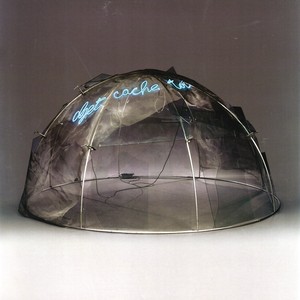
Some of the artists trained or were working as set designers. Perhaps the great acknowledged influence on the movement was that of Polish theater director Jerzy Grotowski, who right around the same time penned his manifesto Towards a Poor Theatre (1968). And this intention of transmogrifying the gallery—indeed the whole world—into a place for surprising, unexpected encounters, a playground, is well-documented in the many archival photos from the time, as well as the artworks that riffed off the idea of housing and creating a different type of abode. Mario Merz’s igloos covered in neon political slogans, for instance, pointed toward a militant belief in a different, nomadic, decommodified sort of existence that prefigures the ethos of Radical Design, another of Celant’s coinages, which would feature prominently in MoMA’s 1972 exhibition Italy: The New Domestic Landscape.
A program as far-reaching and at the same time as loose and as maximalist as this, one that celebrated experimentalism for its own sake and relied on the members’ limitless energy, was perhaps always destined to run quickly out of steam.7Indeed, even if most artists proved remarkably consistent in the years that followed and continued to show together under the Arte Povera banner until at least 1972, the “revolutionary” phase of the movement was already over by the time of the exhibition Arte povera più azioni povere (Arte Povera Plus Poor Actions), just a little over a year after the first group show at the Galleria La Bertesca in Genoa in 1967.
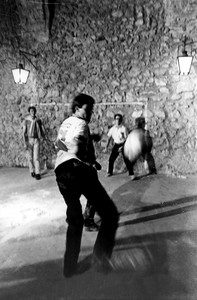
A three-day tour de force, this seminal exhibition that took place in October 1968 in Amalfi saw artists such as Pascali, Pistoletto, and Merz show their works in what used to be the arsenal of the Amalfitan Republic and take to the streets of the small port city through a series of more or less improvised happenings and performances, which also included an impromptu football match.
Improvised football match on the ground of Michelangelo Pistoletto’s installation in Arte povera più azioni povere, October 4–6, 1968, Amalfi, Italy. Photo: Bruno Manconi, courtesy Archivio Lia Rumma
As such, it was the apotheosis of Arte Povera’s ethos, its desire to bridge the gap between art and life and transform existence so that instincts for freedom and creativity present in every human being would finally find their full expression. At the same time, in many ways it was also its terminus. Incompatible views about the nature of Arte Povera and how far its revolution should venture came to a head during the exhibition’s symposium. And soon after—as Gabriele Guercio writes in his reappraisal of the show for the catalogue—Celant would find himself writing that “the days in Amalfi had left him with a sense of the impossibility of ‘fostering unrequested encounters, establishing a collective, and searching for a dialogue.’”8
Still, even if the movement never managed to coalesce around a single, coherent program—indeed, perhaps it was always suspicious of such a thing—there is much that continues to inspire about Arte Povera’s project. Art has always been less about recipes than intimations, and indeed most of the issues this set of radical searchers identified in the late 1960s have only gotten worse. The idea of development, based on unbridled consumerism and exploitation of nature, at which they originally took aim during a time when it seemed triumphant has now presented us with the bill and brought us to the brink of ecological collapse. Likewise, Marx’s “real man,” as Celant calls it in his manifesto, has further receded in the distance.9 With its Franciscan ethos and playful, open-ended approach toward the world, Arte Povera then stands as a residue of a different imagined future: one perhaps poorer in stuff to buy and sell but way richer in things that matter most, free time and possibilities; one where human beings—finally emancipated from the imperative to produce and consume—turn into artist-scientists set free to marvel at the universe and investigate the terms of their existence.
1 Germano Celant, “Arte Povera. Appunti per una guerriglia,” Flash Art, no. 5 (1967).
7 Something of the kind was remarked on by communist painter Renato Guttuso, who at the time noted how this anarchist approach in which revolution would automatically follow from the unleashing of unfettered freedom and endless mobilization, political and aesthetic, would instead lead to anomie.
8Arte Povera (Paris: Editions Dilecta, 2024), “Amalfi 1968: A Memoir of the Future,” by Gabriele Guercio.
9Germano Celant, “Arte Povera. Appunti per una guerriglia,” Flash Art, no. 5 (1967).
Bartolomeo Sala is an Italian freelance writer and editor based in London. His writing has appeared in the FT Magazine, the New Statesman, the Brooklyn Rail, and elsewhere. He works as a coeditor for the magazine Translator Mag.