
Now available
Gagosian Quarterly Summer 2026
The Summer 2026 issue of Gagosian Quarterly is now available, featuring Ellen Gallagher’s Fast-Fish and Loose-Fish (2026) on the cover.
Gagosian is pleased to participate in Frieze New York 2026 with a presentation of works by a group of international contemporary artists with diverse approaches to abstraction and nature. The paintings, sculptures, and photographs on view are inspired by colors, forms, and materials found outdoors, exploring our relationship with our environment through interpretations of growth and transformation. Participating artists include Derrick Adams, Richard Diebenkorn, Helen Frankenthaler, Theaster Gates, Cy Gavin, Nan Goldin, Titus Kaphar, Jeff Koons, Rick Lowe, Tyler Mitchell, Sabine Moritz, Giuseppe Penone, Gerhard Richter, Sarah Sze, Adriana Varejão, Mary Weatherford, Stanley Whitney, and Francesca Woodman.
Sarah Sze’s mixed-media painting Badlands (2026) merges collaged imagery including hands and fragments of landscapes and seascapes with streaks and drips of paint, juxtaposing representation and abstraction to address the multiplicity of contemporary experience. Stanley Whitney’s painting Spring Sung (2026) uses blocks and bands of ebullient color and lively brushwork to evoke both seasonal change and the syncopated cadences of jazz. Tyler Mitchell’s Treading II (2026) is a photographic work on a mirrored support that reinforces the reflected elements in its composition. Picturing a swimmer buoyed by colorful balloons, it is concerned with identity, nature, and artifice. Uniting these disparate works, vivid color and repeated patterns channel principles of abstraction that are rooted in natural harmonies and rhythms.
Titled after the Greek myth of Marsyas, Giuseppe Penone’s Marsia (Marsyas) (2025) is a dynamic relief of overlapping cork sheets. Connecting the growth of cork bark to that of skin, one panel is marked with patterns in gold leaf derived from an imprint of Penone’s hand. Carved roughly from wood, and then charred and gilded, Titus Kaphar’s While You Wake . . . (Sentinel 3) (2025) is a portrait bust of the artist’s cousin, part of a sculptural project dedicated to family and close friends he regards as “saints” who have sustained him.
Helen Frankenthaler’s Celebration Bouquet (1962) is a joyous abstraction of a brightly colored bouquet in a horizontal composition that also hints at the pose of a reclining figure. Three photographs by Francesca Woodman dating from c. 1975 to 1980 position the female body with flowers and other plants in enigmatic images that self-consciously subvert tropes that equate women with nature.
Richard Diebenkorn’s untitled gouache from 1952 in blue, green, and red combines Abstract Expressionist methods with aerial views of terrain, following a revelatory cross-country airplane flight. Made with acrylic and collage, Rick Lowe’s painting Untitled (2025) draws from the maplike networks of tabletop domino games to create exploratory mode of abstraction. To create Moby Dick (2026), Sabine Moritz painted with interlaced brushstrokes in a panoply of colors, forming what she considers to be a kind of “psychological landscape.”
In the large-scale canvas Untitled (Reflection) (2026), Cy Gavin interprets the dynamic ripples and shimmering refractions of moving water with fluid painterly gestures. To make Deserto com água (Desert with Water) (2025), Adriana Varejão added plaster to a pair of canvases and allowed them to dry, producing deeply cracked surfaces that recall fissures of parched earth, then applied pale blue oil paint that suggests both flowing water and aqueous glaze.
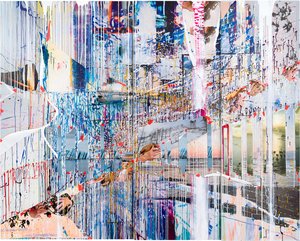
Sarah Sze, Badlands, 2026 © Sarah Sze
Gagosian’s booth at Frieze New York 2026. Video: Pushpin Films
The Summer 2026 issue of Gagosian Quarterly is now available, featuring Ellen Gallagher’s Fast-Fish and Loose-Fish (2026) on the cover.

In this video, Jenny Saville sits down inside her first major exhibition in Venice to discuss how the great Venetian artists of the past and the city’s heritage influence her work. The show brings together more than thirty canvases and works on paper from the 1990s to the present, tracing the development of her practice, which is deeply rooted in the history of painting.

Francis Bacon lived and worked in Paris for a decade starting in the mid-1970s. The city and the art he encountered there provided a profound backdrop for his austere late style, which often brings together smooth, colorful backgrounds, spare architectural signifiers, and sculptural human forms. Here, three striking paintings from that period are considered by Sebastian Smee.
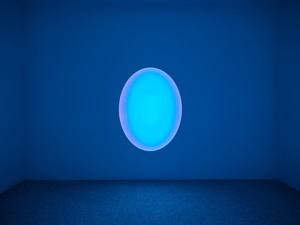
An exhibition at Gagosian, Hong Kong, brings together three of James Turrell’s Glasswork pieces along with site plans, photographs, and models of his Skyspaces and Roden Crater. Here, Alice Godwin explores the history of the Glassworks and their relationship to the artist’s wider practice.

Janne Sirén considers Anselm Kiefer’s new paintings, the subject of an exhibition at Gagosian, New York, entitled Seal My Ears Shut and I Shall Hear You Still.

On April 16, the Institute of Contemporary Art, Boston, opened the first midcareer survey of Derrick Adams’s multidisciplinary practice. Covering over twenty years of work, the exhibition, titled View Master, brings together the artist’s painting, sculpture, collage, performance, and video, as well as a vibrant new commission created for the museum’s façade. Ahead of the opening, Adams met with Tessa Bachi Haas, cocurator of the survey, to discuss his formative experiences with television, the impact of his work in arts education on his practice, and the importance of taking a more complex, more joyful, and more expansive approach to Black American life and culture.

Adam D. Weinberg has been working with Giuseppe Penone on an exhibition of the artist’s new sculptures, The Reflection of Bronze, that opens at Gagosian, New York, on April 22. The works explore the character and possibilities of bronze. Here, Weinberg considers Penone’s enduring engagement with the alloy and addresses the conceptual underpinnings of the exhibition’s three-room structure.

On March 28, a major exhibition of Jenny Saville’s work opened at Ca’ Pesaro–Galleria Internazionale d’Arte Moderna in Venice, bringing together nearly thirty paintings from the 1990s to the present. The exhibition is curated by Elisabetta Barisoni, head of the museums division at Venice’s Ca’ Pesaro, Museo Fortuny, and head of MUVE in Mestre. Saville’s monumental canvases are set in dialogue with the great Venetian artists of the past, creating a unique encounter between contemporary painting and the city’s artistic heritage. Here, the artist speaks with Stefania Ventra, professor with Ca’ Foscari University of Venice, about her early trips to Venice, the radicality of Titian’s painting, and depicting emotional truth.

Jeff Koons tells Alison McDonald about his appreciation for the pioneering artist and thinker Marcel Duchamp.
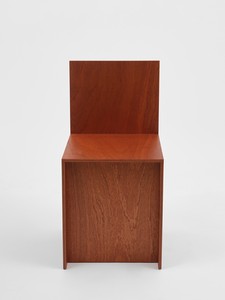
From their respective fields, three international cultural figures—artist and designer Ronan Bouroullec, fashion visionary Michèle Lamy, and chef and restaurateur Enrique Olvera—reflect on Donald Judd’s work in furniture, the subject of recent exhibitions in South Korea and Japan.
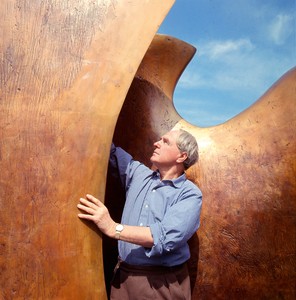
Laura Bruni writes about a major exhibition celebrating the work of the British sculptor Henry Moore at the Royal Botanic Gardens, Kew, London.
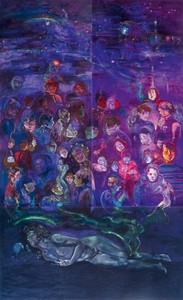
The most recent edition of Picture Books, an imprint organized by Emma Cline and Gagosian, pairs Mary Gaitskill’s novella STAUF: A Tragedy with Jill Mulleady’s painting The Shift. In celebration of this forthcoming publication, Gaitskill and Mulleady discuss the myth of Faust, good and evil in the digital age, and the channeling of raw matter into art.