November 17, 2014

frank gehry:
fondation louis vuitton

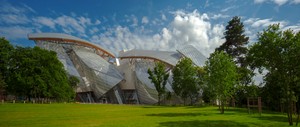
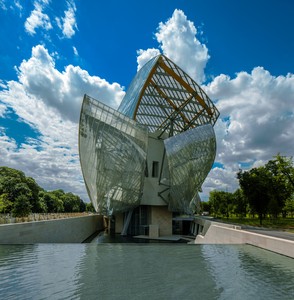
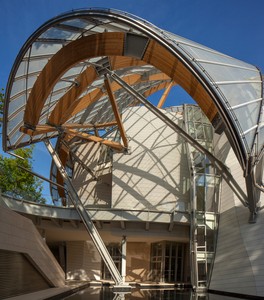
In the autumn of 2014, it appeared as if a ship had sailed into the Bois de Boulogne in Paris. Well, it was not a ship so much as an architectural tour de force: a vast building made with more than 3,200 panels of glass and 15,000 tons of steel. This striking building was the long-awaited premiere of Bernard Arnault’s Fondation Louis Vuitton and the latest triumph for its architect, Frank Gehry. Here the celebrated architect discusses the project with Gagosian’s Derek Blasberg.

Fondation Louis Vuitton, Paris

Fondation Louis Vuitton, Paris

Fondation Louis Vuitton, Paris

Derek Blasberg First, let’s talk about Paris. Do you have any vivid or formative memories about Paris or the Bois de Boulogne?

Frank Gehry I’ve loved Paris since I lived there in 1960. The first time that I visited the garden with Bernard Arnault, I could feel the history of the place; it made me remember Proust, who writes about it in his books. I actually started to cry.

DB It seems as though this building must have been an emotional project, and ultimately it is a triumph. There are so many iconic structures already in Paris. Was that a daunting observation, or was it exciting to anticipate that this structure might join that pantheon?

FG I don’t think about it that way. Of course I have great respect and admiration for the buildings of Paris, and I know them well from my time living and working there—in fact, I studied them. But this project is in a setting that is not immediately adjacent to those buildings. It had to respect the heritage of the older buildings, but it also had to be something different.

DBWhen did you start working on its design? What informed your decisions?

FGWhen I first met Bernard Arnault in 2001, he told me about his plan to build a place in Paris that would encourage creativity and make contemporary art accessible to everybody. He brought me to the Jardin d’Acclimatation. We discussed creating an ephemeral building in the tradition of the nineteenth-century garden pavilions. The question was how to accommodate the functions of the building and still have a building that would seem open and transparent. That’s why the building is made of two layers—the glass sails on the outer layer and the “icebergs,” which house the galleries.

Gagosian quarterly weekend reads

Get the best of the Quarterly in your inbox twice a month.

By subscribing you agree to our Privacy Policy.

Fondation Louis Vuitton, Paris

DBI know you are a fan of water—and fish, which you’ve used as inspiration for some of your artworks and earlier buildings—so does it put a smile on your face that you’ve put a big ship in the middle of Paris?

FGI wanted to create a regatta through the park—not just one ship, but many! The big panels of curved glass that form the facade, what we call “the sails,” help bring the park into the building, and the building into the park. From the outside, you see the sky, the trees, and the water reflected in the sails. When you’re inside, you see out to the surroundings and feel connected to the garden.

Fondation Louis Vuitton, Paris

DBI was told that you designed this building from the inside out. Unlike other spaces, when you design galleries, you need to hang works on walls, not glass. What other factors dictated the way this project came together?

FG When you design a museum, you ordinarily start with a philosophy of how the galleries ought to work, and then you decide where to put them in relation to each other and the building as a whole. This was a different problem. This is a building in the Bois de Boulogne. If it didn’t have the glass, we would have been required to create a lower and more blocklike structure. But we wanted the glass, to make the Fondation reminiscent of a garden building. That decision enabled us to add some height to the building, which gave us more space. The height also allowed us to create exterior terraces that connect the Jardin to the building. Visitors can walk up the exterior of the building to the topmost terrace, which has extraordinary views of Paris.

DBThe building is so impressive. How has it been to work with Fondation Louis Vuitton on the project?

FGThis was really a collaboration with Bernard Arnault. He took part in every round of study and revision. His input was critical to the process. This would have been a very different building if it had been done for anyone other than Bernard. He was fantastic to work with as was his team.
Photos: © Todd Eberle for Fondation Louis Vuitton, 2014

Black-and-white portrait of Derek C. Blasberg

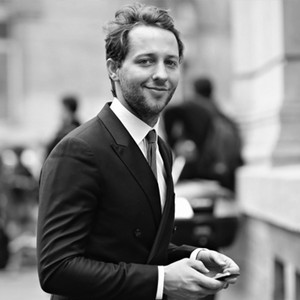
Derek C. Blasberg is a writer, fashion editor, and New York Times best-selling author. He has been with Gagosian since 2014, and is currently the executive editor of Gagosian Quarterly.

See all Articles

Frank Gehry: Every Building, a Self-Portrait

Frank Gehry: Every Building, a Self-Portrait

Deborah McLeod, senior director at Gagosian, Beverly Hills, reflects on the generous and innovative vision of Frank Gehry. Having worked with the architect and artist for more than a decade, McLeod addresses his outsize impact on the city of Los Angeles and the world beyond.

Frank Gehry: Fish Lamps

Frank Gehry: Fish Lamps

Paul Goldberger traces the history of the fish form throughout Frank Gehry’s career.

Frank Gehry Drawings

Frank Gehry Drawings

Frank Gehry speaks to Jean-Louis Cohen about the early years of his practice, including his work with LA artists, and the role of sketching in his design process. The first volume of the catalogue raisonné of the architect’s drawings, edited by Cohen, was published by Cahiers d’Art earlier this year.

The New World of Charlotte Perriand

The New World of Charlotte Perriand

Inspired by a visit to the Fondation Louis Vuitton’s exhibition Charlotte Perriand: Inventing a New World, William Middleton explores the life of this modernist pioneer and her impact on the worlds of design, art, and architecture.

Derrick Adams: View Master

Derrick Adams: View Master

On April 16, the Institute of Contemporary Art, Boston, opened the first midcareer survey of Derrick Adams’s multidisciplinary practice. Covering over twenty years of work, the exhibition, titled View Master, brings together the artist’s painting, sculpture, collage, performance, and video, as well as a vibrant new commission created for the museum’s façade. Ahead of the opening, Adams met with Tessa Bachi Haas, cocurator of the survey, to discuss his formative experiences with television, the impact of his work in arts education on his practice, and the importance of taking a more complex, more joyful, and more expansive approach to Black American life and culture.

Engaging with the Past: An Interview with Jenny Saville

Engaging with the Past: An Interview with Jenny Saville

On March 28, a major exhibition of Jenny Saville’s work opened at Ca’ Pesaro–Galleria Internazionale d’Arte Moderna in Venice, bringing together nearly thirty paintings from the 1990s to the present. The exhibition is curated by Elisabetta Barisoni, head of the museums division at Venice’s Ca’ Pesaro, Museo Fortuny, and head of MUVE in Mestre. Saville’s monumental canvases are set in dialogue with the great Venetian artists of the past, creating a unique encounter between contemporary painting and the city’s artistic heritage. Here, the artist speaks with Stefania Ventra, professor with Ca’ Foscari University of Venice, about her early trips to Venice, the radicality of Titian’s painting, and depicting emotional truth.

A Tremendous Generosity: Jeff Koons on Marcel Duchamp

A Tremendous Generosity: Jeff Koons on Marcel Duchamp

Jeff Koons tells Alison McDonald about his appreciation for the pioneering artist and thinker Marcel Duchamp.

Peter Hujar & Paul Thek

The Art of Biography
Peter Hujar & Paul Thek

Andrew Durbin’s dual biography, The Wonderful World That Almost Was: A Life of Peter Hujar and Paul Thek, published by Farrar, Straus and Giroux, tracks the convergences and divergences in the lives of the two artists, from their first meeting in Coral Cables, Florida, in 1956 through their generative romantic and creative partnership in New York, Italy, Fire Island, and beyond. Ahead of the release, Durbin met with the Quarterly’s Wyatt Allgeier to speak about the development of the project, the sublime noncompliance of these two artists, and the motifs of love, death, and rebirth that weave through the telling of their story.

Tradition and Innovation: The 2026 Loewe Foundation Craft Prize

Tradition and Innovation: The 2026 Loewe Foundation Craft Prize

The Loewe Foundation Craft Prize celebrates its ninth edition with an exhibition at the National Gallery Singapore.

Fashion and Art: Daniel Roseberry

Fashion and Art: Daniel Roseberry

Daniel Roseberry, the creative director of Schiaparelli, met with the Quarterly’s Derek C. Blasberg at the maison’s historic headquarters at 21 place Vendôme, Paris, following the Schiaparelli Fall/Winter 2026–27 ready-to-wear show. Since taking the helm in 2019, Roseberry has been credited with advancing the heritage of the house through unpredictable sculptural designs that carry Elsa Schiaparelli’s Surrealist spirit into a new century. The pair discuss the much-anticipated exhibition Schiaparelli: Fashion Becomes Art, now on view at the Victoria & Albert Museum, London, as well as Roseberry’s early exposures to art, his continued dedication to drawing, and the enduring legacy of Elsa Schiaparelli’s daring vision.

Helter Skelter: Arthur Jafa and Richard Prince

Helter Skelter: Arthur Jafa and Richard Prince

Helter Skelter—an exhibition at Fondazione Prada’s Venetian venue, Ca’ Corner della Regina—marks the first creative dialogue between two visionaries of American art, Arthur Jafa and Richard Prince. The show explores the grit, grift, violence, and ingenuity of American culture through more than fifty works, including photography, video, and large-scale installations that interrogate themes of race, gender, media, and politics. In the interview below, Nancy Spector, the exhibition’s curator, speaks about the shared motifs—from apocalyptic sunsets to a fascination with “monstrosity”—that led her to pair these artists for the first time.

Theaster Gates: Dave, All My Relations

Theaster Gates: Dave, All My Relations

A conversation between Theaster Gates and Jessica Bell Brown, with an introduction by Sydney Stutterheim.