
Flags
Gillian Pistell writes on the loaded symbol of the American flag in the work of postwar and contemporary artists.
Summer 2026 Issue
Ed Ruscha sits down with the author and explorer Erling Kagge to discuss existence.
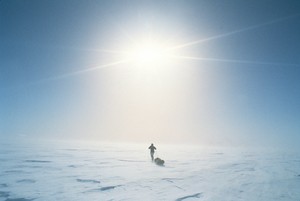
Erling Kagge at the South Pole. Photo: Erling Kagge
Erling Kagge at the South Pole. Photo: Erling Kagge
Ed RuschaThe photo of you at a distance in your book Silence [2016], who took that?
Erling KaggeI did. I just clipped the camera on a tripod and put it on the ice. Clicked on ten to twenty seconds and walked away from the camera.
ERYou were alone on this trip?
EKTo the South Pole, yes. Quite often when people are “alone” on expeditions, they bring a photographer, but I was alone for fifty days and nights. I think my trip was similar to your paintings in the sense that it was very much about silence.
ERThe book reminded me of the idea of isolation and being away from people. It had a particularly good message to it—one that nobody really thinks about because they’re so busy. “Gotta do this, gotta do that,” you know? But all of a sudden you have to stop.
EKIt may be difficult to stop. Busying oneself becomes a goal in and of itself, even when it has to end up in nothing.
ERThere used to be a shop here in London, off Piccadilly Circus, the G. Smith & Sons snuff shop. You could buy anything, snuff or tobacco, and there was a sign out front that said “Everything in the world goes up in smoke, so smoke” [laughter].
EKSounds like a painting by Ed Ruscha. So how are you able to get away from the daily stress?
ERI actually embrace it. I move around a lot but I’m not traveling much; I’m usually at my studio and often I’m there alone. It’s a great feeling.
EKIdentical to the desert.
ERIn the desert there’s no noise and you rarely hear anything. There might be people who live maybe three miles away. So I made this hearing thing out of a big piece of paper. I rolled it up so it’s like a megaphone and I sit there and listen. I can hear dogs bark, and I know there are no dogs nearby but three miles away there are dogs. I can hear them.
EKTo me, the opposite of silence is not sound but distractions. The telephone buzzing, cars passing, radio running, someone who wants to speak to you, something you have to do, some confirmation you’re waiting for. The more we’re inundated the more we wish to be distracted. It should be the other way around, but often it isn’t. Even thinking can be a kind of noise. Silence is about rediscovering, through pausing, the things that bring us joy. Experiencing rather than overthinking. Allowing each moment to be big enough. Not living through other people and other things.
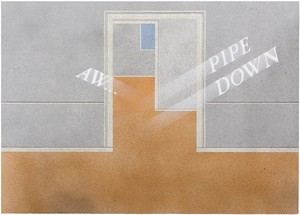
Ed Ruscha, Aw… Pipe Down, 2025, acrylic on canvas, 60 × 84 inches (152.4 × 213.4 cm). Photo: Jeff McLane
ERI read the newspaper—I have an iPad, but that’s as far as I’ve gotten with digital instruments. Most people are distracted by them, aren’t they? You go to an airport and everybody’s locked in.
EKThere’s a new way to greet people: You stretch out your right arm and say, “Do you have a charger?”
To me, all of your paintings are about silence, plus landscape. But these new paintings I think are also about movement. It’s in the language—you move and are being moved, there’s motion and emotion. And there’s something in the paintings that’s about wondering, and I think wondering should be the engine in life. People wonder less and less; if they find themselves wondering at anything, they quickly pull out their smartphones to find the answer. But in these paintings, you cannot. And to me, especially the paintings inspired by [the turn-of-the-twentieth-century Danish painter Vilhelm] Hammershøi, they also look like something in love.
ERSomething in love?
EKTo me a love story is obviously about affection. There’s affection, obsession, but it often has an end, and eventually an emptiness appears. Things become banal, repetitive, boring. You end up saying the same few words that are passed back and forth throughout the house, and somehow those words survive you.
ERI’d never seen an original Hammershøi work, but I saw them in a catalogue and I thought they were very sad, in a way, very plain, plainspoken. But they were striking in the way he appreciated the inside of a room, especially his own. He rearranged in his mind the architecture, the walls, the molding, the wainscoting, and it just affected me in a way. It’s a little trigger that said, Live in his world for a while and see how it is, without imitating him. I could try to paint like him but that would be useless because he had this little private language. But there’s something about the paintings that just stops you, puts the brakes on the modern world. Everything is slow moving. It’s gray and cold. It reminded me of winter scenes, you know? I don’t know much about his life, but I think he went to Paris once and got in with a wild scene and didn’t like it. “I’ll just go back home and live the quiet life” [laughs].
EKHas an artist from a different century been that inspiring to you before?
ERThere are so many periods. I saw these Giotto works and thought, God, he painted the most hideous eyes on people. They’re nasty-looking eyes. I wonder what went on in his mind.
EKDo you want to know [laughs]?
ERA lot of what you do has to do with the physical. But with all your accomplishments, do you think there’s more to explore, or do you feel like it’s all over?
EKThat’s the good news: There’s always more to explore [laughs].
You see things, experience the world, you’re moving around, being moved, and then you get in touch with your inner silence. And that inner silence is who you are. Noise is about everyone else.
Erling Kagge
ERHave you considered outer space?
EKTo fly to the moon? I would do it right away. It’s just three days up there, one day on the surface, and three days back again. It’s 360 to 390,000 kilometers. Mars is 56 million kilometers: That’s too far for me. But yes, to me the world remains unexplored. Everything on earth is changing all the time, and you’re changing, so in that sense the world, and everything we see, also art, is new every day. The history of exploration is a history of rediscovery. Almost every time a famous European explorer claimed to have discovered new land, local people were on the beach waving when he arrived.
ERWhen you go to the North Pole, is there anything that’s been left there by humans?
EKNo.
ERNo markers or poles or flags or anything like that? Or do they just blow away and die?
EKWhen you get to the North Pole it looks exactly the same as it did when you were a hundred kilometers or twenty kilometers away from it. There’s no there there. Traditionally people have something to bring back home from an expedition. Even from Antarctica and the moon, you can bring rocks back home. From the North Pole there’s nothing. It’s a place of extremes. Your compass needle always points south. The wind always comes from the south and blows toward the south. There’s only one sunset and one sunrise each year: The sun sets at the North Pole on September 22, the autumn equinox, and appears again on March 21, the spring equinox. In my experience it’s the most difficult place to get to on Earth. But today, for the first time in 2.7 million years, the ice is melting. So we’re in for some big changes.
ERPeople don’t seem to realize that, but you read almost everywhere that the ice is melting. And it’s easy to not think about that, I guess.
EKPeople tend to choose the easiest options in life, which is a mistake. I believe most of us would have better lives if we more often went for the more challenging and difficult alternatives.
ERDo you feel like you want to go back up there?
EKI go back to the Arctic fairly often. It’s about being in nature, just like you heading to the desert as often as you can. One reason the world has so many problems today is that we’ve separated ourselves from nature. We believe we don’t need nature; we’ve conquered nature. People claim to be sad, lonely, and depressed, and of course it gets sad, lonely, and depressing if you believe you can get to know yourself and discover the world by sitting and looking down at a screen. And on a global scale, with climate change, it’s difficult to relate to a world that heats up if you don’t relate to nature.
ERYou made it clear that you never know you’re at the North Pole, but I think you’ve referred to the North Pole as our navel.
EKExactly. Everything turns around the North Pole: the Earth, the whole universe, the stars, the planets.
ERYou were so isolated out there, and almost not knowing where you were. I go to the desert a lot. Even though it’s fairly remote, I’m sure Indians have passed through there before, but they never left anything. It looks like it did maybe ten thousand years ago. These are areas not that far from intense civilizations like Los Angeles, but there’s no evidence, so there’s probably a lot right here in civilization that has yet to be discovered.
EKSomehow the biggest mysteries for most of us are in our own backyard, and always have been. In classic travel accounts, people travel far, far away to get to know themselves and the world, but it’s when they get home that they find answers to the questions they’d been asking themselves. One reason is that the answers are within you, in your inner silence. You see things, experience the world, you’re moving around, being moved, and then you get in touch with your inner silence. And that inner silence is who you are. Noise is about everyone else.
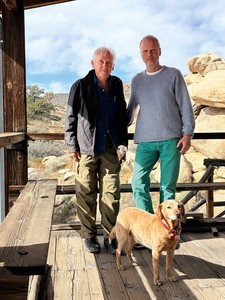
Ed Ruscha and Erling Kagge, 2026. Photo: Peder Lund
ERDo you have to work toward this inner silence, or do you feel like you’re just there sometimes?
EKBoth, in the sense that this silence is inside us all the time, waiting for us to explore it. You can discover your silence in the middle of traffic in Piccadilly Circus, but you have to take a pause, take a break for two minutes. Or, when I walk to the South Pole alone, it could last for fifty days.
But this silence can be uncomfortable. As the philosopher Blaise Pascal wrote almost four hundred years ago, all of humanity’s problems stem from our inability to sit in silence in a room alone doing nothing. Instead of doing nothing, we’re doing something, and that’s the beginning of all our problems.
ERAnd I guess when you do something, you might call it progress.
EKYou can call it progress. You can call it anything you like.
ERBut maybe there are people among us who can go to a loud party yet still maintain this inner silence.
EKAbsolutely. I think sometimes when there’s too much noise in my head or around me, I can turn on some music, close out all the sounds, and then I can find the inner silence. But silence is not about turning your back to the world to live a more egocentric life. It’s the opposite. It’s about getting to know yourself. It’s about understanding other people, seeing the world from a different perspective, loving life.
ERI guess some people have to struggle to make that happen while others are willing to let the next thing that comes across their field of vision control what they do. What do you call that—Zen Buddhism?
EKI think, again, you can call it whatever you like.
ERCall it the fun of life, the distraction of life, or the misery of life.
EKThe great thing is that silence expands time and expands space, while noise narrows time and narrows space. If you have a lot of noise in your life, your world becomes more one-dimensional, more predictable, and eventually you feel that life is short. And this is precisely the secret held by all those who relate to silence: Life is prolonged. Silence expands time rather than collapses it.
ERThat’s a good theory to follow, because some people struggle to get some moment of rest. I don’t know whether you would call silence a moment of rest.
EKIt’s a rest, it’s a break, it’s a pause.
To be different is an important fact, an important step to reach. To have your own voice so it doesn’t sound like someone else’s voice.
Ed Ruscha
ERSometimes people look at it like it’s a battle to cut out the outside world, like they have to fight to get that silence. But it sounds like you always know that you’re going to get back to that comfort of silence, or of noninvolvement with the outside world, even if there’s something in you that may want to keep up with the world too.
EKI think you need both.
ERDo both.
EKWhen looking at your paintings, and great art in general, I start to wonder what kind of experiences are coming together in the work. The artist’s humor, heartbreaks, great times, doubt, desires, losses, pleasure—to different degrees, everything comes into this one piece of art. Obviously I’m unable to understand all of it but I’m happy to try to understand some of it. I really like that it’s a great room for doubt.
ERYou have different manifestations of art. There’s an idea in some artists’ minds that you should to try to picture the sublime, and then there are people like the Futurists who come along making noise on purpose. They want to take cymbals and go bang, bang, bang in your life. They want to do it with colors and noise, musical noise, all that abstract stuff. I think the Futurists are a way to describe those people who are going to the opposite side of the serene artist’s mind. They want noise and they love war. A lot of the Surrealists who went to war were Futurists and a lot of them got killed.
EKThey liked the beginning of the war.
ERMaybe not the outcome [laughter].
EKPeople quite often tend to enjoy the beginning of a war.
Did you ever consider, with the London paintings, not having any words? When I see these paintings, as I said, I feel it’s partly a love story, but there are also these words that are just hanging in the room: “To myself says I.”
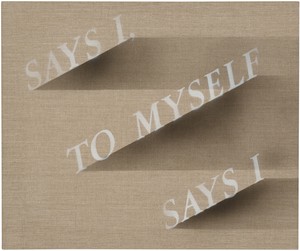
Ed Ruscha, Says I, to Myself Says I, 2024, acrylic on linen, 20 × 24 inches (50.8 × 61 cm). Photo: Jeff McLane
ERI heard my mother say that: “Says I, to myself says I.” I had to search to find out that it’s really an Irish song from the 1920s.
EKYour mother probably heard the song.
ERIt’s so funny. But there’s also something theatrical about voices coming from behind a wall, or from behind the inside of a room that has a division in it they call a doorway. It’s like bolts, like metal bolts in a blender: You put that blender on, you can imagine what that sounds like, and that’s what your life as an artist is like. For most people your whole life is like that. Yeses and nos and heres and theres. Everybody’s life is made up of a combination of all these things. It’s like a rattlebag of ideas that work back and forth.
EKDo you find life to be a struggle? Is your life hard?
ERMy quick answer is no, life isn’t really a struggle.
EKSomeone said life is simple but we make it a struggle.
ERThat’s probably true.
EKThe whole Johnny Cash thing: “This world is rough. And if a man’s gonna make it, he’s gotta be tough” [laughter].
ERI’m reading a good book by Werner Herzog.
EKOh, which one?
ERThe Future of Truth [2025], it’s a new book, a small book. I went to a birthday party for him a couple of weeks ago, given by Benedikt Taschen, who introduced Werner, saying, “Well, Werner, are you going to say something?” So Werner gets up, but from the first word, bang, there’s a mariachi band in the hallway with trumpets and guitars. It drowned him out. Werner had to sit down.
EKI love his movies, but I think he’d like to be someone else, too.
ERAn author?
EKI think quite often successful people would like to be something else. You succeed in one field, but then you’d like to start a restaurant or become a DJ or an author. As Heidegger wrote, “Everyone is the other, no one is themselves.”
ERThat in itself is a struggle, isn’t it? Maybe I want to be something else. Well, it’s too late to be a baseball player.
EKI’m a “possiblist,” in the sense that nothing is really impossible, it’s all degrees between 0.1 and 99.9. So for you to become a baseball player is extremely unlikely, but not impossible.
ERToo many people are quick to say, Hey, nothing’s impossible.
EKThat’s naïve too. What’s happening after these two shows?
ERI don’t know. I’ve had a thought about making a movie about a guy who gets lost in the desert. I’m just in the beginning stages of that.
EKAnd his name is Ed Ruscha?
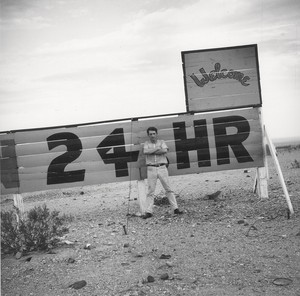
Ed Ruscha, 1962. Photo: Patty Callahan
ERCould be. Actually it springs from an old movie made in 1950 or so about the same subject of a guy getting lost in the desert. In my film he gets deliberately left in the desert. He’s got a broken leg.
EKSo he can’t follow the others.
ERHe can’t follow the others and he can’t really walk and he has to struggle to survive and maybe he looks for water. He doesn’t know too much about how to survive the desert. There are a lot of plants you can chew on and eat to get moisture, and he spots one and it’s jimsonweed, a poisonous weed, so when he eats it he goes through a psychedelic experience.
EKDoes he find water?
ERFinally finds water, yeah.
EKIs it going to be like ten minutes or a full movie?
ERMaybe a full movie, I don’t know. It’s the beginning of it.
EKWhat’s a greater challenge than to make a full movie? It’s again making life more difficult.
ERI’m not disillusioned by anything. I still like the idea of making tiny works of art, little things and little drawings.
EKI think that’s what really fascinated me the first time I visited your studio. You have this great building, you walk in, three or four people are sitting in the first room. They’re all very nice and friends of yours. And then you walk through the next door and it’s quiet. There you have the archive, an extra room with some personal stuff to the left, and then eventually I get to your studio. There’s a little drawing being made, maybe a painting, maybe not. If you walk through the next door, there’s your garden. Things move really, really slowly.
ERI find myself navigating that, going from this one thing to another, on a daily basis. When you’re self-employed, you have to make life happen.
EKWhat does it take to become a great artist?
ERA bunch of oddities that don’t fall into place at the right time. To be different is an important fact, an important step to reach. To have your own voice so it doesn’t sound like someone else’s voice. What got you into what you do? When you were fifteen years old did you say, “I’m going to go to the North Pole?”
EKKind of way before that.
ERWay before that?
EKIn the sense that we’re all born explorers. As soon as we leave our mother’s womb, we want more space, more room in which to move. We stretch our arms and legs out in all directions and scream for air. We have a desire to explore the world. As soon as we learn to walk, we walk through the living room and out of the house, then start to wonder what lies between us and the horizon, and soon enough what lies beyond that. We’re on our way to discovering our own North Poles.
ERWhen you were young, did you ever walk out your back door and think, “I could just keep walking”?
EKAbsolutely—and I did. And the more tired you get, the more interesting it becomes, because the threshold for taking in impressions gets lower when you’re tired; you’re not so controlled. I like getting tired. I like getting exhausted.
silence is not about turning your back to the world to live a more egocentric life. It’s the opposite. It’s about getting to know yourself. It’s about understanding other people, seeing the world from a different perspective, loving life.
Erling Kagge
ERDid you have much of a feeling that you learned anything from the people before who did the same thing?
EKThe answer is definitely yes. The biggest mistake North Pole explorers make is to believe there’s not much to learn from people who went north ahead of you, or from the Inuits. That’s one of the reasons why three out of four who tried to get to the North Pole before the 1890s died. The Inuits, who knew most of the tricks, were considered primitive, people thought there was nothing to learn from them. That’s obviously stupid and sometimes we humans are stupid.
ERI feel like all art comes from other art. You’re a product of all the stuff that went before you, which is a lot of garbage and a lot of valuable stuff. It helps you and nourishes you, like your observation about the people who did this before you. You listened to what you could find out from them.
EKOf course, and the reason you’re successful on an expedition is that you’re curious, work hard with your preparations, have the right gear, a good attitude. What do you think when you hear an artist say, “I have nothing to learn from the past”?
ERI know a lot of artists do that, and a lot of younger artists try to strike out on their own and eliminate art history from their work. They’re so bold, they want to establish some new flag at the North Pole [laughter]. But it’s also important that you don’t take it too seriously.
EKDon’t take what too seriously? The paintings?
ERThe whole subject: living, life and art, adventure, all of that. Treat it lightly and bounce it up and down like a juggler would.
EKIs that something you’ve always done?
ERI don’t set out to do anything on purpose. It just happens to me. I’m a slave to my own choices and I just keep working at them and that keeps me happy. The best part of it is not knowing what’s out there, what’s ahead of us, and that actually is a motivator, don’t you think?
EKI think it’s a motivator. No one knows anything for certain. Absolutely everything can happen, right away. We don’t know the day until the sun has set. What does the Bible say: There’s nothing new under the sun? That’s wrong. Everything is new under the sun.
Ed Ruscha: Says I, to Myself, Says I, Gagosian, Davies Street, London, October 14–December 19, 2025
Ed Ruscha: Talking Doorways, Gagosian, rue de Castiglione, Paris, October 22–December 3, 2025
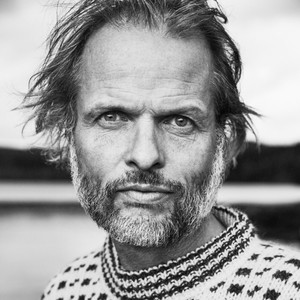
Erling Kagge is a Norwegian explorer and author. He was the first in history to reach the North Pole, the South Pole, and the summit of Mount Everest on foot. He has written nine books on exploration, philosophy, and art collecting. Kagge’s Silence in the Age of Noise (2016) has been translated into forty-two languages. Photo: © Simon Skreddernes
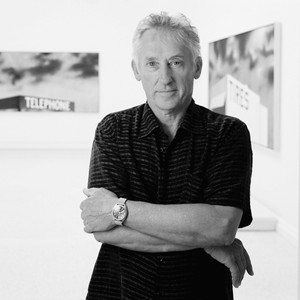
Ed Ruscha’s deadpan representations of Hollywood logos, stylized gas stations, and landscapes distill the imagery of popular culture into a language of cinematic and typographical codes that are as accessible as they are profound. Ruscha has had over twenty solo exhibitions with Gagosian since his first exhibition with the gallery, in 1993. Photo: Gary Regester
Gillian Pistell writes on the loaded symbol of the American flag in the work of postwar and contemporary artists.
Jacoba Urist profiles the legendary collector.
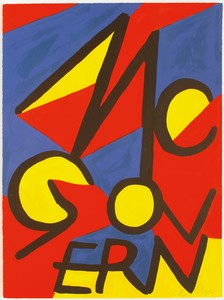
Against the backdrop of the 2020 US presidential election, historian Hal Wert takes us through the artistic and political evolution of American campaign posters, from their origin in 1844 to the present. In an interview with Quarterly editor Gillian Jakab, Wert highlights an array of landmark posters and the artists who made them.
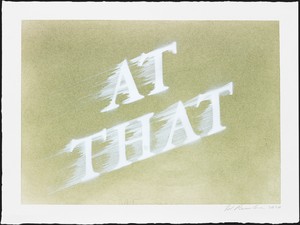
Lisa Turvey examines the range of effects conveyed by the blurred phrases in recent drawings by the artist, detailing the ways these words in motion evoke the experience of the current moment.
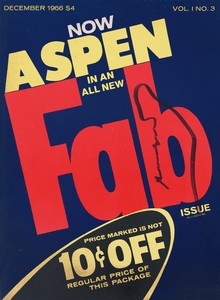
Gwen Allen recounts her discovery of cutting-edge artists’ magazines from the 1960s and 1970s and explores the roots and implications of these singular publications.
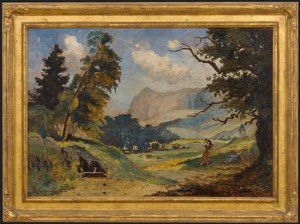
Ed Ruscha tells Viet-Nu Nguyen and Leta Grzan how he first encountered Louis Michel Eilshemius’s paintings, which of the artist’s aesthetic innovations captured his imagination, and how his own work relates to and differs from that of this “Neglected Marvel.”
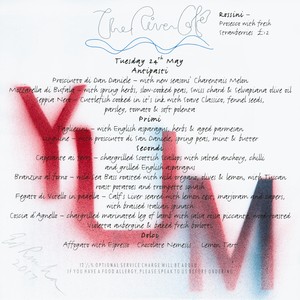
London’s River Café, a culinary mecca perched on a bend in the River Thames, celebrated its thirtieth anniversary in 2018. To celebrate this milestone and the publication of her cookbook River Café London, cofounder Ruth Rogers sat down with Derek Blasberg to discuss the famed restaurant’s allure.
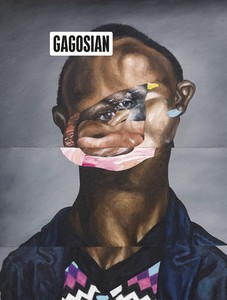
The Fall 2019 issue of Gagosian Quarterly is now available, featuring a detail from Sinking (2019) by Nathaniel Mary Quinn on its cover.
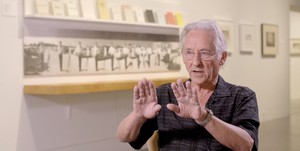
In conjunction with his exhibition VERY at Louisiana Museum of Modern Art in Humlebæk, Denmark, Ed Ruscha sat down with Kasper Bech Dyg to discuss his work.
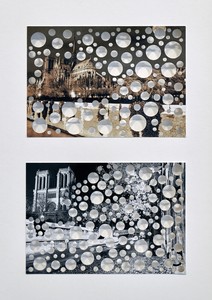
An exhibition at Gagosian, Paris, is raising funds to aid in the reconstruction of the Cathédrale Notre-Dame de Paris following the devastating fire of April 2019. Gagosian directors Serena Cattaneo Adorno and Jean-Olivier Després spoke to Jennifer Knox White about the generous response of artists and others, and what the restoration of this iconic structure means across the world.
An exhibition at the Broad in Los Angeles prompts James Lawrence to examine how artists give shape and meaning to the passage of time, and how the passage of time shapes our evolving accounts of art.
Ed Ruscha sat down with Tom McCarthy and Elizabeth Kornhauser, curator at the Metropolitan Museum of Art, to discuss the nineteenth-century artist Thomas Cole, whose Course of Empire paintings inspired a series of works by Ruscha more than a century later.