Salomé Gómez-Upegui surveys environmentally engaged art from the mid-twentieth century to the urgent present.
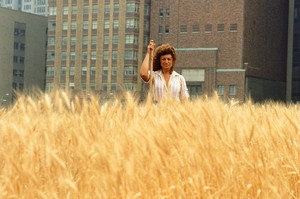
Agnes Denes, Wheatfield—A Confrontation: Battery Park Landfill, Downtown Manhattan—With Artist in the Field, 1982. Photo: John McGrail, courtesy Agnes Denes and Leslie Tonkonow Artworks + Projects
Agnes Denes, Wheatfield—A Confrontation: Battery Park Landfill, Downtown Manhattan—With Artist in the Field, 1982. Photo: John McGrail, courtesy Agnes Denes and Leslie Tonkonow Artworks + Projects
Salomé Gómez-Upegui is a Colombian-American writer and creative consultant based in Miami. She writes about art, gender, social justice, and climate change for a wide range of publications, and is the author of the book Feminista Por Accidente (2021).
2023 was the hottest year on record;1 close to 80 percent of the extreme weather events over the past two decades were influenced by human activities and the use of fossil fuels;2 about half of the planet’s glaciers are expected to disappear by the end of this century;3 and somewhere between Hawaii and California there is a growing island, currently twice the size of Texas, made entirely out of plastic trash.4 For decades, scientists have warned humanity about the perils of a rapidly accelerating climate crisis in which everyone plays a role. In the art world, however, environmental issues were until quite recently still treated as niche subjects. But artists are increasingly addressing the pressing issue of the climate crisis, and this essay, though far from a definitive survey, aims to shed light on some of those who have been bold enough to sound the alarm in unique and unexpected ways, often blazing critical trails in the process.
In the 1960s and ’70s, artists belonging to the Land art movement were some of the first to directly contend with matters of ecology and the climate. Not all Land artists engaged with these subjects, of course, but the Hungarian-American artist Agnes Denes made history in 1969 with one of the first ecological public artworks ever made: Rice/Tree/Burial, a site-specific installation in Sullivan County, New York, that declared the artist’s devotion to environmental justice.5 Denes has continued to address environmental themes throughout her career. In Wheatfield—A Confrontation, for example, she planted two acres of wheat on the Battery Park Landfill in downtown Manhattan to raise awareness about an array of ecological matters including waste management and world hunger. In 2024, with these themes more urgent than ever, she reproduced that iconic work in Honoring Wheatfield—A Confrontation (2024), an installation for Art Basel’s Messeplatz Project set to remain on-site until the crop’s harvest. Widely considered a pioneer of environmental art, Denes has long defended the importance of art in confronting our ecological crisis. “In a time when meaningful global communication and intelligent restructuring of our environment is imperative,” she writes, “art can assume an important role. It can affect intelligent collaboration and the integration of disciplines, and it can offer skillful and benign problem solving. A well-conceived work can motivate people and influence how things are perceived.”6
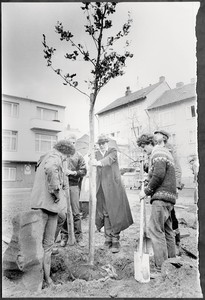
The German artist Joseph Beuys was a pioneer of environmental art, and indeed was a founding member of Germany’s Green Party in 1980. His best-known ecology-related work is surely 7000 Eichen (7000 Oaks), a project to plant 7,000 oak trees around the city of Kassel, Germany, each tree being paired with a basalt pillar. The planting began at the documenta 7 exhibition in Kassel in 1982 and was completed, by the Dia Art Foundation, at documenta 8 in 1987, one year after Beuys’s death.7 Beuys’s goal in this Land art piece was to raise public awareness in matters of conservation and urban renewal.
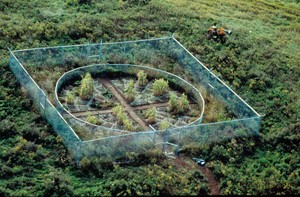
Also worth highlighting are the contributions to environmental art of the American Land artist Mel Chin. In Revival Field (1991–), an experimental work that began at the Pig Eye’s Landfill in St. Paul, Minnesota, and has seen many iterations since, Chin devised a sculptural structure containing “hyperaccumulator plants” that remove heavy-metal toxicity from the land’s soil, directly improving the environmental conditions of whatever site the installation is built on.
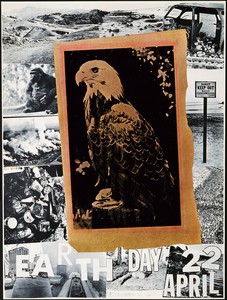
Other late twentieth-century artists contended with environmental matters, if sporadically. In 1970, for instance, the American artist Robert Rauschenberg designed the first Earth Day poster to raise money for the American Environment Foundation in Washington, DC.8 Featuring a sepia-toned image of a bald eagle surrounded by pollution and endangered species, the work highlighted the United States’ prominent role in the global ecological crisis. In 1980, Greenpeace commissioned Judy Chicago to create a poster, Rainbow Warrior, named after the organization’s ship, which participated in numerous campaigns involving ecological issues such as seal hunting, whaling, and nuclear testing. Chicago’s poster featured a kaleidoscopic, warriorlike figure above a group of sea creatures alongside the following phrase: “According to a Native American legend, when the Earth’s creatures have been hunted almost to extinction, a rainbow warrior will descend from the sky to protect them.” Likewise, the activist art collective Guerrilla Girls grappled with themes of environmental justice in the all-text poster Ten Trashy Ideas about the Environment (1994), which featured sarcastic statements such as “I like to use plastic, especially for making art about the environment. After all, art is eternal, and so is plastic,” and “Dumping garbage in rivers and oceans is disgusting, but, hey, ‘Out of sight, out of mind.’”
Public awareness of the climate crisis increased with the Earth Summit, held in Rio de Janeiro in 1992, which produced the United Nations Framework Convention on Climate Change. But artworks and exhibitions addressing the matter continued to be few and far between in the 1990s. In 1996, Superflex, a Danish art collective founded a few years earlier by Jakob Fenger, Bjørnstjerne Christiansen, and Rasmus Rosengren Nielsen, brought an intersectional approach to art on ecological issues with Supergas, a cutting-edge project that transformed biowaste into gas that could be used by rural communities in Africa for cooking or lighting. More recently, Superflex has continued to address ecological matters with projects such as Deep Sea Minding (2019–21), a multiyear initiative to create a series of installations related to global warming and rising sea levels.
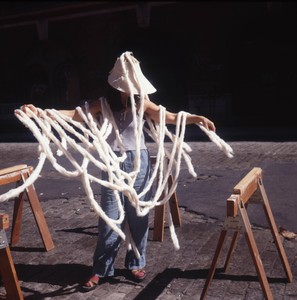
The Chilean artist and poet Cecilia Vicuña is another prominent figure who grappled with themes of climate change well before the subject became mainstream. Her work is particularly important in applying the wisdom of Indigenous communities to understand and confront the ecological crisis. The performance and site-specific installation Cloud-Net (1998–99), made from unspun wool, addresses global warming by incorporating ancestral weaving traditions from the Andes. In an interview in 2018, Vicuña recalled the precarious way in which art critics engaged with this work back then: “No one that wrote about [Cloud-Net] addressed the issue of global warming. They just interpreted it as a work of monumental weaving. Not a single person understood what the actual subject was.”9
After the beginning of the twenty-first century, as our understanding of the magnitude of the climate crisis expanded, a growing number of interdisciplinary artists grappled with these themes in novel and unexpected ways, often in direct collaboration with scientists. For the 2007 exhibition Weather Report: Art and Climate Change, curated by the American art critic Lucy Lippard at the Boulder Museum of Contemporary Art, Colorado, fifty-one artists were invited to create works addressing climate change and global warming, and all were given access to scientists working on the subject matters of their artworks. Reflecting on the importance of art in confronting the crisis, Lippard has said, “An uninformed public will make the wrong decisions or will have no voice in the decisions. That’s where art can help. Some of it will be useless and some will be co-opted [by the art business], but there will always be the visionaries who manage to communicate.”10
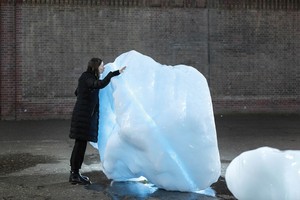
Among those visionaries, the Icelandic Danish artist Olafur Eliasson stands out for his masterful use of natural elements to create mesmerizing pieces that raise awareness about humanity’s relationship to climate change. One of his best-known works is The weather project, a now iconic installation that brought an artificial sun into the Turbine Hall of Tate Modern, London, in 2003, inviting viewers to reflect on our rapidly warming planet. In 2014, Eliasson collaborated with geologist Minik Rosing to produce Ice Watch, an interactive installation, timed to correspond with a meeting of the United Nations Intergovernmental Panel on Climate Change, that transported gargantuan ice blocks from Greenland to City Hall Square, Copenhagen. In 2015, the duo created a second iteration of the work at the place du Panthéon, Paris, where the talks that led to the Paris Climate Agreement were taking place. And in 2018, Ice Watch was shown in London, coinciding with the meeting of world leaders at the COP 24 climate-change conference in Katowice, Poland. “By enabling people to experience and actually touch the blocks of ice, I hope we will connect people to their surroundings in a deeper way and inspire radical change,” Eliasson has said of the project.11
Many artists who work on environmental issues seek to broaden the scope and impact of their practice by creating nonprofits. Eliasson, for instance, cofounded the nonprofit Little Sun with entrepreneur Frederik Ottesen, creating a portable solar lamp that has brought renewable energy to hundreds of thousands of people across Africa since 2012. Similarly, the Argentinian interdisciplinary artist Tomás Saraceno, who has experimented with air-fueled sculptural works in his practice since the early aughts, is the founder of Aerocene, a project (formally a foundation since 2015) that seeks to envision an alternate reality free from fossil fuels and in harmony with earth. Its initiatives include Museo Aero Solar (2007–), an ongoing collection of community-built floating museums made from reused plastic bags. “While fossil fuel enterprises attempt to colonize other planets,” an Aerocene statement reads, “the very same interface between us, the Sun and the atmosphere—the air—continues to be compromised. . . . Can you imagine how would breathing feel in a post fossil fuel economy, and what is our response-ability?”12
An outstanding example of an artist whose practice expands into nonprofit work is American painter and conservationist Haley Mellin, founder of the nonprofit Art into Acres, which works with artists and art institutions to finance large-scale conservation initiatives in vital and threatened ecosystems around the world. As of 2023, the organization had contributed to the preservation of more than 30 million acres of land.13 Mellin is an established painter who focuses on ecological themes: “My paintings,” she has said, “aim to be a gentle reminder that we are not superior, that all species share land and that we are not alone.”14 Moreover, Mellin sees her conservation efforts as an extension of her artistic practice: “A painting is a certain expression of art. Land conservation is a certain expression of art. They both have specific aims.”15
The artists of a nascent art movement, sometimes dubbed “regenerative artists,” intend to foster immediate and constructive connections between communities and their surrounding ecosystems. Interdisciplinary sculptor and photographer Mary Mattingly has pushed the boundaries of regenerative art in surprising ways. In 2009, Mattingly worked with marine engineers, designers, and sculptors to create Waterpod, a sustainable floating habitat that navigated the waterways around New York City’s five boroughs, fostering conversations about environment-focused subjects such as rising tides, food insecurity, and pollution. From 2016 to 2019 she embarked on a similar endeavor with Swale, a “floating food forest,” built on a reclaimed barge, that allowed anyone to harvest fresh food. The project arose after Mattingly found out that growing or foraging food from New York’s public land was illegal; marine common-law principles, however, allowed her to circumvent this difficulty, since the barge was considered a floating island. In 2024, Mattingly plans to reveal Shoal, an expanded and permanent food forest built on a reclaimed barge that will serve the boroughs of Brooklyn and Queens.
Mel Chin, Revival Field, pictured in 1993, Pig’s Eye Landfill, St. Paul, Minnesota. Photo: David Schneider
An additional example of a regenerative artwork is New Forest, Ancient Thrones (2024) by the American artist and activist Jordan Weber. This public sculpture is designed both to monitor air-pollution levels and to clean the air with purifying plants. Somewhat reminiscent of Chin’s Revival Field, the piece is permanently installed in the East Canfield neighborhood of Denver, Colorado, which has historically and disproportionately dealt with high levels of pollution. With this work Weber seeks to serve the local community while also raising awareness of discriminatory urban planning and environmental racism.
Undeniably, already-disadvantaged communities around the world are bearing the brunt of the climate crisis. In this regard the exhibition Breath(e): Toward Climate and Social Justice, curated by Glenn Kaino and Mika Yoshitake at the Hammer Museum, Los Angeles, from September 14, 2024, to January 5, 2025, features the work of more than twenty artists addressing the crisis while considering its connection to matters of social justice.
In 2019, a group of 11,000 scientists from around the world came together to “tell it like it is,” unequivocally stating that what our planet is now facing is far from a mere crisis but a “climate emergency.”16 Under these circumstances, we in the art world can no longer afford to make environmental justice a niche issue, and artists, galleries, and institutions are increasingly taking note. This swift review of environmental artworks that have emerged in recent decades is highly incomplete—and thankfully so. As the climate emergency escalates, so too do the number of artists attempting to confront and call attention to it, and this should provide hope for the future.
5 For the curator and art historian Peter Selz, Rice/Tree/Burial was “probably the first large-scale site-specific piece anywhere with ecological concerns.” Quoted in “Agnes Denes: Works, Writings, Biography,” n.d. Available online at http://www.agnesdenesstudio.com/index.html (accessed June 30, 2024).
16 William J. Ripple, Christopher Wolf, Thomas M. Newsome, Phoebe Barnard, and William R. Moomaw, “World Scientists’ Warning of a Climate Emergency,” BioScience, November 5, 2019. Available online at https://academic.oup.com/bioscience/article/70/1/8/5610806?login=false (accessed June 30, 2024).
Salomé Gómez-Upegui is a Colombian-American writer and creative consultant based in Miami. She writes about art, gender, social justice, and climate change for a wide range of publications, and is the author of the book Feminista Por Accidente (2021).