Zoë Hopkins reports on the Healing Project, a multidisciplinary arts organization founded by the composer, artist, and activist Samora Pinderhughes in 2014. Hopkins examines the project’s collective engagement with individuals impacted by structural violence, incarceration, and systemic oppression.
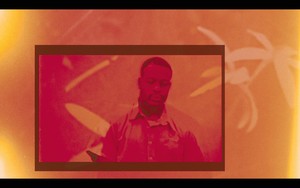
Still from Keith LaMar: SWEET (2024), created by Samora Pinderhughes, Keith LaMar, Christian Padron, and Amanda Krische, single-channel film
Still from Keith LaMar: SWEET (2024), created by Samora Pinderhughes, Keith LaMar, Christian Padron, and Amanda Krische, single-channel film
Zoë Hopkins is a writer and critic based in New York. She received her BA in art history and African American studies at Harvard University and is currently working on her MA in modern and contemporary art at Columbia University. Her writing has appeared in Artforum, the Brooklyn Rail, Cultured, and Hyperallergic.
“I’m sweet, man, you know.”
These words meet the ear with profound clarity, insistence, and a shade of melancholy at the very beginning of the film Keith LaMar: SWEET (2024). It’s LaMar himself who makes this simple declaration, and it’s clear from ripples of static in the background that he’s speaking on the phone. In fact, LaMar has communicated almost entirely through the phone for over thirty years, debarred for the most part from unmediated face-to-face interaction. Since a conviction in 1993, he has been in solitary confinement in a maximum security prison in Ohio and is scheduled to be executed in January 2027.
In the film, though, it is not the bitter fact of this conviction that defines LaMar but the soft core of his sweetness, the ricochet of his laugh, the tender and wide eyes that gaze out at us from childhood photos of him. He is enshrined here in the avowal of his own humanity, which is also a disavowal of the brutality with which the carceral system aims to delete such sweetness from those whom it ensnares. As LaMar said to me during a phone call, “Keith LaMar’s got to tell his own story, otherwise you don’t hear from him.”
Keith LaMar: SWEET emerged out of one of many weekly phone calls between LaMar and Samora Pinderhughes, a codirector of the film along with Christian Padron and Amanda Krische. Pinderhughes—a musician, composer, artist, and self-proclaimed “Black surrealist”—is the executive and artistic director of the Healing Project, an initiative dedicated to enlivening art’s relationship to transformative justice, prison abolition, and community-centered healing in the face of the carceral state. The project is built on sustained, deep-rooted connection with people who have been affected by the criminal-justice system and on the collaborative telling of their stories. This has unfurled in a suite of performances, exhibitions, albums, and films—including SWEET. [Listen to the song version here.]
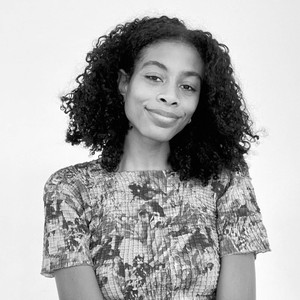
Samora Pinderhughes. Photo: Ray Neutron
Pinderhughes founded the Healing Project in 2014 in response to childhood encounters with structural violence as he grew up in the Bay Area. At the core of the project is a question that he often asks in our discussions: “What would it look like if we built a world around healing?”
In pursuit of answers to this inquiry, Pinderhughes traveled across the country and interviewed over 100 people who are incarcerated, have been incarcerated, or have otherwise been harmed by structural violence and carceral apparatuses. (This project began with ten interviews commissioned from Pinderhughes’s mentor Anna Deavere Smith, the playwright and actor who also heads the NYU Institute on the Arts and Civic Dialogue.) One could summon the word “poignant” to describe the resulting archive of oral histories, but that descriptor feels too delicate for the full complexity of the emotional embroilment and attention that spring from listening carefully to these voices. Several testimonies roil with painful recountings of experiences in prison and with searing critiques of racial and carceral capitalism. Others shimmer with dreams of alternative possibilities as the speakers respond to the question of what healing looks like, how they would design it, and what conditions would be required for such a design to take shape.
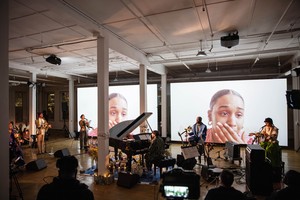
A selection of the interviews has been overlaid with collaborative scores arranged by twenty composers, including Pinderhughes, Chris Pattishall, Rafiq Bhatia, Boom Bishop, and others. These tracks accumulate in an hour-long soundscape that oscillates among moods and genres, from jazz to gospellike synth tones to experimental acoustics, music and voice holding each other in embrace. Twice in 2022—at the Kitchen in New York and at Yerba Buena Center for the Arts in San Francisco—these tracks were presented in exhibition contexts as an immersive sound room outfitted with surround-sound speakers. Pinderhughes also performed a selection of the songs for a live audience at Carnegie Hall in 2023. Next year, Pinderhughes tells me, this sound room will go mobile so that people across the nation can experience these musical testimonies.
On Living (2022), performance: created by Samora Pinderhughes, The Kitchen at Westbeth, New York, November 10, 2022. Photo: Walter Wlodarczyk
Referring to the sound-room installations, Pinderhughes tells me, “It’s powerful as a sound work because I can put all of these people into conversation who have dealt with similar things, have them speaking both to each other and to people who have never experienced these things. When people are listening, they can literally be inside the point of view of these folks who are talking.” The sound room, in other words, invites us to inhabit a chorus of interiorities, to envelop ourselves in a polyphony of voices, instruments, and imaginations, all sounding their insistence on the kinds of freedom we have been taught to believe are impossible. To enter these sound worlds is simultaneously to enter a more capacious conceptualization of our own world, to reconfigure its core around generosity rather than constraint. We are held in the ripple of these sonic textures, carried in their currents of healing and transformation. And the lucidity with which such healing is described in each track makes it feel all the more possible. With a vividness that pricks at the raw heart, one interviewee—his voice set against percussive drill music—details his ideas of a rec center full of health and education resources for his community. Another interviewee, the late activist Sharon Hewitt, baldly asserts the uncontainable prowess of her imagination: “I must seize, in the context of right now, every extraordinary opportunity to be delusional, to see what is not there.”
This pairing of responses points us toward the spark that animates the Healing Project’s work: the knowledge that our fundamental needs move in the same orbit as wild, riotous—and, yes, delusional imagination, that healing involves a twinned attunement to basic material needs and to our need to imagine beyond what we already know. For Pinderhughes, this means “doubling down on the belief of what art can really do.” He emphasizes, “The future work of this project has to be imaginative . . . it is about saying, Can we build a world out of the things that people say they actually need? And that involves really giving the space to identify what those things are. Art can really devise that.”
Sound is not the only register in which the Healing Project’s artistic projects unfold; its work of envisioning is also wrapped up in images. The films of Pinderhughes and collaborators are one vertebra of this visual backbone. A carefully conceived visual language runs under and links together Pinderhughes’s films, which are buttressed by elegiac musical scores and voice-overs, mostly culled from the interview archive. They are shot for the most part on film cameras, so that their balmy ambiances are dappled with grain. Gentle hues and low, natural lighting prevail. Figures often appear blurred or in shadowy silhouette, like auras rather than spectacles. Contravening the hard and hardening edges of carcerality and surveillance, the aesthetics of these films encourage us to give ourselves over to a soft gaze.
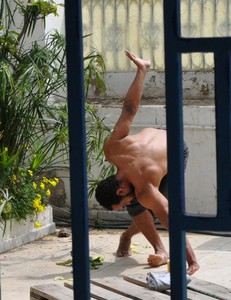
Masculinity (2023), created by Samora Pinderhughes, Christian Padron, Ray Neutron, and Kassim Norris (RSCK), single-channel film
While films such as SWEET hone narratives of individuals with whom the Healing Project has worked (in this case Keith LaMar), others are broader in their consideration. Masculinity (2023), for example, seems to probe stereotypes of Black masculinity with imagery that disrupts them entirely: men wear motorcycle helmets decorated with flowers, old footage shows a young Pinderhughes playing the piano, a boy lies on a plush and patterned carpet playing with a feather, a dancer spins and leaps in a dark and empty studio. Yet the film buzzes with a complexity that exceeds nice and neat positive representation, or images of roses in lieu of guns. The anxiety that so often sculpts the emotional and social lives of Black men pulses through the veins of the narrative. At one moment Pinderhughes’s dubbed voice says, “The truth is ugly, I want to break something so badly, I want to punch walls inside myself forming new tunnels in which the blood runs hotter.” The same child who plays with the feather punches the air in front of the camera earlier in the film. Masculinity entangles tender and brutal realities alike. It inhabits the full, sweeping totality of what Black masculinity is: the love and the violence, the pressure and the release, the impossibly harsh conditioning that has led to this fraughtness, the Black male desires to elude these conditions altogether.
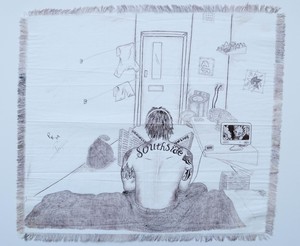
In addition to these short films, the visual narratives of the Healing Project also include works made by the collaborators who are currently incarcerated. During a visit to Pinderhughes’s apartment in Harlem, he shared with me a pair of works made by Peter Mukuria, also known as “Pitt Panther” (after the Black Panther Party), who makes ink drawings on bedsheets sourced in the Virginia prison where he is incarcerated. One of these works, Self Portrait (2022), details a fabulated version of Mukuria’s cell. He sits on the bed, back facing the viewer and festooned with tattoos, as he reads a newspaper and listens to music on a listening device. On the desk next to his bed is a computer whose screen flashes with what looks like a cartoon animation. Above, a small poster is decorated with the initials RIBPP, for “Revolutionary Intercommunal Black Panther Party,” a political party and solidarity network for which Mukuria is the minister of labor.
Peter Mukuria aka Pitt Panther, Self Portrait of Pitt Panther (2022), pen on bedsheet, created for the Healing Project. Photo: Anthony Artis
How can art be more deeply engaged in the messy suturing of the fractures wrought by our political conditions? How can it hold us together?
Zoë Hopkins
Holding the drawing in my hands, the inexorable force of it all came rushing in: the incredible privation in which the work was produced, the fortitude required to repudiate this privation by creating anyway, the marriage of generosity and fugitive vision that propelled its journey beyond the prison walls, Pitt’s unflinching insistence of using any- and everything around him to self-fashion and self-image, to weave his narrative into being and share it. The drawing is one response to a question that Pinderhughes asks during our conversation: “How can we jump outside the prison walls?”
Artists such as Mukuria—and the Healing Project itself—demand of art that it raise its relational stakes. It must rigorously recommit itself to deepening our social and affective entanglements. Art “has made a lot of strides in the last thirty years, taking risks with forms and structure . . . but so much of art is divorced from emotionality,” Pinderhughes muses. “How can we imagine differently what’s possible with the work? What risks can we take with emotion?” Indeed, healing itself is a risk: there are few risks greater than the vulnerability required to undo the accretion of violence that has made prisons and police possible.
LaMar reminds me during our phone talk that “healing is about making whole again.” The Healing Project meets LaMar’s assessment and asks, How can art be more deeply engaged in the messy suturing of the fractures wrought by our political conditions? How can it hold us together? How can it bring us closer to obliterating the distinction between inside and outside the prison walls, and then obliterating prisons altogether? Pinderhughes’s work holds us and, in the same gesture, solicits us to hold in return, to hold and make whole.
To learn more about the Healing Project and how to support its programs, please visit healingprojectsound.org.
Zoë Hopkins is a writer and critic based in New York. She received her BA in art history and African American studies at Harvard University and is currently working on her MA in modern and contemporary art at Columbia University. Her writing has appeared in Artforum, the Brooklyn Rail, Cultured, and Hyperallergic.