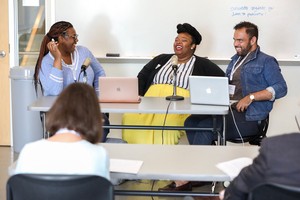
At the close of summer and on the eve of fall, multidisciplinary thinkers and doers Najee Omar, Tatiana Morin, and Diana McClure tended to a conversation on soil, ecosystems, gentrification, and healing. Highlighting the Community Heroes project, stewarded by the Fort Greene Park Conservancy in Brooklyn, and the Urban Soils Institute’s work on Governors Island in New York Harbor, the trio dug into the details and philosophical possibilities of public art in New York City’s green spaces.
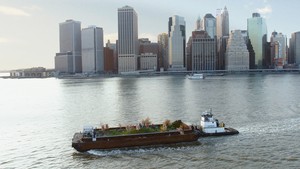
Mary Mattingly’s Swale barge, 2017, New York. Photo: courtesy Mary Mattingly and Cloudfactory
Mary Mattingly’s Swale barge, 2017, New York. Photo: courtesy Mary Mattingly and Cloudfactory
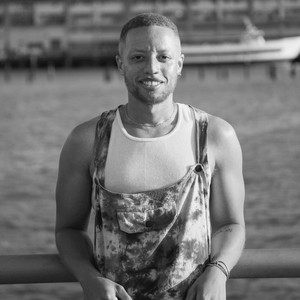
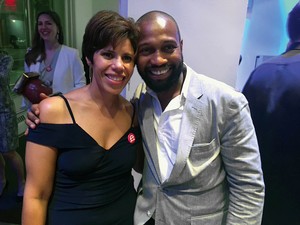
Diana McClure is a multidisciplinary artist and writer based in Brooklyn. She holds degrees in history from Columbia University and in sociology from the New School for Social Research, where she first incorporated photography into a text-and-image-based practice.
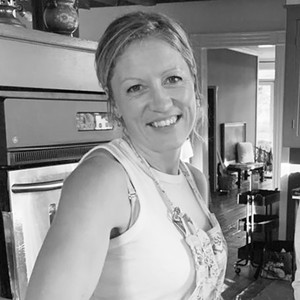
Having earned a BSc in geology from the University of Western Ontario, Tatiana Morin moved to hydrogeology and then rooted herself in soils, in which she has an MS from Southern Federal University, Rostov, Russia.
Diana McClureI was interested in bringing the two of you together because I admire your spirits. You bring a level of joy and delight to what you do, and a holistic view that I really appreciate. It seems to be rooted in your souls, and to be the space from which you take action.
I want to ground our conversation by having you both share a bit about your involvement in socially engaged public art and public green space through Community Heroes and the Urban Soils Institute residency on Governors Island. Najee, I’m going to start with you. How did you first get involved with Community Heroes and how has your involvement changed over time?
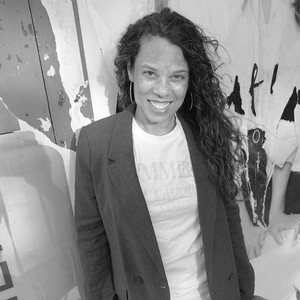
Najee OmarI’m a writer, an organizer, and an educator. My personal practice in writing exists between plays and poetry. I often like to tell stories that are rooted in exploring Black manhood and masculinity, specifically at the intersections of Blackness and queerness through the lens of tenderness. And I’m interested in telling stories that speak to a sense of home.
I work with groups of young people, from kindergarten through seniors, and my goal is to create intergenerational bridges where communities can talk, investigate home, and have agency over their own stories. That’s where my organizing practice comes into play, because I’m a Brooklyn native, a Fort Greene native, and I’m constantly looking for spaces in which to be deeply rooted in my community. And one of the best ways to do that is through activating public space, right? I’ve worked with many Brooklyn organizations—the Weeksville Heritage Center, 651 Arts, BRIC Arts Media, the Brooklyn Academy of Music. A lot of the work asks, How do I get these big institutions to pull people together and give the power back to the people who patronize their spaces, becoming not only advocates but change agents in their own communities? This is what led to my work with Community Heroes and the Fort Greene Park Conservancy.
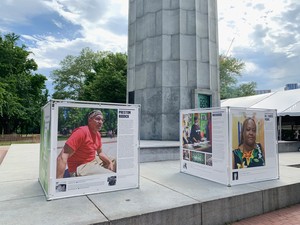
I started as an honoree of the Community Heroes program, which identifies folks in the Fort Greene area who have done transformative work in the community and celebrates them by installing a huge banner with a photographic portrait and biography of them in a public space, making sure that folks in the neighborhood are seeing their everyday heroes. From there I joined the Community Heroes Circle, an advisory board that helps structure the program’s annual celebration of heroes. And this past year I became a board member on the Conservancy’s programming committee, where I’m advising and helping to make sure that the Conservancy is accountable to the community through programming that’s reflective of the neighborhood. This is because I have an affinity for the long-term residents of Fort Greene, especially as it’s become a hotbed of gentrification.
DMTatiana, I’ve heard you speak about soil as the one thing that all beings share on planet Earth. Can you talk about when and why you decided to start the Urban Soils Institute [USI], and especially the USI residency on Governors Island?
Tatiana MorinIn school I fell deeply in love with geology, and Erin Brockovich was a big hero of mine. I thought I wanted to go into forensic hydrogeology and resource management. I got interested in seeing how the heart and bones and flesh of the earth worked: where we came from, why it’s there, and how it exists. I spent a lot of my childhood camping and living outside and engaging in nature; it runs through my veins, thanks to my parents—they brought us up on a very low budget, so going outside was our vacation.
From a very amateur and childish perspective, I wanted to heal the scars of the earth, because they affected people. The idea that you could heal people of those effects started to make sense to me—figuring out what was causing water pollution, for example, and then figuring out how to stop it. I started to work for New York City’s Soil & Water Conservation District [SWCD], where we often acted as the liaison between communities and city agencies working on long-term control plans, overflows, swimmable and fishable waterways, wastewater treatment plants, and pollution overloads. Here, also, the first urban soil survey was conducted by the US Department of Agriculture [USDA] Natural Resources Conservation Service, soil scientists who partnered with the SWCD and dug soil pits to characterize the soils “hidden” in and under the urban landscape. I was lucky enough to tag along on a few soil-pit digs and learn soils through the lens of soil taxonomy, translating the soil layers into the story of their development and history, which influence the soils we see at the surface. When the city started implementing PlaNYC—its sustainability plan to address the city’s stormwater runoff, infrastructure, and so on—and LEED [the Leadership in Energy and Environmental Design rating system] came into play, the issue became that engineers and practitioners needed soil information and resources but didn’t know what to ask for or where to get it.
By working in water and working in geology, I finally got to soils, and I realized: This is the skin of Earth. This is that interactive bed. This is our closest thing to the parent rock that is our Earth, which gives us life and into which we return. So that’s where the reciprocity comes between us and Mother Nature. I realized that people’s relationship with soils takes many forms: It can be interaction with the actual material of soil, or it can be philosophical. It can be spiritual. It can be through language, it can be through art, it can be through the economy.
Some cultures have many different words for soils, some cultures have few. In the past we were taught in elementary school about the common resources of air, water, and soil; we’ve lost that understanding and connection—the fact that our common resources are common to all people and are the raw elements of community, that it’s through these common resources that we care for one another. We care to keep these resources clean, we care to keep them abundant, and we care about their health and survival, because our own health and survival depend on them. Now, suddenly, it’s all dictated who gets clean water, who gets clean air, who gets clean soil. But I think when you build a community and build that connection to our common denominator, which is soil, you end up with a healthy community in all senses of the word, inside and out. So, in 2016, we created the Urban Soils Institute.
DMAnd did the Governors Island residency start then as well?
TMFirst we created a home, as you’re saying, Najee. I love that word because that’s what I find: Soil is the home. Everybody belongs there, because you can talk to any discipline, any walk of life, through soils.
From the start of USI we were also very much on the ground, going to people’s gardens, going to farmers markets, being wherever people needed us to be, to create resources or assistance or to act as a communication conduit for them to access soils. Our first symposium, in 2016, engaged people from all different disciplines, sectors, city agencies, sister agencies, to talk to one another for the first time. Our format had artists, economists, community scientists, professional scientists, industry folk, government folk, all together to share and discuss on a level playing field with no one as the expert, because everybody had an experience or story to tell. Everybody loved it right away. People treated it as if it had already existed for a long time, because we were filling a niche of creating a platform for interacting with soils. This was also the beginning of bringing art and soils together: We made it part of our mission to create a matchmaking program for soil scientists and artists to collaborate and support one another. We realized we needed to show people that science and soils and art can speak the same language. It helps translate to a wider audience, and it starts to spread the lens out like a kaleidoscope.
At the second symposium I met Margaret Boozer, who runs the Red Dirt Studio, a warehouse studio and incubator space for artists and creatives in Maryland. I got to hang out with them down there, talking to their artists and figuring out how we could bring artists to soils and scientists to art. I found that many artists were probing these amazing research questions about soils in their work, and they wanted some scientific input in their processes and understandings. Then there were many scientists who needed to reach the public, or get feedback, but they didn’t know how to communicate their science to the general public, so it became a really good match.
That’s how our initial artist-in-residence program was seeded. Then we met with the artist Mary Mattingly, who was interested in food and water and already had Swale House advocating for those concerns on Governors Island. It was a no-brainer: We joined forces with her in 2017. To this day we have a lot of interest from artists. Usually an artist asks a question and we find a soil scientist who can answer that question. Then they start to collaborate.
DMI’m interested in parks and other green spaces as public luxuries and sites of democratic intersection, places where humans and natural ecosystems intermingle and cross-pollinate, particularly in New York, where you’ll find people from all walks of life sharing park space. Whether it’s for mental health, physical wellness, socializing, engaging with public art, or communing with nature, all of these things can happen in a park. That’s why I’m interested in investing in them as public luxuries. Najee, what impact do you think Community Heroes has had on both Fort Greene Park and the neighborhood? How do conversations around gentrification and belonging relate to this type of democratic space?
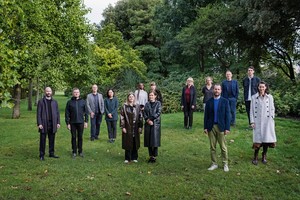
Fort Greene Community Heroes, 2019, annual exhibition in Fort Greene Park, Brooklyn, cofounded by Jasmin Chang and Zac Martin in collaboration with Fort Greene Park Conservancy, Friends of Commodore Barry Park, and Photoville. Photo: courtesy Community Heroes
NOThat’s a great question. Having heroes from your community on display in a public space like Fort Greene Park requires a conversation about the barriers of Fort Greene Park. On one side you have what’s become an affluent part of Fort Greene, which looked completely different demographically thirty years ago. Then on the other end of Fort Greene Park you have New York City public housing. The wealth disparity is significant so there’s a huge divide in the park. The beautiful thing about a program like Community Heroes and its honoring ceremony is that it creates this beautiful bridge for people all over the community to come together. Through their banners, these figures have a presence in the park for months. It’s a great way to acknowledge the history of Brooklyn and specifically the history of the neighborhood.
One of the things you talked about, Tatiana, was the power of healing. That’s a big part of my own practice and what I think Community Heroes offers when you have it in a place like the park. These are folks who are doing really, really heavy work—folks who have worked with communities dealing with abuse or addiction, educators who have given their blood, sweat, and tears to make sure generations of students can be literate, be leaders, et cetera. A lot of the time these heroes are doing their work in silos. Putting them on public display in this way lets them know that the work they’re doing is not in vain and they are not alone. They get a chance to meet other heroes, and folks who are just passing by, whether they’re young people or seniors, get a chance to be introduced to them. And in a place like New York, where so much around us is hustle and bustle and concrete, for us to be called to a space that invites us to slow down, to take in fresh air, to act, to actually breathe, to actually be still, to see and hear one another, creates a kind of healing that’s particular to this program in this space.
TMYes, and when you said parks are a public luxury, Diana, it made me think of soils in relation to the concept of time. In our lifestyles, time is really the thief of life, but in a space like a park, time kind of gets reinvited into life. Nature has its own time that it subscribes to, and no matter how much the world is rushing around it, it keeps its own pace and gets everything done that needs to get done. When you can align your heartbeat with that space and time, you can slow down too. And what you’re saying, Najee, is so valuable: When you put the right ingredients out there, you’re not dictating that relationship or that healing. It happens on its own, whether it’s subconscious or conscious. It allows people to grow something inside themselves.
DMYes. And Tatiana, I wanted to ask you a similar question about what’s currently going on for USI on Governors Island. Through the People’s Garden there you’re deepening collaboration with others on the island within the context of public green space.
TMWe will launch the People’s Symbiosis Garden, funded by the USDA, in the fall of 2025. The People’s Symbiosis Garden is a complement to the artist-residency program in our house on Governors Island. The idea is for it to be a living lab to rehabilitate soils and reintegrate native ecosystems into our urban fabric, as a way to show that gardens can be ecosystems, can improve our natural resources, and can also feed us. Through different programs and research initiatives we will help people to realize that we are integral parts of our own ecosystem. It will be at three sites: the Institute for Public Architecture house, the Earth Matter Farm, and Mary Mattingly’s Swale barge. It’s still difficult to gain ground in the city and to have access to food sovereignty—equitable access to health and nutrition—through growing your own food, or foraging in parks in areas that aren’t contaminated. So what we’re trying to do is create different styles of garden that will allow people to adapt them for whatever scenario they have. So it becomes a modular, adaptable lab.
Another part of the idea is that it doesn’t have to live in one place, that there should be a connected network of people’s gardens, or ecosystems, across the city and along the Hudson, to show that even if our gardens are silos, and they’re each surviving on their own, that’s not how ecosystems work; they need to be connected. And if we can’t connect them geographically because they’re separated by concrete, then the vectors become us ourselves—through social programs, relationship building, whatever it takes, so that we understand that no matter what, we connect these ecosystems together.
DMI’m drawn to both Community Heroes’ vision for Fort Greene and its park and USI’s vision on Governors Island and beyond as hubs that contribute to local urban ecosystems, as alternatives to silos of self-interest and individual aspiration. What are your thoughts on learning to work with people to address a social issue through the lens of art, and on the value of applying this interconnected framework modeled in nature to society at large?
TMI think soils break down silos. Everything in soils is interconnected. You gain independence through interdependence. There’s such an intricate fabric of interconnectedness in soils, but also in the life that they support above them. You have so much biodiversity, and the healthiest ecosystems are the ones that are very biodiverse; that’s where the strengths are. So it would make sense if we, as part of the ecosystem as people, emulate that network of diversity in all our ways of being. It only makes sense for us to imitate it through our art practices, our science practices, our legal practices, or whatever discipline it is.
NOWhat rang in my ears when Tatiana was speaking was the idea of connecting the ecosystem. I’m a very visual person, so I’m thinking about all of these separate gardens, and picturing, What is the fabric that connects us? I love that you mentioned: It’s the public programming, it’s the people. When I think about Community Heroes, I’m thinking about the ecosystem that we create through this program. I’m thinking about how it connects folks across race. Fort Greene is one of the most diverse neighborhoods in Brooklyn, and we take a moment to honor heroes who come from very different backgrounds. That allows us to challenge a bias, to challenge a stereotype, showcasing the full humanity and contributions specifically of people of color and, I mentioned this before, across generations: The special thing that Community Heroes does is introduce the legacies of our elders to younger generations. We create opportunities for young writers and photographers to interview our heroes, building intergenerational bridges in order to have conversations about history, responsibility, or legacy.
DMYes, and I see the intergenerational work of USI through the professors and geologists and different people teaching young people, or someone like myself who otherwise wouldn’t have access. I also think about Governors Island as a neighborhood, in a way: The old houses have now become public homes for art and exploration. I’m so grateful you both took the time to bring your voices together to seed such a fruitful conversation.
Diana McClure is a multidisciplinary artist and writer based in Brooklyn. She holds degrees in history from Columbia University and in sociology from the New School for Social Research, where she first incorporated photography into a text-and-image-based practice.
Having earned a BSc in geology from the University of Western Ontario, Tatiana Morin moved to hydrogeology and then rooted herself in soils, in which she has an MS from Southern Federal University, Rostov, Russia.