Now available
Gagosian Quarterly Summer 2023
The Summer 2023 issue of Gagosian Quarterly is now available, featuring Richard Avedon’s Marilyn Monroe, actor, New York, May 6, 1957 on its cover.
September 26, 2024
Fondation Louis Vuitton is staging Pop Forever, Tom Wesselmann &…, which explores the artist’s legacy through a comprehensive survey of his artworks presented alongside those by thirty-five artists of different generations and nationalities, from the 1920s to the present day. Also, the Estate of Tom Wesselmann, Gagosian, and Almine Rech are releasing a forthcoming monograph dedicated to the artist’s formative series, The Great American Nude. Here, the book’s editor and lead author Susan Davidson meets with Jeffrey Sturges, director of exhibitions for the Estate of Tom Wesselmann, and Gagosian director Jason Ysenburg to discuss the importance of this series.
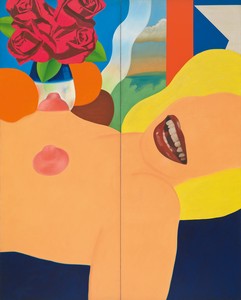
Tom Wesselmann, Great American Nude #53, 1964, oil and printed reproductions on canvas, in 2 parts, overall: 120 × 96 inches (304.8 × 243.8 cm)
Tom Wesselmann, Great American Nude #53, 1964, oil and printed reproductions on canvas, in 2 parts, overall: 120 × 96 inches (304.8 × 243.8 cm)
Jason YsenburgWhat was happening in the world when Wesselmann first initiated the Great American Nude series? Is there anything about the moment in history that connects to the origin of these works?
Jeffrey SturgesThere was an important cultural shift that took place in the 1960s. Wesselmann was born in 1931, a child of the Depression, in a middle-class family from the suburbs of Cincinnati. He was a young adult in the era of the very conservative 1950s. The 1960s benefited from new ways of thinking about society and sexuality in particular. The contraceptive pill became available, new psychological research advocated for a more frank and open discussion of sexuality, and censorship was being challenged.
Susan DavidsonYes, he very much was a product of the postwar boom in America and the freedom of expression that occurred among artists of the earlier generation, namely the Abstract Expressionists. He is one of the defining members of the Pop generation, who were looking to consumerism for inspiration. But in Wesselmann’s case, he looked more toward the tenets of art history to establish his subject matter, which is why we’re here today, to discuss his Great American Nudes.
JYHe focused on the nude in relationship to these social ideas that were being discussed at the time. There was a real openness to things that hadn’t been discussed before and it does seem like these paintings were a way of exploring this new-found optimism, openness, and acceptance.
SDTrue, and it was also a personal expression for him that represented freedom and maturity about his own sexuality.
JSHe goes through a big life change at this moment. After arriving in New York, his first marriage to his college sweetheart ends in divorce. But at Cooper Union, he meets Claire [Wesselmann, née Selley], a fellow student at Cooper Union and begins a new relationship that inspires this series—informed by these new ideas of acceptance and exploration in the culture at large—
SDAnd to be able to record it in his art was really important for him.
JSIt seems like a tribute to this relationship.
SDAbsolutely. And that continues to be important as the series advances because even though the work (and its motivation) is very personal, there was an anonymity to how he depicted the nude. This is a critical point about the works in general: they’re not depictions of an individual even though they have been inspired by an individual.
JYHow does the series evolve over the decade?
SDIt’s not a full decade. He starts in 1961, and by 1969 they’re pretty much finished. After a brief hiatus he creates Great American Nude #100 [1970–73], as almost a mission to complete the series. In any case, by 1965 there is a visual shift in how the works look. They’re no longer collaged; instead, they become slicker and more painterly.
JYWhy make a book focused exclusively on this one series? And what does it demonstrate about Wesselmann as a painter?
JSBy looking so closely at this one series, we learn about the origins of what will come to define the rest of his career. All of the elements that are so much a part of those first paintings then become expanded or elaborated on in the following decades, in all of the series that come afterward.
SDFor me that was challenging. Because when I began, I thought, “Oh, I’m just going to look at one hundred paintings executed sequentially.” But in fact, I had to take so many detours to examine how Wesselmann was developing as an artist. As other series come forward, you can start to see him cropping out particular aspects of the Great American Nude and placing various elements in, say, the Mouth or Smoker paintings.
JYCould you discuss a few of the pivotal works in this series?
SDWell, there are pivotal works and then there are favorites.
JYYou can tell me your favorites and they become pivotal because of your argument.
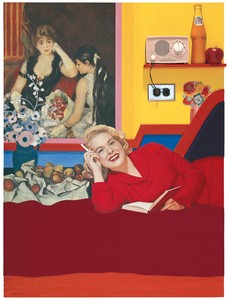
Tom Wesselmann, Great American Nude #50, 1963, paint, printed reproductions, fabric, working radio and plastic bottle and fruit on wooden shelf, with electrical outlet on board, 48 × 36 × 3 inches (121.9 × 91.4 × 7.6 cm)
SDGreat American Nude #50 [1963] is certainly one of them. For one thing, it’s the halfway point, but there are other formal and stylistic changes. She’s not a nude, which I think is interesting, that at the halfway point he chooses to represent a clothed woman. She is a printed reproduction so it’s not as if he’s painted her, but she’s so perfectly Doris Day–like in a way, reading her book and smoking.
JYYes, and the radio’s there and there’s a drink, there are the symbols that will then appear more predominantly in other series.
SDAnd it’s interesting, too, because the cigarette becomes very prominent much later in the series, as well as in other bodies of work, and that very much is a sexual reference, even if this Great American Nude isn’t actually nude.
JYWhat contribution did Wesselmann make to the study of the nude in art and how did he transform it?
SDHe modernizes the subject.
JYWhile utilizing historical references—like Great American Nude #50, with the Renoir painting in the background. He is putting this modern woman in an art-historical context.
SDHe’s putting himself in that history, too, and paying homage to it, whether it’s Matisse’s The Romanian Blouse [1940], Modigliani, Renoir, or any number of other art historical paintings that he places by way of collage into the background. They’re like witnesses invited into the studio.
JSHe’s very self-aware, and I think he’s placing these other paintings in his own work as a test, also. His painting has to stand up to this historical work. He’s saying to himself, “Am I this good?” And at the same time, he’s saying, “I am this good. I am at this level.”
JY“I’m in that same context.”
JSExactly. “I am in this continuum and I’m taking my place in the line.”
JYJeffrey, do you have other favorites?
JSI think Great American Nude #1 [1961] is a pivotal work. It’s the moment where he shifts the scale of his works from something that’s four or five inches that he’s painting or making as a collage on his lap to something that’s on the wall. And he’s really declaring, “This is a great American nude. This is a painting of the scale and the level of the art historical paintings that I want to measure myself against.”
Another important work for me is Great American Nude #48 [1963], which I think is the pinnacle of his collage work because he’s not only including pictures of objects, but he’s including real objects and real space. This is a work that has a rug on the floor in front of the painting with objects on the rug. So as a viewer, you’re almost, but not quite, included into the pictorial space because there’s the implication that you could walk on the rug, if only he let you.
SDThese assemblage examples, of which there aren’t too many, are particularly strong and indicative of what was happening in 1963 to ’64, when Wesselmann starts to make them. They create the domestic environment for the nude to occupy. As I reached the end of the series in writing about them, I realized how he was moving the nude into different settings, almost to where she appears outdoors, like with Great American Nude #83 [1966].
JSOne of the things that these works also bring up is the whole notion of reality, because you have a real table, but underneath the real table there is a rectangular box with a radio that’s drawn on it. And even the window—it’s a real windowsill, but the view out the window is a printed reproduction. As a viewer, you’re trying to negotiate what’s real in this picture, you’re destabilized, and I think it does make you start to question what’s being depicted. It brings this series to an important point about what’s being depicted: What is the great American nude? Is it real? Is it an illusion? I think all those questions start to sharpen in focus in a work like this.
JYLet’s discuss the making of the monograph. Jeffrey, Susan, how did this all begin?
JSWe were very fortunate to work with Susan on other projects before and during research on the Great American Nude series. Susan and I worked together on an exhibition of Wesselmann’s last group of paintings, which date from 2002 to 2004. Since then, we have discussed how Wesselmann was inspired by Matisse and the numerous paintings in his career that reference the elder artist in form, palette, or image. This lifelong engagement with the works of Matisse began with the 1959 pastiche, After Matisse, and continued to his final Sunset Nude paintings.
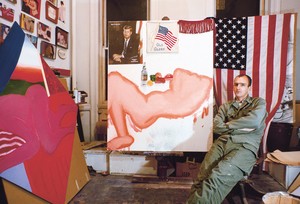
Tom Wesselmann in his studio at 175 Bleecker Street, New York, showing, from left: Great American Nude #17 (1961) and Great American Nude #21 (1961; in progress)
SDI’ve been interested in Wesselmann’s artwork for a long time. When I was a museum curator, I wanted the 2012 retrospective [Beyond Pop: A Tom Wesselmann Retrospective, organized by the Montreal Museum of Fine Arts in collaboration with the Estate of Tom Wesselmann] to come to the institution I worked for, but that wasn’t possible. To be honest, I was completely shocked when the artist’s estate proposed writing this book. I naively said, “Oh sure, why not?” I didn’t fully understand what the very deep dive into these one hundred paintings would entail. I benefited, in a sense, from the pandemic lockdowns, because that quiet time allowed me to study the group as a whole. When I started writing, I organized the text by year, which helped me handle the complexities of the series. I think the challenge was that there were several other bodies of work that needed to be woven into the story before I could think through the series properly. I benefited immensely from coming to the studio and talking with Jeffrey and everyone there about Tom’s process and exploration of different themes, and I hope that we have been able to capture that.
JSWesselmann made these works in the 1960s, in a very different cultural context compared to ours today. In his own time, Wesselmann felt the need to address both the historical tradition of the painted nude and his own understanding of what that image meant to him. We felt it was important to acknowledge this complexity by asking a writer to address these issues with the hindsight we have today. Rachel Middleman is well-versed in the discussions of gender that concerned artists in the 1960s, as well as the history of women artists who exhibited alongside Wesselmann in important early Pop exhibitions. She was able to provide an important context for understanding Wesselmann’s work outside of the familiar accounts of the history of Pop art.
Lauren Mahony prepared a chronology focused on this first decade of Wesselmann’s career, highlighting important exhibitions and events crucial to the development of Pop art. Having already published a chronology focused on the Standing Still Life paintings, Lauren was well-prepared to present the birth of Wesselmann’s career, adding to her previous research with the goal of a completed chronology that covers the development of the Great American Nudes, from 1958 to 1973.
JYSpeaking of, a few years ago research began in the preparation for a Tom Wesselmann catalogue raisonné. Did that effort help with the research for this book?
JSIn 2020, the WPI [Wildenstein Plattner Institute] announced their Tom Wesselmann digital catalogue raisonné. This would be a new approach to catalogue raisonné research and presentation. Prior to the announcement, the estate shared the artist’s records as the basis for this catalogue raisonné. Wesselmann was a meticulous recordkeeper with a systematic approach to the titling and recording of his artworks. Every painting, study, and drawing was given a unique registration number with a description of its size, date, and media, as well as exhibitions and sales. With this wealth of information recorded by the artist in real time, the WPI was given a very reliable foundation for their research so that they could focus on filling in those missing details of provenance and exhibition history—to describe the life of the artwork after it left the studio. It also allowed them to publish an exhaustive listing of the artworks Wesselmann produced in his forty-five-year career not long after this announcement. The Great American Nude monograph and the catalogue raisonné have been developing side by side, but each with a very different focus. The catalogue raisonné project covers the entire career while the Great American Nude monograph is an exhaustive recounting of the history of Tom’s first and most celebrated series. For the estate, the catalogue raisonné project gave a context for such a close examination of a single series. While studying this first series, we could make associations to works that were made decades later and understand the development of Wesselmann’s career. Susan’s elaborate recounting of the beginning of Tom’s career, the circumstances and choices that brought Tom to New York and to painting, help us understand the motivations that pushed him to create this unique series of paintings. There was some urgency in embarking on these projects now. As time passes, we lose access to the direct sources that give us an accurate picture of this time. The oral history project at the Wildenstein Plattner Institute, for example, includes interviews with people who knew Tom during those early years. These firsthand accounts help us understand what these paintings may have meant at the time he made them. The WPI project shows the full breadth of the career. On their website, a scholar can click through an entire series and see how it develops.
SDIt was very useful to have the digital corpus online. I could be anywhere in the world and check and confirm data.
JYWhat do you hope readers will take away from this book? What’s the before-and-after situation?
SDThe before is not knowing and the after is, “My god, what a fantastic artist.” [laughter]
JSThat’s high praise coming from you, Susan, especially with your understanding of the decade that precedes Tom’s work. I mean, I’ve learned so much working on the book with you and alongside the catalogue raisonné project. And I think you do see how intelligent an artist he really was.
Artwork © The Estate of Tom Wesselmann/Licensed by ARS/VAGA, New York
Pop Forever, Tom Wesselmann &. . . , Fondation Louis Vuitton, Paris, October 17, 2024–February 24, 2025

Curator and art historian Susan Davidson is an authority in the fields of Surrealism, Abstract Expressionism, and Pop Art with a specialty in the art of Robert Rauschenberg. Davidson is also an accomplished museum professional with over thirty-year’s experience at two distinguished institutions: The Menil Collection, Houston, and the Solomon R. Guggenheim Museum, New York.

Jeffrey Sturges is the current director of exhibitions for the estate of Tom Wesselmann. He was hired by Wesselmann in 1989 as a studio assistant. He has worked for the Wesselmann family since the artist’s death, in 2004. He was instrumental in overseeing the artist’s first major North American retrospective exhibition tour.
Jason Ysenburg joined Gagosian in 2014. He is the gallery’s liaison for the Helen Frankenthaler Foundation and the Estate of Tom Wesselmann and has worked on numerous exhibitions for the Richard Avedon and Andy Warhol foundations.
The Summer 2023 issue of Gagosian Quarterly is now available, featuring Richard Avedon’s Marilyn Monroe, actor, New York, May 6, 1957 on its cover.
Susan Davidson, editor of the forthcoming monograph on the Great American Nudes, a series of works by Tom Wesselmann, explores the artist’s early experiments with collage, tracing their development from humble beginnings to the iconic series of paintings.
On the occasion of the exhibition Tom Wesselmann: Intimate Spaces at Gagosian, Beverly Hills, Susan Davidson sat down with Jeffrey Sturges to discuss the artist’s key works in his Great American Nudes (1961–73) and subsequent series.
Michael Craig-Martin and Jeffrey Sturges in conversation on Tom Wessselmann’s Standing Still Lifes.
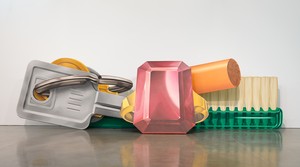
Tom Wesselmann: Standing Still Lifes closes this week at Gagosian New York. In this text, Richard Phillips speaks with Jason Ysenburg about the impact of the exhibition. A video about the exhibition and the artist’s studio practice accompanies the text.
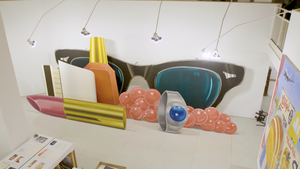
Join us for a look at Tom Wesselmann’s New York studio in this behind-the-scenes video. Featuring archival footage of Wesselmann at work, as well as new interviews with his family, studio team, and friends, the film documents the creative process behind his large-scale works, from early still lifes to later abstractions.
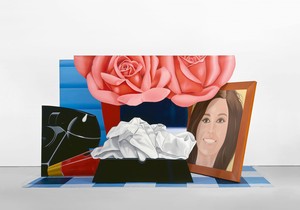
The story behind Tom Wesselmann’s Still Life #59 (1972). Text by Lauren Mahony.
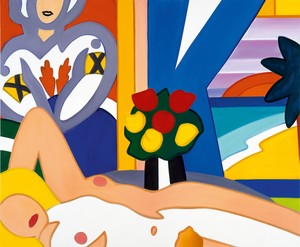
Modern master Henri Matisse was a touchstone for American Pop artist Tom Wesselmann throughout his career.
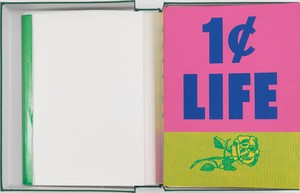
A 1964 publication by the Chinese-American artist and poet Walasse Ting and Abstract Expressionist painter Sam Francis.
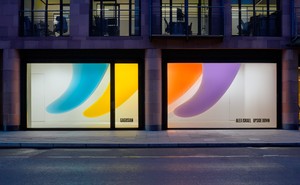
Ahead of Alex Israel’s exhibition of four new Fin sculptures at Gagosian, London, the artist spoke with Susan Casey, author of The Wave: In Pursuit of the Rogues, Freaks, and Giants of the Ocean (2010), about the ocean, surfing, and Los Angeles.

On April 16, the Institute of Contemporary Art, Boston, opened the first midcareer survey of Derrick Adams’s multidisciplinary practice. Covering over twenty years of work, the exhibition, titled View Master, brings together the artist’s painting, sculpture, collage, performance, and video, as well as a vibrant new commission created for the museum’s façade. Ahead of the opening, Adams met with Tessa Bachi Haas, cocurator of the survey, to discuss his formative experiences with television, the impact of his work in arts education on his practice, and the importance of taking a more complex, more joyful, and more expansive approach to Black American life and culture.

Jeff Koons tells Alison McDonald about his appreciation for the pioneering artist and thinker Marcel Duchamp.