Dylan has been either in my life or close to it for most of my adult years.
—Richard Prince, “There Goes My Hero,” 2011
Elusive. Prolific. Singular. There are perhaps no better conceptual interlocutors than Bob Dylan and Richard Prince, undeniable luminaries in their respective fields of music and art. Both are artists in the truest sense of the word, having created multiple bodies of genre-defying work that have redefined the parameters of what art can be and even do.
With forays into each other’s creative domains, Dylan and Prince share a renegade sensibility that flouts conventions and plays with expectations. Prince has maintained a long-standing interest in music, collaborating with bands such as Sonic Youth, using music paraphernalia such as vinyl records as material, and briefly playing in a group with Glenn Branca in the early 1980s, while Dylan has exhibited representational paintings and metal sculptures. Richard Hell articulated other contiguities between the pair in a 2018 article for Gagosian Quarterly: “As an artist, Richard lies and steals in a casual unconcerned way that’s also strategic and a statement about his doubts about himself, reality, and who owns what, not to mention history. This is all on the record. He’s like Bob Dylan in that way.”1
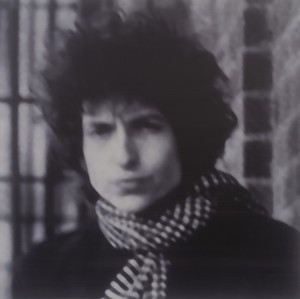
In the three-part Untitled (Dylan) (2014), Prince turns directly to Dylan for inspiration, monumentalizing an already iconic image: the famously blurred photograph of the musician that appears on the cover of his 1966 album Blonde on Blonde. Under Prince’s hand, the picture undergoes a series of important changes: its composition is cropped, converted to grayscale, and enlarged to an impressive ten-by-ten-foot size while maintaining its square album-sleeve format. Prince inkjet-printed the image across three canvases to make a single tripartite work. While the canvases are identical in content and size, they differ notably in their varying degrees of resolution.
Untitled (Dylan) engages with the concept behind Prince’s signature technique of rephotography, which he initiated in 1977. Beginning with high-end furniture advertisements circulated in the New York Times Magazine, Prince started using his camera to take his own photographs from these published pictures, strategically cropping and framing his compositions to remove any textual reference to the commercial domain from which the images were sourced. This process of rephotographing existing imagery revolutionized many of the established ideas around artistic authorship, appropriation, and originality, creating implications that still reverberate in art today.
Untitled (Dylan) expands the process of rephotography into new avenues of Prince’s practice using digital technologies. Here, he isolates Dylan’s portrait, excising the text-based album-cover details—the record-company logo and label “stereo” in the upper left—to create an entirely visual picture. Decontextualized from its commercial function of publicizing Dylan’s record, and presented as a sequence of images rendered at successively lower resolutions, the resulting picture has a captivating familiarity yet remains distanced from the viewer—a paradox that captures the seductive mechanism of celebrity.
The three repetitions of the musician’s image, coupled with Prince’s intensification of the blurred effect of the original cover, communicates the way a person’s public image can be ubiquitous but still inscrutable, as seen through the lens of fame. Certainly Prince’s use of a famous subject like Dylan recalls Andy Warhol’s photo-based silk-screened portraits of celebrities, for instance. Yet while Warhol’s painted portraits often speak to a preoccupation with mainstream celebrity and the cult of personality, Prince’s interests tend to focus on subcultural subjects or the reception of fame—fandom, collecting culture, and alternative circulations of media. This is exemplified by his Untitled (Publicity) pictures (1997–2013/2018), in which Prince frames eight-by-ten-inch celebrity headshots or publicity stills, often apocryphally signed to the artist himself. Notably, it was this particular series that inspired the first meeting between Prince and Dylan, which occurred on the musician’s tour bus in a New Jersey parking lot. According to Prince, the pair convened at the request of Dylan, who explained that he had seen some of the Publicity works and “wanted to know what they were about.”2 This initial meeting reportedly led to an ongoing dialogue between the pair, involving multiple studio visits over subsequent years. Despite the almost fantastic circumstances of their first encounter, the continued relationship makes sense. The mythology around Dylan’s revered but often mysterious persona speaks directly to Prince’s fascination with the reception of celebrity as it materializes in visual culture.
The original Blonde on Blonde photograph of Dylan, wearing a suede jacket and checkered scarf, was taken by the photographer and later film director Jerry Schatzberg during a photo shoot in downtown Manhattan in 1966. When Schatzberg presented Dylan with different options for the album cover, he accidentally included one shot in which the musician was out of focus, a result of the photographer’s trembling hand due to the brisk New York weather. Much against the photographer’s protests, Dylan immediately chose that image as his favorite and the rest is music history. This era of Dylan’s career had a resounding impact on Prince, who has accumulated a substantial collection of Dylan memorabilia and has even made artworks based on these kinds of materials. As he recounted in 2011, “I loved Blonde on Blonde, and really loved the out-of-focus photo of Dylan on the cover with all his new hair. ‘Crimson flames tied through my ears / Rollin’ high and mighty traps.’”3
The mystique around Dylan’s public image also appeals to Prince’s interest in the slippage between truth and fiction. The artist has described how the sense of agreement seen in his rephotographs of repeated advertising conventions or tropes creates a certain reality.4 By reproducing an image of the legendary singer-songwriter in Untitled (Dylan) that disperses the viewer’s attention across three canvases, Prince plays into Dylan’s notorious evasiveness. (The musician’s refusal to attend his own award reception for the 2016 Nobel Prize in Literature comes to mind.) Meanwhile the alterations to the original image in terms of cropping, decoloring, and blurring also undermine the audience’s recollection of the album cover, with Prince’s three-part presentation perhaps redefining, or at least destabilizing, how the picture of Dylan is remembered.
Prince first exhibited one of the three Untitled (Dylan) canvases in his solo exhibition It’s a Free Concert at the Kunsthaus Bregenz in 2014, a show centering on themes of music fandom and concert culture. Some of the works, such as large-format images of Jimi Hendrix, 1950s doo-wop groups, and raging concert audiences, explicitly communicated the focus on music; the idea was expressed more obliquely in the artist’s Band Paintings, works constructed from rubber bands, as well as a suite of pornographic photographs “censored” through the use of stickers from musical CD and DVD packaging. In a television interview on the occasion of the exhibition, Prince explained the reasoning for his choice of subject and his affection for Blonde on Blonde:
The Dylan photograph is simple. I like the album cover Blonde on Blonde, I grew up with it. I’ve looked at that album cover for maybe forty, fifty years of my life! I know it, and it was always curious to me because it was out of focus. And I was always wondering . . . of all the images to portray himself, why did he pick an image that is out of focus? So what I simply did, I took the image and I made it more out of focus. I thought that’s cool . . . it’s a way to continue, or contribute to the image.5
Continuation and contribution—both are achieved in Untitled (Dylan), a work that is as much an homage to a music legend as it is a sly look at the power and plasticity of images in shaping, and being shaped by, cultural memory.