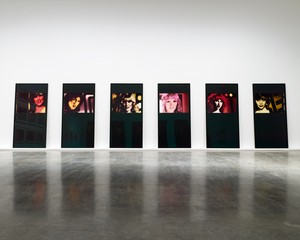
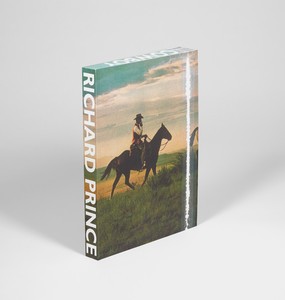
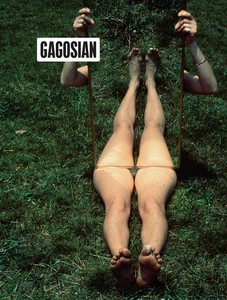
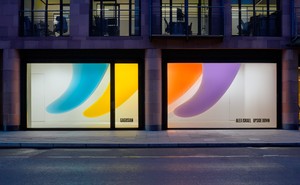
Helter Skelter—an exhibition at Fondazione Prada’s Venetian venue, Ca’ Corner della Regina—marks the first creative dialogue between two visionaries of American art, Arthur Jafa and Richard Prince. The show explores the grit, grift, violence, and ingenuity of American culture through more than fifty works, including photography, video, and large-scale installations that interrogate themes of race, gender, media, and politics. In the interview below, Nancy Spector, the exhibition’s curator, speaks about the shared motifs—from apocalyptic sunsets to a fascination with “monstrosity”—that led her to pair these artists for the first time.
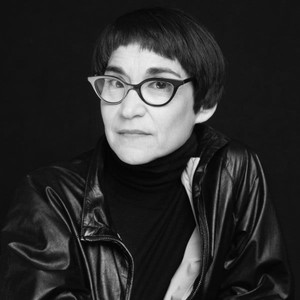
Nancy Spector is a curator, writer, and art historian. She organized Helter Skelter: Arthur Jafa and Richard Prince for the Fondazione Prada, Venice, and Felix Gonzalez-Torres: Sweet Revenge (with cocurator Alejandro Cesarco) for the Reina Sofía, Madrid. She serves as international advisor to the Fondation Louis Vuitton, Paris, and was previously Artistic Director and Chief Curator of the Solomon R. Guggenheim Museum, New York. Photo: Inez & Vinoodh
Wyatt AllgeierNancy, how did you embark on curating this exhibition?
Nancy SpectorI curated Richard Prince’s retrospective at the Guggenheim [in New York, 2007–08], so I’ve been close with him since, and then I did a studio visit with AJ [Arthur Jafa] about three years ago. I’d never met him, and I was in LA, so I invited myself to his studio. It was late on a Saturday and it ended up being this multiple-hour discussion. He’s incredibly generous with his time and ideas. And it was interesting, because in that initial conversation we kept coming back to Richard. He must have known that I’d worked with Richard because I’m not sure what else would have prompted it. I didn’t understand the connection at first, but in 2024 I saw AJ’s video BG [now called BEN GAZARRA] at Gladstone. In that work he recast the secondary characters from [Martin Scorsese’s film] Taxi Driver [1976], like Harvey Keitel, with Black actors, in an act of appropriation that honors the original intent of the film script. It started me thinking about the character played by Jodie Foster in relation to Richard’s photograph Spiritual America [1983], of a young Brooke Shields. There are shared themes of exploitation and pimping, but more importantly both artists uncover the subconscious of an image. They reveal what’s repressed by recontextualizing it. From there, I decided to read their work together, just for myself.
WAWhat were some of the motifs that emerged as you went through their work?
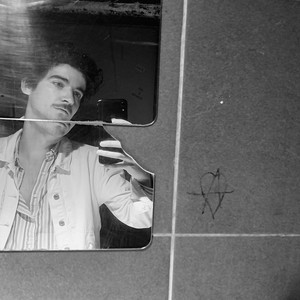
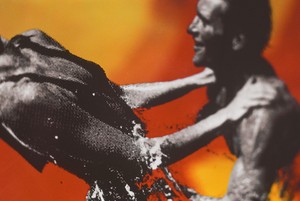
NSIt was uncanny, all the different motifs they share. In AJ’s video Love Is the Message, The Message Is Death [2016], for instance, the burning sun is featured at least five times; it also shows up in his still photography. That made me think of Richard’s Sunsets [1981–82] and their apocalyptic imagery. Then I looked at the self-portraits in which AJ performs for the camera in the guise of Mary Jones, a nineteenth-century transsexual sex worker.
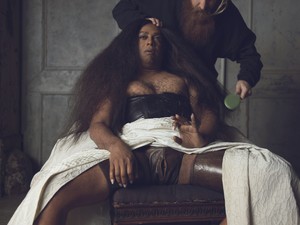
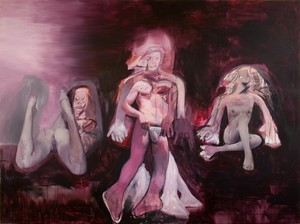
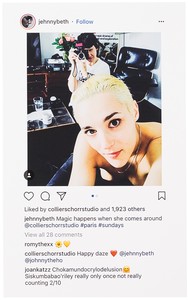
NSThey’re large photographic self-portraits, but in the persona of an actual historical figure. Jones was called the “Man Monster,” which is part of the title of one of the works in that series. I was looking at those alongside Richard’s de Kooning paintings [2006–11], depicting intersex figures. Of course these stem from Richard’s engagement with art history more generally, but there’s so much else going on in that work in terms of nonbinary gender representation, questions about “monstrosity,” and the artist’s self-representation through such signs and symbols. Richard’s always talked about ideas of projection and representation, like the Girlfriend photographs [1987–2012] being multi-directional—wanting a girlfriend, wanting to be a girlfriend. There’s a fluidity in both these series, and more overarchingly in their work. The show evolved from there, encompassing a number of juxtapositions and dialogues across discrete bodies of work.
WAWere AJ and Richard involved in the exhibition from the get-go?
NSNo, I put things together first and then shared with both artists. They both gave their permission for the exhibition to happen and then engaged in an ongoing dialogue with me and with each other. They didn’t know each other at the time. They’d never met, but they have now.
WAIt sounds like it won’t be a chronological exhibition design; you’re working across different bodies of work, different media, different eras. How will the exhibition be organized in the space?
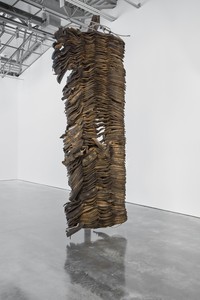
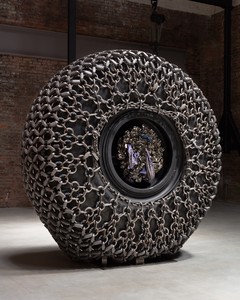
NSThe guiding principle for the installation is to show those moments of intersection where the artists’ shared sensibilities, or shared obsessions, or shared concerns come to light and works begin to speak to one another. The show opens on the ground floor with Richard’s Blasting Mats from the Folk Songs series [2018–] and one of AJ’s Big Wheels [2018], with their references to car culture, the whole “on the road” sensibility.
WAAmericana.
NSYes, as well as intimations of monstrosity. The wheels are literally from monster trucks, which destroy other vehicles in car shows, and the Blasting Mats are forged from materials used to contain explosions, and also strung out across highways as matrices to protect from falling rocks.
WAThe exhibition title is Helter Skelter. Immediately, before we even enter the show, we’re thinking the Manson Family, American violence, American imperialism. Also a particular time, the 1960s and ’70s. How did you come to that title?
NSThe title really came from the artists, well into the process. Yes, of course there’s the Charles Manson reference, which is in both artists’ works: AJ recently exhibited a painting in London of the Sharon Tate crime scene and there’s a Manson reference in one of Richard’s Joke paintings [1987–]. But there’s a broader reference to 1960s LA, the end of ’60s ideology, Joan Didion, the horrific, racist, apocalyptic ideology that Manson was promoting, and of course the Beatles song.
WAManson thought the song was instructing him or something.
NSExactly, but “helter skelter” as a term originates earlier than all of that; it was the name for a British amusement park ride, a tall, spiraling slide. So it refers to a kind of contained, choreographed chaos. It’s also the name of a 1992 exhibition at the Museum of Contemporary Art [MoCA] in Los Angeles that focused on contemporary art made in LA but didn’t include any Black artists. What I love about the title is that it contains all of those multiple references. This is how the whole show operates—it’s complex, layered, and multivalent.
WAIt’s like a rhizome, where different connections are forming and unforming.
NSIt also grounds the exhibition squarely in American culture.
WAThe timing feels apt. The chaos, the aggression, America’s social fabric—these are intense times right now, to put it mildly. What are your thoughts about staging this exhibition in front of an international audience in Venice? Do you have any anxieties about how things might or might not translate?
NSI always have a lot of anxieties [laughter]. We’ve been working on this show for around three years, so the idea came before Trump was reelected. The exhibition will necessarily take on different valences because of the world that we’re in and the brutal realities of Trump’s America. Both artists’ work is steeped in American culture, in the American vernacular—that’s their source material. I imagine most museums in the United States would likely not present a show like this right now. I wouldn’t say all museums—MoCA’s Monuments show is very brave—but I think it takes a lot of risks in ways that you wouldn’t necessarily see here comfortably. The timing is fortuitous in a way that I would never have envisioned. There’s a lot of critique embedded in the work, but I hope viewers also see that there’s a celebration of American grit and perseverance. The aspects of American culture that are attractive to both artists involve the down and dirty, the downtrodden, the underserved.
NSYes, that’s another key component. In one of our conversations AJ said to me—and he’s said it to other people before, I went and found it on the Louisiana Museum [of Modern Art] channel because I wanted to make sure I wasn’t mishearing—that he thinks Richard is the Blackest white artist. His point in saying that was about Richard’s use of appropriation: After Marcel Duchamp, Richard is the patron saint of appropriation. And AJ does this as well, but from a very different context. He’s spoken about his relationship as a Black man to theft; it’s a very different ontology because Black people were owned. Property is experienced in a vastly different way. For him to be doing it, the work has a different kind of urgency and criticality—not to say it’s more pertinent, he wasn’t dismissing Richard in any way, but he was indicating where he fit into that strategy.
WAIt sounds like there’ll be a wide variety of work: video, sculpture, photography, painting. Richard occasionally includes materials from his own collections—is there any of that?
NSYes, we’re including Alfred Stieglitz’s Spiritual America, the photograph of a gelded horse from 1923 that Richard had seen at the Metropolitan Museum of Art when he was working on the Brooke Shields photograph in 1983. He’s lending a print of the photo from his own collection. It was the print that had belonged to Georgia O’Keeffe, who lent it to one of the Société Anonyme exhibitions, so it’s got this gorgeous provenance and exhibition history that speak multitudes about Richard as a collector.
WAWhat else can viewers anticipate seeing in the exhibition?
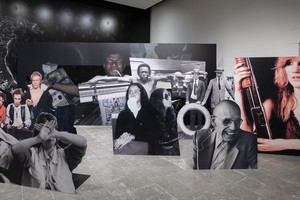
NSWe’re including several of AJ’s videos. The entire mise-en-scène will be unusual in that we’re installing 2D works in rooms where there are videos. AJ’s making three new works for the exhibition, and Richard is also showing some new work, all of which is very exciting. The artists had a lot of free play in the catalogue, so it includes more recent work by each of them with special sequences of imagery. It also features a conversation between them, along with brief texts examining the motifs where their work and their mutual obsessions intersect. These are written by experts in their respective fields: among others, Aria Dean writes on humor, Ashley James writes on identity, the Swedish scholar Martin Lund writes on whiteness, Amy Taubin writes on film, Randy Kennedy writes on car culture, Ashon Crawley writes about the Pentecostal church and music, and the science fiction writer Peter Watts writes on dystopia and politics.
WAYou touched on this earlier, but could you say more about the artists’ approach to masculinity—how they take it seriously but also joke with it a lot?
NSA section of my own catalogue essay expands on Richard’s de Kooning paintings and AJ’s Man Monster—Duffy [2018], looking at these works and the construction of gender. I think both artists consider the breakdown of binary gender identification as emancipatory, whether they embrace that in their own lives or not. It’s something both of them have played with in their photographic self-portraits. Richard’s self-portrait from 1980, the very early one with the mascara, problematizes notions of masculinity. In the exhibition, this is expanded to consider the White Paintings [1989–95] as a critique of white masculinity specifically—I’d never read those works in the context of race before. They’ll be exhibited with AJ’s video The White Album [2018], which explores the concept of whiteness from a Black perspective.
WAThere’s also quite a bit of violence in the work.
NSAJ is clear about embracing the violent, not shying away from it. He’s spoken in many interviews about the fact that he doesn’t work metaphorically. Richard’s engagement with violence is less direct, but the Blasting Mats, for instance, are adjacent to ideas of disaster. AJ has the heavier hand on the scale here, but even Richard’s Sunsets are incredibly dystopic to me.
Richard has been clear in his writings about being impacted by the 1968 student protest movements, which he was a part of. He chose to retreat to the studio as a site of contestation instead of being on the street protesting. So for him the studio was the barricade. AJ, I think, treads a really interesting line, because he chooses things documenting white-supremacist violence that are graphically difficult to look at, and in doing so risks inviting people to overidentify with this gruesome and reprehensible imagery. Viewers may engage with—not always in the right way, unfortunately—that kind of weird attraction to the graphic, or, equally problematic, may see the work as some form of false expiation of guilt. That’s a very provocative gesture. At the same time, though, there’s a lot of humor and play in both artists’ work, you can never pin it down. So I don’t read the work as an indictment of America or of American violence as such, because I think there’s also a celebration of resilience.
WAOf the people. And it’s anti-war.
NSYes, some of Richard’s work is rooted in protest movements. For AJ, it’s more an engagement with Black history and the inextricable presence of violence enacted against African Americans since the founding of the country. I’ve been pondering Richard’s notion of a spiritual America since I organized his exhibition with that title in 2007. I can’t fully explain it, but I think it’s his code for a country that still has free expression. So much of Richard’s work tests it, probes it, as does AJ’s from a distinct, slightly younger perspective. There are many places in the world where you can’t do what they do, artistically, verbally, publicly. In this way I think the exhibition, while critical, is also very celebratory.
WAI think the show’s going to be a bit of a lightning rod, I have to warn you [laughs].
NSYeah, I would like to just install it and leave town [laughter]. But seriously, I’m glad it’s with the Fondazione Prada. I have enormous respect for the program and their attitude. They aren’t afraid of going deep or being real.
Nancy Spector is a curator, writer, and art historian. She organized Helter Skelter: Arthur Jafa and Richard Prince for the Fondazione Prada, Venice, and Felix Gonzalez-Torres: Sweet Revenge (with cocurator Alejandro Cesarco) for the Reina Sofía, Madrid. She serves as international advisor to the Fondation Louis Vuitton, Paris, and was previously Artistic Director and Chief Curator of the Solomon R. Guggenheim Museum, New York. Photo: Inez & Vinoodh