The Palazzo Grassi – Pinault Collection in Venice opened Tatiana Trouvé: The Strange Life of Things this past April. Conceived in close collaboration with the artist, the exhibition’s venue served as a key starting point for the creation of new sculptures, large-scale drawings, and site-specific installations, all presented in dialogue with bodies of work from the past decade. A catalogue was published alongside the exhibition, and here we share Neville Wakefield’s essay on Trouvé’s radical forms of cartography.
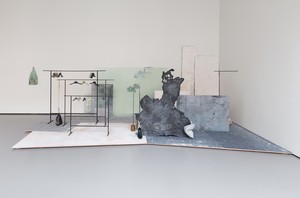
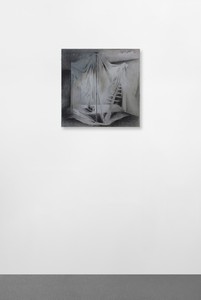
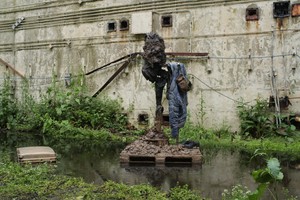
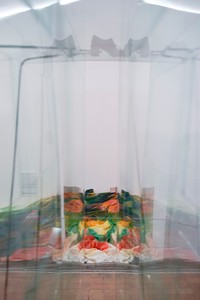
Tatiana Trouvé, Nelson, 2021, and Notes on Sculpture, March 22nd, Water City, 2025, installation view, Tatiana Trouvé: The Strange Life of Things, Palazzo Grassi, Pinault Collection, Venice, April 6, 2025–January 4, 2026. Photo: Sebastiano Pellion di Persano
Tatiana Trouvé, Nelson, 2021, and Notes on Sculpture, March 22nd, Water City, 2025, installation view, Tatiana Trouvé: The Strange Life of Things, Palazzo Grassi, Pinault Collection, Venice, April 6, 2025–January 4, 2026. Photo: Sebastiano Pellion di Persano
Neville Wakefield is a writer and curator who has worked extensively with institutions in the United States and abroad, including the Schaulager, Switzerland, where he curated the groundbreaking Matthew Barney retrospective Prayer Sheet with the Wound and the Nail. His interest in how art behaves outside of institutions led him to cofound Elevation1049, a site-specific biennial in Gstaad, Switzerland, currently in its sixth edition, while his role as founding artistic director of Desert X has been instrumental in reframing the legacy of land art within a context of climate crisis.
The twenty-first century has accustomed us to never being lost. Bounced from satellites, the imagery of route plotters and other navigational devices provides us with continual reporting on where we are, where we’ve been, and where we might be going. Our world has exchanged maps for directions. But directions blinker us to the very systems of knowledge on which they are based. They willfully ignore the idea of the journey as a space of exploration. They ignore the folds and creases over which families and nations have argued and into which history has fallen. But this wasn’t always the case. Before our artificial stars shone their geostationary light from the heavens to the earth, being lost was not something to be feared. It was a reality of navigation, a predicate of discovery, an essential part of the calculus of spatial and human relationships.
I grew up on a small island surrounded by a vast body of water. It was impossible not to be aware of one’s aquatic origins, of the ebbs, flows, and currents that transported and transformed life. The urge to look beyond the horizon was strong. So too was the urge to navigate a surface apparently devoid of features. And because a map of the ocean is essentially blank, it demands that we look elsewhere, to the skies, for our directions. Celestial navigation goes back millennia, to the Phoenicians, the Micronesians, and other seafaring civilizations, and held sway until the mid-1980s when a global positioning system based on military satellite triangulation was made available to the public.
Navigation was at best an inexact science, based on the triangulation of celestial and biological bodies with the line of a horizon. Moon, sun, or stars provide one set of axes, the body of the observer at any given time the other, the curvature of the world’s surface the third. Critical to the equation is a hypothetical known as the “dead reckoning” track. This is a fictitious line. This is where you may want to go but, due to set and drift, it is a line that is impossible to follow. But this path that you can never actually travel is an essential part of the equation that leads to the “fixing” of a precise location. So, at the core of our relational understanding lay the paradox that the map of the real is in fact born of fiction.
Literary philosophy also reveals the triangulation of fiction, reality, and representation as central to the effort to establish the coordinates of the human condition. “On Exactitude in Science” (1946), the great Jorge Luis Borges’s shortest essay, is predicated on misattribution. Suárez Miranda, to whom the paragraph is credited, is a fictional character, writing at a fictional time, about an impossible marriage of representation and reality. The character describes an empire for which the pursuit of cartographic exactitude has become so obsessive that only a map on the same scale as the empire itself will suffice. Over time, the map decayed and the empire fell apart.
In much of the world, inexactitude has been all but banished. Perhaps because of this it has fallen upon artists to become cartographers of those spaces that can only be charted and inhabited in other ways. The idea of fixing a position through “dead reckoning” is one example of the glitch in the irrefutability of exactitude. So is the Situationist concept of “psychogeography,” in which the urban landscape was mapped through the ebb and flow of wandering and purposeless desire. The art of Tatiana Trouvé offers another.
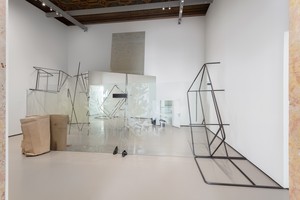
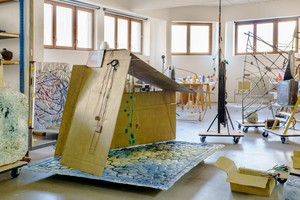
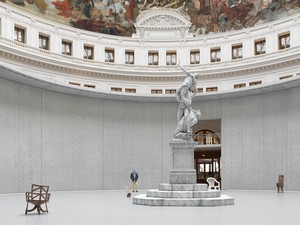
Tatiana Trouvé, L’appuntamento, 2025, installation view, Tatiana Trouvé: The Strange Life of Things, Palazzo Grassi, Pinault Collection, Venice, April 6, 2025–January 4, 2026. Photo: Sebastiano Pellion di Persano
It is perhaps no coincidence then that the title of a recent survey of her work was The Great Atlas of Disorientation (2022). Maps, often formed of knowledge that has been lost, neglected, or ignored, provide a conceptual underwriting of her art. Trouvé’s attraction to the Palazzo Grassi in Venice may in part be because the very architecture of the palazzo has been determined by the mercantile conditions of another map—one built of the trade routes that embedded wealth and materials within the structure itself. Its inlaid marble floor represents the spoils of maritime colonialism and conquest. To step on it is to feel the polish of history, the smooth fictions by which privilege denies its rough origins. But onto this map she has superimposed a texture of experience that belongs to a different time, place, and social reality. The atrium floor is now a street, a composite not of the accumulated wealth that celebrated Venice as the mercantile capital of an Adriatic world but a complex of asphalt resistance, punctuated by casts of manhole covers and metal plates (Hors-sol, 2025) that suggest access to the subterranean infrastructure of the modern city, its pipes, vents, circuits, and channels. These covers, all cast on a one-to-one scale, are not only from Venice, but from other cities in France, Italy, Germany, England, and the United States, suggesting a circulation system that exceeds cities and nation states. This disorientation of place and purpose is typical of a body of work that consistently challenges the systems around which our fragile ecologies have been built.
While not exactly a child of ’68, Trouvé’s approach to life as well as to work has been informed by many of the ideologies trailed in its wake. The idea of a city as the conjunction of hard and soft architectures, as a palimpsest of real estate and states of mind no less real, shapes her relationship to territory and the framing of experience. Time spent living in squats may have encouraged the psychological separation of architecture from permanence. By blurring the conventional boundaries between public and private space, it promoted an awareness of urban experience as a form of social theater, a place whose architectural frame belayed a non-Euclidean space of interaction and play. Both the squatting and the affirmation of the street as an unstructured complex of shelter, protest, and exchange echoed the Situationist presaging of the unrest of ’68. A decade before, Guy Debord, the de facto leader of the Situationist movement, and Danish artist Asger Jorn had created The Naked City: Illustration de l’hypothese des plaques tournantes en psychogeographique (1957), for which they cut apart a typical map of Paris and repositioned the pieces. The oft-quoted slogan “Beneath the cobbles, the beach” [“Sous les paves, la plage”] could also be seen as a call to discover a cartography of desire within the social and architectural structures of repression.
Trouvé’s Hors-sol, her map of the asphalt empire, is both absolutely accurate and largely useless. Like Suárez Miranda’s cartographic quest for exactitude, the floor-based sculpture has also been subjected to the pitiless “inclemencies of the Sun and Winters.” “In the Deserts of the West, still today, there are Tattered Ruins of that Map, inhabited by Animals and Beggars; in all the Land there is no other Relic of the Disciplines of Geography,” the fictional character writes.1 Trouvé’s tattered ruins also record the failed coordinates of Empire and the inclemency visited upon it. A map not of a place but a dérive through multiple sites and the memories layered upon them. Trouvé reworks the Situationist slogan. Beneath the streets, the palazzo.
Sampled from, amongst other places, the streets of Montreuil, an eastern suburb of Paris where she lives and works, Trouvé’s asphalt impressions also speak to the history of movement and unrest recorded on its surfaces. If the floor invokes a version of Action Painting whose antecedents include Jackson Pollock’s exteriorization of the self across the floor of modernism and Robert Smithson’s gravity-fed pours and rundowns, the action of another new sculpture, Storia Notturna, 30 giugno 2023 (2024), includes not just that of the artist but those of others. In 2023, following the fatal police shooting of a 17-year-old boy of North African descent, the streets of Montreuil became a canvas of civil unrest, its surfaces scorched by burnt dustbins. Here the surface of the street is elevated into a vertical orientation as if to create a barricade between it and the rest of the exhibition. Each section is a mold of history, a register of the collective rage of citizens whose invisibility is by design, and a record of a marginalized milieu striving for visibility within a society designed to render such protest unseen.
Water runs through this show as it does through Venice. Its presence is felt beneath the manhole covers, metal plates, and other forms designed to cap the circulations below. Water, which carries everything from memories to microbial life, is plotted on the atrium floor as a constellation of cast coordinates that together create an imaginary map. Real in the sense that it can be walked upon and imaginary in that it leads both everywhere and nowhere, its mapping is unconstrained by geography. Like an ancient flat earth map, it offers a view of the world that includes the divide between the known and the unknown, where the world accessible to physical exploration is represented by land and the world of the unknown, of the imagination, is represented by the infinite connectedness of water. Here the fiction of an artist’s dead reckoning approach to system dynamics yields to the scientific truth of a world in which water and life are in a continual state of circulation. The visceral experience of standing on its irregular surface, feeling the protrusions of history and the portals to other worlds is quite different from the view afforded from the galleries above. Looking down, it is revealed more clearly as a cosmos. Punctuating the dark asphalt, the archipelago of access points become coordinates of a celestial map, a diagram of another system of wayfinding.
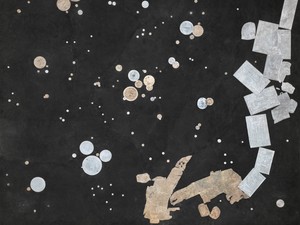
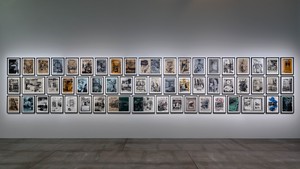
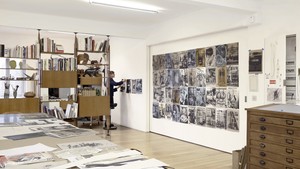
Tatiana Trouvé, Untitled, 2025, from the series Les dessouvenus (2023), black pencil and bleach on paper mounted on canvas. Photo: Sebastiano Pellion di Persano
In another version of this fluid cartography, Trouvé’s drawings often begin with the mapping of process onto thought. Liquid bleach becomes a vehicle of erasure, washing the pigment out of pre-colored paper in the same way that rivers move silt through tributaries and distributaries, deltas and estuaries before forming the sedimentary deposits and patterns that mark the exhaustion of their movement. Entropic in the sense that the swirls and marks left behind describe the ever-fluctuating borders where dynamic systems meet resistance, they are also both the representation and manifestation of the energetic forces that went into their making. The marks left behind look like both atmospheric formations and maps. As with a lot of Trouvé’s work, they suggest ever-shifting registers of scale. Atoms become constellations. The growth patterns of bacteria become those of cumulonimbus clouds. It’s a form of slippage compounded by the fact that what we are looking at is both the map and the territory, where the thing itself and its diagram are perfectly overlaid. The gesture of these painted grounds may be small, but the effect reaches far beyond the edges of their canvas universe. In doing so, they destabilize a longheld relationship with representation. Humanity’s own global positioning system is revealed to be an anthropocentric tool manifestly inadequate for navigating a multiverse.
Objects as much as liquids move through Trouvé’s multiverse. Like the drain and manhole covers, the objects she collects and configures in her sculpture also function as portals to other worlds. Most have a close association with a body. Through their separation, they carry the mnemonic of histories and presences other than their own. These objects too suggest a world of circulation and motion. Shoes, keys, suitcases, blankets, and cushions might all be considered refugees of walking, thinking, traveling, opening and closing, resting and moving, activities from which circumstance and accident have forced them apart. Like the ghosts that inhabit her empty architectures, the objects become talismans inscribed by invisible histories, bridges connecting their mundane empirical presence with the hidden realms of dimensions beyond. Perhaps because of this, Trouvé considers the collected objects not as an archive but as an atlas. The distinction is perhaps significant. Where the idea of the archive suggests a collection of documents that provide historical information, the atlas is purely diagrammatic, superimposing as it does an idea of wayfinding on to a concept of territory. Trouvé’s objects complicate even this idea since they themselves seem often to have lost their way. Orphaned from their original purpose, they adopt a form of animism for which an invisible life starts to map out territories that edge beyond the clean-cut borders of the known. Once again it is the other realm, the space that breaks with the cartographic grid of understanding, that becomes the true subject of the work.
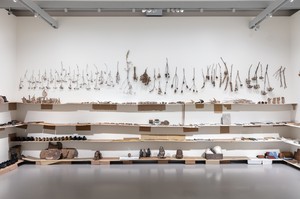
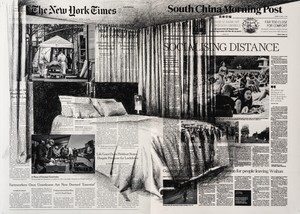
Tatiana Trouvé, L’inventario, 2003–24, installation view, Tatiana Trouvé: The Strange Life of Things, Palazzo Grassi, Pinault Collection, Venice, April 6, 2025–January 4, 2026. Photo: Sebastiano Pellion di Persano
It would be easy to think of Trouvé’s collections of “things” as a study in object anthropology. Furnished with seemingly endless clutter, the sculpture based on the storage shelves in the basement of her studio in Montreuil, L’inventario (2003–24), feels less like being buried alive in the details of the past than having a light shone on the coordinates of a personal atlas. The anthropocentric aspect of the archive is that ultimately it is a set of static directions rather than a map of fluid possibilities. The worlds that Trouvé’s work invokes are dynamic and non-exclusive. They are the “Umwelt” defined and popularized by the Estonian-German zoologist Jakob von Uexküll in 1909. Umwelt comes from the German word for “environment,” but Uexküll used it not to refer to a human’s or animal’s surroundings but to its perceptual world, the sensory bubble that both defines and confines our understanding of the world around us. Famously, he compared an animal’s body to a house. “Each house has a number of windows,” he wrote, “which open onto a garden: a light window, a sound window, an olfactory window, and a great number of tactile windows. Depending on the manner in which these windows are built, the garden changes as it is seen from the house. By no means does it appear as a section of a larger world. Rather it is the only world that belongs to the house—its Umwelt.”2 Each of the elements of L’inventario affords a different window or perspective on an unseen, marginalized, or invisible world. Collectively, they create a garden into which we all see, sense, and feel something different. Like the architectural occlusions that form the leitmotiv of many of the drawn and painted works, the way that we inhabit this house that we call ourselves is restricted by the apertures of understanding that penetrate its otherwise solid walls.
The garden of ideas and forms that Trouvé has created is an invitation to navigate the unseen in ways that are both new and old. Our reliance on technology has consolidated belief systems founded on Euclidian measurements of space and time. But it does so at the expense of other forms of knowledge—be they animal or ancestral. The guiding principles of the stick charts that enabled the people of the Marshall Islands to cross thousands of miles of Pacific Ocean are no more recognizable to us as “maps” than those that guide migrating birds from their feeding grounds close to the Poles to their breeding grounds toward the Equator. Made of coconut fibers, bent palm ribs, and cowries, the stick charts were less an attempt to represent a world as seen from above than to sensate in diagrammatic form a complex of winds, currents, temperatures, shears, wave intervals, and other oceanic phenomena for the Micronesian navigators who understood the ocean as something more than the featureless blue boundary that separates land masses. Art has the capacity to investigate a space where human knowledge either ends or has been lost. In their referencing of the stick charts, Trouvé’s cast bronze entanglements of roots and branches are literally portals into another world of lost knowledge. They invoke a relationship to a world no longer bound by the rigid coordinates of GPS, a suggestion of something far less unyielding but infinitely more compelling—the idea of a space where multiple orientation procedures can interact to create a cosmology where human and non-human possibility exist side by side.
Even though maps of different kinds are embedded throughout Trouvé’s work, they refuse to give us direction. Instead, they offer openings in knowledge, windows onto non-exclusive Umwelten. They frame ideas of territory, connectivity, and space. Collectively, like the exhibition itself, they become a meta-map—a cartography of the very idea of mapping—which embraces the possibility of getting lost. As with the fictitious line of dead reckoning, art is here rendered as fiction, as a fabrication, made not out of a fear of the truth but as part of a desperate attempt to preserve faith in its existence. When we lie, we are actually hiding from the truth. Our dread may be that if we ever stop hiding from the truth, we might discover that the truth—our truth—does not exist. But only in accepting that possibility can we open ourselves to the idea not of a world ruled by a single point of view—let alone a single species—but of multiple worlds coming together to create a cosmology of ideas greater than ourselves.
1 Jorge Luis Borges, Collected Fictions, translated by Andrew Hurley (London: Penguin, 1999), p. 325.
2 Jakob von Uexküll, A Foray into the Worlds of Animals and Humans, with a Theory of Meaning, translated by Joseph D. O’Neil (Minneapolis: University of Minnesota Press, 2010), pp. 200-01.
Neville Wakefield is a writer and curator who has worked extensively with institutions in the United States and abroad, including the Schaulager, Switzerland, where he curated the groundbreaking Matthew Barney retrospective Prayer Sheet with the Wound and the Nail. His interest in how art behaves outside of institutions led him to cofound Elevation1049, a site-specific biennial in Gstaad, Switzerland, currently in its sixth edition, while his role as founding artistic director of Desert X has been instrumental in reframing the legacy of land art within a context of climate crisis.