
Titus Kaphar: The Fire This Time
On the occasion of his exhibition The Fire This Time at Gagosian, Paris, Titus Kaphar discusses themes of history, representation, and collective memory in his recent paintings and hand-carved wood sculptures.
Spring 2026 Issue
Jason Stanley, author of Erasing History: How Fascists Rewrite the Past to Control the Future (2024), considers Titus Kaphar’s new paintings, examining their potent refusals of jingoistic myth-building and their strident remembering of American history.
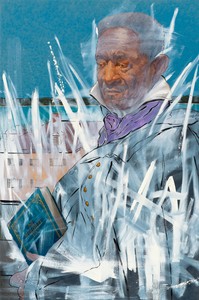
Titus Kaphar, Forget Me Not (James Armistead Lafayette), 2025, oil on linen, 84 × 56 inches (213.4 × 142.2 cm). Photo: Chris Gardner
Titus Kaphar, Forget Me Not (James Armistead Lafayette), 2025, oil on linen, 84 × 56 inches (213.4 × 142.2 cm). Photo: Chris Gardner
At the core of most national myths is a cult of the founders, a veneration of figures taken to be the original figures who defined the nation. It may be, as in the United States, something like the “founding fathers,” or it may be people whose conquests or achievements were so great that they are taken to be essential to the nation’s identity (Joan of Arc?). Such cults can be relatively innocent, but when they are taken as a justification for placing one group of citizens (those who share the founders’ “identity”) above others, they mount an existential threat to democracy. When the founders are represented as embodying a superior racial or religious identity, a cult of the founders may justify atrocity. For over a decade, the work of Titus Kaphar has cut through the American version of this myth, uncovering the history of the people it necessarily erases.
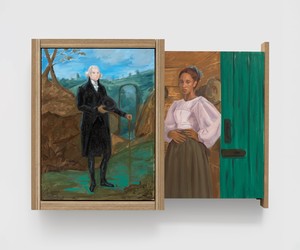
Titus Kaphar, Study of Jefferson Drawer Painting, 2025, oil on linen with wood frame and sliding mechanism, 27 ¼ × 38 ¼ × 6 ½ inches (69.2 × 97.2 × 16.5 cm). Photo: Owen Conway
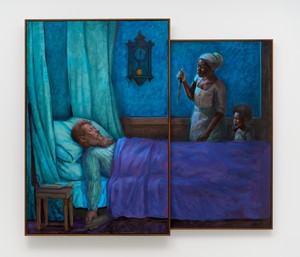
Titus Kaphar, Celia: Embers, Bone, and Ash, 2025, oil on linen with wood frame and sliding mechanism, 85 ½ × 100 × 5 ½ inches (217.2 × 254 × 14 cm). Photo: Owen Conway
In Playing in the Dark: Whiteness and the Literary Imagination (1992) Toni Morrison wrote, “There is quite a lot of juice to be extracted from plummy reminiscences of ‘individualism’ and ‘freedom’ if the tree upon which such fruit hangs is a black population forced to serve as freedom’s polar opposite.” Indeed, large parts of the mythology of American freedom are predicated on the nonfreedom of Black and Indigenous Americans. Think, for example, of the settlers’ covered wagons heading west in the nineteenth century, a picture many of us have in our heads as an iconic symbol of American freedom: That image is simultaneously an image of Indigenous dispossession and loss. In his painting The Cost of Removal (2017), Kaphar reworks a contemporary portrait of Andrew Jackson, the American president responsible for the Indian Removal Act of 1830—an important step in that dispossession. Jackson is shown mounted on horseback, a pose stereotypical of American freedom. Strips of cloth are nailed to the canvas, hanging down from Jackson’s chin to his feet; on these strips Kaphar has written the words Jackson used to justify the removal of Indigenous Americans from their land. The nails recall the nail-studded power objects of Africa’s Kongo religion, an example of which Kaphar had seen at the Yale University Art Gallery. Their presence, then, is a manifestation of Black agency in both material and technique; they are also, well, rusty nails driven into a president’s face.
To represent George Washington as innocent is to demand that history forget those he enslaved. Kaphar’s Shadows of Liberty (2016) is an oil portrait of Washington, on a grand scale characteristic of the subject. Like Jackson in The Cost of Removal, Washington is on horseback and strips of cloth are nailed to his head; here, each strip bears the name of a person he enslaved, the names being drawn from the ledger where he kept track of such things. The title Shadows of Liberty alludes to the same point Morrison makes; that American freedom must be understood in the light of such shadows.
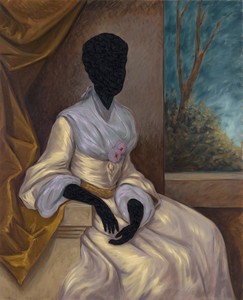
Titus Kaphar, Kinfolk, Breath Is My Precious Inheritance (Elizabeth Keckley), 2025, tar and oil on linen, 74 ⅛ × 60 inches (188.3 × 152.4 cm). Photo: Chris Gardner
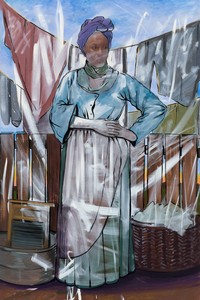
Titus Kaphar, Bathing in the Warmth of Another Stolen Day (Ona Judge), 2025, oil on linen, 84 ⅛ × 56 inches (213.7 × 142.2 cm). Photo: Owen Conway
In his new paintings Kaphar continues his focus on America’s cult of the founders. Bathing in the Warmth of Another Stolen Day (Ona Judge) (2025), for example, refers to a woman enslaved by Washington and his wife, Martha; classified as a fugitive slave after her escape from the household in 1796, she was pursued by agents of the Washington family and located in New Hampshire, but refused to return. Here Kaphar calls our attention to the whitewashing of her legacy and even existence under the conception of “patriotic education” espoused by Donald Trump, and codified in one of the forty executive orders he issued in the first ten days of his second presidency, “Ending Radical Indoctrination in K–12 Schooling,” which calls for schools to instill in their students “a patriotic admiration for our incredible Nation and the values for which we stand.”
American history has always demanded such erasures of the agency of anyone who is not white, Christian, and male (like the founding fathers). They were documented, for example, by W. E. B. Du Bois, whose 1935 book Black Reconstruction challenged the narrative myths that erased Black agency and accomplishment in the Civil War and its aftermath and set up a fictional past that absolved whites of any guilt in ending Reconstruction. Kaphar’s work attacks similar racist myths, and constitutes a powerful visual critique of white innocence, but Kaphar often performs this critique indirectly, his more primary goal being to defend the legacy of Black Americans whose agency and indeed existence is threatened by racist history. Forget Me Not (James Armistead Lafayette)(2025), for example, commemorates an African-American who spied for the Continental Army, having been promised his freedom for passing military intelligence to the Americans while seeming to work for the British. As if to emphasize the absurdity of Trump’s frequent call for a “patriotic history,” Kaphar’s painting reminds us that attacks on Black history and agency are a distortion of patriotism rather than an amplification of it.
Kaphar’s new series operates differently from his earlier work: As well as offering alternative perspectives on our founding myths, it must be read as a defiant resistance to a moment when Black history is subject to specific legal and administrative threat. It speaks both to a lengthy history of erasure and to a current moment when any challenge to these erasures faces increasing legal danger. The current American regime makes its targets deliberately vague (“Anti-Americanism”) but emphasizes exactly the kind of work Kaphar has been making.
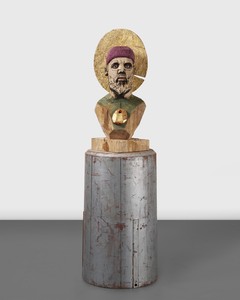
Titus Kaphar, While You Wake . . . (Sentinel 3), 2025, gold leaf and casein on wood with found industrial object, 75 ½ × 22 × 22 inches (191.8 × 55.9 × 55.9 cm). Photo: Chris Gardner
This year marks the 250th anniversary of the founding of the United States, which the Trump regime is planning to celebrate with “patriotic” art and architecture. Kaphar will challenge this propaganda by exhibiting his work in several American museums. Those now in power regard the perspectives his work provides as problematic for their rule. They rightly regard his project as a threat to fascism.
Titus Kaphar: The Fire This Time, Gagosian, 4 rue de Ponthieu, Paris, January 29–March 7, 2026
Artwork © Titus Kaphar

Jason Stanley holds the Bissell-Heyd-Associates Chair in American Studies at the Munk School of Global Affairs & Public Policy at the University of Toronto. He is the author of seven books, which have been translated into over twenty-five languages, and writes often about authoritarianism, free speech, and democracy for the Guardian, the New York Times, and many other publications around the world.
On the occasion of his exhibition The Fire This Time at Gagosian, Paris, Titus Kaphar discusses themes of history, representation, and collective memory in his recent paintings and hand-carved wood sculptures.
Jon Copes asks, What can Black History Month mean in the year 2024? He looks to a selection of scholars and artists for the answer.

Titus Kaphar and director Derek Cianfrance spoke on the opening night of Titus Kaphar Selects, a film program curated by the artist as part of a series copresented by Gagosian and Metrograph in the spring of 2023. The pair discussed their respective practices, including Cianfrance’s film Blue Valentine (2010) and Kaphar’s film Exhibiting Forgiveness, which premiered at the Sundance Film Festival on January 20, 2024.

Jamillah Hinson and Marissa Del Toro, recent curatorial fellows of Titus Kaphar’s nonprofit community arts hub NXTHVN, address their curatorial praxes.
Join Titus Kaphar and Zoé Whitley as they discuss the artist’s recent exhibition New Alte̲rs: Reworking Devotion, featuring paintings and sculptures in which Kaphar examines the history of representation by altering the work’s supports to reveal oft unspoken social and political truths.
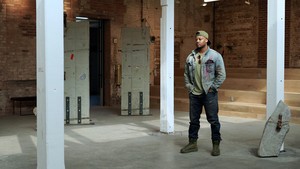
NXTHVN is a new national arts model that empowers emerging artists and curators of color through education and access. Through intergenerational mentorship, professional development, and cross-sector collaboration, NXTHVN accelerates professional careers in the arts. Join Titus Kaphar and Jason Price on a tour of the organization’s headquarters in New Haven, Connecticut. They discuss the founding and vision for this singular arts space.
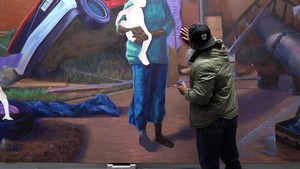
Join the artist in his studio in New Haven, Connecticut, where he speaks about his latest paintings.

In this TED talk, presented during the sweeping protests against racism and police violence following the killing of George Floyd, Titus Kaphar describes how the beauty of a painting can draw the viewer in and allow difficult conversations to emerge. Kaphar discusses his own work and shares the idea behind NXTHVN, a new national arts model he founded to empower artists of color through education and access.
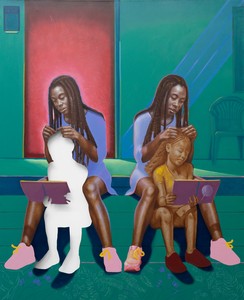
Titus Kaphar and Tochi Onyebuchi present an excerpt from their short story “Seeing the Child,” a poetic rumination on Kaphar’s latest body of work, From a Tropical Space (2019–).

Jacoba Urist reports on a recent trip to the artist’s studio in New Haven, Connecticut, to see his new body of work, From a Tropical Space (2019–). She writes on the emotional and sensory impact of these paintings and considers their singular place in Titus Kaphar’s oeuvre.
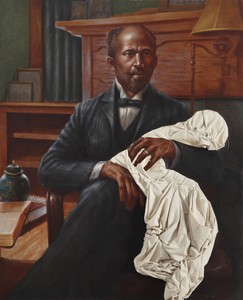
Bridget R. Cooks investigates the aesthetic and narrative conventions deployed by the artist, demonstrating how his paintings force provocative confrontations with history through complex modes of depiction.

Join Titus Kaphar as he talks about making paintings and sculptures that wrestle with the struggles of the past while speaking to the diversity and advances of the present. Working onstage, he points to the narratives coded in the language of art history as he creates a new painting, demonstrating how shifting our focus can prompt us to ask questions and confront unspoken truths.