As You Wish: Part Two
Helen Oyeyemi continues her four-part story cycle with the second installment, “At the Auspicious Hour.”
Spring 2026 Issue
The Quarterly’s 2026 fiction writer, Helen Oyeyemi, kicks off her series with the first installment, “Introduction to a Genie (of Sorts).”
Dust isn’t that different from people. It has sentimental attachments. It keeps secrets. It has characteristics that correlate with the climate and customs of the place where it’s found. That’s probably why the dust I’m telling you about (twenty-first-century temple dust) had a such a positive attitude. Granting wishes? No problem. As long as I don’t rush, I can accumulate the energy to do it!
The dust had a pleasant viewpoint high up on a roof gable that overlooked a tiny courtyard. It watched over the throngs of adolescents who arrived in jeans, trainers, and T-shirts but put on saffron-colored robes to live at the temple as monks for the month of March, when the school holidays only meant they’d cause a ruckus at home. Here the March monks came under the tutelage of adult monks with a variety of temperaments and abilities. In the mornings there were alms-collection outings with calm and serious monks, who showed their charges which gestures pay heed to distress. The livelier and more loquacious among the monks spoke in parables that the kids would suddenly wake up in the middle of the night to debate the meaning of. There were gruff and rugged monks who led their juniors up the nearby mountain (to the dust the expedition’s progress was like an eager little orange thread stitching the foliage together) and stood at the peak chanting in steady voices that bridged heaven and earth. March was an interesting month for the full-time monks in that each type of man noticed that they had at least one disciple among the March monks, and it was an interesting month for the March monks who couldn’t imagine adapting to the sharp and serene symmetries of temple life until, just before it was time to go home, they realized they had adapted. The dust, which was a pretty rich mix of incense ash, flecks of plaster, hair, and ant and centipede fragments that flew up in the air when attacked by volunteers with brooms, acquired the perspective that most characteristics are learned. This has upsides and downsides. For instance, hatred isn’t intuitive. It’s something you have to keep reminding yourself of. Unfortunately, the same goes for feeling joy when good things happen to other people. As for what’s learned, and how well it’s learned—aptitude is a factor, but honestly? Necessity is a greater factor. And at the heart of all the learning there’s a great hesitation, a desire, even, to postpone the date of the examinations that prove what we’re actually qualified to do in the world. It’s not unusual to study indefinitely without putting anything into practice.
The dust, however, developed an objective. It became a witness to a misdemeanor it was moved by, and it thought: This minor memory is just the right size for the likes of me to protect.
You see, there were often girls among the March monks at this temple. Officially only boys were allowed, but some girls who had yet to cross the threshold of puberty said “No way” to being left to a month of mind-disintegrating boredom at home, shaved their heads, and tagged along with their brothers, male cousins, or neighborhood friends. The temple administrators would squint a bit but would sigh and leave it be. The kids the monks squinted indecisively at had their princess status acknowledged through their sleeping quarters, which were less ascetic than everybody else’s dormitories, but otherwise all the March monks mixed freely throughout the day, when supervision was in abundance.
Inevitably there came a March when one of the girlish monks and one of the boyish monks took particular notice of each other. They both liked to bombard the adult monks with questions, and rapidly developed follow-up questions to the answers they received. These two quickly became known for having plenty to say, but they went quiet when ajahn Dawa, the monk at the head of the temple’s holiday program, called them in to ask if they had anything to do with the predawn scenes some of the monks had begun waking up to: dozens of cats and dogs curled up at the feet of every statue in the temple complex, all of these strays resting in the shallowest stages of sleep like a squadron of bodyguards who knew better than to surrender their vigilance. The boyish monk and the girlish monk were the very picture of perplexed youth, looking at each other and at ajahn Dawa with round and guileless eyes. Despite having around fifty years’ less life experience than the ajahn, they were very nice to him and spoke gently, as grandparents correct a grandchild who makes senseless accusations out of the blue. But in his mind ajahn Dawa was unable to clear them of involvement. After he dismissed this suspicious pair, he considered having their activities closely followed, but asking his fellow monks to do this would altogether lower the tone of their fellowship. He could already picture ajahn Asnee saying, “Just to be clear, venerable brother—you’re asking us to . . . harass children?” with his hand just below his rib cage to indicate the height at which the children stood. Upon further reflection ajahn Dawa accepted this as a lesson on allowing frustrated ego to lead him onto the wrong path: He’d seized on the first opportunity to associate those two with phenomena he found ominous . . . all because he was upset that they treated him as if they were his equals. So what if they did? Wasn’t it true? And what was actually ominous about the night strays, anyway? The statues they slept at the base of had their hands raised to bless them and everyone else. Morning after morning, the canines and felines jumped over the temple walls quite peaceably, without seeming to expect breakfast.
Had ajahn Dawa pursued this matter he would’ve discovered that he wasn’t as prideful as he thought and his underlying instinct about this duo was actually half right. The boyish monk was spending the money he’d been given for emergencies on tuna. All the tuna went to a scruffy tomcat who’d marched in at the temple’s gate when there was a clash between four contiguous sets of brawlers over some mumbled words that may or may not have been an insult. It was difficult to say what exactly it was about the cat that had compelled a faction of skinny monks to follow him down the street and step in between big angry men until all the lava cooled. Perhaps that cat had the soul of a general. The boyish monk observed that the tomcat even ate his tuna with a fierce expression, as if fueling up for the next trial of patience.
Meanwhile the girlish monk was spending every penny of her own emergency money on stewed meat for a stray ridgeback who wasn’t all that steady on his legs, had a notion that affectionate pats only came his way by mistake, and made obstinate bids to craft such happenstance, ambling closer and closer with lowered head and sidelong looks until he succeeded. But that was it—between the two of them the boyish monk and the girlish monk were only feeding one cat and one dog . . . they weren’t acquainted with any of the others who made an outdoor dormitory of the temple grounds, so neither monk saw why they should have to own up to being the cause for that.
Having just about evaded investigation, the boyish monk and the girlish monk become sworn brothers and contrived to spend more unsupervised time together. Impossible, of course: The adult monks might have been above surveillance, but the dust was always spying on them from the roof. It scattered down the walls to double-check its findings. The girlish monk and the boyish monk sat cross-legged in diagonally opposing corners of the courtyard. They mostly closed their eyes and stared straight into a sun that was the inverse of the one outside their bodies, but occasionally, when some thought tilted their equanimity, when a patch of skin itched or sweat pooled in a fold of their robes, one of them would open their eyes and look over at the other. They never did this at the same time, so the boyish monk never saw the way the girlish monk looked at him, and the girlish monk couldn’t have guessed that her face was the focal point the boyish monk sought without hesitation as soon as his eyes opened. But as their proficiency at meditation improved, the intervals between these flashes of insecurity lengthened, and there was a half-smile on both faces that said, He’s always there. She’s always there. And that was their March, feeding their dog and their cat first, then sneaking away for something like choir practice, soundlessly singing a song that felt improvised but couldn’t be, as every voice they heard carried its melodies in perfect pitch. Motorbikes revving up, the looping calls of cuckoos, the dainty rustle of lizards sweeping their tails around like petticoats, all these completed the song.
On their last day as March monks, the boyish monk and the girlish monk adopted their diagonally opposing positions and held still from 11am until the bell rang for noon without opening their eyes once or falling asleep. They might have been recording every single sensation or thinking about what it would be like to try this in other, lonelier places. A few minutes after noon, the girlish monk borrowed the boyish monk’s penknife, climbed up onto her counterpart’s shoulders, and scratched a series of letters onto the farthest brick she could reach. He asked her what she’d written and she told him not to worry about it. That’s right, the dust thought. Just leave it to me. The ridgeback dog departed with the girlish monk and her big brother; the dust never saw him or any of the canine statue sleepers again. The tomcat vanished but his associates continued to frequent the temple gardens from time to time.
A couple of decades passed. The former boyish monk ran into a friend who’d taken part in that temple’s March program at the same time as he had. It was Songkran, so both former boyish monks had come home to pay their new year’s respects to their parents. After washing their parents’ hands with distilled water and familiarizing themselves with their cousins’ latest ambitions and achievements, the friends met up to watch the new year’s parade from the balcony of the temple where they’d both been monks for a month (the very same temple where the dust had covered what the girlish monk had written). The Songkran parade in these friends’ hometown couldn’t be beaten, mostly due to the acrobats from the theater school who gave their all to the festivities every year, running along the floats equipped with double-barreled water guns and soaking every pedestrian in the vicinity while turning dazzling backflips and cartwheels. But the boyish monk couldn’t concentrate on the spectacle before him. He kept thinking—somewhere just below this balcony are the words that the girlish monk wrote, whatever they are. When his friend asked what was on his mind, he blurted out some recollections of sneaking off to meditate with the girlish monk, only to be scoffed at: “Come on . . . you’re really telling me you two really didn’t do anything?”
The boyish monk, now an adult monk, said: “What do you mean? What we did wasn’t enough for you?”
After a moment of silence the monk’s friend, now the wonder of a chain of bars in Bangkok, shrugged and suggested going down into the courtyard and seeking out the scratches. “It was that courtyard down there, yes?”
The now adult monk didn’t want to go and look. In fact, not looking for any sign of what the girlish monk felt for him had become a point of discipline, but he didn’t know how to say so. The dust had heard the whole exchange and resolved to put up a fight: This other guy didn’t deserve to read the girlish monk’s confession of love. Luckily, fireworks swarmed the skyline, so the two friends gawped at that instead.
Five more decades passed. The dust flowed around the temple rafters like a languid low-pressure weather system. People who tried to clear it away said that it wasn’t dust, but the temple abbot warned them against spreading strange rumors: “We will definitely take strong legal action.”
One midwinter the abbot of another temple paid a visit to this temple where the dust was running amok. The visiting abbot led the morning rites as a guest of honor, then slowly walked to a certain courtyard, got a chair, and stood up on it. The dust got really close to the visiting abbot’s face and stared at him until he sneezed. It was him—the boyish monk who’d held a girlish monk up on his shoulders a few days ago. (At least, it seemed like a few days ago to the dust. What were all these wrinkles about?) At long last the former boyish monk was ready to look at the letters the girlish monk had carved out with his penknife. He held onto the wall with one hand and swept dust away with the other. He did this without a jot of apprehension: He’d entered a state similar to the one he’d shared with another monk in his youth.
He might have felt apprehensive if he’d kept an eye on what the dust was doing. He had to clap his hands every now and again, to shake debris free, and a few younger monks who’d been hovering in the vicinity to see if they could be of assistance retreated with hacking coughs that echoed down the hallways. As the dust behind him fell into a person-sized heap, the visiting abbot found the knife marks. Wiping a hand on the back of the chair, he took his phone out of the pocket of his robe and shone the flashlight.
The girlish monk had carved out both their initials as they would appear according to the Roman alphabet. There was no symbol that connected the two pairs of initials—she’d simply written his and then hers without any extra space between them, so that the letters appeared to form a single unpronounceable word.
The dust watched the abbot anxiously; he stood on the chair tracing this word with his fingertips; it didn’t look as if he was taking his discovery that well. Then he took a picture of the engraving, typed out a message on his phone, and sent the photo to someone, so he was probably OK after all. There was only one person he could be sending the photo to: his friend the abbess.
No sooner had the abbot climbed down from the chair than a streak of fur whistled past his ankles and pounced on the pile of dust. If the sudden movement hadn’t made him jump, the sheer mass of fallen dust would have. It towered over him. But the tomcat met this great golden beige mass head-on and pummeled away at it with its paws. The abbot was both sorrowful and relieved that this was not the tomcat he’d bought a lot of tuna for. This one didn’t have the soul of a general; he was a sculptor. The dust twisted this way and that, hissed “Ouch, ouch, ouch,” and pulled itself into a hominid shape, seemingly by way of dodging the tomcat’s claws. . . . The visiting abbot covered his eyes and called out for a robe to be brought to the courtyard. The tomcat stood back, appraising the work his will had wrought, then stalked away.
The dust got dressed, bowed to the visiting abbot, and followed the tomcat.
Her first commitment has run its natural course. Now’s the time to establish her wish granting credentials! More on that soon.
Text © Helen Oyeyemi

Helen Oyeyemi’s eleven books include the novels Peaces, Parasol against the Axe, and A New New Me, and the short-story collection What Is Not Yours Is Not Yours. She lives in Prague. Photo: Milan Bureš
Helen Oyeyemi continues her four-part story cycle with the second installment, “At the Auspicious Hour.”

As part of a growing posthumous appreciation of the feminist writer Elaine Kraf, her previously unpublished novel Memory House was released by the Modern Library. Here, Alana Pockros explores Kraf’s iterative worlds.
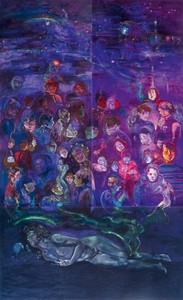
The most recent edition of Picture Books, an imprint organized by Emma Cline and Gagosian, pairs Mary Gaitskill’s novella STAUF: A Tragedy with Jill Mulleady’s painting The Shift. In celebration of this forthcoming publication, Gaitskill and Mulleady discuss the myth of Faust, good and evil in the digital age, and the channeling of raw matter into art.

Sally Mann joined novelist Amor Towles in a conversation about her widely celebrated new book, Art Work: On the Creative Life (2025), at an event hosted by the New School and the Strand in New York. Published by Abrams, Art Work is about the challenges and pleasures of the creative process. Its mix of illuminating stories, practical advice, and life lessons, illustrated throughout with photographs, letters, and journal entries, offers insights into Mann’s own experience of making art. Here, Mann and Towles speak about the writing process, historical ghosts, and fortunate mistakes.

The fourth and final installment of a short story by Catherine Lacey.

Francesca Wade’s new biography of Gertrude Stein sifts through the writer and collector’s layered life and legacy. Here, Wade speaks with the Quarterly’s Gillian Jakab.

The third installment of a short story by Catherine Lacey.

The second installment of a short story by Catherine Lacey.

The first installment of a short story by Catherine Lacey.

We present the final installment of a four-part short story by Arinze Ifeakandu.

We present the third installment of a four-part short story by Arinze Ifeakandu.

Katherine Bucknell, previously the editor of a four-volume edition of Christopher Isherwood’s diaries, has now published Christopher Isherwood Inside Out, an intimate and rigorous biography of the celebrated writer and gay cultural icon. Here she meets with Josh Zajdman to discuss the challenges and revelations of the book.