As You Wish: Part Two
Helen Oyeyemi continues her four-part story cycle with the second installment, “At the Auspicious Hour.”
Summer 2026 Issue
As part of a growing posthumous appreciation of the feminist writer Elaine Kraf, her previously unpublished novel Memory House was released by the Modern Library. Here, Alana Pockros explores Kraf’s iterative worlds.
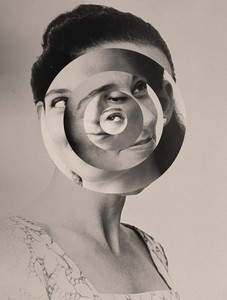
Collage of Elaine Kraf portraits. Design: Graphic Thought Facility, London
Collage of Elaine Kraf portraits. Design: Graphic Thought Facility, London
Elaine Kraf’s 1971 novel The House of Madelaine opens as two women are about to open a door. Elaine, our protagonist and a former kindergarten teacher, is accompanying her old friend Florence on a mission to reconnect with Florence’s lover Gerard. Simple enough. But the second the women cross the Rubicon into the house, we realize that the world within its walls is not exactly our own. Florence’s mother is at the doorway, but ignores her daughter’s attempt to introduce her to Elaine. Instead, she immediately asks Elaine to change the water in a pleated paper cup holding four yellow pansies, but when Elaine picks up the cup, she notices the water is perfectly clean. From here things only get more bizarre, as doors appear that weren’t there before, people and furniture morph in size, art historians turn into doctors, and Elaine becomes a sex worker forced to hold a feather between her butt cheeks. As the critic Jamie Hood puts it vividly in her introduction to the 2025 reissue of the novel, one imagines the late, strange-making filmmaker David Lynch would have “had a field day” adapting it for the screen. After reading through all of Kraf’s oeuvre, you’ll find this suggestion hard to stop imagining.
As in Lynch’s films, much of what transpires in Kraf’s hallucinatory fiction cannot be explained. It’s both childlike and sultry, analytic and inconsequential. Its focus on female characters who are liberated and free-spirited, or else who desire to be but are trapped in stifling heterosexual relationships, has led many writers, also properly, to describe it as feminist. But considered together, one of its most interesting qualities is the way it iterates and innovates off its own frameworks. Among the many distinct characters we meet with Elaine and Florence in The House of Madelaine is the eponymous Madelaine, who presides over the surreal world of the residence like an oracle, delivering orders and maneuvering its inhabitants around like pieces on a chessboard. Elaine may at first appear to the reader as the victim of a dark ploy, but it turns out she’s only victim to herself: Halfway through the novel, Elaine and Madelaine—Mad(Elaine)—become one, mingling two halves of what perhaps was always a whole.
We see something similar in Kraf’s 1979 novel The Princess of 72nd Street. There, Ellen, a bipolar art-school graduate who lives on Manhattan’s Upper West Side, has a pedestrian, depressing sort of life. But when she is manic, or having “a radiance,” she becomes Princess Esmeralda, a grandiose alter ego who rules over the neighborhood, sleeping with strangers and bounding through Haitian restaurants that play “mediocre jazz.” In both novels, two women are like yin and yang, id and superego, or a pair of concentric circles: distinct, often at odds with one another, but sharing a set of overlapping characteristics. Kraf’s selves, you could say, refract one another as much as her novels do themselves.
It’s this iterative quality in Kraf’s fiction that the writer Meghan Racklin singles out in her review of the writer’s 1977 novel Find Him!: “Kraf’s novels have a chimerical, hall-of-mirrors feeling,” Racklin writes, “as if each book were a draft of the next.” This feeling of reworked drafts could not seem more true than in the relationship between The House of Madelaine and Memory House, the last novel Kraf wrote before she passed away in 2013. Until the Modern Library’s Torchbearers Series published it this May for the very first time, the manuscript lay in a storage space collecting dust. (Though we do not know for sure, Kraf’s adoptive daughter, Milena Kraf Altman, believes her mother wrote it in the mid-1990s.) In addition to feeling hypnagogic, fantastical, and at times all too eerie, like The House of Madelaine, Memory House too centers on a pair of old girlfriends who navigate their rocky friendship within the confines of a strange residence whose rules seem to be always shifting. Memory House can also at times lack coherence, but if any of Kraf’s “literary nonsense” novels offer a central message for readers to take away, this one may suggest the clearest of them all: namely, that to create art properly, women must interrogate the depths of their psyches, seeking to fully and completely understand themselves—no matter how many selves we have.
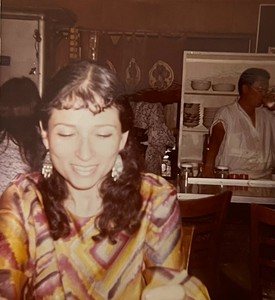
Snapshot of Elaine Kraf, n.d.
If an artist’s residency is a place where creative types go to escape life’s daily distractions, and a psych ward was where mentally ill people once went to cure their psychological ailments, Memory House is something in between. When a limousine driver scoops up the painter and writer Marlane Frack—a play, though not the first, on Kraf’s own name—from her home in Manhattan with that destination in mind, she has as little idea as we do about where she’s going. But the driver, an elderly Japanese film director named Solomon Ito, is holding a copy of her second novel. He recognizes that she is a great writer—or at least was a great writer before she got married and abdicated her art for domestic responsibilities. “Does [Memory House] really exist?” Marlane asks Ito before she hops into his car. “Are there painters, writers, and composers as creatively dead as I am? And why would someone endow an estate to rehabilitate us?” If you read the novel looking for precise answers to these questions, you won’t find them. But you won’t end up caring much either, for once Marlane arrives in her new, delusive utopia, the logistics won’t feel so important.
One of the first, strangest discoveries Marlane has as she navigates Memory House is that although the beachside residence is supposedly a haven for defunct artists—a “great composer,” the former prima ballerina of the “Royal British Ballet Company,” and the “original” Abstract Expressionist painters are among her cohabitants—the house has a “No Creation” rule, which the executor of the estate “embossed in gold.” What, then, is one supposed to do here? For many of the book’s first chapters, Marlane is trying to find out, meeting and talking to seasoned residents in pursuit of clarity. But as much as they try to explain her mission to her, they know she won’t understand it until she’s in its midst. Until then, they might as well be speaking in tongues. “Our benefactor understood humanity in a profound way,” an Abstract Expressionist’s wife named Minna Chase tells Marlane. “Don’t you see that the one rule we’ve been given . . . speaks for everything he wanted us to accomplish?”
The reader will begin to understand this question before Marlane does. As soon as she is on the road with Ito, she begins to float between two realities: her present moment and her latent, inner monologue. On her way to Memory House, her guilty conscience naturally takes her to what she’s left behind: her husband, Lenny Walsh-Gold, a normal if boring spouse who must be “searching for me this very minute.” Lenny continues to haunt her once she’s arrived at Memory House, rudely punctuating her conversations with new friends: “Marlie, Marlie, wake up babe,” he tells her during a lucid daydream. “You been dreaming. It’s me, Lenny. I always loved you.” Marlane’s old friend Nadia, a poet and longtime resident, tells her that to progress in Memory House she must shed her skin: “You’re losing your identity. We have to give up who we were before.” But eventually we realize that Marlane’s reflections on her past are not distractions from her journey toward self-discovery but simply part of its process.
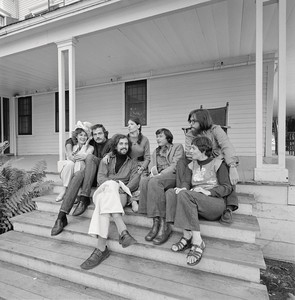
Elaine Kraf (fourth from the left) at the Bread Loaf Writers’ Conference, Middlebury College, Vermont, 1971. Photo: Jonathan Aldrich, Middlebury College Special Collections, Middlebury, Vermont
to create art properly, women must interrogate the depths of their psyches, seeking to fully and completely understand themselves—no matter how many selves we have.
Alana Pockros
Nearly every contemporary writer who has written about Kraf’s novels posthumously has compared them to Lewis Carroll’s Alice’s Adventures in Wonderland (1865). While Kraf wrote Memory House in the 1990s, nobody other than Kraf’s daughter has had access to its contents until this year, which is why it’s startling to realize that Kraf herself may have anticipated this comparison. Upon arriving at Memory House, Marlane is frightened, confused, and wonders if she might still be able to turn back. “Lighten up. You’re not Alice in Wonderland anymore, certainly not chronologically,” a composer named Garreth Styne, whom she eventually falls in love with, tells her, waving a hand in front of her doe eyes. For the rest of the novel he refers to her with Freudian affection as “Alice Phallus.”
Perhaps these direct addresses should not surprise Kraf’s reader. Memory House, like House of Madelaine, abounds with metatextual references to her work and its reputation. In House of Madelaine, when the meddling Madelaine finds Elaine scribbling in her notebooks, she insults her visitor, insisting that “her words are refuse—a collage of floral embroidery.” We see the same kind of self-reference in Memory House, as if Kraf were peeking out from behind the page to address her reader: “This place is stranger than my weirdest novel,” she tells Nadia when she first arrives at Memory House. Kraf also finds every opportunity to comment on the uninviting context in which she was working—the gritty, evolving art and publishing worlds of 1980s and ’90s New York. “There is no justice in the world when it comes to female painters,” Minna Chase exclaims during a particularly tense resident workshop. At an earlier juncture, Marlane recounts a conversation with her literary agent, who insists that the industry will soon pass her by: “The internet, publishing conglomerates, the death of small presses and innovative small bookstores, not to mention the speeding up of intellectual and artistic maturity. Those twenty-four-year-old writers are monsters.”
The references Memory House makes to struggling female artists, a corporatized publishing industry, and heterodox avant-garde fiction are not for nothing. In fact, they tell us a lot about a woman who was underappreciated in her lifetime and is no longer alive to fill in the blanks. As Hannah Williams wrote in an homage to The Princess of 72nd Street, at the time of her writing, in 2022, the name “Elaine Kraf” pulled up little more in an online search than “a six-line Wikipedia page.” Kraf wrote her many novels while working as a special education teacher and a mother, and the strangeness of her writing often led publishers to reject it, leading her to publish some of it with small independent presses and much of it, like Memory House, nowhere at all. But reading this novel now, with the context we do have about her, may offer us more of a window into her life.
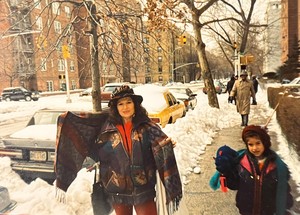
Snapshot of Elaine Kraf, n.d.
Like Marlane Frack, Elaine Kraf was a painter as well as a writer, though always more of a writer, and was married to a nice Jewish man with a corporate job. And like Marlane Frack, Elaine Kraf was the daughter of a father who worked in government and admonished her for not taking a more stable career path herself. In the second half of Memory House, Marlane’s nightmare is realized when her presumed-dead father, the judge Lionel Frack, shows up on the beach like a bottled message, announcing that not only did he secretly harbor creative talents during his lifetime but also that he has written a novel better than any of Marlane’s, which he has published under “an assumed name” with “a gigantic advance.” (The portion of his manuscript we eventually get to read is a mishmashed version of The House of Madelaine, pleated paper cups and all, which Marlane accuses him of plagiarizing.)
By the novel’s end, Lionel Frack’s presence proves itself as more than a cruel and arbitrary ruse. After falling into a fever—a rite of passage in Memory House—Marlane visits “Doctor Amazing,” who uses her vulnerable state to extract her darkest, most repressed childhood memories through an associative olfactory exercise. “It is necessary to suffer deeply,” Nadia tells Marlane. “There will be visions. You will hear voices you never expected to hear. Outside, in the world, events get in the way. Creative production takes over. Do you see what happens when creativity is used to cover up memories and feelings?” If rehashing old conversations with Lenny and confronting her father’s punishing specter are all part of Marlane’s psychic path toward a cleansed creative mind, what surfaces during her fever dreams is something of a final wash.
In Memory House, Marlane Frack technically always remains Marlane Frack. She has no alter ego, no witchy evil twin with a curiously, comically similar name. But the embittered, stymied artist we meet at the novel’s opening is not the enlightened, agape woman we know by its end. There were always two realities, the reader realizes: the Marlane who remained married, at home, and “out of the running” as a novelist, and the Marlane who let herself be free and solo to cleanse her mind and make great art. Like the great, quirky artist Elaine Kraf, who according to her daughter, was a woman who “reinvented herself every couple of years,” Marlane, and all of her shape-shifting sisters, always, all this time, had more options.
Photos: courtesy Milena Kraf Altman
Elaine Kraf, Memory House (Modern Library, 2026)

Alana Pockros is an associate editor at The Nation and a contributing editor at the Cleveland Review of Books. Her essays and criticism have appeared in The New York Times Magazine, The Paris Review, The Point, and elsewhere. She lives in Brooklyn, New York.
Helen Oyeyemi continues her four-part story cycle with the second installment, “At the Auspicious Hour.”
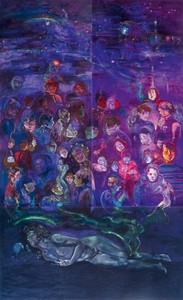
The most recent edition of Picture Books, an imprint organized by Emma Cline and Gagosian, pairs Mary Gaitskill’s novella STAUF: A Tragedy with Jill Mulleady’s painting The Shift. In celebration of this forthcoming publication, Gaitskill and Mulleady discuss the myth of Faust, good and evil in the digital age, and the channeling of raw matter into art.

Sally Mann joined novelist Amor Towles in a conversation about her widely celebrated new book, Art Work: On the Creative Life (2025), at an event hosted by the New School and the Strand in New York. Published by Abrams, Art Work is about the challenges and pleasures of the creative process. Its mix of illuminating stories, practical advice, and life lessons, illustrated throughout with photographs, letters, and journal entries, offers insights into Mann’s own experience of making art. Here, Mann and Towles speak about the writing process, historical ghosts, and fortunate mistakes.
The Quarterly’s 2026 fiction writer, Helen Oyeyemi, kicks off her series with the first installment, “Introduction to a Genie (of Sorts).”

The fourth and final installment of a short story by Catherine Lacey.

Francesca Wade’s new biography of Gertrude Stein sifts through the writer and collector’s layered life and legacy. Here, Wade speaks with the Quarterly’s Gillian Jakab.

The third installment of a short story by Catherine Lacey.

The second installment of a short story by Catherine Lacey.

The first installment of a short story by Catherine Lacey.

We present the final installment of a four-part short story by Arinze Ifeakandu.

We present the third installment of a four-part short story by Arinze Ifeakandu.
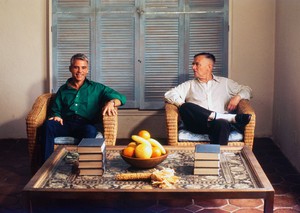
Katherine Bucknell, previously the editor of a four-volume edition of Christopher Isherwood’s diaries, has now published Christopher Isherwood Inside Out, an intimate and rigorous biography of the celebrated writer and gay cultural icon. Here she meets with Josh Zajdman to discuss the challenges and revelations of the book.