
The Many Shades of Elaine Kraf
As part of a growing posthumous appreciation of the feminist writer Elaine Kraf, her previously unpublished novel Memory House was released by the Modern Library. Here, Alana Pockros explores Kraf’s iterative worlds.
Summer 2026 Issue
Helen Oyeyemi continues her four-part story cycle with the second installment, “At the Auspicious Hour.”
I’ll tell you what the most common wish is: I wish I knew what to wish for.
And you know what? That wouldn’t be a waste of your one wish. Yes, out of an entire lifetime of asking, the quota only allows for one almost impossible gift per person. I understand that this may be disappointing, but it is the best we can do.
Identifying a primary desire would do wonders for the insomniac who can only shut off the sound of mocking laughter by churning his blankets with his fists and feet. As someone who has placed all his faith in systems—in documenting, reporting, confirming that every step of a process is in concordance with regulations—what should the insomniac wish for after many months of legal proceedings conclude with a verdict that the person whose violence took his sleep from him has been found not guilty? The laughter he hears follows the melody of Adele’s Laughing Song from Die Fledermaus (of course it’s Strauss, whose music lives at the critical juncture where jest coincides with seriousness). Ja, sehr komisch—ha, ha, ha ist die Sache—ha, ha, ha, Drum verzeihn Sie—ha, ha, ha, wenn ich lache, ha, ha ha. . . . The main refrain plays as the insomniac breathes in and out, and because of this he’s not far from believing he’s a music-box handle that’s subject to a droll delusion of being a person. Suppose he’s offered his one wish—what’s the wish that resurrects his morale? Being let in on this joke, or whatever it is? A just outcome for his legal case? A third or fourth request that forgoes sorting his heartsickness into manageable subdivisions and heals him outright?
The debtor who passes her days sending beguiling messages from within the walls of a windowless and skyless compound—how can she find the exact wording of the wish that would raze the very archetype of that place to the ground? What about the actor who’s allowed himself a few years to move on from nonspeaking appearances as a TV extra but finds himself going backward instead—none of the scenes he was standing in the background of makes the final cut. Meanwhile, a number of his fellow extras make nonstop advancements. He doesn’t think that he’s more dedicated or less dedicated than these fellow extras—his main thought is, Well, aren’t we more or less the same? He’s set his heart on acting as his life’s work. . . . This state of affairs has him stumped. Even if our rookie wish-granter, recently formed from temple dust, appears before him and he is convinced that she really can rocket-boost his contribution to cinema, he can sense a catch . . . a big one. Being chosen wouldn’t be a prudent use of his one wish, and the reason is right there, staring out of his blind spot.
Suppose a seventy-something who lives alone with her forty-something son grows to fear the brightness of his glance. Asking someone to move out because you’re bothered by the look in their eyes is a tricky thing to pull off if the person you’re asking is a lodger, let alone one’s only child. What’s taking place is more than an estrangement, though the two of them spend a lot of their time in close quarters. They’re both on their phones for hours at a time. The mother doesn’t know what her son is doing on his phone: Sometimes he smirks, sometimes he bristles, or sighs. She only knows what she’s doing on her phone: reading and cross-referencing world news articles and half-jokingly messaging emergency plans to a few close friends. More than anything, this lady wonders what to wish for. One wish granted per person barely makes a ripple when you look at each wish as an attempt to outwit each other’s lucky breaks. As you must have guessed already, the floor really is lava, and . . . again, I’m sorry about that. It’s the sort of thing one could be sorry about forever. Why not make a wish anyway? That isn’t all a person does to survive: We submit our applications in all places and on all planes. At the auspicious hour you’re called to interview.
Picture the rookie wish-granter as she discovers you reading all this. I bet she’d say something like, “Oh, I’d love to have time to read! How nice that you do . . . I’m happy for you.” This would be said in a tone of voice that leaves you 50 percent sure of her approval and 50 percent sure of her disapproval. The list of things she likes is much longer than the list of things she doesn’t like, but sneaky behavior is near the top of her “dislikes” list. Oh well . . . since she doesn’t know you’re checking up on her in this way, it follows that as long as you keep it to yourself, there’s no way for her to find out and retaliate.
Right now she’s tackling the matter of reasonable wishes that one simply doesn’t want to grant.
For around three hours in total, the rookie wish-granter walks behind the tomcat who sculpted her from a column of dust. They cross narrow streets lined with shrubs. The tomcat seems to be on familiar terms with every spot of shade in the city, and these darknesses draw a veil of scent over the tomcat’s head first and the rookie wish-granter’s next. Even in alleyways that crackle with the scent of roasted offal, the trees can’t hide their attraction to dust. Blossoms of all sizes fall like someone in love, dropping recklessly into the rookie wish-granter’s path. These soft, weighty bundles turn out to be pink, golden, or cream colored when looked at in sunlight. Neem, gardenia, frangipani. The rookie wish-granter already knows them from years of temple offerings. There are few comforts greater than being kissed by trees: ten kisses short as one, and one long as twenty, to borrow words from one poet. And kisses are a better fate than wisdom, to borrow words from another. Hopefully vows sworn by flower petals make up for not receiving any love from the tomcat, who strolls, rests for a bit, stands up in order to menace a few birds, has a standoff with a notably self-confident lizard, settles on the orange linings of certain shadows to clean his paws and whiskers, strolls further. Though he does occasionally look behind him, there’s no correlation between his backward glances and the polite “Hello—excuse me—may I approach?” that the rookie wish-granter utters every mile or so.
In her own mind she’s pursuing a potential mentor in a respectful and appropriate manner. The tomcat disagrees; the tomcat’s wish is for the genie to go away. She has no choice but to respect this, and yet—perhaps, just perhaps, caught up in his desire for personal freedom, the tomcat doesn’t understand that his wish amounts to abandonment of a minor? You don’t draw a living being out of a column of dust and simply leave without a word of advice or encouragement. It isn’t right.
I’m making it sound as if everybody else in the neighborhood has left so that the rookie wish-granter can follow the tomcat and be courted by trees without distraction. It isn’t like that; there are crowds of people and crowds of worries that go around hand-in-hand with the people they are overwhelming. Twice, the rookie wish-granter gets lost in these crowds; she can’t help stopping and asking the most worried people what they’d like to happen. Deflection after deflection—this is not the right time to ask, and at first glance she seems like far too great an investment, this disheveled woman in an orange robe asking what she can do for you as if that’s the only thing in the world that matters to her. She only adds to the worries of the people she tries to speak to; they dread to think how much assistance she needs. Definitely much more than any of them can manage. There is someone who takes her at her word, though: a long-haired man with half a moustache on the left side of his face and half a beard on the right side of his face. The rookie wish-granter finds this fellow rewarding to look at, but when she tells him he’s quite beautiful, he says, “No. I’m thirsty.” He’s really firm about that fact. He’s standing in a shop doorway pointing to a bottle of fizzy red liquid that’s standing on the pavement. The lid has been unscrewed but there’s no straw—a strange omission, since everyone knows that a drinking straw is the final touch that makes strawberry Fanta an acceptable offering to ghosts.
“There needs to be a straw here,” says the man who doesn’t want to hear about being beautiful.
The rookie wish-granter hesitates, looking around for the tomcat, relaxing when she spots him apparently napping beneath a café table. There’s something she has to check before she goes to ask for a straw.
“Are you . . . er . . . are you alive?” She isn’t sure why, she just feels like he might be.
The man crosses his arms and says, “Just listen to yourself! You’re beautiful. Are you alive? If you’re going to keep bringing up ridiculous topics, just forget I said anything.”
“Sorry—I only meant to say . . . well. You know who the strawberry Fanta bottles are for, don’t you, sir?”
He turns his back on her and sulks. He’s the only person who’s made a request; she won’t let him down. She goes to show the café owner the bottle of Fanta, the café owner hands her a straw, she puts it in the bottle, and the thirsty man puts an end to his thirst. His moustache and beard fill out on both sides. “That’s more like it!” he says. Since he immediately begins asking for another favor, it’s a relief when the tomcat opens his eyes and stands up. Time to go.
Leaving the entangled streets and alleyways behind, the tomcat and the rookie wish-granter make their way along a main road and the tomcat sits himself down at a bus stop. The rookie wish-granter reasons that bus stops are open to all. There’s no protocol issue with waiting for the same bus as an irresponsible parent who’s slowly but surely trying to get away from you. She takes a seat beside the tomcat and says, “Hello, sir. I should begin by thanking you . . . ”
An expression of mild concern appears on the tomcat’s face and the rookie wish-granter almost backtracks into some pretense that she was talking to the man sitting on the other side of the tomcat. This is the first time she’s ever seen a cat look as if they’re at a loss as to how to deal with someone. It’s a sharply inhibiting sight. She’s only ever been acquainted with cats who behave as if they know what’s going on even if they haven’t a clue.
Another thought arises to steady her resolve: The tomcat’s expression is just one among the many that stand between her and her genie qualifications. She stands up and bows to the tomcat. The tomcat looks away and heaves something like a sigh. The sigh opens up the twenty million silences of cats to her, and this is what she hears: All right, you’ve thanked me, hopefully that’s enough for you.
“Sorry, sir—I just wanted to ask if there’s anything you’d like to tell me as a father?”
The cat’s silence asks her what she thinks a father is, and why on earth she thinks it has to be him.
According to the rookie wish-granter’s understanding of the matter, a father is somebody you honor on Father’s Day and consider a fount of moral and emotional guidance for the rest of the year. She says as much.
The tomcat’s silence is the equivalent of a Hmmmmm. Then the silence alters just enough to communicate that all the tomcat did was craft an image for her to inhabit. He saw that a genie was arriving and his main thought was, Since it’s come to this, I can try to nip yet another aesthetic nuisance in the bud. He quickly crafted features that created an impression of a person who is approachable, efficient, and difficult to intimidate, discarded the remainder of the dust column, and felt he had seen to it that if she revealed her occupation to anybody she wouldn’t be entirely disbelieved. He stressed that there had been nothing hopeful or tender about his actions. It had all been done to spare his sensibilities in case they ever ran into each other again.
“I see,” says the rookie wish-granter. “So it was all just an impulse? All right. Thanks for letting me know.”
The tomcat’s silence inquires as to what she plans to do next.
“I suppose I’d better find a name to go by. And then I’ll . . . go from there.”
The tomcat is wordlessly relieved to hear this. A helmeted motorcycle-rider pulls up in the bus lane and ignores all the subsequent honking from passing cars and lorries as she prepares a metallic leather backpack for the tomcat to climb into. “Couldn’t you give me a lift first?” the rookie wish-granter asks. There’s no harm in asking. And she wants to make sure she’s the first to depart the scene, not the tomcat. The tomcat is indignant but ultimately prefers waiting a bit longer at the bus stop to prolonging links with a people pleaser.
The tomcat’s chauffeur drops the rookie wish-granter off at a club downtown that’s around the size of a walk-in restaurant freezer. Depending on proficiency levels, dancing is an extremely revealing act. The better you are at it, the more outwardly inscrutable you become, because then all that can be seen is skill. The rookie wish-granter doesn’t have that problem, so she’s decided to attend a Naming Dance and get a name that suits her in a hurry.
The club’s interior is a marshmallow explosion. Pink lights, twinkling rose-gold podiums, and a raspberry-colored booth where the DJ spins discs alongside three adjudicators with clipboards. There is a fee, but it’s waived when she offers to grant a wish instead. Which makes it obvious that the club owners have seen the likes of her before.
There’s no room for the rookie wish-granter to wait her turn inside, so she stands outside the building counting down from one million with her hands jammed in the pockets of her robe as the wall behind her vibrates. When it’s her turn to be named, the rookie wish-granter jumps onto a podium and her head, hips, and shoulders (I’m only mentioning the most active parts) whomp whomp whomp their way through the lavish aural experience that is “2 of Amerikaz Most Wanted.” Having danced as hard as she can, she falls to her knees. There’s some sort of constriction in her throat and a strange taste in her mouth, as if she’s been licking pennies. Still, she manages to raise her head just in time to see the DJ giving her a thumbs-up as the adjudicators raise their clipboards. Two of them have written the name Mumtaz Fadahunsi and one has written the name Josette Tayebbi. Mumtaz F it is, then.
For the rest of the evening, Mumtaz mops the brows of Naming Dance attendees and serves them water with ice cubes clinking around in it. She watches the dancers, the DJ, and the adjudicators—one of the adjudicators begins to stand out to her on account of their having a palpable wish—but the information that passes between the DJ, the adjudicators, and the dancers whizzes past Mumtaz. There are some personality traits she’s able to surmise . . . for instance, a person who strongly resists pleasure clearly expresses this through movement, and a person who denies themselves nothing telegraphs that tendency too. But Mumtaz F misses the part where this translates into a first name and surname. It must do, because after pumping their arms in the air and screaming their admiration for the frenzies that take place on the podiums, the adjudicators pick up their pens and write down names without consulting each other.
On occasion all three adjudicators choose different names. The DJ’s vote is the decider. After a little while the DJs and the adjudicators begin to signal that they’re unhappy about the degree of interest Mumtaz is showing in their process, and she doesn’t feel she can afford to spook the adjudicator she wants to have a chat with, the one with the giant mirror-effect sunglasses. So she volunteers to do a couple of circuits of the streets surrounding the club, handing out flyers a member of staff supplies her with. As she hands the flyers over, the member of staff warns Mumtaz that helping out with flyers doesn’t count as wish-granting. Mumtaz nods.
The flyers and their recipients deliver highs and lows. A great many of the flyers are politely accepted and then stuffed into recycling bins with such haste that they flop to the ground and Mumtaz is compelled to pick them up and repeat the deposit. She has pleasant exchanges concerning names, she’s told off for falsely promising reinvention, she’s asked to respond to in-depth philosophical questions that she doubts would ever have occurred to her otherwise.
Before Mumtaz F can stop herself, she wishes someone good luck with their audition, and then she wishes somebody else good luck with their blind date. There’s an unease that comes with these wishes. Returning to the club seems like a good idea. Maybe that can avert or slow down her line crossing.
The adjudicator with the mirror-effect sunglasses has just finished her shift. She steps out as Mumtaz is about to step in: For a moment it seems as if Mumtaz is holding the door open just for her. The adjudicator thanks Mumtaz for that, Mumtaz thanks the adjudicator for the name Mumtaz Fadahunsi.
“Oh, I was just doing my job,” the adjudicator says. She seems less offended by scrutiny now that the pressure’s off. She stands there on the pavement with a convex likeness of Mumtaz covering each eye. “Are you going to ask how we do it?”
“No . . . I was actually going to ask about your wish.”
“My wish?” The adjudicator puts a hand to her forehead, then pulls a box out of her tote bag. Mumtaz holds the box for her while she pulls out other items: scissors, a couple of big sheets of papyrus, and shiny masking tape with butterflies printed on it. In the alleyway behind the club they wrap the present together—it’s a bit tricky to do this as neatly as the adjudicator would have liked because of the shape of the box. It is a heart-shaped box with eight points. I’d love to draw this for those who may wonder in what way an eight-pointed object can be considered a heart, but even if I could reproduce an image with any accuracy, this is just one of those situations where visuals don’t help. As they wrap the present, Mumtaz tries to solicit a wish from the adjudicator.
The adjudicator isn’t keen.
“I’m Tiffany, by the way,” she says, pointedly. You asked what I’d wish for before getting any preliminary data. “I don’t think I’d make a good wish.”
“Don’t let that stop you. I could suggest a wish.”
“Oh yes? Let’s have an example.”
“You could wish for world peace.”
Tiffany says, “Ah . . . Mumtaz. I don’t mean to sound impatient here, but as wishes go, that’s got to be one of the worst ones to grant. How do you think the world has ended up with so many dictators? Has world peace ever been anything other than peace according to whoever holds power? Would—”
“OK, OK,” Mumtaz says. “That was just an icebreaker anyway. Now what about your real wish?”
“Oh, that.” Tiffany puts the perfectly wrapped present into Mumtaz’s pocket. “Take it—it’s for you. So, listen up . . . I wish to be a genie as well.”
Mumtaz beams and pats her pocket. “As well as what? A name adjudicator?”
“No, I meant I wish to be a genie as well as you,” Tiffany says. “I don’t want to be a replacement genie or anything like that.”
This isn’t the wish Mumtaz saw, but there’s no use making an issue of it. They shake hands.
“Granted. What now?” Mumtaz asks.
“Now we get my girlfriend to propose to me.”
“That isn’t a two-genie task,” says Mumtaz. “Is it?”
The adjudicator genie adjusts her sunglasses. “I suppose we’ll see,” she says.
Text © Helen Oyeyemi

Helen Oyeyemi’s eleven books include the novels Peaces, Parasol against the Axe, and A New New Me, and the short-story collection What Is Not Yours Is Not Yours. She lives in Prague. Photo: Milan Bureš
As part of a growing posthumous appreciation of the feminist writer Elaine Kraf, her previously unpublished novel Memory House was released by the Modern Library. Here, Alana Pockros explores Kraf’s iterative worlds.
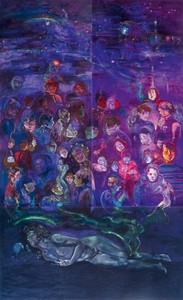
The most recent edition of Picture Books, an imprint organized by Emma Cline and Gagosian, pairs Mary Gaitskill’s novella STAUF: A Tragedy with Jill Mulleady’s painting The Shift. In celebration of this forthcoming publication, Gaitskill and Mulleady discuss the myth of Faust, good and evil in the digital age, and the channeling of raw matter into art.

Sally Mann joined novelist Amor Towles in a conversation about her widely celebrated new book, Art Work: On the Creative Life (2025), at an event hosted by the New School and the Strand in New York. Published by Abrams, Art Work is about the challenges and pleasures of the creative process. Its mix of illuminating stories, practical advice, and life lessons, illustrated throughout with photographs, letters, and journal entries, offers insights into Mann’s own experience of making art. Here, Mann and Towles speak about the writing process, historical ghosts, and fortunate mistakes.

The Quarterly’s 2026 fiction writer, Helen Oyeyemi, kicks off her series with the first installment, “Introduction to a Genie (of Sorts).”

The fourth and final installment of a short story by Catherine Lacey.

Francesca Wade’s new biography of Gertrude Stein sifts through the writer and collector’s layered life and legacy. Here, Wade speaks with the Quarterly’s Gillian Jakab.

The third installment of a short story by Catherine Lacey.

The second installment of a short story by Catherine Lacey.

The first installment of a short story by Catherine Lacey.

We present the final installment of a four-part short story by Arinze Ifeakandu.

We present the third installment of a four-part short story by Arinze Ifeakandu.

Katherine Bucknell, previously the editor of a four-volume edition of Christopher Isherwood’s diaries, has now published Christopher Isherwood Inside Out, an intimate and rigorous biography of the celebrated writer and gay cultural icon. Here she meets with Josh Zajdman to discuss the challenges and revelations of the book.