The real prize in writing, like in many religions, is an afterlife. This is what motivated Gertrude Stein to donate her archives to Yale and to task her partner, Alice B. Toklas, with complete posthumous publication. This is also what drew Toklas, an American Jew, to convert to Catholicism in her last years (she prayed she could jail-break Stein from limbo and reunite with her in heaven). And this is the organizing principle of Francesca Wade’s new biography. Divided into two sections, Gertrude Stein: An Afterlife offers an updated telling of the avant-garde writer’s life, followed by a take on the construction of her legacy over time. Here, Wade speaks with the Quarterly’s Gillian Jakab about solving archival mysteries, leaning into contradiction, and spotting Stein’s influence in the art world.
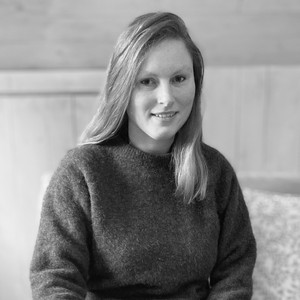
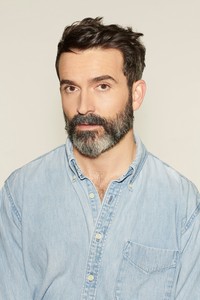
Francesca Wade is the author of Square Haunting: Five Writers in London between the Wars (2020). She has received fellowships from the Dorothy and Lewis B. Cullman Center, the Leon Levy Center for Biography, and the Harvard Radcliffe Institute, and her writing has appeared in the New York Review of Books, the London Review of Books, the Paris Review, Granta, and elsewhere. Photo: Nick During
Gillian JakabIt’s so nice to meet you. I’ve been lugging around my well-worn galley of An Afterlife for months, so it’s like you’ve been with me all summer. In the prologue you write how you, like many people, first knew Gertrude Stein as something like myth, a figure of early-twentieth-century Paris romanticized by art-history students and caricatured in works like Woody Allen’s Midnight in Paris (2011). You were able to get beneath the surface with some new research material that had become available. Could you say a little about what brought you to this project? How it began?
Francesca WadeThe project originated in reading Janet Malcolm’s book Two Lives: Gertrude and Alice [Yale University Press, 2007]. I was especially drawn to the story she tells of Leon Katz, a scholar who interviewed Alice B. Toklas in the 1950s but never published their conversations. Malcolm’s interest was primarily in the proprietorial nature of scholarship and the rivalry between different players in the field, but after reading I wondered what had happened to that Toklas material since the publication of Malcolm’s book. Had Katz responded? Had he published? When I looked him up, I discovered he died in 2017 and that his papers now seemed to be at the Beinecke Library at Yale. I was coming to New York anyway so I decided to make a trip to see them without thinking at that point I would write a book.
And the project expanded from there. I initially wanted to write about Leon Katz and finish that story, but then realized that actually this material gave a whole new way into the story of Stein and her life. It also shed light on questions I’d got very interested in from writing my last book, Square Haunting[: Five Writers in London between the Wars, 2020], about the ways in which legacies are constructed and history made by the gatekeepers who shape those legends. Stein seemed like an excellent case study for an inquiry into the nature of biography. And then it just grew beyond that because I got more and more fascinated by her work.
GJIt’s an impressive feat of a project. What’s something surprising you found in the archive?
FWThere were two main archive trips. The first was to see Leon Katz’s research files, which provide such a fascinating commentary on the vast Stein archive, like a para-text. It’s been catalogued since, but when I went to see it the boxes were in pretty chaotic order. There were printed emails, unsent letters to the New Yorker complaining about Janet Malcolm’s book [laughter]. . . . It was a history of his research. It starts off with this notebook he had with him when he was in Paris interviewing Toklas and scribbling frantically. It’s unclear whether he was taking notes as they spoke in the absence of a Dictaphone; he wrote later that at some point, in order to make her feel more comfortable, he stopped taking notes in front of her and would go home later and write things up, which obviously brings up questions of memory, what’s on and off the record, how far he was constructing the story of the conversations, and how careful and controlled Toklas was in the way she spoke to him, because she was very wary of interviews. So that early research was in the archive as well as the next fifty years of his scholarly trajectory.
Katz was a fascinating character; he wrote plays about his time with Toklas, so there are many fictionalized versions of the interviews, which add even more mystery to what actually happened between them. And while I’m interested in trying to find out what happened, I’m also aware that’s never going to be possible. And actually, untangling the protective myths of the stakeholders in this complex historic power dynamic is so interesting in relation to what a biographer is always doing: trying to impose a narrative on a life. It involves so many choices, not even conscious ones: whom you talk to, what material survives. And for someone like Stein, who was so much a self-mythologizer and had friends who were such self-mythologizers, there are just so many stories and anecdotes and preconceptions to wrestle with, which made her such a tantalizing subject.
GJYou decided to structure the story in two parts, “Life” and “Afterlife.” There’s narrative continuity; Part One ends at Stein’s death and Part Two picks up with the public announcement of it. So “Afterlife” continues chronologically in some ways, detailing the efforts of others to guard Stein’s legacy and tell of Toklas’s life afterward. But you also revisit some of the stories introduced in Part One, now with some of the new information. I was wondering how that structure came about: What was the process?
FWWhen I originally came up with the idea of the book, I thought it would just be the afterlife. I planned to write this biography of Stein where she wouldn’t actually appear on stage—it would start at her death and make a comment on the way biography is always a construct, always piecing together material from what we have when the person is no longer around to talk. But a couple of years into that process, I realized there was just too much background information I needed to fill in first. To understand why something is a revelation when it’s found in the archive, you have to know why Stein left the story out of her own memoir, for example. And then by the time you’ve gone back and explained all of that, it’s less of an exciting discovery.
So at some point I hit on this idea of a story in two halves, with the first half leaning on the way that Stein told the stories and the second half delving into the archive and giving Toklas more of a voice—because she’s quite a shadowy figure in the first half of the book, as she was to most of their friends in Stein’s lifetime. By moving a lot of the narrative to the first half, it meant that the second half could be much more focused on the chronology of Toklas coming into this new role as the steward of Stein’s legacy and taking on this job that was just as devotional as the one she had in Stein’s lifetime, but in honor of a memory rather than of a person. It brought up all these moral and ethical dilemmas for her, having to second-guess how Stein would have wanted her to behave and deciding what to do when that came into conflict with her natural desire for privacy, I think.
GJYou mentioned the friends who were part of Stein’s self-mythology. The prime example, of course, is Picasso. Stein’s friendship with and portrait by Picasso become essential to her concept of genius. What do you think drew her to him early on, and how did their relationship develop?
FWI think it became very important to her to link them together. It’s interesting to probe why. The thing that Leon Katz discovered in the archive, the thing that led Toklas to let him in to do these interviews, was a set of notebooks, almost a diary of Stein’s first decade in Paris, when she met Picasso. It’s interesting to see how much he comes up in those notebooks; she was clearly quite fascinated by him and by the direction his work was taking. The myth she liked to tell was that painting her portrait brought him out of the Rose Period and into Cubism.
GJBecause of its angular, kind of masklike quality?
FWYeah, exactly. And while he was painting, she was in her mind writing Melanctha (1906), which she describes as the first step in literature out of the nineteenth century into the twentieth. So it worked very well for Stein to position those two dramatic modern developments as stemming from the same moment, from this intense gaze between the two of them.
By the time Stein was propounding this myth, Picasso had achieved enormous commercial validation and she had not. So I think yoking their names together was important. But Picasso was a pretty constant friend through her life, apart from a few periods when they stopped speaking shortly after the Autobiography of Alice B. Toklas (1933). He told her he was starting to write poetry and she was famously furious and said, “Painting belongs to you and poetry belongs to me.” There was an interesting tension there, in wanting to keep something for herself—their friendship in a way relied on them having different mediums. But Picasso was really loyal to Toklas after Stein’s death and paid some of her hospital bills later in life. There’s a bit of a conception that they fell out but actually he was there for Toklas to the end. Stein collected his early work, but she was priced out of him pretty quickly; that maybe was no bad thing for the intellectual friendship.
GJStein’s life story could almost be told through the lens of her art collection, from when she first joined her brother Leo in Europe, and they began buying paintings together, to the splitting of the collection when their tastes diverged and rivalry set in, the guarding of it during the war, the selling of it to self-publish her work and afterward for Alice to live on, and eventually the reunification of the collection in museums.
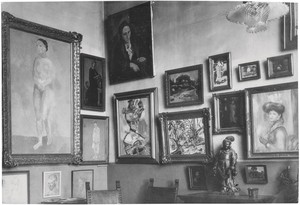
Pablo Picasso’s portrait of Stein (1906) hangs at the top corner at 27 rue de Fleurus, Paris, c. 1913, Gertrude Stein and Alice B. Toklas Papers, Yale Collection of American Literature, Beinecke Rare Book and Manuscript Library
FWThe bulk of the collecting, or the famous part of it, she did with Leo when she was working quite privately and hadn’t yet started her ascent to fame. So I think, in a way, she had a very private, personal relationship with the art, because it surrounded her—she wrote with the paintings around her. She describes how Cézanne’s portrait of Madame Cézanne [Madame Cézanne with a Fan, 1878/88] gave her whole new ideas about how to fill space and achieve representation; she was often staring at it, and I think Picasso would come round and stare at it too. So having that very intimate relationship with art was certainly formative for her, and the way Stein’s writing uses shapes and colors must be influenced by the experience of writing surrounded by shapes and colors. I think that’s why she was so interested in what Picasso was onto, breaking out of traditional forms, because she was looking for ways to do that too.
She’d come out of medical school and had a scientific background; she trained with William James at Harvard and then at Johns Hopkins, where she spent about a year researching the brain stem and doing quite serious neurological work. So to have that background, and then be immersed in this world of modern art, and putting that into the domestic space, was quite a heady confluence. She split with Leo in 1913, after Toklas moved in; she and Toklas then continued to collect together, and to rearrange the paintings and bring in new artists and sell off old things when they needed to. The collection is totally inextricable from her writing, not least because financially it made the writing possible. She was set up by her eldest brother with an invested income, which enabled her and Leo to start the collection. And then once everything became valuable, she knew that she could sell paintings at any time. She was quite unsentimental, I think, about parting with her artworks if it enabled her to do something she wanted to do, like publish her own books or buy food during the war.
GJI like the way you describe Stein creating shapes and experimental forms of words on the page. In the biography there are some lovely passages where you engage with her writing and offer a bit of literary analysis, but not in an overly academic way. I’m curious what your experience was like engaging with the prose as a way into Stein’s story—especially in her more experimental and “difficult” style.
FWHaving now been immersed in her writing for so long, I’ve attuned to her style in a way that I’ve forgotten what it’s like to encounter Stein for the first time—it’s obviously bewildering and disorienting. And I think what helped me, actually, was reading it aloud, because when you’re looking at it on the page, especially the early, repetitive style, your eyes glaze over and you think, Where’s this going? But when you start to read it out loud or hear it, you attune to the rhythms. It’s a bit like postmodern dance or minimalist music, the insistence of the beat or the movement. You’re looking out for these slight variations and they start to accumulate and stretch the possibilities until it reaches a kind of profundity that’s quite moving and powerful. Then in Tender Buttons (1914) she breaks away from that repetitive style and tries to put words together in ways they’d never been put together before. There’s a lot of humor in some of the juxtapositions and a kind of pleasure you can get from just hearing the way the words fit together—seeing what comes to mind.
It was quite liberating to remind myself that there’s no right or wrong way of reading Stein. I think that’s something people worry about: not getting it. It can be freeing to think that understanding isn’t actually the goal here, it’s something more procedural about experiencing the text and what it’s doing inside your head. People have always dismissed Stein’s work saying it just doesn’t make any sense, but it’s not meant to make sense. Instead, it rewards curiosity or a sort of openness to following the train of thought and seeing where it goes. And it’s just more fun, I think, to read it assuming it’s serious than assuming it’s not serious. Which is why I became fascinated by the ways other people have read Stein over the years, both scholars and artists, and I found it interesting to see how poets and dancers and musicians have taken up her work in making their own. Over the summer I went to see Lucinda Childs’s new dance Stein, for example, which reflects on language and repetition. Many artists have built on the possibilities they see in Stein’s work without being bogged down in what it’s “about.”
GJA lot of these contradictions and ambiguities come up with Stein. She desperately wanted to be accepted by her readers, but she rejected the idea of being “understood,” as you said. She paved a path for women and lesbians but rejected the feminist movement and reproduced patriarchal norms in her own way. Then there are opposing political stances she took up at different points in her life, shown by the hindsight of biography. How did you navigate these kinds of contradictions?
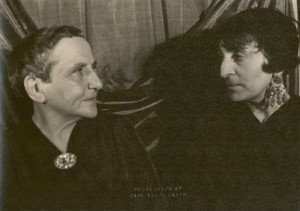
Stein and Toklas, November 1934. Photo: Carl Van Vechten, The Carl Van Vechten Trust, Gertrude Stein and Alice B. Toklas Papers, Yale Collection of American Literature, Beinecke Rare Book and Manuscript Library
FWI think by laying them bare, not trying to solve them. I write quite early on that I’m going for something like a Cubist portrait. I think Stein had multiple masks, if that’s the metaphor to go with, because she was always in one sense very public and loved to pose for photographs; she was very canny about the self-image she was projecting. I think a lot of the stuff that went on when other people were around was quite theatrical and done for show. And part of the relationship with Toklas was geared toward presenting a certain image in public, which has a lot to do with her wanting people to see her as a genius, and part of that involved having a wife who would welcome you in and show you what a genius her husband is. It was audacious, and obnoxious, and people didn’t really know what to make of their gender and relationship performance.
But I think what I really got from the archive was how different things were behind closed doors. Their relationship was actually much more collaborative and complex than the slightly reductive caricature that has come down to us. I think Stein just never wanted to be pinned down. She wanted to be singular and to confound. A lot of the contrarian things she said, I think, had to do with her wanting to shock and flout expectations. And to some extent it worked.
GJBefore reading An Afterlife I’d coincidentally seen two different performing-arts works grappling with some of the same material. A 2023 play by Renée Silverman, The Judgment of Josephine Baker, imagines Stein and Toklas at the gates of purgatory awaiting judgment from Baker. And there was a dance performance by Hallie Chametzky, The truth is the truth is the truth is the.
FWOh yeah, I’ve been in touch with her.
GJIt’s an interesting moment to look at Stein’s legacy, and perhaps her World War II years? The play cast Baker and her heroic work for the Resistance during the Occupation as a foil to Stein and Toklas’s rather murkier means of weathering the war. (A book about Baker’s Resistance efforts was actually published earlier this year.)1 But as you write, though there’s a wide gap between the heroes and the villains, most people were just trying to survive or didn’t fully know what was going on. It’s definitely not black and white. I was wondering, in our moment, as fascism looms large again, are there any lessons to draw from this today?
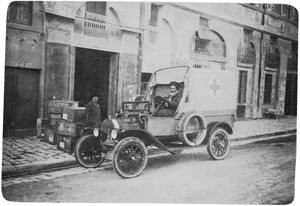
Stein and Toklas at work for the American Fund for the French Wounded during World War I, c. 1918, Gertrude Stein and Alice B. Toklas Papers, Yale Collection of American Literature, Beinecke Rare Book and Manuscript Library
FWBe a resistance hero, is probably the lesson [laughter]. I spent so long thinking about this because I’d come to this project reading Malcolm’s book, which had raised the question of how these two Jewish lesbians had survived the war. One of the Stein scholars Malcolm interviewed, Edward Burns, was doing research at the time in the French national archives and found a lot of new material about Bernard Faÿ, a close friend of Stein’s who had taken a job in the Vichy administration. Faÿ was prosecuted after the war for collaboration—he had led a campaign persecuting Freemasons. Stein died before his trial, and it’s important to remember that very little was known about the terrible things he was doing until much later. But Faÿ later claimed to have protected Stein and Toklas during the war. About five years after Malcolm wrote her book the scholar Barbara Will published another, Unlikely Collaboration (2013), which focused on the relationship between Faÿ and Stein and is very, very damning about him, but sort of implicates Stein by association. And that’s where it gets murky, because there’s actually not much evidence for what Stein knew during the war about what was going on outside the small village where she and Toklas lived. But these ideas got a lot of publicity, and people leapt on the friendship with Faÿ as a reason to vilify Stein. Her reception has always been plagued by misogyny and anti-Semitism and homophobia, in more or less veiled terms; now that there was a plausible association with fascism, even if the link was vague, it’s as if it was a relief to be able to dismiss her entirely.
Stein scholars have done a lot of work since 2011, methodically going through and weighing evidence, figuring out where she was, what she knew when, what the situation was for Jews in different areas of France. And what I wanted to do in my book was lay this out, and in no way whitewash Stein but provide a bit more context for some of the allegations that have been made against her, some with more basis, some with less. It did become apparent to people in France that the Vichy collaboration with the Nazis was vicious and murderous, but they didn’t know the full extent of it until 1945. News doesn’t travel so far in deep rural France but the rumors that were swelling around were enough to know that terrible things were happening, which obviously would have implicated Stein, being Jewish herself.
I did a lot of reading about how Jews in France survived in those times, because the statistic is that 75 percent of Jews in France did survive the war, which is notably higher than in Eastern European countries. And in recent years there’s been very interesting scholarly research done on the question, How did people survive? The stories that survivors tend to tell describe local neighbors and officials banding together in acts of resistance, not wanting to denounce people in their community when they realized that the Vichy government was collaborating with the Nazis. And Stein was close friends with the local prefect in the area where she lived for so long. So even if Faÿ told her that he’d offered her protection, I find it hard to see what that would have actually looked like in practice. I think it seems pretty clear that he did protect the art collection and managed somehow to keep that from being looted, but for her own safety I think it was probably the local neighbors who helped the most.
Going back to the contradictions, Stein did translate some speeches by [Vichy chief of state Philippe] Pétain, and it’s so ambiguous what the context of that project was. The translation’s very weird: It’s very literal, and it’s hard to see how, had it been published in that form, it could have inspired anyone to believe in him. But when she writes about Pétain she clearly has this kind of nostalgic attraction to the idea of the great male leader saving the country and protecting the people. She changes her mind over the course of the war, a shift tracked in her book Wars I have Seen (1945): By the end, she grudgingly admits that Pétain had not turned out as she’d hoped. But I think this attachment to the idea that he was going to save France also comes from Stein’s deep need for solitude and peace. In hindsight that’s hard to justify, compared to someone like Baker, who risked her life working for the Resistance. But I think what Stein really wanted, when the war began, was just to write and be with Alice and stay in France, where they knew people, and avoid disruption as far as she possibly could. So when she hoped the armistice was going to mean that life could basically carry on, she wasn’t looking far outside herself. It’s a selfish position, but I think it was just her position. It’s very hard to untangle what she was doing for self-protection and what she was doing for ideological reasons, or from loyalty to a friend rather than loyalty to his position. I knew it had to be an important part of the book, but I also didn’t want it to become too much the focus because I don’t think Stein’s politics or her wartime activities are the most interesting things about her. It’s her writing that’s the reason she lives on.
GJThere was that constant fear of her being known for her persona and salon rather than for her work.
FWAnd in a way, the war may have become part of the legend. It’s another myth that has ballooned and become distorted until people can say, as they have to me, Wasn’t Stein a Nazi? And no one has ever suggested that! She always spoke against Hitler, she never denounced anyone, she never went to a fascist rally.
GJShe was surviving as a Jewish American in France.
FWExactly. The relish with which people seem to have latched onto the idea that there must be something suspicious about her is sort of interesting.
GJYour first book was about the lives of different women writers in London. Are you working on anything next?
FWYeah, my next idea is to do with women poet activists in ’70s New York. I’m in the very early stages, but I’m thinking about poets like Adrienne Rich and Audre Lorde, whose work was inextricable from their political commitments and who saw what they were doing with language as part of their broader politics.
GJA group biography—it sounds like there will be many, maybe conflicting voices in this story.
FWYeah—as we’ve seen, the reasons they contradict each other are usually what’s most interesting. And then there’s the archive, which has its own tales.
Francesca Wade is the author of Square Haunting: Five Writers in London between the Wars (2020). She has received fellowships from the Dorothy and Lewis B. Cullman Center, the Leon Levy Center for Biography, and the Harvard Radcliffe Institute, and her writing has appeared in the New York Review of Books, the London Review of Books, the Paris Review, Granta, and elsewhere. Photo: Nick During