
Now available
Gagosian Quarterly Summer 2026
The Summer 2026 issue of Gagosian Quarterly is now available, featuring Ellen Gallagher’s Fast-Fish and Loose-Fish (2026) on the cover.
April 3, 2026
Sharad Chari reflects on a recent visit to Ellen Gallagher’s studio in Rotterdam, Netherlands, thinking through the artist’s intertextual interrogation of the oceanic and the ways in which her practice is informed by a wider Black intellectual and artistic world, an abiding interest in Herman Melville’s Moby-Dick, and the imperatives that surround this studio by the Port of Rotterdam.
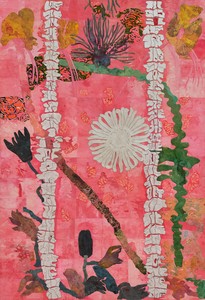
Ellen Gallagher, Fast-Fish and Loose-Fish, 2026, oil, pigment, palladium, and paper on canvas, 116 ⅝ × 79 ½ inches (296.1 × 202.9 cm). Photo: Thomas Lannes
Ellen Gallagher, Fast-Fish and Loose-Fish, 2026, oil, pigment, palladium, and paper on canvas, 116 ⅝ × 79 ½ inches (296.1 × 202.9 cm). Photo: Thomas Lannes
As we look out the window of the train speeding through the Dutch countryside, Ellen Gallagher muses about a scene in Renata Pinheiro and Sérgio Oliveira’s film Açúcar (2017) in which a ship glides over a field of sugarcane. Turning to me, she remarks that seventeenth-century Dutch princes flooded these lowlands in watery defense against invasion. “You see, dew becomes a momentary ocean,” she offers, as if in explanation. In the next breath, she describes eels crossing the fields at twilight. “Imagine a cow looking in surprise at eels crossing!” We laugh. Gallagher tells me that she began her series Watery Ecstatic in these nether-lands, in a sea of references.
I am a human geographer, which means I am interested in all kinds of geo-graphia, or earthly and oceanic writing that might respond to our burning planet. I am also an enthusiast of this artist, whom I had traveled to meet in order to understand her oceanic practice, particularly the series Watery Ecstatic (2001–), Ecstatic Draft of Fishes (2019–), and Fast-Fish and Loose-Fish (2023–), in relation to earlier works like the Dew Breaker (2015) paintings exhibited in the 2015 Venice Biennale curated by Okwui Enwezor.
Gallagher’s entire corpus is oceanic; it is characterized by upwellings of matter and form, and by imperatives that return in unpredictable yet insistently creative ways. Her oceanic paintings respond to Édouard Glissant’s salutation drawn from Surrealist poetry—je te salue, vieil Océan!—but with Derek Walcott’s patient attention to the “grey vault” for its storied turbulence.1 There are many stories, influences, citations, paintings, and texts submerged within each piece. Here, I reflect on one day in the company of this singular thinker, to offer preliminary thoughts on what Gallagher sees while submerged, as she invites us to descend to the seabed.
We had been speaking at Amsterdam’s Stedelijk Museum in front of her tetraptych Negroes Battling in a Cave (2016), her wry take on Kazimir Malevich’s impossible claim to pure abstraction. We discussed how the selections from the Stedelijk’s collection in this set of rooms, titled “Tomorrow Is Another Day,” were in conversation with the landmark 2016 Pace Gallery exhibition Blackness in Abstraction curated by Adrienne Edwards. A striking work at the Stedelijk by Julie Mehretu abstracts in transparent form the photography of political turbulence. This piece is encased by a metal sculpture by Nairy Baghramian—a combination that, to paraphrase Gallagher, displays Black queer women working as a crew.
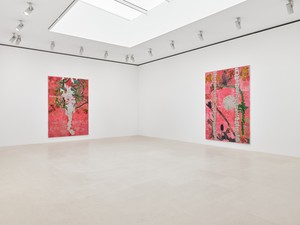
Installation view, Ellen Gallagher: Fast-Fish and Loose-Fish, Gagosian, Paris, March 26–May 23, 2026. Photo: Thomas Lannes
Earlier that morning, we had begun a complex dialogue about artists’ legacies, and why the topic is so important for some, and so fraught for others. Consider Francis Bacon, Gallagher says, and the way his studio was repatriated to Dublin despite his own sense of permanent exile. His reconstructed studio at Hugh Lane includes the swabs of color on a door that Gallagher speculates has inspired so many artists’ spot paintings, but it also shows something about the enduring power and insight of the non-virtuosic brushstroke. Non-virtuosic labor is important to Gallagher, and it returns in her seabed paintings.
A different approach to the question of legacy—though she didn’t tell me this—is modeled by Gallagher, Mehretu, and their artist comrades Adam Pendleton and Rashid Johnson, who came together to purchase Nina Simone’s childhood home in Tryon, North Carolina. Working as a crew, they partnered with the African American Cultural Heritage Action Fund not just to restore the home, but to secure it in perpetuity.2 This is another kind of upwelling or materialization in the face of capitalism’s unrelenting transformation of all landscapes—indeed, of the entire planet.
I begin with this rush of ideas in conversation, in medias res, as we make our way to the Stedelijk and back to Gallagher’s studio by the Port of Rotterdam, as it conveys something essential about this thinker: her imaginative capacity to transport us to various places, including the bottom of the sea, and her commitment beyond the dictates of the art market to the collective labor necessary to sustain the capacities of others. In other words: Remember your crew!
All this crew talk reminds me to introduce another figure in our conversation, a most important witness to our planetary plight. But for now, he is silent. This is Pip, “a young Black cabin boy” in Herman Melville’s 1851 novel Moby-Dick. Generations of Black thinkers have been drawn to this figure as one place to find the abiding “real or fabricated Africanist presence” in American literary and cultural life, in Toni Morrison’s succinct formulation. Tired of fighting Black erasure and misrepresentation, at some point Morrison says she “stopped reading as a reader and began to read as a writer” to discern the background racial order of things, its grids of intelligibility and dissimulation.3 As I recall the wall of books in Gallagher’s studio, I think about how she reads as a painter, and paints as a reader as well.
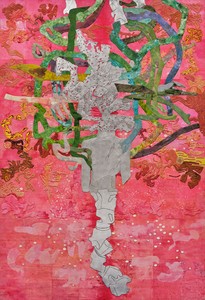
Ellen Gallagher, Fast-Fish and Loose-Fish, 2025, oil, pigment, palladium, and paper on canvas, 116 ⅝ × 79 ½ inches (296 × 202 cm). Photo: Thomas Lannes
Throughout our conversation, Gallagher points to various milieus of reading and thinking, like the witty, self-referential conversations at the Dark Room Collective at 31 Inman Street in Cambridge, Massachusetts, which hosted luminaries like Alice Walker, Samuel Delany, and Derek Walcott, and produced many more. Their origin story is that some of them attended James Baldwin’s funeral in December 1987, at which Amiri Baraka invoked Baldwin’s spirit, “the spirit of life thrilling to its own consciousness.”4 As a dear friend puts it: This is the haunting we want!
Gallagher also recalls the OutWrite queer literary conferences of the early 1990s. And then, “Gina Dent made a salon from the UK to New York City,” by which Gallagher refers in shorthand to a landmark three-day event in December 1991 organized by Michele Wallace at the Studio Museum in Harlem and at Dia in SoHo, which brought together Black British and American intellectual currents, culminating in Dent’s edited Black Popular Culture, a signal text for capturing in its “Discussion” interludes the eros of this Black Atlantic encounter.5 All of which is to say that Gallagher is from that hazy world before the internet, when sites of intense interaction like these could be generative of profusions of artistic work. For Black cultural politics on both sides of the pond, these were particularly freeing moments in what we might now think of as the long counterrevolution since the 1980s.
A different kind of engagement with Blackness is at the eye of this maelstrom. As an astute interlocutor, Robin D. G. Kelley, argues, Gallagher “confounds critics who regard her as one of several black artists exploring racial identity and stereotype, as well as those who assert, with a sense of relief or surprise, that she ‘transcends’ a politics of race and identity.” Instead, “Gallagher employs and remixes historically burdened signs, ephemera, narratives, materials, to confound and challenge us to plumb the depths—whether it be the ocean, memory, skin, or the layers that comprise her paintings.”6 Consider Gallagher’s insight that Black performance of blackface minstrelsy marks a key moment in the history of American abstraction, so that to turn to its ephemera is to paint with Morrison’s writerly injunction to attend to Africanist presence within the canon. As Gallagher says to me more generally about her work, it has been about “activating humanity in the smallest space, making elastic what is static.”

Ellen Gallagher in her studio in Rotterdam, Netherlands. Photo: Marlena Waldthausen/laif/Redux
This is precisely why David Hammons is so important to Gallagher, as a Black artist whose artworks, as Glenn Ligon puts it, are “always too Fellini, too carnivalesque, too damn freaky-deke to be useful as a set of cheering fictions, an expression of an essential, unchanging blackness.”7 Sampada Aranke notes that Hammons’s “deformation of mastery strives toward a wink at the canonical” while indexing Blackness in glancing ways.8 Hammons attends insistently to materiality and embodiment, to the everyday, and to the non-virtuosic. In his basketball paintings, or in kicking a bucket around New York City pavements in Phat Free (1995/99), or in his attempt to make Dak’Art 2004 responsive to the Senegalese public in Sheep Raffle,9 Hammons’s embodied performance prefigures a future without property or propriety.
Gallagher’s parallel move to the demotic might be in her use of penmanship paper as the first layer over canvas; it is a medium that messages the school exercise book, the draft, or structure for improvisation. Penmanship paper also marks Gallagher’s tarrying with grids, including grids of signification, as in “our impulse to locate blackness within a knowable sign.”10 As Gallagher goes to the undersea—inspired in part by Detroit techno group Drexciya’s invention of an underwater Black civilization birthed by slaves who jumped into aquatic fugitivity—the paper is increasingly wet, stained, and color saturated. As the penmanship paper changes form in Gallagher’s hands, Kelley argues that it becomes “ever more fugitive,” more regenerative, but also under conditions not of its making: “Drexciya is not Utopia. It blooms under siege.”11
In Carol Armstrong’s meditation on the materiality of Gallagher’s craft, penmanship paper, stuck and washed, makes the grid more “wave-like.” Armstrong notes Gallagher’s labors “of cutting and collaging, of digging into and building up, of subtraction and addition, accretion and layering,” part of the “medium-hybridity that is fundamental to her work—its simultaneous recourse to the strategies of drawing, writing, painting, collaging, constructing and the sculptural processes of carving and moulding, relief and intaglio printing, as well as xeroxing and other photo-based planographic means.” Armstrong calls it “an anti-illustrational politics at play” in refusing the primacy of text over image.12 I would also like to think of it as a labor politics, at a studio on one of the world’s great working harbors.
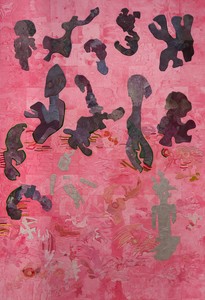
Ellen Gallagher, Fast-Fish and Loose-Fish, 2023, oil, pigment, palladium, and paper on canvas, 116 ½ × 79 ½ inches (295.9 x 201.9 cm). Photo: Tony Nathan
Pip clears his throat.
And so, we turn to Melville’s Moby-Dick, read with the contemporaneous 1840 J. M. W. Turner painting Slave Ship (Slavers Throwing Overboard the Dead and Dying, Typhon Coming On). I focus on just two aspects of Moby-Dick here: chapter 89, “Fast-Fish and Loose-Fish” (the title of a series by Gallagher), and Pip. I will be brief.
Chapter 89 begins with disputes between fishermen about who has rights to fish (or whales) that escape capture and are caught by another, perhaps with a harpoon, or “any other recognized symbol of possession.” Melville writes: “I. A Fast-Fish belongs to the party fast to it. II. A Loose-Fish is fair game for anybody who can soonest catch it.”13 Either way, Melville seems to think that the oceanic nonhuman is destined to become property, and that, as the saying goes, “possession is half the law,” which is to say that the law often presumes a thing’s possessor to be its rightful owner. “But often possession is the whole of the law,” Melville continues. In other words, he recognizes that all that we take to be property is in fact grounded in histories of racialized colonial conquest, and all that we take to be Loose-Fish might be as well in the future. Thus has it ever been, or so it seems:
What was America in 1492 but a Loose-Fish, in which Columbus struck the Spanish standard by way of waifing it for his royal master and mistress? What was Poland to the Czar? What Greece to the Turk? What India to England? What at last will Mexico be to the United States? All Loose-Fish. What are the Rights of Man and the Liberties of the World but Loose-Fish? What are all men’s minds and opinions but Loose-Fish? What is the principle of religious belief in them but a Loose-Fish? What to the ostentatious smuggling verbalists are the thoughts of thinkers but Loose-Fish? What is the great globe itself but a Loose-Fish? And what are you, dear reader, but a Loose-Fish and a Fast-Fish too?”14
To more carefully read this in relation to Gallagher’s seabed paintings, we must turn to Pip. We will see that he is both Fast-Fish and Loose-Fish, but also, for a time, something beyond both entirely.
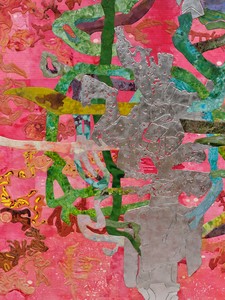
Ellen Gallagher, Fast-Fish and Loose-Fish, 2025 (detail), oil, pigment, palladium, and paper on canvas, 116 ⅝ × 79 ½ inches (296 × 202 cm). Photo: Thomas Lannes
Though he has been clearing his throat, Pip does not say much in the book. And not much is said about him. In one chapter, he plays the tambourine and jumps around and squeals and sings in the style of blackface minstrelsy as the men on the Pequod work together, bridging languages and histories; it is a scene to which the Black communist C. L. R. James is drawn for its promise of proletarian internationalism.15 We are told that Pip is Black in the same way that we do not know that the narrator who tells us to call him Ishmael is not Black, though the name Ishmael references the son of a biblical bondswoman, and he earns much less than most of the crew. We do know that whaling ships were a refuge for Black American men during the mid-nineteenth-century renewal of the Fugitive Slave Act, when bounty hunters terrorized people who tried to emancipate themselves.
Fast forward to the Pequod having traversed the Atlantic as well as, for the largest section of the book, the Indian Ocean. Pip falls into the sea from a whaleboat twice. The first time, he is rebuked that his rescue takes precious time from their pursuit—time that costs more than his price on an Alabama auction block. When he falls in a second time, he is abandoned for a while. Cast adrift, slowly sinking, he is afforded a new kind of submerged sight:
Carried down alive to wondrous depths, where strange shapes of the unwarped primal world glided to and fro before his passive eyes; and the miser-merman, Wisdom revealed his hoarded heaps; and among the joyous, heartless, ever-juvenile eternities, Pip saw the multitudinous, God-omnipresent, coral insects, that out of the firmament of waters heaved the colossal orbs. He saw God’s foot upon the treadle of the loom, and spoke it; and therefore his shipmates called him mad. So man’s insanity is heaven’s sense.16
A Black child laborer living with the threat of re-enslavement, thrown into the sea, and saturated with the depravity of his own species does not see redemptive visions of an Abrahamic deity, but rather of an “unwarped primal world” of “coral insects” and “ever-juvenile eternities” enmeshed in a loom-like aquatic weaving.
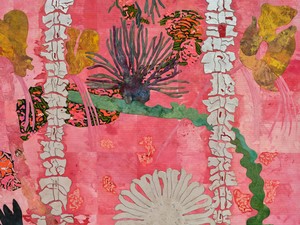
Ellen Gallagher, Fast-Fish and Loose-Fish, 2026 (detail), oil, pigment, palladium, and paper on canvas, 116 ⅝ × 79 ½ inches (296.1 × 202.9 cm). Photo: Thomas Lannes
Hovering between slave and free, Fast-Fish and Loose-Fish, Pip is an inescapable interlocutor in Gallagher’s descent to the seabed. She thinks of her oceanic paintings as increasingly saturated, but the base hues have shifted from blues to pinks; their different indexical associations in our time of media saturation point to intensifying warming and endangerment.17 Into this stained, cut, abraded layer, Gallagher presses and pools slivered forms. In some of the seabed paintings, we see figures that are a combination of whale vertebrae and transformed Fang figurines, upwellings from previous works. The Black aqua-futurism of Drexciya has now been woven into another reality.
As the palladium whalebone descends to the seabed, it feeds other life forms, like Osedax “bone-devouring” worms. Her seabeds continue to reveal to Gallagher “the warp and weft of a biometric tapestry.”18 The vertical seabed painting that I saw in formation on a contraption that let it slide up and down through the floor of Gallagher’s studio was of double vertebrae within the tentacles of plantlike fossil encrustations. As the painting literally punctures the studio floor, it reminds us that all around us in the port, people continue to labor on the docks. Not far away, cruise ships have been repurposed as offshore housing for refugees not yet allowed entrance into the Netherlands. Much remains dormant, alive to possibility, both within the work of art and in its surrounding milieu.
Zooming out, consider that more than half of the world ocean’s seabed is beyond national territorial jurisdiction and popular determination, despite being designated by the United Nations Convention on the Law of the Sea as “the common heritage of mankind.” Access to this vast oceanic common is regulated by a highly secretive body called the International Seabed Authority, with connections to private and governmental interests with the vast financial and technical resources necessary to capture its resources—to turn its untold wonders into Fast-Fish.
As we spoke in her studio, Gallagher observed that while in earlier works she worked on both sides of the canvas, punching through and then patching up the back that the viewer never sees, in the vertical paintings, these “non-virtuosic” aspects of the work are visible on the front. When we see the seabed paintings, we see Bacon’s door, the working port, the threatened seabed, and all that is afforded from outside the studio, beyond the precise intentions of the artist herself. Submergent visions in these seabed paintings might appear to us when we least expect them, from the unrepresentable totality or the unconscious that Melville grasps for, through a non-Abrahamic mysticism that Sigmund Freud refuses as an implausible oceanic feeling. A Black radical commitment turns instead to what it might mean to labor in this liminal zone with Gallagher’s ethic of “activating life in the smallest space, making elastic what is static,” where Loose-Fish might become something else. We regard this, with Gallagher and Pip, as a crew.
1 Édouard Glissant, Poetics of Relation (University of Michigan Press, 1997), 7; Derek Walcott, “The Sea Is History,” in Selected Poems (Farrar, Straus and Giroux, 2007), reprinted with permission at https://poets.org/poem/sea-history.
2 Carly Olson, “Saving the House That Gave Voice to Nina Simone,” Architectural Digest, November 17, 2025, https://www.architecturaldigest.com/story/nina-simone-childhood-home-tryon-south-carolina.
3 Toni Morrison, Playing in the Dark: Whiteness and the Literary Imagination (Vintage Books, 1992), pp. 4, 15. The latter phrase channels Michel Foucault.
4 Sophie Nguyen, “How the Dark Room Collective Sparked ‘Total Life’ in Literature,” Harvard Magazine, February 19, 2016, https://www.harvardmagazine.com/2016/02/elbow-room.
5 Gina Dent, ed., Black Popular Culture, Dia Center for the Arts Discussions in Contemporary Culture 8 (Bay Press, 1992).
6 Robin D. G. Kelley, “Confounding Myths,” in AxME, ed. Ellen Gallagher (Tate Publishing, 2013), pp. 8, 9.
7 Glenn Ligon, “Black Light: David Hammons and the Poetics of Emptiness,” in David Hammons, ed. Kellie Jones (MIT Press, 2024), p. 97.
8 Sampada Aranke, “How to See Like Hammons,” in David Hammons, p. 209.
9 Manthia Diawara, “David Hammons’s Sheep Raffle at Dak’Art 2004: Reading Black Art Through Léopold Sédar Senghor’s Négritude,” in David Hammons, pp. 113–24.
10 Kelley, “Confounding Myths,” p. 18.
11 Kelley, “Confounding Myths,” p. 18.
12 Carol Armstrong, “Mythopoetics and Materials,” in AxME, pp. 22–23.
13 Herman Melville, Moby-Dick, ed. Hershel Parker (W. W. Norton, 2018), p. 295.
14 Melville, Moby-Dick, pp. 296–97.
15 C. L. R. James, Mariners, Renegades and Castaways: The Story of Herman Melville and the World We Live In (1953; repr., Dartmouth College Press, 2001).
16 Melville, Moby-Dick, p. 308.
17 Stefan Helmreich, “The Colors of Saturated Seas,” in Saturation: An Elemental Politics, ed. Melody Jue and Rafico Ruiz (Duke University Press, 2021).
18 Carol Armstrong, “Not Down in Any Map: The Art of Ellen Gallagher,” Artforum 62, no. 6 (February 2024): https://www.artforum.com/features/carol-armstrong-art-ellen-gallagher-548436/.
Ellen Gallagher: Fast-Fish and Loose-Fish, Gagosian, rue de Ponthieu, Paris, March 26–May 23, 2026
Artwork © Ellen Gallagher
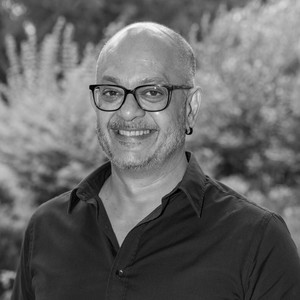
Sharad Chari is a geographer and a professor at the University of California at Berkeley interested in forms of earth-writing in a burning world. His books include Gramsci at Sea (2023) and Apartheid Remains (2024).
The Summer 2026 issue of Gagosian Quarterly is now available, featuring Ellen Gallagher’s Fast-Fish and Loose-Fish (2026) on the cover.
Text by Salamishah Tillet.
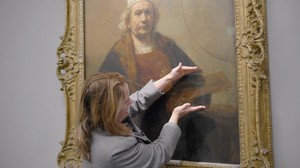
Jenny Saville reveals the process behind her new self-portrait, painted in response to Rembrandt’s masterpiece Self-Portrait with Two Circles.
The Summer 2019 issue of Gagosian Quarterly is now available, featuring a detail from Afrylic by Ellen Gallagher on its cover.
The Spring 2019 issue of Gagosian Quarterly is now available, featuring Red Pot with Lute Player #2 by Jonas Wood on its cover.

Ellen Gallagher in conversation with Adrienne Edwards.
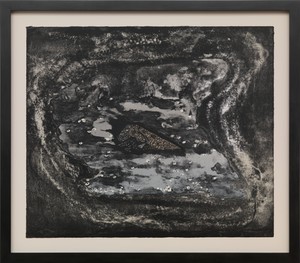
Philip Hoare, author of The Whale and The Sea Inside, creates a narrative about Ellen Gallagher’s newest lithograph, Lips Sink.
Ahead of Alex Israel’s exhibition of four new Fin sculptures at Gagosian, London, the artist spoke with Susan Casey, author of The Wave: In Pursuit of the Rogues, Freaks, and Giants of the Ocean (2010), about the ocean, surfing, and Los Angeles.

On July 9, Simon Hantaï: the last studio opens at Gagosian, Gstaad. Curated by Anne Baldassari, the show comprises sixteen of the artist’s dernier atelier (last studio) paintings of 1982–85. The exhibition is accompanied by an illustrated catalogue, copublished by Gagosian and Skira, which features an essay by Baldassari and an extensive portfolio of previously unpublished photographs by Édouard Boubat. Here, we share the introductory chapter from the publication.

Adam D. Weinberg has been working with Giuseppe Penone on an exhibition of the artist’s new sculptures, The Reflection of Bronze, that opens at Gagosian, New York, on April 22. The works explore the character and possibilities of bronze. Here, Weinberg considers Penone’s enduring engagement with the alloy and addresses the conceptual underpinnings of the exhibition’s three-room structure.
Laura Bruni writes about a major exhibition celebrating the work of the British sculptor Henry Moore at the Royal Botanic Gardens, Kew, London.
On the occasion of Baselitz: AVANTI! at the Museo Novecento in Florence, Italy, Holly EJ Black considers the roots and reverberations of Georg Baselitz’s printmaking.