
Now available
Gagosian Quarterly Summer 2026
The Summer 2026 issue of Gagosian Quarterly is now available, featuring Ellen Gallagher’s Fast-Fish and Loose-Fish (2026) on the cover.
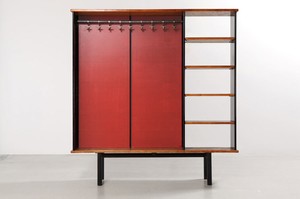
Jean Prouvé
Vestiaire Antony, 1956
Bent sheet steel, wood, and Isorel, 74 3/16 × 70 ¼ × 13 ¾ inches (188.5 × 178.5 × 35 cm)
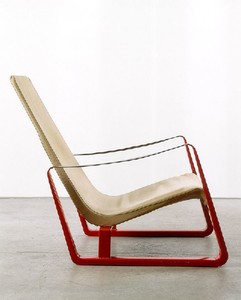
Jean Prouvé
Cité armchair (red), c. 1933
Metal, leather and canvas, 33 ⅜ × 27 ½ × 35 ⅜ inches (85 × 70 × 90 cm)
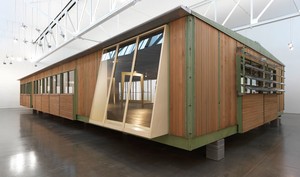
Jean Prouvé
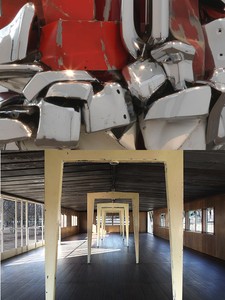
Ferembal Demountable House, 1948
Metal, wood, aluminum, and glass, 137 13/16 × 933 1/16 × 417 5/16 inches (350 × 2,370 × 1,060 cm)
Photo by Rob McKeever
Jean Prouvé was born in Nancy, France in 1901, where he died in 1984. He is widely acknowledged as one of the twentieth century's most important and influential designers whose wide-ranging oeuvre combined bold elegance with economy of means and strong social conscience. Working as a craftsman, designer, manufacturer, architect, teacher, and engineer, his career spanned more than sixty years, during which time he produced prefabricated houses, building components and facades, as well as furniture for the home, office and school. Prouvé has played a pivotal role in the development of cutting-edge technology and modular systems for mass production in the post-war modernist period.
Prouvé trained as an artisan blacksmith and his intimate knowledge of metal remained the foundation of his work and career. Aware of the limitations of ornamental and wrought-iron work and keen to embrace the modern movement, he moved on to steel and aluminum, folding and arc-welding. In 1931 he established the Atelier Jean Prouvé, where he began to produce light-weight metal furniture of his own design, as well as collaborating with some of the best-known designers of his time, including Le Corbusier and Charlotte Perriand. Furniture production became a core part of his business. He favored the public sector in the growing areas of health, education and administration, which reflected a social ideal but also offered the economies of scale. By 1936 he was producing a catalogue of standard models for hospitals, schools and offices. The potential for mass production inspired Prouvé to develop and patent industrial products using folded sheet metal for the construction of buildings. These included movable partitioning, metal doors and elevator cages.
The onset of WWII and the age of austerity that followed marked a period of enforced experiment for Prouvé and in 1947 he moved his operations to Maxéville, just outside Nancy. With his own design studio, he could combine research, prototype development and production. At Maxéville he set about fulfilling his ambitious plan to alter the building process from a craft-based practice to that of a mechanized industry, producing not only houses, prefabricated huts, doors, windows, roof elements and façade panels but also a production line for furniture based on his own designs. It was in this creative environment that the prefabricated refugee houses of 1945 were developed, followed by the flat-packed, tropical houses for Niger and the Republic of Congo in 1949 and 1950.
His work is included in private and public collections worldwide, including Centre Georges Pompidou, Paris and Museum of Modern Art, New York. Major exhibitions include “Jean Prouvé: Constructeur, 1901–1984,” Centre Georges Pompidou, Paris (1990–91); “Jean Prouvé: Three Nomadic Structures,” Pacific Design Center, Museum of Contemporary Art, Los Angeles (2005); “Jean Prouvé: A Tropical House,” Hammer Museum, Los Angeles (2006); “Jean Prouvé: The Poetics of the Technical Object,” Vitra Design Museum, Weil am Rhein, Germany (2006–07, traveled to Kamakura Museum of Modern Art; Deutsches Architekturmuseum, Frankfurt; Netherlands Architecture Institute, Maastricht; Hotel de Ville de Boulogne-Billancourt, Paris; Design Museum, London; and Museo dell'Ara Pacis, Rome, among other venues); “Ateliers Jean Prouvé,” Museum of Modern Art, New York (2008-09); a multi-exhibition, multi-venue tribute at Musée des beaux-arts, Nancy, France (2012); and “A Passion for Jean Prouvé: From Furniture to Architecture,” Pinacoteca Agnelli, Turin (2013).
The Summer 2026 issue of Gagosian Quarterly is now available, featuring Ellen Gallagher’s Fast-Fish and Loose-Fish (2026) on the cover.

In this video, Jenny Saville sits down inside her first major exhibition in Venice to discuss how the great Venetian artists of the past and the city’s heritage influence her work. The show brings together more than thirty canvases and works on paper from the 1990s to the present, tracing the development of her practice, which is deeply rooted in the history of painting.
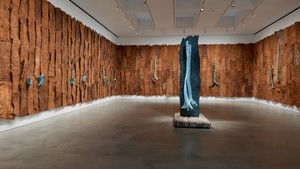
On the occasion of his exhibition The Reflection of Bronze at Gagosian, New York, Giuseppe Penone and curator Adam D. Weinberg sit down to discuss the genesis of, and their collaboration on, the show.
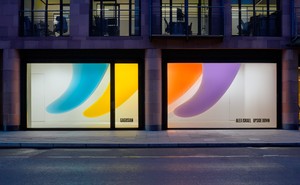
Ahead of Alex Israel’s exhibition of four new Fin sculptures at Gagosian, London, the artist spoke with Susan Casey, author of The Wave: In Pursuit of the Rogues, Freaks, and Giants of the Ocean (2010), about the ocean, surfing, and Los Angeles.
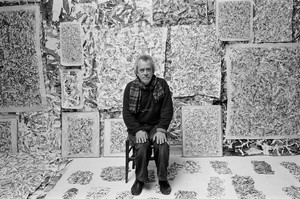
On July 9, Simon Hantaï: the last studio opens at Gagosian, Gstaad. Curated by Anne Baldassari, the show comprises sixteen of the artist’s dernier atelier (last studio) paintings of 1982–85. The exhibition is accompanied by an illustrated catalogue, copublished by Gagosian and Skira, which features an essay by Baldassari and an extensive portfolio of previously unpublished photographs by Édouard Boubat. Here, we share the introductory chapter from the publication.
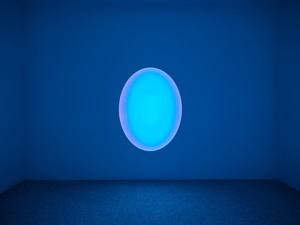
An exhibition at Gagosian, Hong Kong, brings together three of James Turrell’s Glasswork pieces along with site plans, photographs, and models of his Skyspaces and Roden Crater. Here, Alice Godwin explores the history of the Glassworks and their relationship to the artist’s wider practice.

On April 16, the Institute of Contemporary Art, Boston, opened the first midcareer survey of Derrick Adams’s multidisciplinary practice. Covering over twenty years of work, the exhibition, titled View Master, brings together the artist’s painting, sculpture, collage, performance, and video, as well as a vibrant new commission created for the museum’s façade. Ahead of the opening, Adams met with Tessa Bachi Haas, cocurator of the survey, to discuss his formative experiences with television, the impact of his work in arts education on his practice, and the importance of taking a more complex, more joyful, and more expansive approach to Black American life and culture.

Adam D. Weinberg has been working with Giuseppe Penone on an exhibition of the artist’s new sculptures, The Reflection of Bronze, that opens at Gagosian, New York, on April 22. The works explore the character and possibilities of bronze. Here, Weinberg considers Penone’s enduring engagement with the alloy and addresses the conceptual underpinnings of the exhibition’s three-room structure.

Jeff Koons tells Alison McDonald about his appreciation for the pioneering artist and thinker Marcel Duchamp.
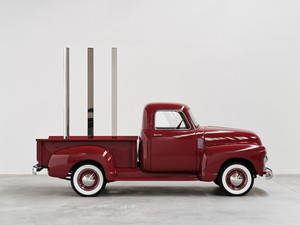
The Singular Experience at Gagosian’s Le Bourget gallery is the largest exhibition of Walter De Maria’s work in France in several decades. Organized by Donna De Salvo, senior adjunct curator at Dia Art Foundation, the exhibition marks the first time De Maria’s final sculpture, Truck Trilogy (2011–17), is being shown outside of the United States. Here, De Salvo speaks with artist Lucy Raven about her evolving kinship with De Maria and more.
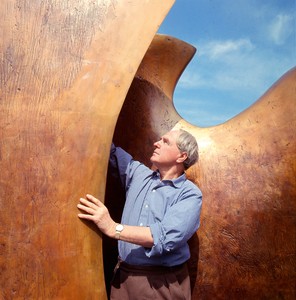
Laura Bruni writes about a major exhibition celebrating the work of the British sculptor Henry Moore at the Royal Botanic Gardens, Kew, London.
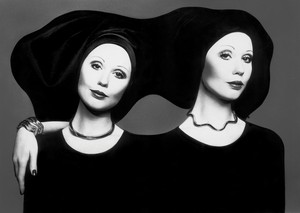
The exhibition Pomellato, Le Joaillier Révolutionnaire opened at Palais de Tokyo, Paris, on June 24. The Italian jewelry house’s trailblazing advertising campaigns—created by some of the most consequential names in photography—act as the narrative arc of the exhibition, curated by Alba Cappellieri. Here, Sarah Godfrey tracks Pomellato’s history, speaks with Cappellieri about what drew her to this project, and examines some of the key photographs from the show.


