
Now available
Gagosian Quarterly Summer 2026
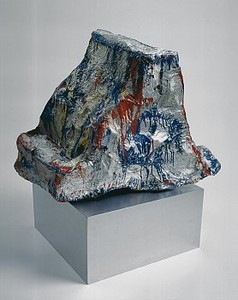
The Summer 2026 issue of Gagosian Quarterly is now available, featuring Ellen Gallagher’s Fast-Fish and Loose-Fish (2026) on the cover.
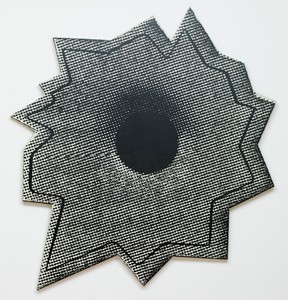
Nate Lowman
Green Escalade, 2005
Silkscreen on canvas, 75 × 70 ½ inches (190.5 × 179.1 cm)
© Nate Lowman
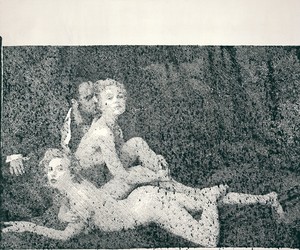
Nate Lowman
It’s nothing personal/Curtains, 2007
Acrylic on canvas, 48 × 72 inches (121.9 × 182.9 cm)
© Nate Lowman
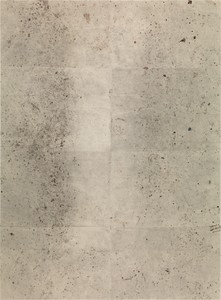
Nate Lowman
Joe Dirt, 2011
Dirt and sugar on canvas, 106 × 78 inches (269.2 × 198.1 cm)
© Nate Lowman
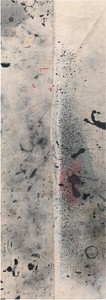
Nate Lowman
Down on Your Luck, 2012
Alkyd, dirt, oil, and dental floss on canvas, 90 ½ × 31 ½ inches (229.9 × 80 cm)
© Nate Lowman
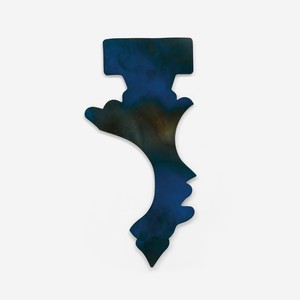
Nate Lowman
Eat Me, 2014
Oil on canvas, 61 × 30 inches (154.9 × 76.2 cm)
© Nate Lowman
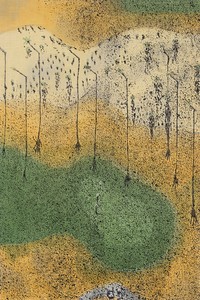
Nate Lowman
Fore, 2018
Oil and alkyd on linen, 71 ½ × 47 ½ inches (181.6 × 120.7 cm)
© Nate Lowman
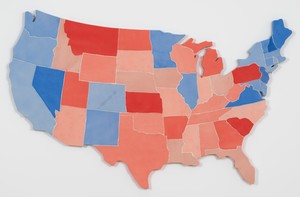
Nate Lowman
Nov 8, 2016, 2018
Oil and nylon thread on canvas, 47 × 79 inches (119.4 × 200.7 cm)
© Nate Lowman
I typically feel that good artworks are violent against the architecture that holds them.
—Nate Lowman
Nate Lowman collects and transforms the detritus of contemporary American life, reevaluating familiar signs and symbols. His alkyd paintings recall both blurred, photocopied images and fresh, inky tattoos, while his shaped canvases, text works, and screen prints transform smiley faces, bullet holes, word games, celebrities, and historical events into uncanny hieroglyphs for the present moment.
Lowman was born in Las Vegas and grew up in Idyllwild, California. When he was fifteen, he visited New York to see a Cy Twombly exhibition at the Museum of Modern Art. While there, he attended a poetry reading at St. Mark’s Church, where Patti Smith emerged from the audience and sang a few songs. He decided to move to New York, where he attended New York University from 1997 to 2001 and worked on weekends (and eventually full-time) as a security guard at Dia Center for the Arts (now Dia:Chelsea).
Since the early 2000s Lowman has used alkyd, a dense, shiny paint that he applies in thick dots into the surface of the canvas, mimicking the process of creating a tattoo. The resulting images echo the blurring that occurs when an image is repeatedly photocopied, common in DIY posters and zines. Alongside these works, Lowman created shaped canvases, depicting crossed-out smiley faces, doodled hearts and flowers, car air fresheners, and bullet holes. Several bullet-hole works were included in Lowman’s first solo show, The End. And Other American Pastimes, presented at Maccarone in 2005. The exhibition also featured found images from newspapers, signs, and ads that attested to Lowman’s fascination with youth, innuendo, masculinity, and violence.
Lowman’s practice varies widely: he has exhibited cars and gas pumps, incorporated found objects and signs, and hung his works salon-style, filling gallery walls with canvases of various shapes and sizes. For his exhibition at Midway Contemporary Art, Minneapolis, in 2006, Lowman provided artists Dan Colen, Adam McEwen, Josh Smith, Agathe Snow, John Tremblay, and Aaron Young with rejected bullet-hole canvases and asked that they use them to create new works. Applying the tactics of advertising and endorsement to the post-1990s art world, Lowman then paired each of the artists’ works with his own promotional add-ons, including newspaper photocopies and hand-painted texts, providing a critical commentary on celebrity culture and collaboration. After participating in several group shows from 2006 to 2009, Lowman began a series of paintings inspired by Willem de Kooning’s 1954 series Marilyn Monroe, reinterpreting de Kooning’s style and subject using the colors of 1980s surfboards. These were included in I Wanted to be an Artist but all I got was this Lousy Career (2012–13), a solo exhibition at the Brant Foundation Art Study Center, Greenwich, Connecticut. For this show, Lowman created a room-sized installation titled Four Seasons (2009–12) in which he represented each season with various images taken from the news and tabloids.
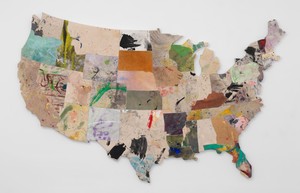
Lowman’s work, while it incorporates elements of Pop, appropriation, and assemblage, is deeply political in its intentions, never allowing an image to become neutralized by its context. His sculpture The Never Ending Story (2007), comprising rusted gas pumps, serves as a metaphor for the war in Iraq, and his more recent paintings deal with climate change, depicting radar images of Hurricanes Maria, Irma, and Harvey. In 2013 Lowman began his Maps series. Expanding on the earlier shaped canvases, the Maps examine the arbitrariness of borders, merging erratic splatters and stains with allusions to American quilt-making and Pop art.
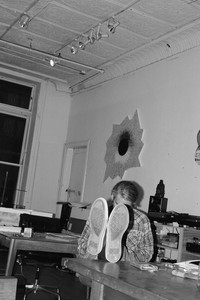
The Summer 2026 issue of Gagosian Quarterly is now available, featuring Ellen Gallagher’s Fast-Fish and Loose-Fish (2026) on the cover.

In this video, Jenny Saville sits down inside her first major exhibition in Venice to discuss how the great Venetian artists of the past and the city’s heritage influence her work. The show brings together more than thirty canvases and works on paper from the 1990s to the present, tracing the development of her practice, which is deeply rooted in the history of painting.

Francis Bacon lived and worked in Paris for a decade starting in the mid-1970s. The city and the art he encountered there provided a profound backdrop for his austere late style, which often brings together smooth, colorful backgrounds, spare architectural signifiers, and sculptural human forms. Here, three striking paintings from that period are considered by Sebastian Smee.
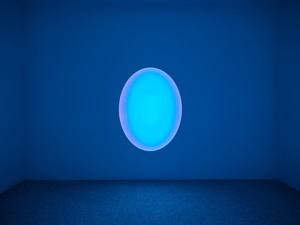
An exhibition at Gagosian, Hong Kong, brings together three of James Turrell’s Glasswork pieces along with site plans, photographs, and models of his Skyspaces and Roden Crater. Here, Alice Godwin explores the history of the Glassworks and their relationship to the artist’s wider practice.

Janne Sirén considers Anselm Kiefer’s new paintings, the subject of an exhibition at Gagosian, New York, entitled Seal My Ears Shut and I Shall Hear You Still.

On April 16, the Institute of Contemporary Art, Boston, opened the first midcareer survey of Derrick Adams’s multidisciplinary practice. Covering over twenty years of work, the exhibition, titled View Master, brings together the artist’s painting, sculpture, collage, performance, and video, as well as a vibrant new commission created for the museum’s façade. Ahead of the opening, Adams met with Tessa Bachi Haas, cocurator of the survey, to discuss his formative experiences with television, the impact of his work in arts education on his practice, and the importance of taking a more complex, more joyful, and more expansive approach to Black American life and culture.

Adam D. Weinberg has been working with Giuseppe Penone on an exhibition of the artist’s new sculptures, The Reflection of Bronze, that opens at Gagosian, New York, on April 22. The works explore the character and possibilities of bronze. Here, Weinberg considers Penone’s enduring engagement with the alloy and addresses the conceptual underpinnings of the exhibition’s three-room structure.

On March 28, a major exhibition of Jenny Saville’s work opened at Ca’ Pesaro–Galleria Internazionale d’Arte Moderna in Venice, bringing together nearly thirty paintings from the 1990s to the present. The exhibition is curated by Elisabetta Barisoni, head of the museums division at Venice’s Ca’ Pesaro, Museo Fortuny, and head of MUVE in Mestre. Saville’s monumental canvases are set in dialogue with the great Venetian artists of the past, creating a unique encounter between contemporary painting and the city’s artistic heritage. Here, the artist speaks with Stefania Ventra, professor with Ca’ Foscari University of Venice, about her early trips to Venice, the radicality of Titian’s painting, and depicting emotional truth.

Jeff Koons tells Alison McDonald about his appreciation for the pioneering artist and thinker Marcel Duchamp.
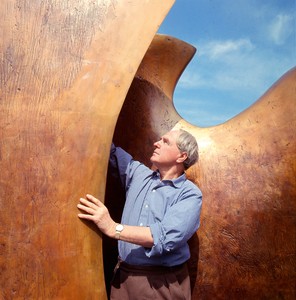
Laura Bruni writes about a major exhibition celebrating the work of the British sculptor Henry Moore at the Royal Botanic Gardens, Kew, London.
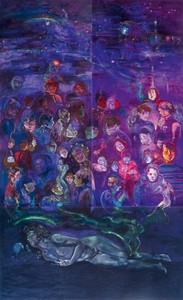
The most recent edition of Picture Books, an imprint organized by Emma Cline and Gagosian, pairs Mary Gaitskill’s novella STAUF: A Tragedy with Jill Mulleady’s painting The Shift. In celebration of this forthcoming publication, Gaitskill and Mulleady discuss the myth of Faust, good and evil in the digital age, and the channeling of raw matter into art.
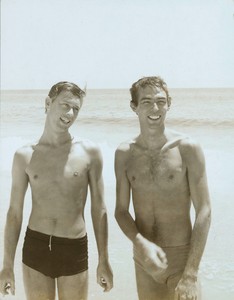
Andrew Durbin’s dual biography The Wonderful World That Almost Was: A Life of Peter Hujar and Paul Thek, published by Farrar, Straus and Giroux, tracks the convergences and divergences in the lives of the two artists, from their first meeting in Coral Cables, Florida, in 1956 through their generative romantic and creative partnership in New York, Italy, Fire Island, and beyond. Ahead of the release, Durbin met with the Quarterly’s Wyatt Allgeier to speak about the development of the project, the sublime noncompliance of these two artists, and the motifs of love, death, and rebirth that weave through the telling of their story.

