

Now available
Gagosian Quarterly Summer 2026
The Summer 2026 issue of Gagosian Quarterly is now available, featuring Ellen Gallagher’s Fast-Fish and Loose-Fish (2026) on the cover.
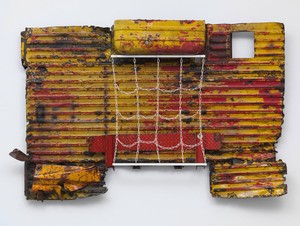
Robert Rauschenberg
Rasputin’s Revenge Early Winter (Glut), 1987
Assembled metal parts with plastic coated chain, 62 × 97 ¾ × 13 ¼ inches (157.5 × 248.3 × 33.7 cm)
© The Robert Rauschenberg Foundation 2014/Licensed by VAGA, New York, photo by Rob McKeever
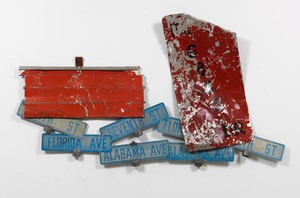
Robert Rauschenberg
Freeway Glut, 1986
Riveted and painted metal, 51 15/16 × 90 15/16 × 6 5/16 inchs (132 × 231 × 16 cm)
© The Robert Rauschenberg Foundation 2014/Licensed by VAGA, New York, photo by Tom VanEynde
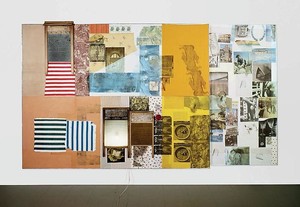
Robert Rauschenberg
Palladian Xmas (Spread), 1980
Solvent transfer, acrylic, fabric and collage on wood panel, 74 ¼ × 133 ¾ × 7 ½ inches (188.6 × 339.7 × 19 cm)
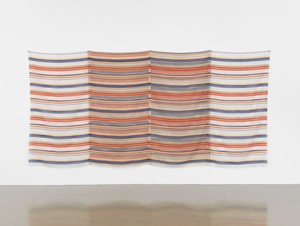
Robert Rauschenberg
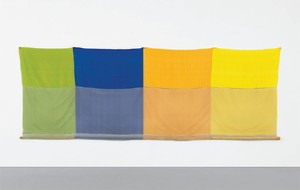
Gear (Jammer), 1976
Sewn fabric, 82 × 172 inches (208.3 × 426.9 cm)
© The Robert Rauschenberg Foundation 2013/Licensed by VAGA, New York
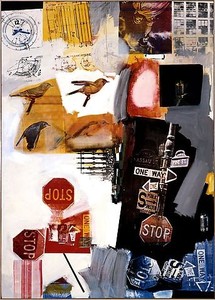
Robert Rauschenberg
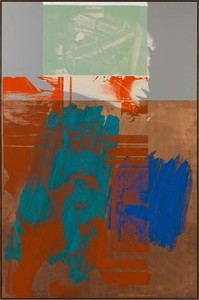
Overdrive, 1963
Oil and silkscreen ink on canvas, 84 × 60 inches (213.4 × 152.4 cm)
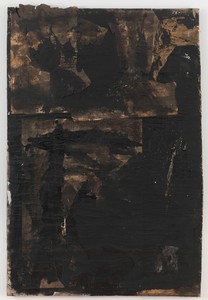
Robert Rauschenberg
Untitled, c. 1952
Paint and newspaper on primed cotton duck, 55 ⅛ × 36 ¾ inches (140 × 93.3 cm)
© The Robert Rauschenberg Foundation 2013/Licensed by VAGA, New York, photo by Rob McKeever
Robert Rauschenberg ushered in a new era of postwar American art in the wake of Abstract Expressionism. His approach, along with that of his contemporary Jasper Johns, was sometimes termed “Neo-Dada,” due to its relation to both European forebears and the physical gestures of American Abstract Expressionists. His Combine works (1954 to early 1960s) blurred the distinctions between painting and sculpture, as their flat surfaces were augmented with discarded materials and appropriated images. Rauschenberg also worked with photography, printmaking, papermaking, and performance, the last of which resulted in a number of collaborations with choreographers, including Merce Cunningham, Paul Taylor, and Trisha Brown. Rauschenberg was among the founding members of the innovative group Experiments in Art and Technology (E.A.T.) in 1966, and in 1984 he established the Rauschenberg Overseas Culture Interchange (ROCI) to bring art to communities around the world, saying, “I feel strong in my beliefs, based on my varied and widely traveled collaborations, that a one-to-one contact through art contains potent peaceful powers, and is the most non-elitist way to share exotic and common information, seducing us into creative mutual understandings for the benefit of all.” Rauschenberg’s nontraditional art practice and creative energy generated an enduring influence that impacted generations of artists, as noted by art historian Branden W. Joseph: “Rauschenberg’s was a position with which artists across the board were confronted and to which they almost necessarily had to respond. . . . Rauschenberg’s work served as a stimulus, an impetus and a challenge.”
Robert Rauschenberg was born in 1925, in Port Arthur, Texas, and died on Captiva Island, Florida, in 2008. He has had numerous exhibitions worldwide, including Robert Rauschenberg: A Retrospective, Solomon R. Guggenheim Museum, New York (1997, traveled to Menil Collection, Contemporary Arts Museum, and Museum of Fine Arts, Houston; Museum Ludwig, Cologne; and Guggenheim Museum Bilbao, Spain, through 1999); Combines, Metropolitan Museum of Art, New York (2005, traveled to Museum of Contemporary Art, Los Angeles; Centre Pompidou, Paris; and Moderna Museet, Stockholm, in 2007); Cardboards and Related Pieces, Menil Collection, Houston (2007); Traveling ’70–’76, Museu de Arte Contemporânea de Serralves, Porto, Portugal (2008, traveled to Haus der Kunst, Munich; and Madre, Naples, Italy, in 2009); Gluts, Peggy Guggenheim Collection, Venice (2009, traveled to Tinguely Museum, Basel; Guggenheim Museum Bilbao, Spain; and Villa e Collezione Panza, Varese, Italy, in 2010); and Botanical Vaudeville, Inverleith House, Royal Botanic Garden, Edinburgh (2011). Gagosian first exhibited Rauschenberg’s work in 1986.
The Summer 2026 issue of Gagosian Quarterly is now available, featuring Ellen Gallagher’s Fast-Fish and Loose-Fish (2026) on the cover.

In this video, Jenny Saville sits down inside her first major exhibition in Venice to discuss how the great Venetian artists of the past and the city’s heritage influence her work. The show brings together more than thirty canvases and works on paper from the 1990s to the present, tracing the development of her practice, which is deeply rooted in the history of painting.
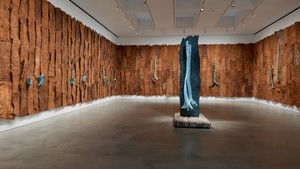
On the occasion of his exhibition The Reflection of Bronze at Gagosian, New York, Giuseppe Penone and curator Adam D. Weinberg sit down to discuss the genesis of, and their collaboration on, the show.
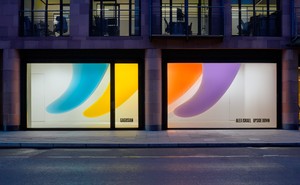
Ahead of Alex Israel’s exhibition of four new Fin sculptures at Gagosian, London, the artist spoke with Susan Casey, author of The Wave: In Pursuit of the Rogues, Freaks, and Giants of the Ocean (2010), about the ocean, surfing, and Los Angeles.
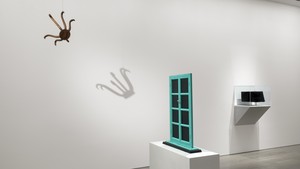
Marcel Duchamp is the inaugural exhibition of the gallery’s new ground-floor space in the historic building at 980 Madison Avenue. In this video, the Quarterly’s Alison McDonald discusses the artist’s most iconic readymades and their connection to New York City.
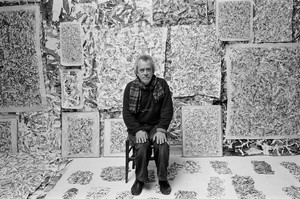
On July 9, Simon Hantaï: the last studio opens at Gagosian, Gstaad. Curated by Anne Baldassari, the show comprises sixteen of the artist’s dernier atelier (last studio) paintings of 1982–85. The exhibition is accompanied by an illustrated catalogue, copublished by Gagosian and Skira, which features an essay by Baldassari and an extensive portfolio of previously unpublished photographs by Édouard Boubat. Here, we share the introductory chapter from the publication.
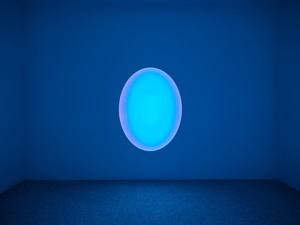
An exhibition at Gagosian, Hong Kong, brings together three of James Turrell’s Glasswork pieces along with site plans, photographs, and models of his Skyspaces and Roden Crater. Here, Alice Godwin explores the history of the Glassworks and their relationship to the artist’s wider practice.

On April 16, the Institute of Contemporary Art, Boston, opened the first midcareer survey of Derrick Adams’s multidisciplinary practice. Covering over twenty years of work, the exhibition, titled View Master, brings together the artist’s painting, sculpture, collage, performance, and video, as well as a vibrant new commission created for the museum’s façade. Ahead of the opening, Adams met with Tessa Bachi Haas, cocurator of the survey, to discuss his formative experiences with television, the impact of his work in arts education on his practice, and the importance of taking a more complex, more joyful, and more expansive approach to Black American life and culture.

Adam D. Weinberg has been working with Giuseppe Penone on an exhibition of the artist’s new sculptures, The Reflection of Bronze, that opens at Gagosian, New York, on April 22. The works explore the character and possibilities of bronze. Here, Weinberg considers Penone’s enduring engagement with the alloy and addresses the conceptual underpinnings of the exhibition’s three-room structure.

Jeff Koons tells Alison McDonald about his appreciation for the pioneering artist and thinker Marcel Duchamp.
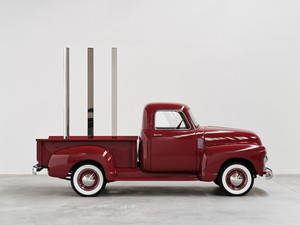
The Singular Experience at Gagosian’s Le Bourget gallery is the largest exhibition of Walter De Maria’s work in France in several decades. Organized by Donna De Salvo, senior adjunct curator at Dia Art Foundation, the exhibition marks the first time De Maria’s final sculpture, Truck Trilogy (2011–17), is being shown outside of the United States. Here, De Salvo speaks with artist Lucy Raven about her evolving kinship with De Maria and more.
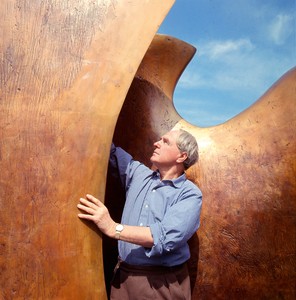
Laura Bruni writes about a major exhibition celebrating the work of the British sculptor Henry Moore at the Royal Botanic Gardens, Kew, London.


