Now available
Gagosian Quarterly Summer 2026
The Summer 2026 issue of Gagosian Quarterly is now available, featuring Ellen Gallagher’s Fast-Fish and Loose-Fish (2026) on the cover.
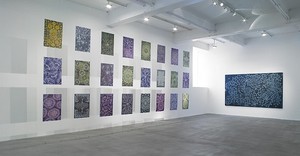
Alberto Di Fabio: Vortices
Installation view
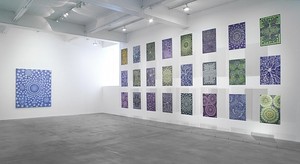
Alberto Di Fabio: Vortices
Installation view
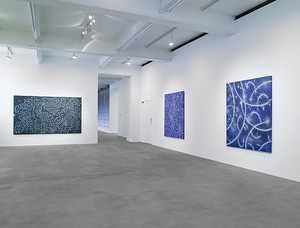
Alberto Di Fabio: Vortices
Installation view
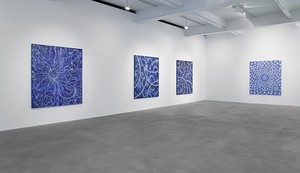
Alberto Di Fabio: Vortices
Installation view
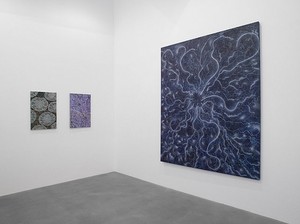
Alberto Di Fabio: Vortices
Installation view
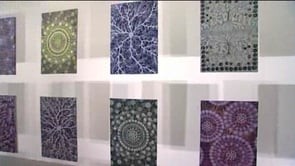
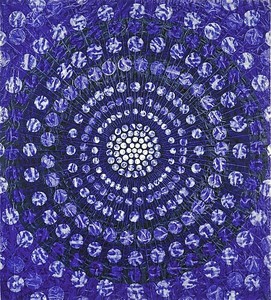
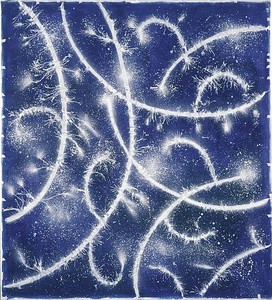
Alberto Di Fabio
Untitled, 2006
Acrylic on canvas, 78-11/16 × 68 ⅞ inches (200 × 175cm)
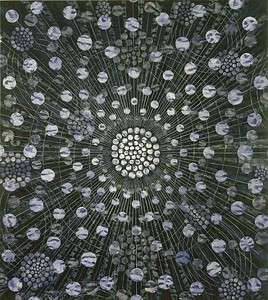
Alberto Di Fabio
Untitled, 2007
Acrylic on canvas, 78-11/16 × 69 5/16 inches (200 × 176cm)
Alberto Di Fabio
Untitled, 2006
Acrylic on canvas, 78-11/16 × 68 ⅞ inches (200 × 175cm)
Gagosian Gallery is pleased to announce an exhibition of new paintings and works on paper by Alberto Di Fabio.
Di Fabio's work merges the worlds of art and science with themes of biology, ecology and nature. This particular series of works explores structures of the human body and brain. Large-scale paintings pulsate with colourful organic shapes. The images are microscopic in their focus, implying biological diagrams, cellular structures, flora, eco systems, and pharmacological research. Di Fabio creates abstract paintings by overlapping layers of images abstracted from scientific and medical references and his own reflections, enlarging the particulars and adding details. His works on paper continue his dedication to organic form, subject, and process.
Vortices has a dual meaning here, referring both to the spinning, turbulent flow that swirls strongly around a center, and to the early twentieth century British art group – which included Wyndham Lewis, Ezra Pound, James Joyce and T.S. Eliot, as well as the French sculptor Gaudier-Brzeska— who set out to liberate Britain from the legacy of the past and obliterate all traces of the Victorian era by placing the machine age at the centre of their work. Di Fabio observes how the human mind's capacity for information seems amplified due to the increasing means of communications that saturate our daily lives, and he invites us to reconsider the body in its most essential functions - posing questions about science and aesthetic, life and art.
Alberto Di Fabio was born in Avezzano in 1966 and studied at the Academia delle Belle Arti, Rome. He has exhibited internationally, including the Beijing International Art Biennale (2005), Insomnia, Galleria Pack, Milan (2007) and Umberto Di Marino Arte Contemporanea, Napoli, Italy (2007). DiFabio lives and works in Rome.
A fully illustrated catalogue, with an essay by freelance art critic and writer, Alan Jones, will accompany this exhibition.
The Summer 2026 issue of Gagosian Quarterly is now available, featuring Ellen Gallagher’s Fast-Fish and Loose-Fish (2026) on the cover.

In this video, Jenny Saville sits down inside her first major exhibition in Venice to discuss how the great Venetian artists of the past and the city’s heritage influence her work. The show brings together more than thirty canvases and works on paper from the 1990s to the present, tracing the development of her practice, which is deeply rooted in the history of painting.
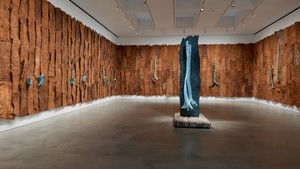
On the occasion of his exhibition The Reflection of Bronze at Gagosian, New York, Giuseppe Penone and curator Adam D. Weinberg sit down to discuss the genesis of, and their collaboration on, the show.
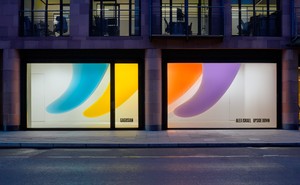
Ahead of Alex Israel’s exhibition of four new Fin sculptures at Gagosian, London, the artist spoke with Susan Casey, author of The Wave: In Pursuit of the Rogues, Freaks, and Giants of the Ocean (2010), about the ocean, surfing, and Los Angeles.
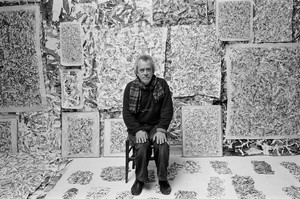
On July 9, Simon Hantaï: the last studio opens at Gagosian, Gstaad. Curated by Anne Baldassari, the show comprises sixteen of the artist’s dernier atelier (last studio) paintings of 1982–85. The exhibition is accompanied by an illustrated catalogue, copublished by Gagosian and Skira, which features an essay by Baldassari and an extensive portfolio of previously unpublished photographs by Édouard Boubat. Here, we share the introductory chapter from the publication.
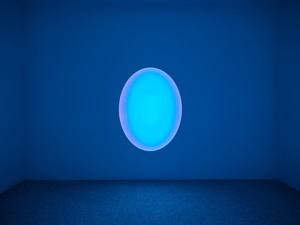
An exhibition at Gagosian, Hong Kong, brings together three of James Turrell’s Glasswork pieces along with site plans, photographs, and models of his Skyspaces and Roden Crater. Here, Alice Godwin explores the history of the Glassworks and their relationship to the artist’s wider practice.

On April 16, the Institute of Contemporary Art, Boston, opened the first midcareer survey of Derrick Adams’s multidisciplinary practice. Covering over twenty years of work, the exhibition, titled View Master, brings together the artist’s painting, sculpture, collage, performance, and video, as well as a vibrant new commission created for the museum’s façade. Ahead of the opening, Adams met with Tessa Bachi Haas, cocurator of the survey, to discuss his formative experiences with television, the impact of his work in arts education on his practice, and the importance of taking a more complex, more joyful, and more expansive approach to Black American life and culture.

Adam D. Weinberg has been working with Giuseppe Penone on an exhibition of the artist’s new sculptures, The Reflection of Bronze, that opens at Gagosian, New York, on April 22. The works explore the character and possibilities of bronze. Here, Weinberg considers Penone’s enduring engagement with the alloy and addresses the conceptual underpinnings of the exhibition’s three-room structure.

Jeff Koons tells Alison McDonald about his appreciation for the pioneering artist and thinker Marcel Duchamp.
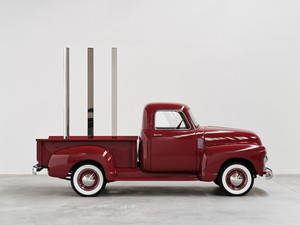
The Singular Experience at Gagosian’s Le Bourget gallery is the largest exhibition of Walter De Maria’s work in France in several decades. Organized by Donna De Salvo, senior adjunct curator at Dia Art Foundation, the exhibition marks the first time De Maria’s final sculpture, Truck Trilogy (2011–17), is being shown outside of the United States. Here, De Salvo speaks with artist Lucy Raven about her evolving kinship with De Maria and more.
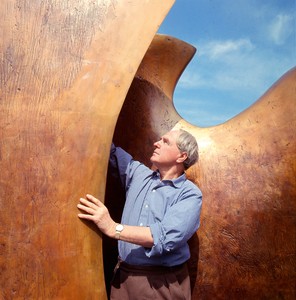
Laura Bruni writes about a major exhibition celebrating the work of the British sculptor Henry Moore at the Royal Botanic Gardens, Kew, London.
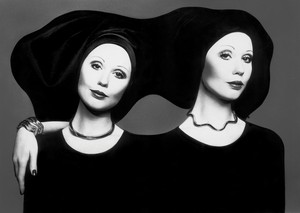
The exhibition Pomellato, Le Joaillier Révolutionnaire opened at Palais de Tokyo, Paris, on June 24. The Italian jewelry house’s trailblazing advertising campaigns—created by some of the most consequential names in photography—act as the narrative arc of the exhibition, curated by Alba Cappellieri. Here, Sarah Godfrey tracks Pomellato’s history, speaks with Cappellieri about what drew her to this project, and examines some of the key photographs from the show.