Now available
Gagosian Quarterly Summer 2026
The Summer 2026 issue of Gagosian Quarterly is now available, featuring Ellen Gallagher’s Fast-Fish and Loose-Fish (2026) on the cover.
Installation video
Installation view
Installation view
Installation view
Installation view
Installation view
Installation view
Installation view
Installation view
Installation view
Installation view
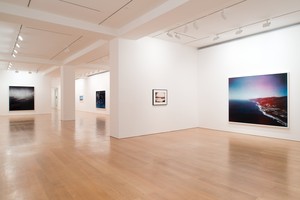
Installation view
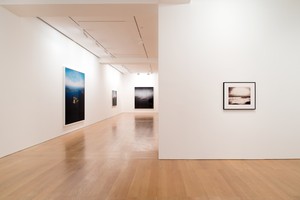
Installation view
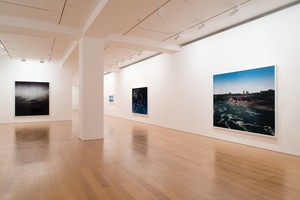
Installation view
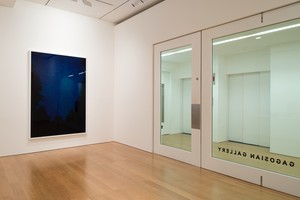
Installation view
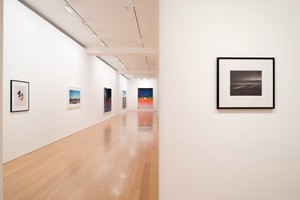
Installation view
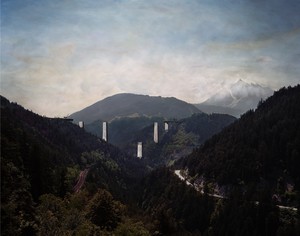
Florian Maier-Aichen
Untitled, 2009
Chromogenic print, framed: 47 ¾ × 60 ½ inches (121.3 × 153.7 cm), edition of 6
© Florian Maier-Aichen
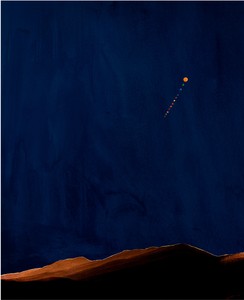
Florian Maier-Aichen
Nacht im Riesengebirge (Night in the Riesengebirge), 2011
Chromogenic print, 60 × 49 ¼ inches framed (152.4 × 125.1 cm), edition of 6
© Florian Maier-Aichen
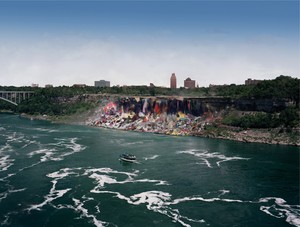
Florian Maier-Aichen
Untitled (Dewatered), 2009
Chromogenic print, framed: 71 ¾ × 94 inches framed (182 × 239 cm), edition of 6
© Florian Maier-Aichen
Photography used to be like alchemy in the nineteenth century. It was the medium of the few; now it is a mass medium—and slightly dead. Maybe it is reactionary to turn backwards, to try and establish art history again, but that is the most interesting part of the process—not just the black box.
—Florian Maier-Aichen
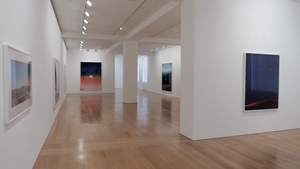
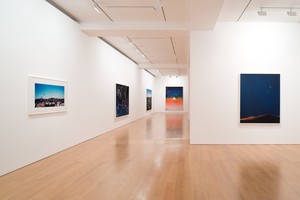
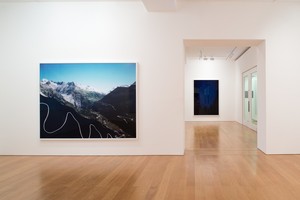
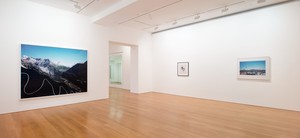
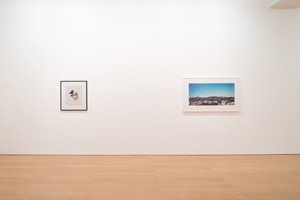
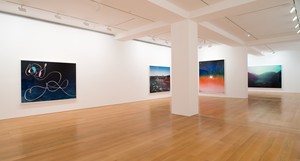
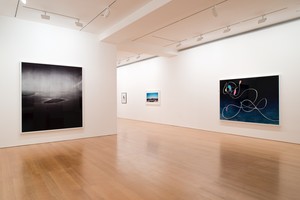
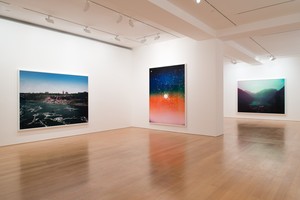
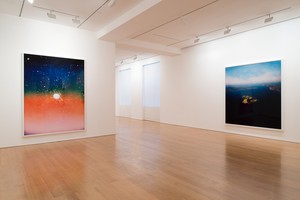
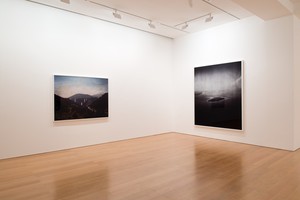
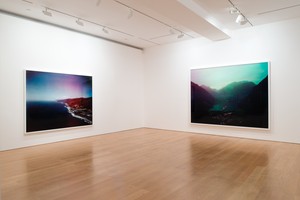
Gagosian Hong Kong is pleased to announce an exhibition of photographs by Florian Maier-Aichen. Encompassing a selection of images produced over the past decade, this is the first exhibition of his work in Hong Kong.
Maier-Aichen combines traditional photographic techniques—albumen, silver-gelatin, and c-printing—with hand-drawn elements and computer-imaging processes. Inspired by early photographers who used combination printing to heighten the colors and details of their landscape images, he makes seamless photographs that do not betray the intricate and layered modes of production required to create them. A broader poetic landscape tradition—from Song dynasty depictions of nature to the nineteenth century, multi-negative innovations of Gustave Le Gray—is at work in each image. Maier-Aichen’s manipulations recall the stylized scenery of calligraphic scroll landscapes, which are also treated as spontaneous distillations of reality. Foregoing representational genres altogether, some of his latest works elevate abstractions produced by hand and splatters of paint to a new realm of photo-painterly gesture.
Untitled (2013) is from a new series of abstract compositions in which a splatter is the central motif. The splatters are produced by pouring acrylic paint directly and spontaneously onto paper rolls. A reproduction of the splatter is then laid over color graduated backgrounds on a huge copystand, and re-photographed. Different levels of detail emerge out of the multiple layers of process, recalling former times in traditional photography when the image would slowly and miraculously materialize in the darkroom developing tray. In another singular work, a dynamic drawn line reminiscent of ink-wash painting or calligraphy is similarly transformed into a photographic still-life against a studio backdrop. The unique gesture is thus a stand-in for the decisive moment of the shutter that produces the snapshot, reflecting Maier-Aichen’s desire to provide a romantic counterpart to the technical side of photography.
Florian Maier-Aichen was born in Stuttgart, Germany in 1973. His work has been collected and exhibited by museums including The Armand Hammer Museum of Art and Culture Center, Los Angeles; Cincinnati Art Museum; Corcoran Gallery of Art, Washington, D.C.; Denver Art Museum; Museum of Contemporary Art, Los Angeles; Los Angeles County Museum of Art; Walker Art Center, Minneapolis; and Whitney Museum of American Art, New York. Recent solo museum exhibitions include Museum of Contemporary Art at Pacific Design Center, Los Angeles (2007); and Museo Thyssen-Bornemisza, Madrid (2008). Selected group exhibitions include “The Artistʼs Museum,” Museum of Contemporary Art, Los Angeles (2010); “The Smithson Effect,” Utah Museum of Fine Arts, Salt Lake City (2011); and “Natural History,” Carnegie Museum of Art, Pittsburgh (2012). Maier-Aichen lives and works in Cologne and Los Angeles.
The Summer 2026 issue of Gagosian Quarterly is now available, featuring Ellen Gallagher’s Fast-Fish and Loose-Fish (2026) on the cover.

In this video, Jenny Saville sits down inside her first major exhibition in Venice to discuss how the great Venetian artists of the past and the city’s heritage influence her work. The show brings together more than thirty canvases and works on paper from the 1990s to the present, tracing the development of her practice, which is deeply rooted in the history of painting.

Francis Bacon lived and worked in Paris for a decade starting in the mid-1970s. The city and the art he encountered there provided a profound backdrop for his austere late style, which often brings together smooth, colorful backgrounds, spare architectural signifiers, and sculptural human forms. Here, three striking paintings from that period are considered by Sebastian Smee.
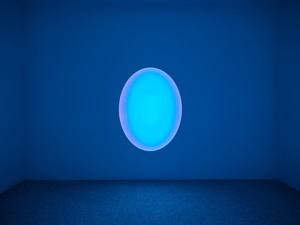
An exhibition at Gagosian, Hong Kong, brings together three of James Turrell’s Glasswork pieces along with site plans, photographs, and models of his Skyspaces and Roden Crater. Here, Alice Godwin explores the history of the Glassworks and their relationship to the artist’s wider practice.

Janne Sirén considers Anselm Kiefer’s new paintings, the subject of an exhibition at Gagosian, New York, entitled Seal My Ears Shut and I Shall Hear You Still.

On April 16, the Institute of Contemporary Art, Boston, opened the first midcareer survey of Derrick Adams’s multidisciplinary practice. Covering over twenty years of work, the exhibition, titled View Master, brings together the artist’s painting, sculpture, collage, performance, and video, as well as a vibrant new commission created for the museum’s façade. Ahead of the opening, Adams met with Tessa Bachi Haas, cocurator of the survey, to discuss his formative experiences with television, the impact of his work in arts education on his practice, and the importance of taking a more complex, more joyful, and more expansive approach to Black American life and culture.

Adam D. Weinberg has been working with Giuseppe Penone on an exhibition of the artist’s new sculptures, The Reflection of Bronze, that opens at Gagosian, New York, on April 22. The works explore the character and possibilities of bronze. Here, Weinberg considers Penone’s enduring engagement with the alloy and addresses the conceptual underpinnings of the exhibition’s three-room structure.

On March 28, a major exhibition of Jenny Saville’s work opened at Ca’ Pesaro–Galleria Internazionale d’Arte Moderna in Venice, bringing together nearly thirty paintings from the 1990s to the present. The exhibition is curated by Elisabetta Barisoni, head of the museums division at Venice’s Ca’ Pesaro, Museo Fortuny, and head of MUVE in Mestre. Saville’s monumental canvases are set in dialogue with the great Venetian artists of the past, creating a unique encounter between contemporary painting and the city’s artistic heritage. Here, the artist speaks with Stefania Ventra, professor with Ca’ Foscari University of Venice, about her early trips to Venice, the radicality of Titian’s painting, and depicting emotional truth.

Jeff Koons tells Alison McDonald about his appreciation for the pioneering artist and thinker Marcel Duchamp.
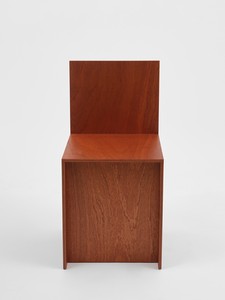
From their respective fields, three international cultural figures—artist and designer Ronan Bouroullec, fashion visionary Michèle Lamy, and chef and restaurateur Enrique Olvera—reflect on Donald Judd’s work in furniture, the subject of recent exhibitions in South Korea and Japan.
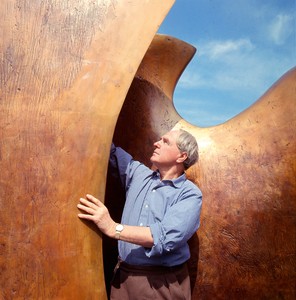
Laura Bruni writes about a major exhibition celebrating the work of the British sculptor Henry Moore at the Royal Botanic Gardens, Kew, London.
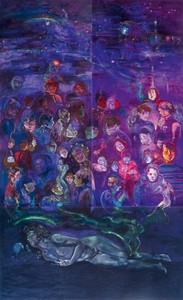
The most recent edition of Picture Books, an imprint organized by Emma Cline and Gagosian, pairs Mary Gaitskill’s novella STAUF: A Tragedy with Jill Mulleady’s painting The Shift. In celebration of this forthcoming publication, Gaitskill and Mulleady discuss the myth of Faust, good and evil in the digital age, and the channeling of raw matter into art.