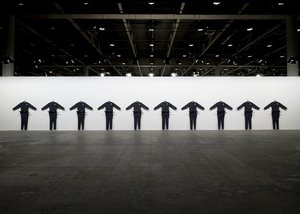
Chris Burden’s L.A.P.D. Uniforms (1993) features in Art Basel Unlimited 2026, an exhibition platform for large-scale projects that transcend the limits of the standard booth.

Chris Burden’s L.A.P.D. Uniforms comprises an edition of thirty oversize police uniforms that was produced in collaboration with the Fabric Workshop, Philadelphia, during Burden’s 1992–93 residency. The work was conceived and made in the aftermath of the 1992 Los Angeles riots, which followed the acquittal of four predominantly white police officers for the beating of Rodney King, an African American man. At nearly seven-and-a-half feet tall, the uniforms are imposing symbols of authoritarianism that tower above most viewers, creating an oppressive psychological impact. 

#ChrisBurden

Chris Burden, L.A.P.D. Uniforms, 1993, installation view, Art Basel Unlimited 2026 © 2026 Chris Burden/Licensed by the Chris Burden Estate and Artists Rights Society (ARS), New York. Photo: Owen Conway

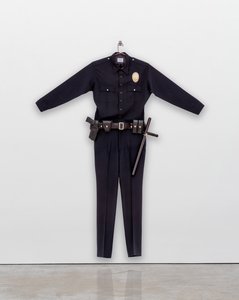
A police officer uniform fitted for an almost nine-foot person hanging on a wall

Chris Burden

L.A.P.D. Uniforms, 1993

Fabric, leather, wood, metal, and plastic
88 × 72 × 6 inches (223.5 × 182.9 × 15.2 cm)
Edition of 30 + 1 AP

For his role as artist-in-residence at the Fabric Workshop in Philadelphia in 1992–93, Chris Burden’s potential new project was subject to one stipulation: he had to create a work from cloth. This marked an exciting new challenge for Burden, as he had never before used fabric in his sculptures, which were largely made of metal and wood and addressed themes of mechanical power or natural forces.

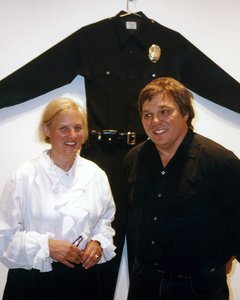
Following a visit to his studio nestled in the Topanga Canyon mountains in early 1992, Marion “Kippy” Boulton Stroud, the founder and artistic director of the Fabric Workshop, awaited Burden’s proposal. Yet it wasn’t until the Los Angeles–based artist witnessed the eruption of riots across his beloved city—in the wake of the April 1992 acquittal of four predominantly white LAPD officers for the beating of Rodney King, an African American man, during an arrest—that Burden’s concept for the residency took shape. “I have an idea,” he professed on a call.

Chris Burden with Marion “Kippy” Boulton Stroud

Chris Burden with Marion “Kippy” Boulton Stroud at the opening of Chris Burden: L.A.P.D. Uniforms and America’s Darker Moments at the Fabric Workshop and Museum, Philadelphia, 1994. Artwork © 2026 Chris Burden/Licensed by the Chris Burden Estate and Artists Rights Society (ARS), New York. Photo: courtesy Fabric Workshop and Museum

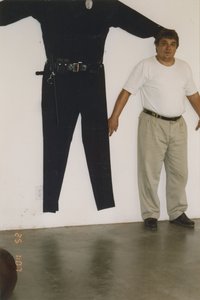
A radical figure with a fierce political consciousness, Burden was never one to shy away from difficult subjects or themes. Responding to systemic racial injustice and intimidatory policing tactics, L.A.P.D. Uniforms is no exception. The work comprises an edition of thirty oversize replicas of Los Angeles Police Department uniforms, each equipped with a regulation belt, holster, baton, handcuffs, police badge, and 92F Beretta handgun. Burden had strategically enlarged the garments to measure over seven feet tall; at this scale, they appear life-size from a distance but loom over the viewer with an unnerving authoritarian presence when viewed up close.

Looks normal from distance but actually would fit 8'8" man.

—Chris Burden
Chris Burden standing with his back against a wall with an oversize uniform hanging on it

Chris Burden standing next to his L.A.P.D. Uniforms (1993) at the Fabric Workshop, Philadelphia, July 1993

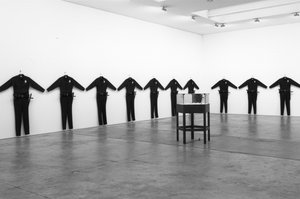
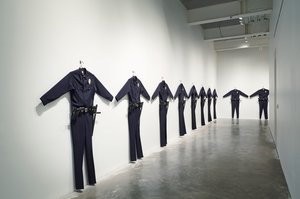
This expression of power was heightened by the way in which the works are typically installed; each uniform is placed on a specially built armature with a hanger. These are then positioned flat against the wall with sleeves outstretched so that they nearly touch one another. When several are shown, Burden’s L.A.P.D. Uniforms creates the effect of a visual cordon—enhancing their substantial physical presence. As noted in a July 1993 letter to Gagosian Gallery, Burden’s choice to present the uniforms on hangers was a nod to Joseph Beuys’s Felt Suit (1970).

In 2026, L.A.P.D. Uniforms continues to make a resoundingly powerful statement about institutional authority and how it is visually represented. The full edition was first exhibited at Gagosian Gallery’s Wooster Street location in early 1994, where it was shown alongside America’s Darker Moments (1994), a work that explores similar themes of aggression and violence in American history. Since then, L.A.P.D. Uniforms has been featured in several major museum exhibitions, including two of the artist’s critically acclaimed surveys: at the Museum of Applied Arts (MAK) in Vienna in 1996 and Chris Burden: Extreme Measures at the New Museum of Contemporary Art in New York in 2013–14. Both the Los Angeles County Museum of Art (LACMA) and the Fabric Workshop and Museum have editions of this work in their permanent collections.

Gallery with ten oversize police uniform hanging in a visual cordon on the wall and a sculpture in the center of the room

Installation view, Chris Burden: L.A.P.D. Uniforms, America’s Darker Moments, Small Guns, Gagosian, Wooster Street, New York, February 26–March 26, 1994. Artwork © 2026 Chris Burden/Licensed by the Chris Burden Estate and Artists Rights Society (ARS), New York. Photo: Erik Landsberg

Gallery with ten oversize police uniform hanging in a visual cordon on the wall

Chris Burden, L.A.P.D. Uniforms, 1993, installation view, Chris Burden: Extreme Measures, New Museum, New York, October 2, 2013–January 12, 2014. Artwork © 2026 Chris Burden/Licensed by the Chris Burden Estate and Artists Rights Society (ARS), New York. Photo: Benoit Pailley

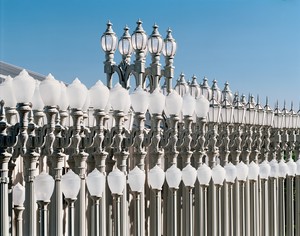
Born in Boston, Massachusetts, Burden moved to California to attend Pomona College in the late 1960s; he continued living and working in the Los Angeles area until his death in 2015. His work is inexorably tied to the region, evidenced by his frequent use of found materials that were locally sourced and particularly characteristic of the city, as in his iconic streetlamp sculpture Urban Light (2009) installed in the public plaza at LACMA. This local focus was also certainly the case with L.A.P.D. Uniforms, for which Burden carefully researched and developed nearly regulation-standard copies of Los Angeles police uniforms, looking directly to the representatives of authority in his city.

As seen in archival documentation, some elements of L.A.P.D. Uniforms were purchased directly from official suppliers, while other parts were custom made. The badges, for instance, were made by a jeweler in Providence, Rhode Island, who insisted on having documentation of the legal grounds for these replicas. Upon review of the patent and copyright history, the Fabric Workshop determined, in consultation with an attorney, that the enlargement of the badges and their use in “an original piece of art with a strong socio-political theme” was within legal bounds. Each badge is numbered 1–30, with the number corresponding with Burden’s edition of the piece. For the garments themselves, which were manufactured by a company that produced official police uniforms, Burden experimented with scale, playing with different proportions to achieve his desired effect.

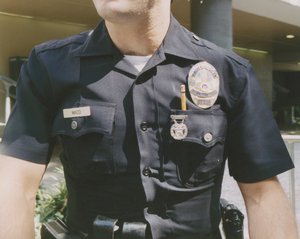
Photograph of the chest of a police officer in uniform

Source photograph of a Los Angeles police officer taken at a local precinct by project coordinator Mary Anne Friel, c. 1992

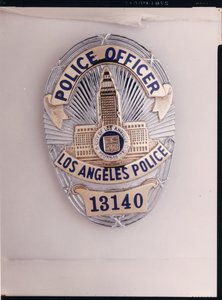
Los Angeles Police Department badge

Photograph of Los Angeles Police Department badge used to make master copy for molds

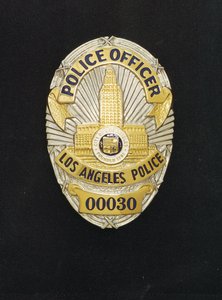
Oversize replica of a Los Angeles Police Department badge

Completed replica badge for edition 30 of L.A.P.D. Uniforms (1993)

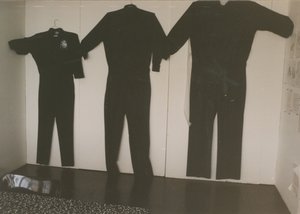
Three handmade police uniforms in varying sizes hanging on the wall

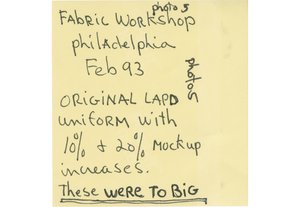
Photograph of prototypes in various sizes for L.A.P.D. Uniforms (1993) at Fabric Workshop, Philadelphia, February 1993, and accompanying handwritten note by Chris Burden on reverse (below)

Yellow sticky note with handwritten note
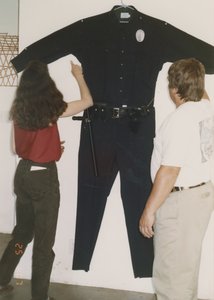
Two people inspecting a handmade copy of a police uniform hanging on the wall

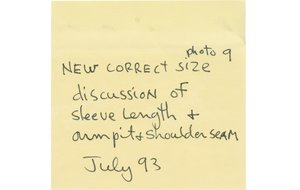
Chris Burden and project coordinator Mary Anne Friel discussing the construction of the uniform at the Fabric Workshop, Philadelphia, July 1993, and accompanying handwritten note by Chris Burden on reverse (below)

Yellow sticky note with handwritten note

One particularly difficult element of L.A.P.D. Uniforms concerned the acquisition and safety of the handguns, which were real when Burden first exhibited them in New York in 1994. According to the artist, “That was an experience. I went to a gun shop, bought thirty Berettas [with] no questions asked. . . . The best part was when I went to take them back to the same gun store and I said, ‘And I want them all to be rendered inoperable.’ And they said, ‘Permanently? . . . You don’t want to ruin these beautiful guns, do you?’ And I said, ‘Yes, I do.’”

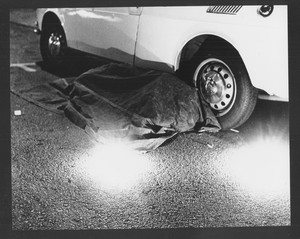
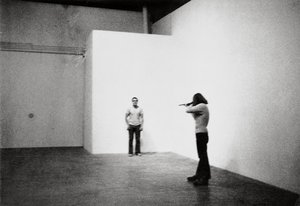
In order to exhibit and transport them over state lines, Burden had each firearm permanently disabled in compliance with local gun laws, then emptied the bullets of gun powder, deactivating them as well. These modifications were confirmed by a ballistics inspector in the City of New York Police Department who deemed them approved “theatrical props,” citing film and movie regulations. Notably, guns have played a significant role in Burden’s early performance career; he first gained notoriety with his unforgettable piece Shoot (1971), in which he was shot in the arm by a friend, while he toyed with potentially illicit behavior in other works such as Wiretap (1977), in which he surreptitiously recorded two arts professionals disparaging one another on the phone.

A person about to shoot another person in a gallery

Chris Burden, Shoot, 1971, performance at F Space, Santa Ana, California, November 19, 1971 © 2026 Chris Burden/Licensed by the Chris Burden Estate and Artists Rights Society (ARS), New York

In 2026, the Estate of Chris Burden refabricated the handguns and police batons in accordance with Swiss law for their presentation at Basel. While seemingly authentic, the Beretta replicas have been sliced in half like relief sculptures, making their inoperability evident. The batons, which have been painstakingly crafted to resemble real weapons, are in fact composed of an innocuous soft foam.

L.A.P.D. Uniforms encapsulates Burden’s longtime investigations of the tactics of coercion and fear deployed by those in power, as well as observations on the social unrest at the time the work was created in the early to mid-1990s. As he stated, “I’ve always sort of been intimidated by policemen, and I wanted to have them be 10 percent bigger, so that when they were displayed. . . . you would just see them as, ‘Holy cow, cops are huge,’ kind of thing.” Yet despite being conceived in response to a specific historical event, L.A.P.D. Uniforms remains a strikingly relevant commentary on American society over thirty years later. Confronting themes of surveillance, discipline, and intimidation, its meaning continues to evolve and expand as it is considered in different cultural contexts, transforming the work anew for contemporary audiences.

The Dark Sides of Light and Space

The Dark Sides of Light and Space

Tracking works by Chris Burden, Bruce Nauman, Maria Nordman, and Eric Orr as outliers and outcroppings of the California Light and Space movement, Michael Auping argues that darkness—the absence of light and space—is a key element of the aesthetic.

A Living Symbol

A Living Symbol

As American identity once again comes into question during a politically charged election cycle, the Quarterly revisits the motif of the American flag in art. Here, John B. Ravenal contextualizes Robert Lazzarini’s new wall-based flag sculptures and elucidates the tensions they lay bare in the symbol of our nation.

Artist, Audience, Accomplice

Artist, Audience, Accomplice

Sydney Stutterheim has published Artist, Audience, Accomplice: Ethics and Authorship in Art of the 1970s and 1980s (Duke University Press, 2024), a survey of performance art and related practices that involve, in various manners, the figure of the accomplice. To celebrate the publication, the Quarterly is publishing an excerpt that examines Chris Burden’s Deadman (1972).

American Artist, Yayoi Shionoiri, and Sydney Stutterheim on Poetic Practical: The Unrealized Work of Chris Burden

In Conversation
American Artist, Yayoi Shionoiri, and Sydney Stutterheim on Poetic Practical: The Unrealized Work of Chris Burden

Join Gagosian to celebrate the publication of Poetic Practical: The Unrealized Work of Chris Burden with a conversation between American Artist, Yayoi Shionoiri, and Sydney Stutterheim presented at the Kitchen, New York. Considering the book’s sustained examination of sixty-seven projects that remained incomplete at the time of Burden’s death in 2015, the trio discuss the various ways that an artist’s work and legacy live on beyond their lifetime.

Chris Burden: Prelude to a Lost Performance

At the Edge
Chris Burden: Prelude to a Lost Performance

Michael Auping tells the Quarterly’s Alison McDonald about the preparations for a performance by Chris Burden at the Newport Harbor Art Museum in Southern California in 1974—and the event’s abrupt cancellation—providing a glimpse into the mindset of a young, aggressive, and ambitious artist in the early stages of his career.

Gagosian Quarterly Summer 2022

Now available
Gagosian Quarterly Summer 2022

The Summer 2022 issue of Gagosian Quarterly is now available, with two different covers—featuring Takashi Murakami’s 108 Bonnō MURAKAMI.FLOWERS (2022) and Andreas Gursky’s V & R II (2022).

Chris Burden: Poetic Practical

Chris Burden: Poetic Practical

A new publication exploring the work that Chris Burden conceived but left unrealized delves into his archive to present sixty-seven visionary projects that reveal the aspirations of this formidable artist. The book’s editors, Sydney Stutterheim and Andie Trainer, discuss its development with Yayoi Shionoiri, executive director of the Chris Burden Estate.

Chris Burden: Big Wrench

Gagosian Quarterly Films
Chris Burden: Big Wrench

From January 23 to February 21, 2019, Gagosian Quarterly presented a special online screening of Chris Burden’s 1980 video Big Wrench.

Big Wrench

Big Wrench

Sydney Stutterheim looks at the brief but feverish obsession behind this 1980 video by Chris Burden.

Deluxe Photo Book

Deluxe Photo Book

Sydney Stutterheim discusses Chris Burden’s Deluxe Photo Book 1971–73 on the occasion of its inclusion in About Photography at Gagosian San Francisco.

Urban Light: A Ten Year Anniversary

Urban Light: A Ten Year Anniversary

Ten years ago LACMA premiered Chris Burden’s Urban Light, which has since become an iconic landmark for the city of Los Angeles. To celebrate the anniversary, we look back to 2008 with a conversation between Chris Burden and Michael Govan, director of LACMA.

Burden

Spotlight
Burden

The story behind Chris Burden’s Buddha’s Fingers (2014–15) and its connection to all of his streetlamp installations. Text by Sydney Stutterheim.