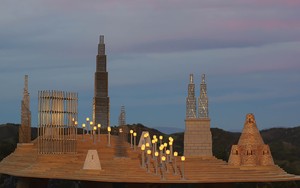
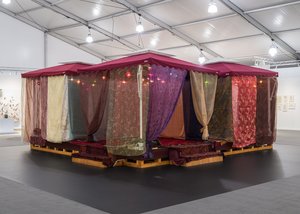
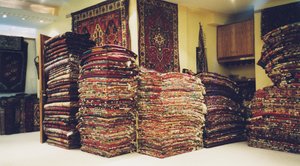
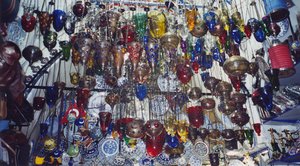
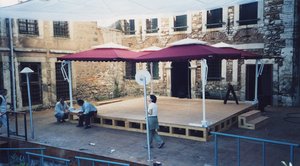
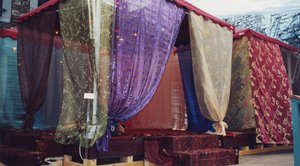
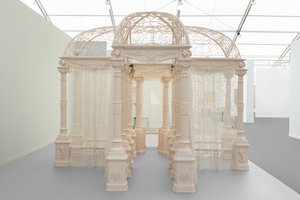
Gagosian is pleased to announce its participation in Frieze Los Angeles 2025 with Nomadic Folly (2001), an enveloping large-scale installation by Chris Burden that was produced for the seventh Istanbul Biennial, incorporating locally sourced materials and objects. This is the first time that the work has been exhibited in the United States. At a profoundly difficult moment for the city of Los Angeles, this project by one of its greatest artists—perhaps his gentlest and most humanistic—offers visitors a place to gather in safety and community.

#FriezeLA

Chris Burden’s Nomadic Folly (2001) installed at Frieze Los Angeles 2025. Artwork © 2025 Chris Burden/Licensed by the Chris Burden Estate and Artists Rights Society (ARS), New York. Video: Romoff Media 

<p data-block-key="8sh4j"><i>Nomadic Folly</i>, 2001</p>

Chris Burden

Nomadic Folly, 2001

Wood platform, 4 cloth and metal umbrellas, woven carpets, braided ropes, pillows, silken fabrics, glass and metal lamps, iPod, and speakers

11 ½ × 20 × 20 feet (3.5 × 6.1 × 6.1 m)

Listen to the author Sydney Stutterheim read this essay.

In challenging times, art can provide a place for escape, for joy, and for community. Chris Burden’s Nomadic Folly (2001), Gagosian’s featured solo presentation for Frieze Los Angeles 2025, offers all of these things.

While this marks the first time Nomadic Folly has ever been shown in the United States, the work—a large-format, interactive sculptural installation—was initially created by Burden for the seventh Istanbul Biennial, which opened on September 21, 2001. When the California-based artist arrived in Turkey, he only had drawings and preliminary plans for Nomadic Folly, which would be constructed on-site in the courtyard of the eighteenth-century Imperial Mint at Istanbul’s Topkapi Palace. Leaving behind the enormous destruction from the terrorist attacks that took place in the United States on September 11, 2001, just ten days before the Biennial opened, Burden immersed himself in the profound beauty of Middle Eastern culture. He sourced all of his materials from local souks to produce a work that the artist described as “an oasis of beauty,” one that exists as a reprieve within a world otherwise undone.

An oasis of beauty.

—Chris Burden
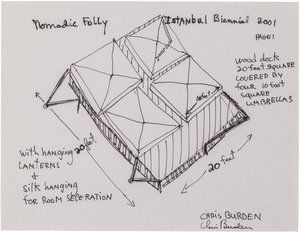
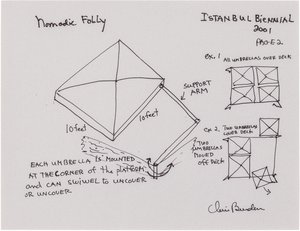
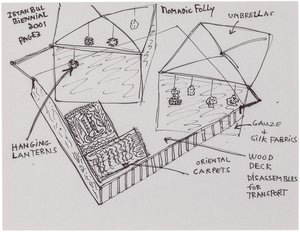
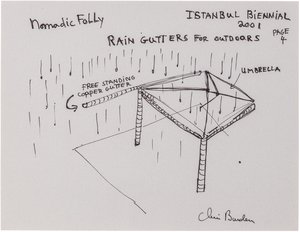
Drawings of instructions of how to assemble a sculpture

Chris Burden’s preparatory drawings for constructing Nomadic Folly (2001)

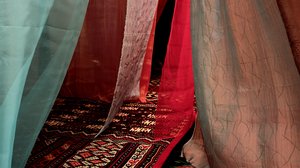
In the wake of the devastating fires in Los Angeles in early 2025, Gagosian returns to Burden’s ambitions of creating art that can bring people together. Nomadic Folly is composed of a twenty-square-foot wood platform, upon which the artist has built an architectural folly inspired by Turkish culture and history. Using umbrellas, silken fabrics, and braided ropes, Burden constructed four interior “rooms,” each decorated with soft pillows, plush rugs, and glass and metal hanging lamps; it is accompanied by a selection of traditional Middle Eastern music that plays continuously. The artist’s intention, which is maintained in Gagosian’s booth at Frieze Los Angeles, is for visitors to remove their shoes before entry and linger in the warmth of the tranquil, dreamlike setting. Both then, in 2001, and now, Nomadic Folly demonstrates art’s ability to offer a space for contemplation.

Photographs taken by Chris Burden while sourcing materials and building Nomadic Folly (2001) on-site in Istanbul for the seventh Istanbul Biennial, 2001. Photos: © 2025 Chris Burden/Licensed by the Chris Burden Estate and Artists Rights Society (ARS), New York

Burden presents a multisensory experience for the viewer, one carefully crafted to transform sight, sound, and touch and encourage human interaction. Surrounded by diaphanous fabrics in jewellike shades of aquamarine, brown topaz, amethyst, garnet, and ruby, the audience is meant to find respite as reality quite literally dissolves from view. The music transports one’s imagination to far-off places and times, while the textures of the fabrics arouse unique bodily sensations. What emerges is a transportive site of visual opulence and social conviviality, where the act of coming together with others might serve as the foundation for building something new, even maybe joyous, from life’s exigencies.

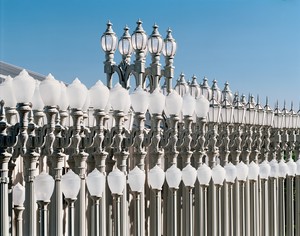
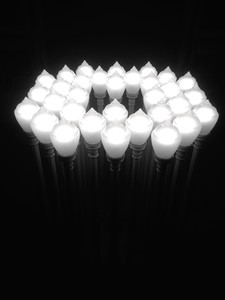
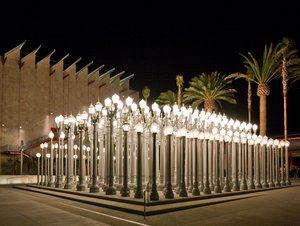
As one of Los Angeles’s most celebrated and well-known artists, Burden produced what is arguably the city’s most iconic works of public art. Urban Light (2008), his magnificent installation of 202 powder-coated vintage streetlamps arranged into a series of rows, forms a temple of light at the entrance of the Los Angeles County Museum of Art. Like Nomadic Folly, this later work draws upon architecture of the past—in this case, ancient Roman colonnades—to inspire optimism for the future based on a celebration of humanity’s historical achievements and the greatness that is possible when we come together as one.

Urban Lights at LACMA

Chris Burden, Urban Light, 2008, permanent installation, Los Angeles County Museum of Art. Artwork © 2025 Chris Burden/Licensed by the Chris Burden Estate and Artists Rights Society (ARS), New York

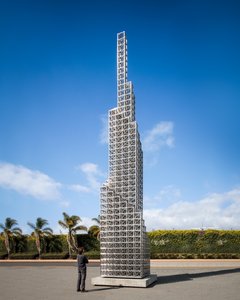
Nomadic Folly relates to Burden’s long-standing engagement with architecture and urbanism, both of which recur in various forms throughout his career. Whether towering skyscrapers built from stainless-steel reproductions of children’s building toys such as Erector and Meccano sets, or the creation of miniature cities populated with building types from around the globe, Burden has continually probed the relationship between architecture and art. He had initially planned to pursue a career as an architect; however, Pomona College, where he completed his undergraduate studies, did not offer a dedicated BFA degree in the field. Instead, Burden took classes in physics and art. After completing a series of summer internships at architectural firms, he switched tracks, citing the slow progression in architecture from apprentice to being able to execute one’s vision. Sculpture seemed to offer his desired scale and ambition, without the time lag; he noted in a 2003 lecture at the Southern California Institute of Architecture that “in sculpture, I could get something done right away.”

In sculpture, I could get something done right away.

—Chris Burden
Erector steel Skyscraper reproduction with a person looking up at it

Chris Burden, 40 Foot Stepped Skyscraper, 2011, installation view, Frieze Los Angeles 2023 © 2025 Chris Burden/Licensed by the Chris Burden Estate and Artists Rights Society (ARS), New York. Photo: Josh White

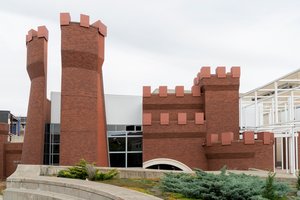
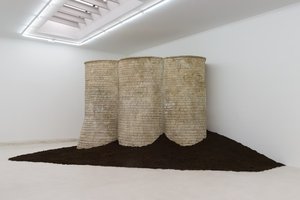
In architecture, the term “folly” describes a decorative, and often temporary, structure, which frequently alludes in style to existing building types or conventional motifs. Most famously found in English gardens, follies have no practical purpose other than providing aesthetic enjoyment and a site of relaxation. This sense of playful whimsy is evident as well in other sculptural interventions or sculptures by Burden, such as Wexner Castle (1990), which saw the artist altering the façade of Peter Eisenman’s building designed for the Wexner Center for the Visual Arts in Columbus, Ohio, with medieval architectural features such as crenellations, or La Tour des Trois Museaux (1994), in which Burden erected a faux thirteenth-century stone fortress from pieces of foam and wood.

Brick sculpture castle on the facade of a building

Chris Burden, Wexner Castle, 1990/2020, installation view, Wexner Center for the Visual Arts, Ohio State University, Columbus © 2025 Chris Burden/Licensed by the Chris Burden Estate and Artists Rights Society (ARS), New York

Three carved foam towers on top of a large pile of dirt

Chris Burden, La Tour des Trois Museaux, 1994, FRAC Champagne-Ardenne, Reims, France © 2025 Chris Burden/Licensed by the Chris Burden Estate and Artists Rights Society (ARS), New York. Photo: André Morin

Both unique and emblematic of Burden’s remarkable artistic practice, Nomadic Folly is one of only two follies that the artist created in his lifetime. It predates Dreamer’s Folly, which was made in 2010. This later piece represented a more permanent structure, being built from cast-iron gazebos; notably, both works were shown together at Gagosian’s Rome gallery in Burden’s 2010 exhibition The Heart: Open or Closed, which explored themes of humanity’s capacity for hate and tolerance.

In the context of ongoing relief efforts to support the city of Los Angeles, Gagosian is participating in the LA Arts Community Fire Relief Fund. Led by the J. Paul Getty Trust, with support from a coalition of major arts organizations and philanthropists, the fund provides critical emergency support for artists and art workers impacted by the fire.

Chris Burden, Dreamer’s Folly, 2010, installation view, Frieze Los Angeles 2022 © 2025 Chris Burden/Licensed by the Chris Burden Estate and Artists Rights Society (ARS), New York. Photo: Sebastiano Pellion di Persano

The Dark Sides of Light and Space

The Dark Sides of Light and Space

Tracking works by Chris Burden, Bruce Nauman, Maria Nordman, and Eric Orr as outliers and outcroppings of the California Light and Space movement, Michael Auping argues that darkness—the absence of light and space—is a key element of the aesthetic.

A Living Symbol

A Living Symbol

As American identity once again comes into question during a politically charged election cycle, the Quarterly revisits the motif of the American flag in art. Here, John B. Ravenal contextualizes Robert Lazzarini’s new wall-based flag sculptures and elucidates the tensions they lay bare in the symbol of our nation.

Artist, Audience, Accomplice

Artist, Audience, Accomplice

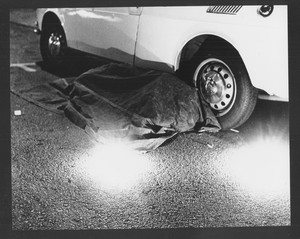
Sydney Stutterheim has published Artist, Audience, Accomplice: Ethics and Authorship in Art of the 1970s and 1980s (Duke University Press, 2024), a survey of performance art and related practices that involve, in various manners, the figure of the accomplice. To celebrate the publication, the Quarterly is publishing an excerpt that examines Chris Burden’s Deadman (1972).

American Artist, Yayoi Shionoiri, and Sydney Stutterheim on Poetic Practical: The Unrealized Work of Chris Burden

In Conversation
American Artist, Yayoi Shionoiri, and Sydney Stutterheim on Poetic Practical: The Unrealized Work of Chris Burden

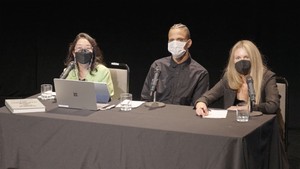
Join Gagosian to celebrate the publication of Poetic Practical: The Unrealized Work of Chris Burden with a conversation between American Artist, Yayoi Shionoiri, and Sydney Stutterheim presented at the Kitchen, New York. Considering the book’s sustained examination of sixty-seven projects that remained incomplete at the time of Burden’s death in 2015, the trio discuss the various ways that an artist’s work and legacy live on beyond their lifetime.

Chris Burden: Prelude to a Lost Performance

At the Edge
Chris Burden: Prelude to a Lost Performance

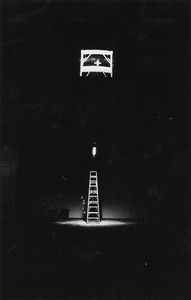
Michael Auping tells the Quarterly’s Alison McDonald about the preparations for a performance by Chris Burden at the Newport Harbor Art Museum in Southern California in 1974—and the event’s abrupt cancellation—providing a glimpse into the mindset of a young, aggressive, and ambitious artist in the early stages of his career.

Gagosian Quarterly Summer 2022

Now available
Gagosian Quarterly Summer 2022

The Summer 2022 issue of Gagosian Quarterly is now available, with two different covers—featuring Takashi Murakami’s 108 Bonnō MURAKAMI.FLOWERS (2022) and Andreas Gursky’s V & R II (2022).

Chris Burden: Poetic Practical

Chris Burden: Poetic Practical

A new publication exploring the work that Chris Burden conceived but left unrealized delves into his archive to present sixty-seven visionary projects that reveal the aspirations of this formidable artist. The book’s editors, Sydney Stutterheim and Andie Trainer, discuss its development with Yayoi Shionoiri, executive director of the Chris Burden Estate.

Chris Burden: Big Wrench

Gagosian Quarterly Films
Chris Burden: Big Wrench

From January 23 to February 21, 2019, Gagosian Quarterly presented a special online screening of Chris Burden’s 1980 video Big Wrench.

Big Wrench

Big Wrench

Sydney Stutterheim looks at the brief but feverish obsession behind this 1980 video by Chris Burden.

Deluxe Photo Book

Deluxe Photo Book

Sydney Stutterheim discusses Chris Burden’s Deluxe Photo Book 1971–73 on the occasion of its inclusion in About Photography at Gagosian San Francisco.

Urban Light: A Ten Year Anniversary

Urban Light: A Ten Year Anniversary

Ten years ago LACMA premiered Chris Burden’s Urban Light, which has since become an iconic landmark for the city of Los Angeles. To celebrate the anniversary, we look back to 2008 with a conversation between Chris Burden and Michael Govan, director of LACMA.

Burden

Spotlight
Burden

The story behind Chris Burden’s Buddha’s Fingers (2014–15) and its connection to all of his streetlamp installations. Text by Sydney Stutterheim.