September 25, 2015

Richard Wright

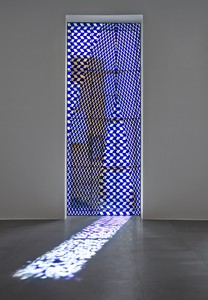
This fall Gagosian Rome will present the first major exhibition of Richard Wright’s work in Italy. For this exhibition, which is also the first view in continental Europe of his work using leaded glass, Wright has intervened in the architecture of the elliptical gallery, replacing the floor-to-ceiling windows with panels of staggering complexity that “paint with light.” Louise Neri discusses Wright’s new exploration of glass works.

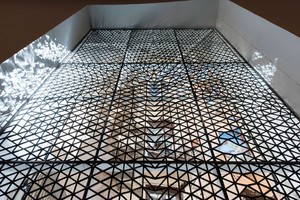
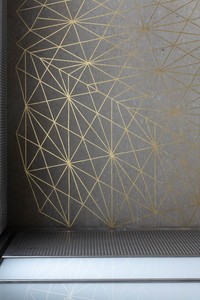
Richard Wright, No title, leaded glass, 181 ⅛ × 68 ½ inches (460 × 174 cm)

Richard Wright, No title, leaded glass, 181 ⅛ × 68 ½ inches (460 × 174 cm)

Richard Wright, No title, leaded glass, 181 ⅛ × 68 ½ inches (460 × 174 cm)

Richard Wright is best known for his rigorous site-specific yet transient works that unite painting with graphic, typographic, and ornamental elements. Actively engaging the laws of visual perspective, he charges architectural spaces with a fourth dimension of subtle yet extreme optical complexity, subverting the static exchange between painting and viewer. Treating painting as “the art of the infinite surface” he makes his works directly on the interior surfaces of buildings at greatly varying scales—sometimes comprising tens of thousands of hand-drawn and painted marks. Searching out the “problem” in the space as a starting point—as each space and problem is unique, the strategy is sustaining—Wright works as often in overlooked, interstitial areas (edges, safety features, corners) as on vacant walls and ceilings. Paradoxically, these elaborate and time-consuming paintings and applied metal-leaf drawings usually disappear after the exhibition, an act resistant to the age of rampant commodification.

Gagosian quarterly weekend reads

Get the best of the Quarterly in your inbox twice a month.

By subscribing you agree to our Privacy Policy.

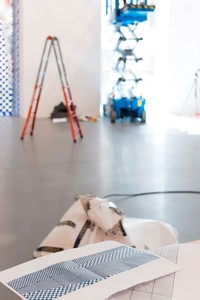
Images of the installation process of Richard Wright at Gagosian Rome

Wright’s paintings are rhythmic structures extracted from things, experiences, artworks, and artifacts. Oscillating between illusion and abstraction, they evince associations with both pure and applied art, as well as subculture: Minimal art, Classical and Renaissance murals, the Russian avant-garde, De Stijl, Abstract Expressionism, and Op Art; clothing, commercial art, and porcelain; goth and punk. The ciphers that he has developed over time tend to be geometrical (repeated lines or forms), organic (plants), or drawn from popular culture and sometimes a mixture of all three. If the first two are most often inspired by art-historical sources, such as nonobjective art or Art Nouveau, the last owes much to music and musical sources such as record covers and fanzines. Slowly over time, Wright’s repertoire of forms has become ever more complex and intricate, probably a result of the elaborate drawings that he makes each day. Whether metal filigree or dizzying lines of force deriving from a graphic technique used in engineering, his paintings are feats of painstaking complexity.

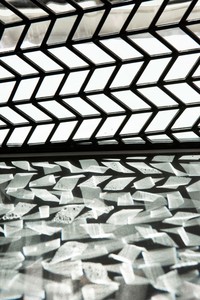
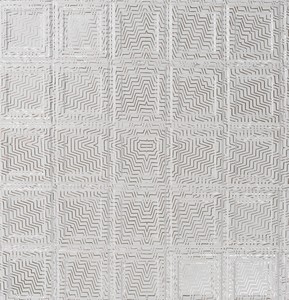
Richard Wright, No Title, 2015 (detail)

Given the central role that light has played in his work to date, it is perhaps not surprising that recently Wright has begun working in leaded glass, exploring both its material and nonmaterial qualities, such as its natural tendency to capture and reflect light. The results are nothing short of extraordinary: Echoing the fleeting nature of his wall paintings, the new glass works generate dynamic drawings and patterns that shift through space according to the passage of light and time.

Working with the York Glaziers Trust, one of the oldest stained-glass conservation studios in Europe, Wright began to experiment with leaded-glass technique in response to a permanent commission for the Tate Britain renovation, The Millbank Project (2011–13). His large arched window with its complex geometric panels in clear glass is now a prominent feature at the Millbank entrance. In a subsequent project at the Modern Institute in Glasgow, intricately figured leaded-glass panels were inserted into the skylights of the otherwise empty space, drawing the eye upward. Throughout the day, the sun traversed the skylights, giving rise to dazzling and ethereal light shows that projected shafts and skeins of pure and palpable energy into the space below.

Richard Wright, No Title, 2015 (detail)

The new glass works for Gagosian Rome are Wright’s most elaborate to date and, importantly, give the viewer a new proximity to the work. In the elliptical gallery, he has replaced each of three 5-meter-tall, floor-to-ceiling, south-facing windows with twelve evenly sized leaded-glass panels. Two of the windows are clear, colorless glass, while in the third he has experimented with color for the first time. Generated from an intensive daily practice of physical composition that involves drawing and folding paper at a 1:1 scale, each leaded- glass panel comprises hundreds of handmade geometric elements that vary in transparency and texture. Each angled section is framed in lead, building into a field of staggeringly complex rhythms.

And through these rhythmic matrices, daylight streams, filling the gallery with its celestial and ephemeral presence.

Artwork © Richard Wright. Photos by Matteo D’Eletto M3 Studio. Richard Wright is on view at Gagosian Rome, September 29–November 10, 2015.

Black-and-white portrait of Louise Neri

Louise Neri has been a director at Gagosian since 2006, working with artists and developing exhibitions, editorial projects, and communications across the global platform. A former editor of Parkett magazine, she has authored and edited many books and articles on contemporary art. Beyond the exhibitions she has organized for Gagosian, she cocurated the 1997 Whitney Biennial and the 1998 São Paulo Bienal, among numerous international projects. Photo: Lin Lougheed

See all Articles

Richard Wright and Martin Clark

In Conversation
Richard Wright and Martin Clark

Richard Wright and Martin Clark, director of Camden Art Centre, London, discuss Wright’s latest body of work, recent commissions, and new monograph, which provides a comprehensive overview of his practice between 2010 and 2020.

No Title

No Title

In an excerpt from his forthcoming monograph, Richard Wright pens a personal and philosophical text about painting.

Richard Wright

Behind the Art
Richard Wright

In an interview with Kay Pallister, the artist explains his relationship to drawing and the importance of time in his site-specific works.

Gagosian Quarterly Summer 2019

Now available
Gagosian Quarterly Summer 2019

The Summer 2019 issue of Gagosian Quarterly is now available, featuring a detail from Afrylic by Ellen Gallagher on its cover.

Francis Bacon: Reinventing Realism

Francis Bacon: Reinventing Realism

Francis Bacon lived and worked in Paris for a decade starting in the mid-1970s. The city and the art he encountered there provided a profound backdrop for his austere late style, which often brings together smooth, colorful backgrounds, spare architectural signifiers, and sculptural human forms. Here, three striking paintings from that period are considered by Sebastian Smee.

Divine Emanations: Nymphs, Poets, and the Painter’s Palette

Divine Emanations: Nymphs, Poets, and the Painter’s Palette

Janne Sirén considers Anselm Kiefer’s new paintings, the subject of an exhibition at Gagosian, New York, entitled Seal My Ears Shut and I Shall Hear You Still.

Giuseppe Penone: The Reflection of Bronze

Giuseppe Penone: The Reflection of Bronze

Adam D. Weinberg has been working with Giuseppe Penone on an exhibition of the artist’s new sculptures, The Reflection of Bronze, that opens at Gagosian, New York, on April 22. The works explore the character and possibilities of bronze. Here, Weinberg considers Penone’s enduring engagement with the alloy and addresses the conceptual underpinnings of the exhibition’s three-room structure.

Donald Judd: Patiently Constructed

Donald Judd: Patiently Constructed

From their respective fields, three international cultural figures—artist and designer Ronan Bouroullec, fashion visionary Michèle Lamy, and chef and restaurateur Enrique Olvera—reflect on Donald Judd’s work in furniture, the subject of recent exhibitions in South Korea and Japan.

Henry Moore: Monumental Nature

Henry Moore: Monumental Nature

Laura Bruni writes about a major exhibition celebrating the work of the British sculptor Henry Moore at the Royal Botanic Gardens, Kew, London.

Portrait of the Artist as a Young Choreographer: Emily Coates Dances Early Balanchine

Portrait of the Artist as a Young Choreographer: Emily Coates Dances Early Balanchine

Mark Franko considers how Emily Coates resurrects the spirit of George Balanchine’s American beginnings through archival research, spoken dialogue, and movement in her performance Tell Me Where It Comes From.

Francesca Woodman: Brushing with Infinity

Francesca Woodman: Brushing with Infinity

On the occasion of the exhibition Francesca Woodman: Lately I Find a Sliver of Mirror Is Simply to Slice an Eyelid at Gagosian, Rome, Alyce Mahon explores the artist’s engagements and affinities with Surrealism, from the writings of André Breton to the photographs of Hans Bellmer. Mahon focuses on the time Woodman spent in Rome while she was a student at the Rhode Island School of Design.

Ellen Gallagher: Submergent Visions

Ellen Gallagher: Submergent Visions

Sharad Chari reflects on a recent visit to Ellen Gallagher’s studio in Rotterdam, Netherlands, thinking through the artist’s intertextual interrogation of the oceanic and the ways in which her practice is informed by a wider Black intellectual and artistic world, an abiding interest in Herman Melville’s Moby-Dick, and the imperatives that surround this studio by the Port of Rotterdam.