Mark Franko considers how Emily Coates resurrects the spirit of George Balanchine’s American beginnings through archival research, spoken dialogue, and movement in her performance Tell Me Where It Comes From.
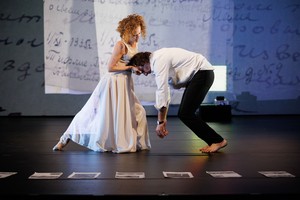
Emily Coates and Derek Lucci in Tell Me Where It Comes From(2025), choreographed by Emily Coates; directed by Ain Gordon, Wadsworth Atheneum Museum of Art, Hartford, Connecticut, 2026. Photo: Maria Baranova
Emily Coates and Derek Lucci in Tell Me Where It Comes From(2025), choreographed by Emily Coates; directed by Ain Gordon, Wadsworth Atheneum Museum of Art, Hartford, Connecticut, 2026. Photo: Maria Baranova
Mark Franko is Laura H. Carnell Professor of Dance and heads the Institute of Dance Scholarship at Temple University. Dancing Modernism/Performing Politics was reissued in 2023 in a revised edition from Indiana University Press. Text as Dance: Walter Benjamin, Louis Marin and Choreographies of the Baroque was published in 2025 by Bloomsbury.
Tell Me Where It Comes Fromis Emily Coates’s clever and complex evening-length lecture-performance reflecting upon George Balanchine’s aesthetic in the 1930s, prior to his 1948 cofounding of the New York City Ballet with the writer, philanthropist, and cultural figure Lincoln Kirstein.1 Kirstein brought Balanchine from Paris to the United States in 1933 to create a distinctly American (read: not Russian) form of ballet. Kirstein’s project—often referred to as the Americanization of ballet—initially aimed at the creation of a company comprised of an equal number of Black and white dancers. Although the multiracial aspect of his proposal did not become a reality at the time, Kirstein’s Popular Front views were disseminated in broadsides such as “Blast at Ballet: A Corrective for the American Audience”(1938), where he proposed that ballet was a democratic form that could appeal to the masses.
Coates’s work reflects a growing interest in Balanchine’s early career in the United States, with examples including Elizabeth Kendall’s Balanchine Finds His America (2025) and James Steichen’s Balanchine and Kirstein’s American Enterprise (2018). What Coates’s research adds is what only performance can: a vision of how bodies moved and what they communicated in a now-distant historical past. A former New York City Ballet dancer herself, Coates has also worked for years with postmodern choreographer Yvonne Rainer, whose views on ballet are known to be critical. In Rainer’s 2007 tribute to Balanchine’s Agon (1957), titled AG Indexical, Coates performed on pointe among modern dancers in sneakers. She also carried out crucial archival research behind Rainer’s 2019 restaging of her Parts of Some Sextets (1965), a substantial piece that revealed a less strictly minimalist facet of her choreography.
Tell Me Where It Comes From emerges from this complex admixture of influences. But Coates’s performance evokes neither the stereotypical Balanchine ballerina nor Rainer’s uncompromising postmodernism. The aim, it seems, is to create a dance that revives qualities of a once-nascent movement language whose aesthetic powers have faded, or at least certainly transformed, over time.
Coates—credited with conception, choreography, and script—also does a lot on stage. She dances, monologues, and professes while interacting with her collaborators to reconstruct, document, and express Balanchine’s state of mind upon arriving on US shores. Playing the triple role of Balanchine dancer, reenactor of Balanchine’s historical choreography, and dance scholar as historian-sleuth, she is by turns dizzying, insightful, and witty. She transitions deftly from one role to another with humorous self-deprecation and tireless meta-commentary. It is a delicate balancing act, supported by Ain Gordon’s direction. In playing the scholarly investigator, Coates conjures up a dancing persona of a different period. Without reenacting specific works, she presents a montage of movement ideas.
This is without doubt a historical project, and the performance I saw gained a somewhat uncanny historical atmosphere thanks to the fact that it took place at the Avery Theater (at the Wadsworth Atheneum Museum of Art in Hartford, Connecticut), the same site where some of Balanchine’s constitutive pieces were first performed. This is precisely where Kirstein first set up shop with the émigré choreographer. Furthermore, the Wadsworth boasts major holdings of Ballets Russes memorabilia sold to the museum by Serge Lifar after his failed US tour in 1933, as well as a significant collection of modern art thanks to Arthur Everett Austin Jr., museum director from 1927 through 1944.2 Coates extensively used the museum’s archive to prepare her work.3
In the work, Coates verbally reflects on her early Balanchine training and conducts ballet barre exercises for herself and actor Derek Lucci, who partners her throughout. She simultaneously teaches the class, takes the class, describes her student as her dance partner/collaborator, and muses on her own dancing past. Lucci, clearly an actor cast as a dancer, is nonetheless theatrically effective, with an air of awkward grace enhanced by gestural precision.
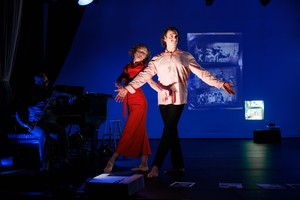
Emily Coates and Derek Lucci in Tell Me Where It Comes From(2025), choreographed by Emily Coates; directed by Ain Gordon, Wadsworth Atheneum Museum of Art, Hartford, Connecticut, 2026. Photo: Maria Baranova
Coates then changes hats to conduct a seminar with the audience on a photograph from Balanchine’s Serenade (1935) projected onto the cyclorama. She analyzes a “pre-yearning” gesture that avoids the ballet cliché. Coates’s turn to early Balanchine places historical gestures back in the stream of their original emergence, where they stand forth as fresh rather than timeworn. The thesis is that early Balanchine ballets are qualitatively distinct from his later work but also contain keys to understanding his oeuvre. Although one can recognize numerous quotes from Balanchine’s choreography, this idea of derivation is multifaceted. Coates’s vision of Balanchine is different from what we might expect, particularly because she does not use pointe shoes, but it takes on convincing shape through her embodiment of a unique lyricism.
Coates tells us at the start: “Everything you will see comes from something else.” Where things come from also implies a deeper personal meaning for Balanchine, and in some sense an origin. Coates seeks to discover what animated Balanchine’s art most intimately by turning to psychological quandaries over love relationships traced in his correspondence. (It is well known that Balanchine was resolutely heterosexual, whereas Kirstein’s ballet milieu was predominantly gay, at least as concerns many of the male artists.) As we listen to excerpts from Balanchine’s letters to ballerina Vera Zorina being translated from the Russian, for example, we are privy to a dawning paradox: To create another’s happiness is to create one’s own unhappiness. Coates and Lucci improvise to the reading of this text as imagery from Balanchine’s Orpheus (1948) flickers through their movements. In this reenactment of his early aesthetic by reconstructing psychological and sentimental dilemmas, the idea may be that we discover the ur-Balanchine, the original source of what is now familiar to us.
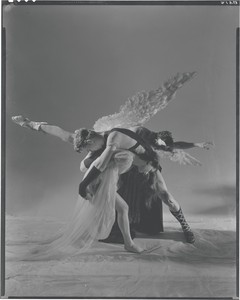
Thematically speaking, the structure of this primitive or ur identity is the Orphic myth, with its loss of the beloved as the sacrifice of sight to sound: music without vision as the condition for Orpheus’s failed recovery of Eurydice from death.4 Here, Coates switches from a biographical to a structural and almost archetypal methodology. The Orphic myth manifests in a long trio between Orpheus, Eurydice, and the Angel of Death (danced by former NYCB dancer Henry Seth). With this trio, dance takes over the stage, leaving meta-commentary behind. It is a deeply moving part of Tell Me Where It Comes From and it evokes elements of Balanchine’s Orfeo ed Euridice, a 1936 production of Christoph Willibald Gluck’s opera at New York’s Metropolitan Opera, with set and costumes by Pavel Tchelitchew, in which the singers were banished to the orchestra pit. Elizabeth Kendall tells us that Balanchine was inspired by the 1911 production of the opera by Michel Fokine and Vsevolod Meyerhold, in which he had danced.5 Of course, there was also Balanchine’s later Orpheus (1948), to Igor Stravinsky’s score, in which the Dark Angel also plays a prominent role.6 The trio toward the end of Balanchine’s Serenade (1935) also comes to mind, with its tragic love triangle of two women and one man. Coates maintains that these motifs held deep psychological significance for Balanchine. But Balanchine is known as the musical choreographer of the twentieth century par excellence, and it is also possible that his use of the Orpheus myth not only mirrors his tragic love experiences but also allegorizes the importance of music in his choreographic practice.
Orfeo ed Euridice (1936), choreographed by George Balanchine, 1936. Photo: George Platt-Lynes, Jerome Robbins Dance Division, New York Public Library
The final section of Coates’s piece, to exquisite musical accompaniment by composer Charles Burnham, is clearly meant to be contemplative. It begins with Lucci reading a letter by Balanchine’s wife, dancer Tanaquil Le Clercq, in a whiny falsetto. (At the Avery, at least, his delivery seemed out of keeping with the rest of the piece and thus felt satiric; it certainly pulled things away from the historical reverence theretofore so carefully built up.) Straining in many different directions—at one point a musicologist walks on stage to comment on Balanchine’s musical compositions—there is an overabundance of ideas. The research behind the piece, which the piece also stages as research, is more a dramaturgical exercise than a thesis-driven proposal. The sources that truly engage Coates are letters read aloud and projected images, complemented by choreographic quotations. Tell Me Where It Comes From is very much a meditation on the relationship between word, image, and choreographic creativity. The revelations come, however, less in the scholarly analysis or in the pinpointing of a biographical source than in the dancing. The ballet stage as the locus of such an assemblage is in itself arresting.
Balanchine’s interpolation of the Angel of Death in his retellings of the Orpheus myth was influenced by French poet and playwright Jean Cocteau, whom Kirstein greatly admired. Cocteau visited Kirstein in New York in 1936, the year of Balanchine’s first Orfeo. Cocteau’s angel Heurtebise first appeared emanating from an elevator plaque in the poem “L’Ange Heurtebise” (1925), and then in his 1926 play Orphée as a glazier, a denizen of everydayness who advises Eurydice. Kirstein was enthusiastic about Cocteau’s interest in the poetry concealed within the everyday; Cocteau first dealt with this idea in his groundbreaking 1917 ballet Parade. But the poet’s sense of how to modernize myth seems also to have touched Balanchine, and the emphasis Coates places on the trio subtly reinforces this idea.
The recurrent iconographic elements of the Orpheus / Eurydice / Angel of Death triangle in Tell Me Where It Comes From bring us back to the relationship between Balanchine and Kirstein, one that dance scholarship often portrays as guarded, if not distrustful. Yet Balanchine’s Cocteau-esque adoption of the Angel of Death implies to the contrary a deep-seated connection between Balanchine and Kirstein—perhaps even a meeting of the minds. The production is brimming with collaborators walking on and off stage, which may be the ultimate answer to the question: Where does it come from?
1Tell Me Where It Comes From premiered in 2025 on a Works in Process program at the Solomon R. Guggenheim Museum, New York, with subsequent performances at the Avery Theater, Wadsworth Atheneum Museum of Art, Hartford, Connecticut, in February 2026 and the Yale Schwarzman Center, New Haven, Connecticut, in April 2026.
2 Kirstein’s relationship with the Wadsworth Atheneum is well documented in Nicholas Fox Weber, Parton Saints: Five Rebels Who Opened America to a New Art (1928–1943) (New Haven, CT: Yale University Press, 1995). See also the aforementioned James Steichen, Balanchine and Kirstein’s American Enterprise (New York: Oxford University Press, 2018).
3 In a lecture demonstration/preview, “The Trail of Early Balanchine Archives,” held at the Bruno Walter Auditorium of the New York Public Library on October 23, 2025, Coates proposed that the gesture of hands covering the eyes was a recurrent motif in photos she found at the Wadsworth Atheneum Museum of Art archive.
4 As Antonio Cascelli argues, “The contrast between seeing and hearing is at the center of the Orpheus myth: by turning back toward Eurydice before leaving the underworld, Orpheus chooses the visibility of the eye over the audibility of the ear.” Antonio Cascelli, “L’Orfeo: Memory, Recollection, and the Tragedy of Choosing Between Seeing and Hearing,” Rivista del Dipartimento di Musicologia e beni culturali, no. 17 (2018): p. 274.
5 Elizabeth Kendall, Balanchine Finds His America: A Tale of Love Lost and Ballet Reborn (New York: Oxford University Press, 2025), p. 58.
6 The motif of the search for Eurydice by Orpheus and the Angel of Death took on a homoerotic tone in the famous 1948 Orpheus photos by George Platt-Lynes.
Mark Franko is Laura H. Carnell Professor of Dance and heads the Institute of Dance Scholarship at Temple University. Dancing Modernism/Performing Politics was reissued in 2023 in a revised edition from Indiana University Press. Text as Dance: Walter Benjamin, Louis Marin and Choreographies of the Baroque was published in 2025 by Bloomsbury.