Carlos Valladares wades through the discourse around the musician and actress Charli XCX’s mockumentary, guiding us through its myriad references, from the Spice Girls to Andy Warhol.
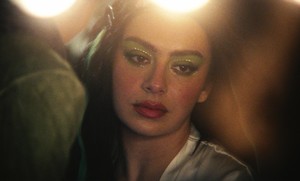
Still from The Moment (2026), directed by Aidan Zamiri; pictured: Charli XCX. Photo: courtesy A24
Still from The Moment (2026), directed by Aidan Zamiri; pictured: Charli XCX. Photo: courtesy A24
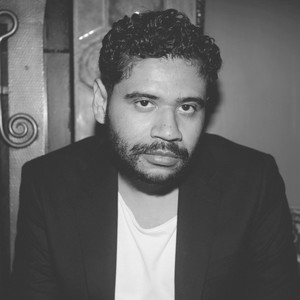
Carlos Valladares is a writer and critic from Los Angeles. He studied film at Stanford University and began his PhD in History of Art and Film & Media Studies at Yale University in fall 2019. He contributes regularly to Art in America, n+1, and Frieze. He lives in New York. Photo: Jade Sacker
By the time this piece appears, the moment for The Moment will seem to have passed—all the better to gauge its merits. What landscape did Charli XCX’s and Aidan Zamiri’s film enter? A diseased solipsism, patriotically and culturally sanctioned, reigns supreme. Charli XCX has just created the soundtrack for a major box-office success, Wuthering Heights (2026), whose director, Emerald Fennell, has felt the need to clarify that her Hollywood, export-friendly product is ultimately about her own vision of the novel as a fourteen-year-old, not what the magnificent text itself, published in 1847, says about our world and life in 2026.1 Today, our monuments coalesce in various odd car-crashes of events, juxtaposed for us on the Videodromes inside our pockets. Social media continue to wage a successful war against the idea of person-to-person connection, bombing our collective unconscious with the idea that their endlessly scrolled-down feed tailored to our desires is preferable to encounters with various others: for the frat bro, a woman; for the Westernized white subject, the world of Asia, Africa, and South America; for Gen Z, the past before 2000; for a Netflix consumer, the unstreamable Looking for Mr. Goodbar (1977). Into this arena enters a fraught, queasy, transitional, and exciting work like The Moment.
The opening credits glitch out into a series of strobe-flashed logos, a sarcastic list of the makers and brands that sustain the film-product: A24, Atlantic Records, Beats, Aperol spritz, SAG-AFTRA—as if we were witnessing late millennials strongly misremember the Pop art credits of Jean-Luc Godard films (which were a good thing). And like Godard’s dialectical “documentary” Sympathy for the Devil/One Plus One (1968), on the making of a Rolling Stones song and the unmaking of Western civilization, The Moment pits two disparate strands in mortal combat: “reality” and “artifice,” the raw materials that we shape to make our lives and the myriad micro-interventions outside our control (stupid bosses, credit cards, Discourse™) that upset our own designs. Neither strand wins in The Moment, the struggle climaxing in a profound, petered-out, bitter punch line as our heroine sells out a part of her soul so the other, real part can live in private with friends: “be a 365 partygirl from the comfort of your own home—now streaming on Amazon Music.” But The Moment is only an opening salvo. Charli XCX’s mockumentary is a riposte and an acknowledgment, of an atypically intelligent sort, by major tastemakers and trendsetters of our sordid times: Not only are we in the shit, but we can recognize why, and who is responsible. Thus we chart an uncertain path forward. Pain is named. Whither?
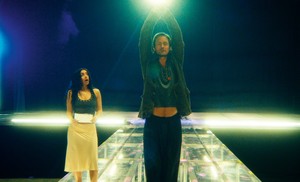
Still from The Moment (2026), directed by Aidan Zamiri; pictured: Charli XCX and Alexander Skarsgård. Photo: courtesy A24
The Moment follows a fictionalized version of Charli XCX as she rehearses for a massive world tour in support of her landmark Brat album. After critics and audiences have acclaimed the album and its “vibe,” after the entire summer of 2024 has been renamed “Brat Summer,” after her lime-green aesthetic has been memed to death, and after Kamala Harris’s failed US presidential campaign has tried to use Brat (with Charli’s blessing on Twitter/X) as a lame way of engaging young voters, Charli has decided to cancel. That won’t do, say the suits; her record label, Atlantic, has decided to film a concert tour and release it not in cinemas but online, so that “Brat Summer can last forever.” “Forever”: maybe the most horrifying word Charli has ever heard. She goes along with it, to the delight of the annoying film director Johannes (Alexander Skarsgård) and to the frustration of her best friend and creative consultant Celeste (Hailey Gates). Escapes to Ibiza, attempts to dodge the promotion of a green Brat credit card for Charli’s Gay Stans: None of these alleviate the pressure. Charli must face her own music, a music she’s sick of, as she searches for wider, less green, more cinematic pastures.
Enter The Moment, which rejects the current drive for the smooth-brained consumption of entertainment. It’s a mockumentary fully aware that it will become a period piece, not a Spice World (1997) cash-in nor a reinvention of A Hard Day’s Night (1964) but a scientific observation of a phenomenon in which the ringleader has become a detached observer of her own bacchanalia. Control of her venture has been seized from the OG. It zombies on against her will, garishly, cringefully, bolstered by the age-old suspects: the capitalist cannibalization of a good cultural idea, the baby boomer desire to make a moment last “forever,” the endless thirst for a megabrand that will financially benefit all parties. Distancing herself from an edifice she herself has carefully built, using bricks culled in art schools and London raves, Charli XCX (Charlotte Emma Aitchison), in the spirit of play, now wants to smash the whole house into smithereens. To accomplish the task, she enlists the help of a range of crafty artists in front of and behind the camera. Zamiri, writer/director, conceived of the music video for “360” in which a war room of It girls (Rachel Sennott, Gabbriette, Julia Fox, Hari Nef, Chloe Cherry, and Chloë Sevigny) discuss, with deadpan seriousness, what the New Girl should look like: “Totally waiter vibes.” “It’s definitely a je ne sais quoi situation.” “It’s about being really hot in like a scary way.” Sean Price Williams, cinematographer, zips and dartingly tracks Charli as if she were the subject of a Maysles Brothers documentary—or perhaps of Yoko Ono and John Lennon’s Rape (1969), in which a woman is relentlessly pursued by the male-coded eye of the camera until she reaches total psychological breakdown (viz., a haunting moment in an Uber in which Charli tearfully removes the runny green makeup and waterlogged studs above and below her eyes—and which, in a bit of movie magic, became the film’s poster image). The dynamic Robert Altman–esque ensemble—an effectively annoyed Rosanna Arquette as the boss lady (“Okay, how do we keep this Braaaat thing going”), an extremely funny Skarsgård as the dopey liberal director-for-hire (“Phones off, guys, this is a sacred space”), and Kylie Jenner’s five-minute cameo in a spa in Ibiza (“The second people are getting sick of you, you have to go like harder. . . . Just do your dance, you know, the fruit!!”)—all convincingly parade in and out of Charli’s view, reminding her that she might just end up another archaic reference in the archival podcasts of tomorrow.
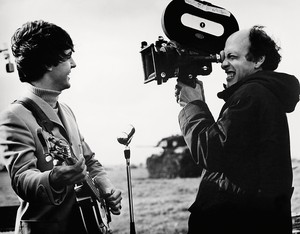
Paul McCartney and director Richard Lester on the set of Help!, 1965. Photo: courtesy Everett Collection
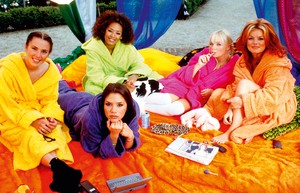
If it feels like we’ve been here before, you are correct. The Moment is Charli’s War of the References. Who’s your favorite? It’s a postmodern settling of jukebox-musical scores. (One of the funniest Moment jokes: But for the first few lines of “360” and half of one of the least-listened-to gems on Brat, “I Might Say Something Stupid,” Charli does not perform a single one of her songs—in a movie ostensibly about her fictionalized life as a major pop star.) The journalists for the loud trades and magazines (Hollywood Reporter, Variety, the New Yorker podcast) think Charli, Zamiri, Williams, and company are trying and failing to do a Christopher Guest mockumentary, or an updated Madonna: Truth or Dare (1991). (Hint: they are not.) The Letterboxd crowd and the Gay Stans, egged on by Charli, see nothing but the Spice Girls mockumentary Spice World, a cornier and safer movie than The Moment.
Me, I thought of Godard, Altman’s Player (1992), the TV show Arrested Development (2003–06 plus later installments), and especially Richard Lester’s Hard Day’s Night, which strikes me as the most relevant ancestry. The Moment is in direct dialogue, as was Spice World, with Lester’s zeitgeist-defining masterpiece, famously dubbed “the Citizen Kane of jukebox musicals” by the critic Andrew Sarris.2 The Beatles were hip and aware of their status: four poor Scousers suddenly catapulted to a level of celebrity and artistic renown not seen since the days of their fellow working-class Englishman Charles Chaplin. They had the ears of gods, cultivating a revolution in their music—but they were also unserious in public, exuding a goofball energy that made them freakishly perfect as movie stars. So it is with Charli, who is not so much unserious as unbothered: She mixes modes as she wishes, and The Moment is the result of someone genuinely, restlessly interested in crossing among media, trying on different hats, experimenting and seeing what comes of it. The suits, naturally, do not like this. They want to be able to pin their talent down to a sound, a brand, a hook. We are encouraged nowadays to morph into a demented brand version of ourselves so that we are easily digested in the online and frightening exchange of zeroes and ones, real and AI flesh. Charli, by contrast, deranges—and she works with people who derange with her. What else can explain her and Williams’s innovative reinvigoration of the now-cliché anxiety crescendos of Safdie Brothers films and their ilk?3The Moment has a quick-paced, start-stop, elegantly musical, Lesterian rhythm that is leagues away from most of the films being shown in multiplexes today, whether Marvel or Marty Supreme (2025).
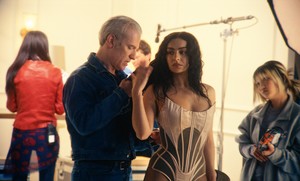
Still from The Moment (2026), directed by Aidan Zamiri; pictured: Mel Ottenberg and Charli XCX. Photo: courtesy A24
Those hectoring critics who call the film hypocritical miss its point entirely; those who think it’s not funny (it was for the audience I was in) try, perhaps too hard, to find the funny in what’s very quietly observed as a bleak, culture-bombed landscape, one that Zamiri and Charli observe with a stellar poker face. Clearly they’re in on the joke: Charli is there and not there, an active persona as modeled for the cult of the star as Andy Warhol, Monica Vitti, or Timothée Chalamet.4 The makers of The Moment do not pretend to slice radically into new cultural visions on the level of Callie Hernandez’s and Courtney Stephens’s Invention (2025) or the low-fi films of Hong Sang-soo, nor is The Moment a game-changing subversion of its star’s image in the same league as, off the top of the head, Chantal Goya’s in Godard’s Masculin Feminin (1966), Lennon’s in Lester’s How I Won the War (1967), or Ingrid Bergman’s in Roberto Rossellini’s Stromboli (1950). The tragedy that The Moment is more than aware of is that of stasis: It is caught in a battle of references. Culture has devolved into a collaboration between bullies and mediocrities who together decide life for us all. We are not in control of the narrative.
But certain artists are starting to wake up, however messily, using whatever inadequate language they can muster.5 They realize that art, politics, poetry, beauty, economics—all these things—are aggressively mixed up. And meanwhile, do you hear the bombs? Does the fire inch closer to your Amazon Fire TV? Do you hear the rioting? The clamor of the people?6 What Charli achieves here compares to Warhol’s Death and Disaster series: She offers her persona as sacrifice to the endless stream of the Image Regime, but does so with a flat, productively ironic, and unsentimental attitude. And as with Warhol, the sacrifice comes with a touch of melancholia, in the wake of disasters such as ambulance crashes, tuna-can poisonings, fake suicides, real sellouts. The once hearthlike comfort of the home has begun to resemble the weird, dank, cloistered feel of the crypt. Indeed, one can, as the film’s final, bitterly Altmanesque text suggests, be a 365 partygirl from the comfort of one’s home. Nightclub, stories, dreams, and nightmares collapse into one space, black hole style.
So, will the revolution be televised? Will we just let it?
1 “I wanted to make something that was the book that I experienced when I was 14. . . . [wanted to] see what it would feel like to fulfil my 14-year-old wish, which is both good and bad.” Emerald Fennell, quoted in Ian Youngs, “‘Primal and sexual’: Wuthering Heights director on bringing Brontë to life,” BBC, September 26, 2025. Available online at www.bbc.com/news/articles/cly0nnrr48ko (accessed March 1, 2026).
2 Andrew Sarris, “A Hard Day’s Night,” The Village Voice, August 27, 1964.
3 One effect of the Safdie Brothers’ cinematic style—raw, handheld, street-level, driven by abrasive soundscapes, relentless close-ups, and actors incessantly yelling over each other’s words—is a sense of spiral-down despair that produces a near-physical anxiety in the viewer, an effect that has been both celebrated and lambasted. Josh Safdie’s Marty Supreme (2025), directed solo without his brother Benny, continues in the same style. The brothers’ films Heaven Knows What (2014) and Good Time (2017) were shot by Sean Price Williams, cinematographer of The Moment and the subject of an interview with me in the Winter 2025 issue of the Quarterly.
4 A thoroughly personal judgment incoming: Charli’s “acting”—her “being”?—in The Moment is, to me, far more interesting and harder to characterize than the entire 150 minutes of Timothée Chalamet puffing his chest and acting an elephantine, garish, winning ass in the bloated Marty Supreme. Both, it is useless to deny, are touchstones of our own moment.
5 I would be remiss not to mention that Charli wrote a much-debated Substack essay, “The Death of Cool,” clarifying many of her positions. It was recently published in print in A Rabbit’s Foot no. 13 (December 2025): pp. 94–95. The influence of Andy Warhol’s writings—many of them aptly and famously ghostwritten by those in his orbit—are palpable throughout the essay, and many of its ideas are more effectively cinematized in The Moment.
6 At the climax of The Moment, wherein Charli at last runs utterly afoul of her US banker patrons, a set of beguiling images are juxtaposed: the burning of a Brat flag, rioters smashing into what looks like the Target near Brooklyn’s Barclays Center, and protests on the street that resemble those for BLM in 2020, or perhaps the Columbia student protests in support of Palestinians in Gaza in 2024. The revolution has arrived, the rebellion cannot be quelled—yet, charming idea!, it is compelled by a Mary Poppins-y run on a bank provoked by a pop star sellout.
Carlos Valladares is a writer and critic from Los Angeles. He studied film at Stanford University and began his PhD in History of Art and Film & Media Studies at Yale University in fall 2019. He contributes regularly to Art in America, n+1, and Frieze. He lives in New York. Photo: Jade Sacker