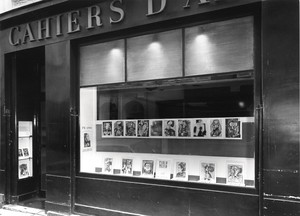
Book Corner
Cahiers d’Art
Rare-book specialist Douglas Flamm speaks with Staffan Ahrenberg about the history and evolution of the storied publishing house.
Fall 2017 Issue
Lauren Mahony discusses two rare books by Henri Matisse selected for the Gagosian Shop by rare-book specialist Douglas Flamm.
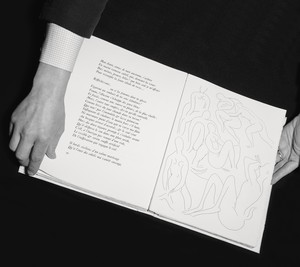
Image of Henri Matisse’s Poésies de Stéphane Mallarmé, published in 1932 by Albert Skira
Image of Henri Matisse’s Poésies de Stéphane Mallarmé, published in 1932 by Albert Skira
Henri Matisse was sixty years old when he embarked on his first major illustrated book, Poésies de Stéphane Mallarmé, inaugurating a new phase in his career during which books became a sustained part of his work. Begun in 1930, Poésies . . . was published in 1932 by Albert Skira, who had invited Matisse to illustrate the volume, a collection of poems first published in 1887. (Skira’s first project of this type, a selection from Ovid’s Metamorphoses illustrated by Pablo Picasso, had appeared in 1931.)
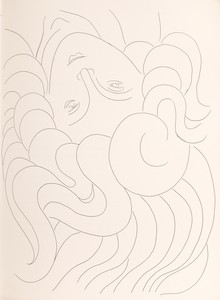
Image of Henri Matisse’s Poésies de Stéphane Mallarmé, published in 1932 by Albert Skira
Matisse was fully engaged with the Mallarmé project for nearly two years, concurrent with the large mural on the subject of dance that he was planning for the Barnes Foundation, in Merion, Pennsylvania. Although he had provided illustrations for books earlier on, he had never before been as deeply involved in the overall concept of making a book. Carefully planning the layout and design elements, he made over 200 preparatory drawings, from which he went on to print sixty etchings; twenty-nine were ultimately included in the publication.
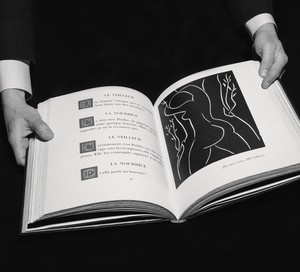
Image of Henri Matisse’s Pasiphaé: Chant de Minos (Les Crétois), published in 1944 by Martin Fabiani
On the challenge of marrying image with text, Matisse would recall in 1946, “The problem was then to balance the two pages—one white, with the etching, the other comparatively black, with the type.”1 To achieve this balance he scaled his drawings to fill the page—a large one, at about thirteen inches tall by nearly ten inches wide—but used thin, minimal lines without shading, leaving the page mostly white. Seeing the book recently at Gagosian, the noted Matisse scholar John Elderfield spoke of the “absolute fluency” of Matisse’s drawing, remarking on the artist’s ability to create areas of greater and lesser luminosity with simple etched lines. Among the wide-ranging subjects depicted in the etchings are Edgar Allan Poe, botanical elements, and Arcadian imagery that recalls both Matisse’s compositions of twenty years prior and the mural-size painting The Dance, simultaneously in process for the Barnes.
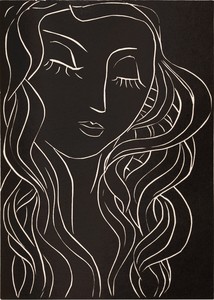
Image of Henri Matisse’s Pasiphaé: Chant de Minos (Les Crétois), published in 1944 by Martin Fabiani
Twelve years later, in 1944, Matisse completed another ambitious illustrated book, this one published by Martin Fabiani, his art dealer during the Second World War.2 Pasiphaé: Chant de Minos (Les Crétois), Henry de Montherlant’s modern interpretation of the classical story, is illustrated with 148 linoleum cuts (the cover, eighty full-page plates, forty-five decorative elements, and eighty-four oversized decorative block letters, printed in red, at the beginning of each paragraph). Pasiphaé marks the first time Matisse used linocut, which creates images drawn in white against a black ground—the opposite effect from the Mallarmé etchings. Riva Castleman, writing in 1978, discussed the balance between image and text, as Matisse had in 1946: “The white lines incised into the black ground of each plate provided a considerably different weight to the illustrations as they opposed pages of text, and the embellishment of the text pages with initials and head and tail pieces deftly offset this imbalance. . . . For the first time purely decorative elements, such as groups of undulating lines, serpentines, and stars, are plucked from their customary positions in Matisse’s compositions and, in the bands above and below, act like traps for the loose blocks of typography.”3 In the second half of the book, a band of stars repeats at the top of several pages; these stars become larger as the reader progresses through the text, as though animated in space.
Each of these livres d’artistes, or artist’s books, is the result of a total collaboration between artist and publisher and each presents a striking pairing of art and literature. Elderfield, who included both the Mallarmé and Pasiphaé in his landmark 1992 Matisse retrospective at the Museum of Modern Art, recently remarked, “His very first paintings, made when he was twenty-one, were of piles of books. He was a great reader, who loved books, so it is not surprising that he made great illustrated books. His illustrated books are so integral to his art as a whole.”
1 Henri Matisse, “How I Made My Books,” 1946, repr. in Jack D. Flam, Matisse on Art (Berkeley and Los Angeles: University of California Press, 1995), p. 167.
2 See Riva Castleman’s catalogue entries in John Elderfield, Matisse in the Collection of The Museum of Modern Art (New York: the Museum of Modern Art, 1978), pp. 140–42.
3 Ibid., p. 142
All artwork © 2017 Succession H. Matisse/Artists Rights Society (ARS), NY

Lauren Mahony is a director in the publications department at Gagosian, where she has worked on exhibitions and publications devoted to Willem de Kooning, Helen Frankenthaler, Brice Marden, and David Reed, among others, since 2012. She previously worked as a curatorial assistant in the department of painting and sculpture at the Museum of Modern Art, New York. Photo: Rob McKeever
Rare-book specialist Douglas Flamm speaks with Staffan Ahrenberg about the history and evolution of the storied publishing house.
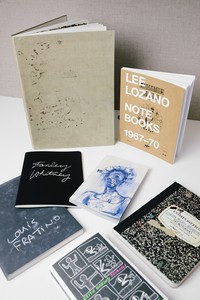
Megan N. Liberty explores artists’ engagement with notebooks and diaries, thinking through the various meanings that arise when these private ledgers become public.
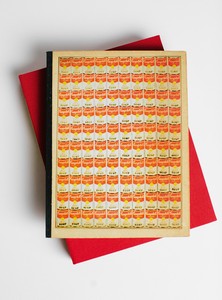
Rare-book expert Douglas Flamm speaks with designer Norman Diekman about his unique collection of books on art and architecture. Diekman describes his first plunge into book collecting, the history behind it, and the way his passion for collecting grew.
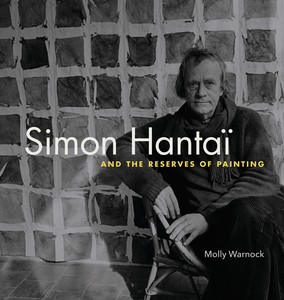
An excerpt from Molly Warnock’s Simon Hantaï and the Reserves of Painting, published by Pennsylvania State University Press in 2020, explores the painter’s developments in the late 1950s and early 1960s.
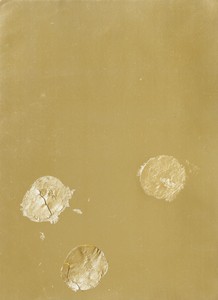
Rare-book specialist Douglas Flamm and curator Michael Cary sit down to discuss the varied publishing projects and passions of Yves Klein.
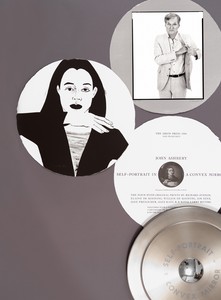
Wyatt Allgeier discusses the 1984 Arion Press edition of John Ashbery’s Self-Portrait in a Convex Mirror, featuring prints by Richard Avedon, Alex Katz, Elaine and Willem de Kooning, and more.
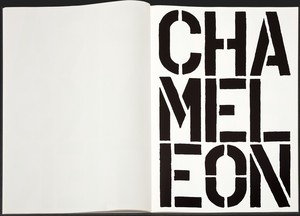
Christopher Wool’s Black Book (1989) was selected by Douglas Flamm, a rare-book specialist at Gagosian, for a special focus. Text by Anna Heyward.
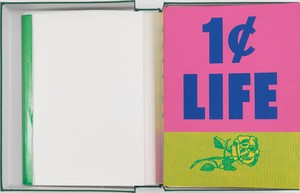
A 1964 publication by the Chinese-American artist and poet Walasse Ting and Abstract Expressionist painter Sam Francis.

Ahead of Alex Israel’s exhibition of four new Fin sculptures at Gagosian, London, the artist spoke with Susan Casey, author of The Wave: In Pursuit of the Rogues, Freaks, and Giants of the Ocean (2010), about the ocean, surfing, and Los Angeles.
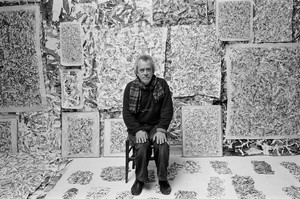
On July 9, Simon Hantaï: the last studio opens at Gagosian, Gstaad. Curated by Anne Baldassari, the show comprises sixteen of the artist’s dernier atelier (last studio) paintings of 1982–85. The exhibition is accompanied by an illustrated catalogue, copublished by Gagosian and Skira, which features an essay by Baldassari and an extensive portfolio of previously unpublished photographs by Édouard Boubat. Here, we share the introductory chapter from the publication.

Adam D. Weinberg has been working with Giuseppe Penone on an exhibition of the artist’s new sculptures, The Reflection of Bronze, that opens at Gagosian, New York, on April 22. The works explore the character and possibilities of bronze. Here, Weinberg considers Penone’s enduring engagement with the alloy and addresses the conceptual underpinnings of the exhibition’s three-room structure.
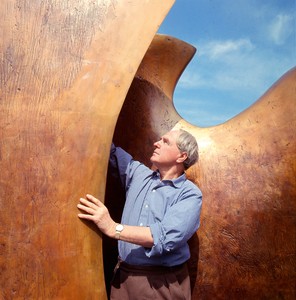
Laura Bruni writes about a major exhibition celebrating the work of the British sculptor Henry Moore at the Royal Botanic Gardens, Kew, London.