
Theaster Gates: Dave, All My Relations
A conversation between Theaster Gates and Jessica Bell Brown, with an introduction by Sydney Stutterheim.
Fall 2024 Issue
Writer and curator Olivia Anani met Theaster Gates in his exhibition Black Mystic at Gagosian, Le Bourget, to discuss the importance of translation and relocation, the ever-expanding horizons of his practice, and his use of tar.
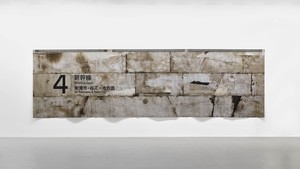
Theaster Gates, Untitled, 2024, industrial oil-based enamel, rubber torch down, bitumen, and steel, 9 feet 4 ⅝ inches × 31 feet 9 ⅛ inches (2.9 × 9.7 m)
Theaster Gates, Untitled, 2024, industrial oil-based enamel, rubber torch down, bitumen, and steel, 9 feet 4 ⅝ inches × 31 feet 9 ⅛ inches (2.9 × 9.7 m)
Olivia AnaniI was fortunate to grow up with family and friendly connections across several African countries. I remember being exposed, through my mother’s love of craftsmanship, to the expertise in each of these regions: goldsmiths and jewelers from Senegal, silverwork and leatherwork from Tuareg artisans in Niger, Akan gold weights and kente textiles from Ghana, Ethiopian pleated cotton, Malian embroidery on bazin, woodworking from Benin and Togo, bronzes from Burkina Faso. . . . I bring this up because each of these places brought something new to the conversation. This is also one of the reasons why I’m so interested in your practice, because it’s really a 360-degree practice. You’re interested in and preoccupied with all aspects of life.
Theaster GatesFirst, I love labor and I have a respect for labor: labor deserves to be esteemed as a cultural practice in the same way as painting. One way to frame the exhibition is through two words: transference and transgression. The transference is not only my dad transferring knowledge about how to make, but also the ability to imagine transferring the skill from a traditional labor practice to an artistic practice, and then the transference of the material from the roof to the floor to the wall. In that sense, what my work does the most is relocate, and in the act of relocation, I’m able to allocate new meaning, new significance, and different value.
I love gospel music but I stopped going to church. I had a major crisis with the institution of the church, but I wanted to try to maintain some sense of a spiritual self. So, I created a band called the Black Monks. The transference in that case is the relocation of the music from the pulpit and the choir stand to the museum, and to others who would otherwise never have a spiritual experience in the Black church. Once during a performance, a white curator suddenly passed out.
OAYou mean, as in the context of a Holy Ghost experience?
TGYes. And when he came to, he explained that he didn’t know how it happened: he was listening to the music, and it felt overwhelming, and then he fell to the ground. In this case the transference was one-to-one. Even when I left the church, I didn’t become ironic; I didn’t become critical of the ecstatic possibility of the music. But its relocation to the museum meant that people could have a one-to-one experience of real ecstasy without ever having encountered an ecstatic thing before.
OAWhich is fascinating, because it means that in this case you were not only transferring the form or the tradition or the history of the musical experience in the church, you were also transferring its energetic charge.
TGThe energy, the power. People say, “Oh, your dad is a roofer.” Yeah, but that’s not the clincher. The clincher is that my mom gave me the gift of translation. And here that translation is, How do I make roofing legible to the art world? How do you translate? What’s the shift from one vocabulary to another to make people understand its value without a whole lot of explanation? Artists should not have to speak a lot. Let the work speak. Can the work speak?
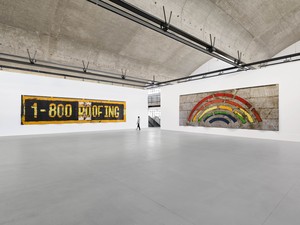
Installation view, Theaster Gates: Black Mystic, Gagosian, Le Bourget, France, April 13–June 29, 2024
And then transgression—what that word means for me is a shift that requires some kind of fault: you do something wrong. It’s a shift and there’s a cost. The shift is me accepting that I entered the art world with a very different toolkit than a conventional, academically trained artist. The trained artist learned the basics in the four years of undergraduate studies. I learned about composition on the roof, from twelve years old to eighteen years old, and then in undergrad I gained an understanding of urban planning. I had hand ability and disciplinary knowledge in a field separate from art. So while most art students were reading about other artists, in constant conversation with the Flemish painters or the eighteenth-century use of blue, I was thinking about the commodification of the planet and how every inch of this place is owned by someone . . . on paper.
I feel that one of my transgressions is that I entered the art world with other things on my mind. And art and the market became complicit with my desires to satisfy these other disciplinary ways of knowing. I want to fix the city, so art should be the tool whereby I activate my desire to fix the city. I want to grieve, so art should be the vehicle through which I grieve. And it means that sometimes you walk into an exhibition and it feels like a funeral. You walk into an exhibition and it feels like a church. You walk into an exhibition and it feels like a symposium. And that’s because I’m trying to bend the discipline toward my love of these other practices or toward my problems at hand. To do that comes with a cost. People don’t know how to evaluate it.
With three moves, three paintings, Black Mystic attempts to weld together my history with Japan and my history with Mississippi. Maybe somewhere in those three paintings is both a philosophical understanding of Japanese aesthetics, Japanese religion, Japanese form, and the jankiness or the can-do self-determinism of the Black experience all over the world with the materials we have. At the end of the day, our roof won’t leak. It may not be perfect, but the patching will keep most of the water out of the house. At least our expensive color TV—
OA—is protected.
TG—is protected. You know what I mean? The TV might be worth more than the house. That’s okay.
I like this translocation, this kind of movement between these worlds. I’m trying to find ways to own this material as a way of creating a new regime in the canon of materials that are recognized as potentially artistic, so that at some point others would be like, “I think I want to be a potter too.” Or, “I think this roofing material holds something I could use.” That feels like movement building, like building an ideological foundation that says to other people, “Maybe the trades that you learned from your families are also important.”
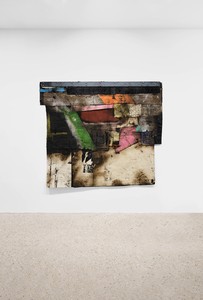
Theaster Gates, Untitled, 2024, industrial oil-based enamel, rubber torch down, bitumen, and steel, 86 ½ × 100 ⅝ inches (219.5 × 255.5 cm)
OAAnd have you felt that you’ve achieved that for tar, clay, and other roofing materials?
TGI think the floodgates are open with ceramics. That part feels okay. With tar, I still feel like I’m wrapping my head around, my hands around, what I’m after. Now that I’m past the honorific, celebrating my dad, I’m at form. I’m now at something that’s genuinely mine. I’d like to deepen some of the technical aspects of roofing—roofing for the wall.
OA“Roofing for the wall,” that’s a beautiful phrase. There’s such a rich layering of meaning—biographical, historical, structural—from the very intimate scale to the city-planning scale. And beyond your subject matter, there’s also the painterly research. How do we talk about painting, but painting as an act, as subject matter, as the experience of the painter exploring their medium?
TGAnd how do I resist the exploitation of the sublime, spiritual Africanist experience? How do I resist exploitation of our deepest selves? The way I resist is to establish new forms. I won’t just borrow one-to-one. I want to make it mine. I want the tar painting to nod at my dad, nod at history, nod at my family, nod at the market, nod at color, nod at painting, and resolve itself as my form, as an answer.
There have been moments when art collectors who are not Black have asked, “Theaster, what are you trying to make in these color field paintings? Are you trying to align yourself with only the white makers? Why don’t you make things that are more charged? I know there’s anger. Why does it always deliver so coolly?”
OAThey don’t sense the anger in tar?
TGRight? What they’re saying is that what their non-Black souls need is the manifestation, or the reoccurrence, of the violence. They so desperately want the ongoing acknowledgment of their great power and my complicity, of my weakness and their ability to tame the most savage. They want to see that scenario play out.
OAThere’s that desire, definitely, and also a desire for a legible way of processing information, of having everything laid out in a certain way that’s clear and encyclopedic, a very intense impulse toward nonopacity.
TGAnd that impulse is also a declaration of what’s important. I want to develop a different set of codes that matter to us. If I can become masterful at making code, I can then develop an alternative archive of things on their own footing. We’re taking knowledge sets that we’ve gathered from all over the world, and then we’re applying those knowledge sets toward the creation of our codes. They may not matter to the art market. They may not matter to other painters. Doesn’t matter. It’s my code. And then, some might argue, “Well, how do we evaluate it?”
OAAnd how do we evaluate it monetarily?
TGAnd based on their archive.
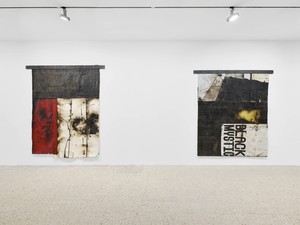
Installation view, Theaster Gates: Black Mystic, Gagosian, Le Bourget, France, April 13–June 29, 2024
OAI think that kind of resistance is essential in the self-determination of the artist. I find it suspicious when artists are told what to paint and very dutifully paint that.
TGThank you for saying it. Because I’m a resisting-ass person.
OAYou have to be. That’s why I was intrigued when you said that your father could have been an artist because he had an independence of thought. Can we talk about the subtleties of roofing as artmaking?
TGSay you had a roof and a chimney. I’d watch my dad take roofing paper and a roofing knife and go cut, cut, cut. He just knew where the cuts needed to lie to accommodate the chimney. It was like wrapping paper. He would make these cuts without measuring, but I had to measure—
OAAnd you’re like, How do you know where to cut?
TGYeah, how do you know? And he would do it in the same way people think about Japanese calligraphy. You’ve practiced so much that at a point, you don’t have to think about it anymore.
OAIt’s exactly like swordsmanship, too, or the martial arts.
TGRight. With a specific type of brush, one might imagine that the line can only be a thick line, but to watch an expert calligrapher control a line, that shit is beautiful.
OAThe variations in pressure.
TGIt requires a nonlazy hand. You must be thinking all the time. My dad had that. But there was no one to codify it the way we’ve codified calligraphy. There was no one to name this swipe that he did. He was just cutting. In the absence of the codification and the archive, it’s an unrecorded history. But what if I went back and created a language for roofing, and then I published a catalogue of the names of things?
OAA kind of treatise like [the Japanese martial-arts treatise] The Book of Five Rings [c. 1645]?
TGExactly.
OABut for roofing.
TGOne more example. In the old way of roofing you’d have an underlayer material. You tar the roof, you put this underlayer on, you tar on top of that, and then you put the final layer on. And the mop—the mop was a regular mop.
OAA regular mop?
TGLike a cotton mop, because synthetic hairs would burn in the roofing material. The tar would come out into a bucket and then you’d mop.
OAI’m thinking about Japanese ink painting and the range of brushes used.
TGExactly, c’mon. You mop and then someone else rolls. Then you roll it back. Then you mop the next section. Then they kick it and roll. You would mop, mop, mop, mop. And then kick, kick, kick, kick. This is your new line. Mop, mop, mop, mop. Kick.
I think what my dad gave me, which I think is what the art academy gives you, was an understanding of and a sensitivity to process. You learn your tools. You learn the process. And the more I understand the technologies of perspective, and scroll painting and flat painting, the greater the arsenal of processes that I have in my head, the more I can render a subject, a field, or a horizon. I feel like my dad gave me that for the built environment. That’s a good gift.
OAThere’s a book called Secrecy in Japanese Arts: “Secret Transmission” as a Way of Knowledge [2005], by Maki Isaka Morinaga, about secret treatises passed down the lines in swordsmanship and Noh theater. She studies two treatises, by Yagyū Munenori and Zeami Motokiyo, respectively, that were obviously not supposed to be read by outsiders but eventually transpired out. It’s a fascinating study of: What do we transmit? What do we keep secret? What do we put outside? And it makes you think about Black families. You mentioned the gift that your mother saw in you for translation—can you tell me more about that?
TGMy mom understood that when you’re in a situation that makes you angry, you manage your temper and remember what your goal is. You translate your intended goal, not your feelings. I try to translate my anger into a more effective kind of communication. My mom would always say to me, “Use your translation tools.” She might say, “Talk to God. What would Christ do?” She had spiritual and emotional filters that would help me with the translation possibilities. Before you send that email, pause and pray.
OAI’ll think about your mom next time I want to send an angry email.
TGBefore you send that email, pause and pray [laughs].
Theaster Gates: Black Mystic, Gagosian, Le Bourget, April 13–June 29, 2024
Artwork © Theaster Gates; photos: Thomas Lannes
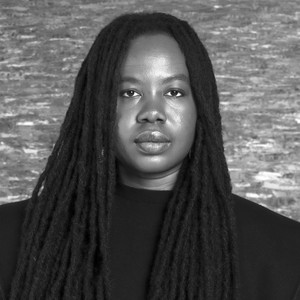
Olivia Anani is a writer, curator, and art-market expert based in Paris and Cotonou, Benin. A member of the board of directors of the Amis du Palais de Tokyo, Anani was named one of the most influential women in French culture in 2021, as part of the distinction 100 Femmes de Culture. Photo: © Xavier Defaix
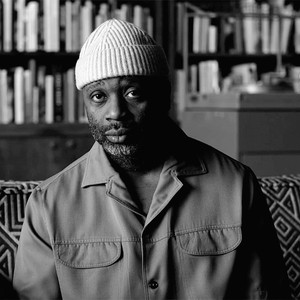
Theaster Gates’s practice traverses an extraordinary range, from collecting to social gathering, architecture and object making, experimental music and sound, and the ethical and physical reconstruction of civic life. His interdisciplinary fusion of archiving, performance, institution building, painting, and sculpting is deeply rooted in African American histories and cultures, and revolves around the transformation of objects, edifices, and communities through art and cultural activity. Photo: Chris Strong
A conversation between Theaster Gates and Jessica Bell Brown, with an introduction by Sydney Stutterheim.
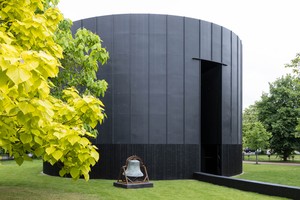
In this ongoing series, curator Hans Ulrich Obrist has devised a set of thirty-seven questions that invite artists, authors, musicians, and other visionaries to address key elements of their lives and creative practices. Respondents are invited to make a selection from the larger questionnaire and to reply in as many or as few words as they desire. For this installment, we are honored to present the artist Theaster Gates, whose Serpentine Pavilion 2022 Black Chapel opened in London on June 10.
The Summer 2022 issue of Gagosian Quarterly is now available, with two different covers—featuring Takashi Murakami’s 108 Bonnō MURAKAMI.FLOWERS (2022) and Andreas Gursky’s V & R II (2022).
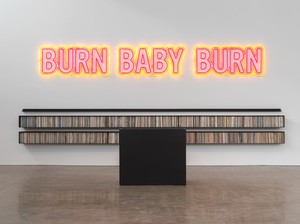
Theaster Gates, steward of the Frankie Knuckles record collection, is engaging with the late DJ and musician’s archive of records, ephemera, and personal effects. For the Quarterly’s “Social Works” supplement, guest edited by Antwaun Sargent, Gates presents a selection of Knuckles’s personal record collection. Chantala Kommanivanh, a Chicago-based artist, educator, and musician—and the records manager for Rebuild Foundation, Chicago—provides annotations, contextualizing these records’ importance and unique qualities. Ron Trent, a dear friend of Knuckles’s, speaks to the legacy evinced by these materials.
Join the artists for an extended conversation about their most recent exhibitions, their forebears in the world of ceramics, and the key role that history plays in their practices.
The Fall 2020 issue of Gagosian Quarterly is now available.

As a prelude to his first-ever solo exhibition in New York, Theaster Gates discusses his prescient work with the photographic archive of Chicago’s Johnson Publishing Company and his formation of Black Image Corporation as a conceptual project. In conversation with Louise Neri, he expands on his strategies as artist and social innovator in his quest to redeem and renew the sacred power of Black images and Black space.
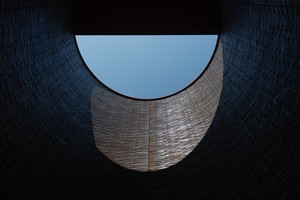
Social historian Chris Dingwall reflects on Theaster Gates’s engagement with the history of quotidian materials, focusing on the symbolic qualities and function of his brick-based sculpture.
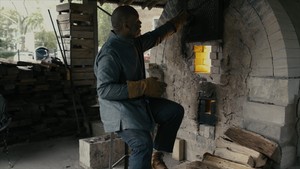
Join Theaster Gates in his studio as he prepares for an upcoming exhibition at Gagosian, New York. In this video, shot on location in Chicago during the tumultuous weeks of protest in late spring 2020, Gates reflects on the metaphorical power of materials and process, and on the redemptive potential of art.
James Lawrence explores how contemporary artists have grappled with the subject of the library.
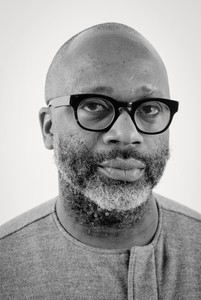
Theaster Gates’s exhibition Amalgam explores the social histories of migration and interracial relations by highlighting the specific history of the Maine island of Malaga. Here, William Whitney considers the exhibition in relation to Gates’s ongoing art practices and social commitments.
The Winter 2019 issue of Gagosian Quarterly is now available, featuring a selection from Christopher Wool’s Westtexaspsychosculpture series on its cover.