A conversation between Theaster Gates and Jessica Bell Brown, with an introduction by Sydney Stutterheim.
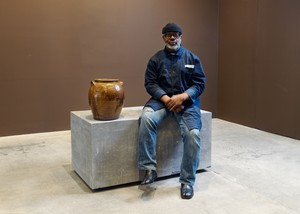
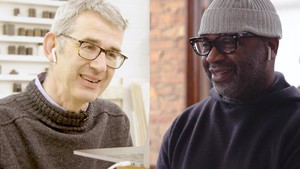
Theaster Gates inside his exhibition Dave: All My Relations, Gagosian, Park & 75, New York, March 26–May 2, 2026. Photo: Maris Hutchinson
Theaster Gates inside his exhibition Dave: All My Relations, Gagosian, Park & 75, New York, March 26–May 2, 2026. Photo: Maris Hutchinson
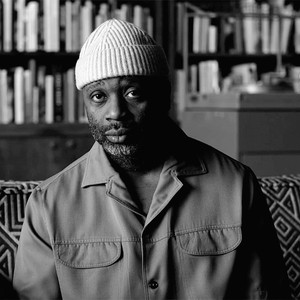
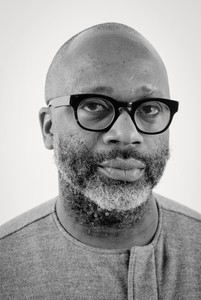
Theaster Gates’s practice traverses an extraordinary range, from collecting to social gathering, architecture and object making, experimental music and sound, and the ethical and physical reconstruction of civic life. His interdisciplinary fusion of archiving, performance, institution building, painting, and sculpting is deeply rooted in African American histories and cultures, and revolves around the transformation of objects, edifices, and communities through art and cultural activity. Photo: Chris Strong
Sydney Stutterheim is a writer, curator, and art historian whose research focuses on postwar and contemporary art. She is the author of Artist, Audience, Accomplice: Ethics and Authorship in Art of the 1970s and 1980s (2024) as well as Richard Prince: Early Photography 1977–87 (2025), among other publications. In addition to writing numerous catalogue essays, interviews, and articles, she was the coeditor of Poetic Practical: The Unrealized Work of Chris Burden (2022).
Earth to earth, ashes to ashes, dust to dust. Book of Common Prayer, 1549
Theaster Gates has been thinking about lineage, craft, and guardianship for over twenty years. Across his diverse body of work, which spans from sculptural paintings and pots to land art and socially engaged projects, Gates explores ways of restoring undervalued histories, particularly as they intersect with Black subjectivity. His Civil Tapestries (2011–), for instance, allude to the repressive violence enacted on 1960s civil rights activists by police using high-pressure fire hoses, and incorporate such hoses in elegant, Minimalism-inspired compositions. A recent commission for the forthcoming Obama Presidential Center in Chicago expands on Gates’s archive-based work preserving African American history and its cultural representations, as in his vast collection of materials from the Johnson Publishing Company, which produced the influential Ebony and Jet magazines. Yet despite Gates’s fluidity with mediums, his multifaceted artistic career is perhaps best articulated through his work in clay.
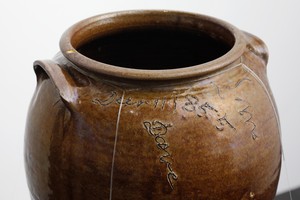
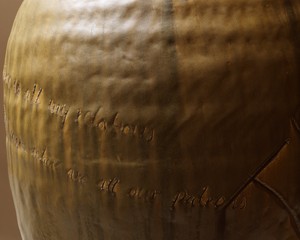
The artist’s most recent project, presented this spring at Gagosian’s Park & 75 location, synthesized and developed a set of concerns that have been of utmost importance to him for decades. In Dave: All My Relations he honored the innovative and daring work of David Drake (c. 1801–1874), an enslaved South Carolina potter who defied contemporary laws criminalizing literacy among Black people by making virtuosic monumental pots inscribed with his signature and his original poetic verses. Having discovered Dave’s work in the 1990s, Gates used Gagosian’s exhibition space as a vessel to extend this historical legacy into 2026, achieving the most powerful expression of these ideas to date.
While pursuing a degree in urban planning at Iowa State University in the early 1990s, Gates began studying with the ceramics professor Ingrid Lilligren, who became a lifelong mentor. With her encouragement he traveled to Tokoname, Japan, to attend a pottery workshop in 2004. This first trip to Tokoname led to a twenty-year engagement with the town; subsequent visits deepened his interest in Mingei, a movement begun in the 1920s that embraced the simplicity and elegance of folk craft. This exposure gave Gates a clearer understanding of the possibilities of ceramics as an art form, yet questions remained for him regarding the presence of Black potters in the American craft tradition.
David Drake, Untitled (Storage Jar), 1857 (detail), installation view, Theaster Gates: Afro-Mingei, Mori Art Museum, Tokyo, 2024. Photo: Koroda Takeru, courtesy Mori Art Museum, Tokyo, and Theaster Gates Studio
Back in the United States, Gates further pursued this point of inquiry, attempting to uncover a more complete and accurate history of pioneering ceramicists. With the help of Lilligren, Gates encountered a rare exhibition catalogue for a 1998 show at the McKissick Museum, University of South Carolina, titled “I made this jar...” The Life and Works of the Enslaved African-American Potter, Dave. These findings became the driving force for his next major artistic project: the 2010 exhibition To Speculate Darkly at the Milwaukee Art Museum, which featured one of Dave’s original pots on view alongside Gates’s own artistic work.
Dave quickly became an integral figure in Gates’s practice. Otherwise known as Dave the Potter, Dave lived in the vicinity of Edgefield, South Carolina, a center of ceramic production in the antebellum South. Edgefield was known for its alkaline-glazed stoneware pots, which were used to store food and perishables. The pots were made by enslaved people for use by their owners, but that history was eventually obscured to promulgate white-centered narratives of creative expression and innovation. To exalt this forgotten history Gates created and performed musical hymnals and lectures alongside the display of a loaned vessel by Dave in his 2010 show.
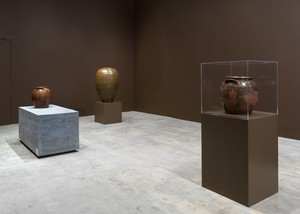
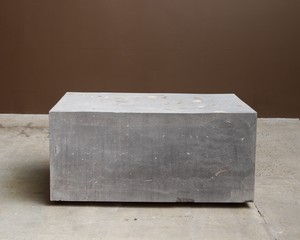
In Dave: All My Relations Gates deepened his previous investigations of Dave’s legacy, placing the two artists’ work into a speculative dialogue. The show centered on three pots, which were placed atop plinths installed in the center of the gallery. As a tribute to the foundational role that Dave had played on his practice, Gates created a custom pedestal comprising pulverized fragments of forty-five pots he made and fired in his studio, with clay shards remaining visible amidst the otherwise smooth gray surface. This sculpture served as the base for the display of an original pot by Dave, which Gates has gifted to Dave’s descendants. Gates’s plinth, which assumes a Minimalist sculptural form, quite literally supports Dave’s pot, creating an act of stewardship that is conceptually critical to the artist’s project. A second stoneware vessel by Dave was also on view; in late 2025, it was restituted to Dave’s family by the Museum of Fine Arts Boston. Accompanying these two pots by Dave is a monumental vessel made by Gates, which features a poetic couplet inscribed on its surface in homage to Dave as a creative forefather.
Gates has described the experience of his work as an impartation, citing the biblical idea of the passage of gifts and wisdom between people. This spiritual notion is integral to Gates’s project more broadly, particularly as it intersects with sacrifice and redemption. From his recycling of discarded building materials to his conservation of historical records, Gates sees the reconstitution of materials as a creative action. For him, the marginalized position of clay pottery—traditionally seen as a form of craft rather than a high art—is linked to the traditional experience of the Black subject as creator. By asserting his commitment to this lineage of pottery, Gates aims to reimagine not only the material of his objects but their historical position as well.
Jessica Bell BrownTheaster, tell us about the spirit of your forthcoming exhibition with Gagosian and your long-standing connection with David Drake.
Theaster GatesIt’s more like a project than an exhibition—it’s very, very specific. I’ve been thinking about David Drake for the last twenty-plus years. He’s become quite known in the past two decades: He was an enslaved potter who wrote his name on his pots, along with couplets, at a time when it was illegal for enslaved people to be literate. He’s come to represent a kind of mythic hero to me within conceptual and craft traditions in the United States—the earliest Black cat I’ve been able to identify by name and by signature who is directly connected to a set of things that I do, which is make pots.
I put together an exhibition in 2010 called To Speculate Darkly at the Milwaukee Art Museum, in partnership with the Chipstone Foundation and Joyce Foundation, where I looked at Dave’s work and his life as a Black potter, but it was also about making speculations about who I am, who he was, what clay is in this moment. Fast-forward: The curator I worked with in Milwaukee, Ethan Lasser, decided to revisit Dave in partnership with the Metropolitan Museum of Art in New York and the Museum of Fine Arts Boston, in an exhibition called Hear Me Now. While doing that he did a lot of research and a genealogist, April Hynes, identified Dave’s descendants, and over the years he has engaged those descendants as new characters in this project.
One of the things born from the descendants knowing of their ancestor was that they really wanted to gain access to some of Dave’s vessels and began a kind of reconstitution of those works. And so I got a call saying, “Hey, the descendants of Dave would love to be in touch with you and would love to talk to you about their ancestor and what you’re up to.” We started a very cordial conversation about Dave, which led to this project where I am thinking about my own practice and relationship to his work, as well as the politics of craft, familial lineage, clay as an archive, and the industry of clay in terms of labor and economics. All of those things might come to bear in very simple ways in this project space with Gagosian.
JBBYou used the word “lineage,” and perhaps we can think about clay as a way for you to map yourself as an artist within this lineage. Would you say that David Drake is at the center of that?
TGI used to think all the time about the phrase “You choose your family.” There are friends who become family, and then folk who you’re in the trenches with in varying ways. But I think another kind of lineage, which is real in ceramics, is who trained you and who trained them. So I also have my lineage of Ingrid Lilligren and then Paul Soldner, potters two generations ahead of me who I’m connected to. But I think of Dave as one of two mythic historic figures, the other being Yamaguchi, whom we’ll talk about another day. These are two folks who set me right in terms of building a psychic DNA, an intellectual and haptic sensibility around what it means to be a maker.
There was a period when I was really channeling Dave and trying to make bodies of work as big as his. I was working individually, before studio assistants and that kind of thing, and it was really about the craft. I reached a moment where Dave was communicating back to me through clay and I conjured it in a lot of ways, including the creation of a hymnal. My first hymnal was around this acknowledgment, this celebration.
JBBThe 2010 exhibition had a sonic register. Did you write music for this project as well?
TGOh yeah. There’s a song that goes, [singing] “Up in the east, out in the west, I’ll be the potter you know best. Up in the east, out in the west, I’ll be the potter you know the best. My name goes here.” And then I went to his couplets: “Go ask Jack, he’ll want his beef, he’ll want his beef.” And then, “The Great and Noble Dave, the Great and Noble Dave, the Great and Noble Dave, the Great and Noble Dave.” It’s such a big cacophony. At the end of the song, we just kept saying, “My name goes here, my name goes here, my name goes here, the great and noble Dave.” We did like fifteen of these anthems and hymns, and it felt like a technique to keep his spirit alive, not unlike the use of hymns in Protestant song or the spirituals of enslaved people. I used those tools of deepening one’s psychic truth about this historic character through song. I used all of my wiles to realize that. And we built a killer choir, where the sonic became a device for the continuity of legacy. The hymn was my propaganda, my psychic sticky glue that would help us get from not knowing the history of Black craft to being absolutely certain that we’re a part of Black craft.
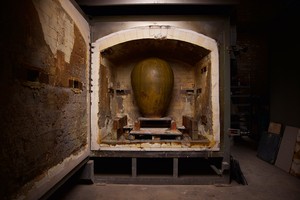
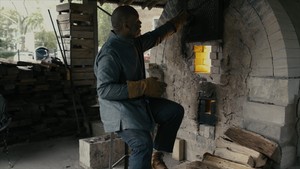
Theaster Gates’s ceramics studio, Chicago, 2026. Photo: Chris Strong
JBBI like to think of this as an act of veneration, an honoring of the labor and the making, but also as an act of proclaiming a history or a lineage through craft. You’re returning now to some of those earlier provocations around David Drake and your relationship to craft, and to being a potter.
TGMy exhibition Black Vessel [2021] at Gagosian in New York and my Basel project Ashen [2022] are where I really focused on these wood-fired ceramic works. You can go back even earlier, to my exhibition The Minor Arts [2017] at the National Gallery in Washington, DC. The reason that show was called The Minor Arts was that I was looking at craft in its entirety in my studio, and textiles, ceramics, coins, tools, silver goods, things that are crafted—within art history each of those categories would be called “the minor arts.” I was interested in the idea that art history has always relegated craft to its own non-majority state, that craft occupied the same positionality that my Black self occupied. And I loved that. I was grappling with the audacity, not only of my own status and its transcendence of the title, but also of crafts’ transcendence of that title.
JBBZooming out a bit more, I want to focus on histories of Black craft and how they show up, or not, in art history. I’ve been thinking a lot about the Black furniture- and cabinet-maker Thomas Day, and he has led me to reflect on how Black creators are everywhere in US history. Black histories of labor are ingrained in the edifices that we encounter every day. I’m keenly interested in how labor in your work plays out and conditions us to think about the significance of a brick, or a tile, or a roof shingle. I wonder could you tell us about your artistic labor as a gesture of generosity, or even an invitation for us to think about how we map these points?
TGWell, first, I think there was a real intention to make Black labor anonymous, to blur the role our hands played in shaping this country. And that was done through capitalism, which disregards labor and labor’s name and labor’s individual hand as important to the overall project. So let’s say, even when the person’s intention wasn’t racist, there was something about being in a racist structure that removed our names from our labor, our ethnicities from our labor, and that removal ended up being a way of distorting American history, so that we imagine every beautiful mansion ever built was probably built by white people. And it’s easy to erase because the names were often never recorded. How do you then identify the architects and engineers and those who were ingenious alongside those who made bricks and were itinerant skilled laborers? All of that history is tertiary to the other histories that we remember about Black folk, so when you look at those buildings you don’t imagine Black labor, you imagine white intelligence and white civility. Part of the project of addressing Thomas Day and Dave Drake is giving name to a constellation of makers who built this country, and who, with creativity and ingenuity and also swag, contributed to the aesthetic intention of the times.
JBBTo return to your upcoming project in New York, could you say more about what you’ll be presenting?
TGThe thing I’m offering at Gagosian is very simple: It’s Dave’s pottery alongside a plinth made from my crushed pots. That’s it. I’ll be the plinth and Dave will be the story. And it’s almost like the space is really a place of transference. I don’t even think of it as an exhibition space.
TGYeah. Benediction, elegy—a poem of consolation for those who have passed. One of the things potters struggle with is sacrificing and letting go of vessels. You think all your vessels are good; you want to keep everything you’ve made because you’ve invested your time and energy. But when you’re learning, you’re actually not good. My teacher would say, “Just remake it, just throw it and then rewedge it and then throw it again and rewedge it.” And you would do that over and over, but I’d become really attached. Over the years, I’ve become attached to a lot of vessels that could have been sacrificed. And if I’d moved them along faster, maybe my growth rate could have been faster. In some ways I feel like this thing that I’m doing is, I’m letting go of . . . I’m choosing the sacrifice so that I can be in service to this pot that is absolutely singular, Dave’s.
And it’s difficult to let go of these pots, to go through and say, Okay, we can let go of those twenty, we can let go of these fifty, because when I look at the aggregated set of pots, they represent my time, my resources, my creativity, the creativity of others at the studio, important moments when even if we failed, we learned a lot. I feel, what a great sacrifice to turn all of that into a pulverized powder that can carry the presence of history into the future.
It’s important to say that Dave didn’t need me, I needed Dave. I get to be one of the carriers of his story, so that no matter what’s happening at a federal level or at a local level or at a racial level, the arts and artists will play a role in keeping the Black craft archive alive. Turning a pot into a particulate, which is its origin, is exactly how energy works; the death of the vessel is the life of the plinth, and that’s good. That works. That checks out.
Theaster Gates’s practice traverses an extraordinary range, from collecting to social gathering, architecture and object making, experimental music and sound, and the ethical and physical reconstruction of civic life. His interdisciplinary fusion of archiving, performance, institution building, painting, and sculpting is deeply rooted in African American histories and cultures, and revolves around the transformation of objects, edifices, and communities through art and cultural activity. Photo: Chris Strong
Sydney Stutterheim is a writer, curator, and art historian whose research focuses on postwar and contemporary art. She is the author of Artist, Audience, Accomplice: Ethics and Authorship in Art of the 1970s and 1980s (2024) as well as Richard Prince: Early Photography 1977–87 (2025), among other publications. In addition to writing numerous catalogue essays, interviews, and articles, she was the coeditor of Poetic Practical: The Unrealized Work of Chris Burden (2022).