September 26, 2024

Derrick Adams:
Super Nudes

Fondation Louis Vuitton commissioned Derrick Adams, Tomokazu Matsuyama, and Mickalene Thomas to respond to the work of Tom Wesselmann for their exhibition Pop Forever Tom Wesselmann &… (October 17, 2024–February 24, 2025). Here, Derrick Adams speaks with the Quarterly’s Wyatt Allgeier about the origin of his Super Nudes series and its investigations of humor, power, and vulnerability.

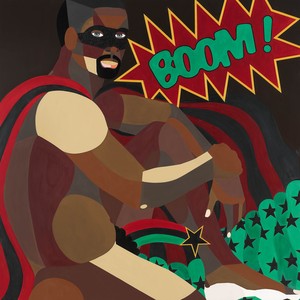
Derrick Adam's artwork "Super Nude 3" features a painting of a man sitting, he wears an superhero cape and mask, and the word "Boom!" is painted next to him

Derrick Adams, Super Nude 3, 2024, acrylic, latex paint, and fabric collage on panel, in artist’s frame, 60 ⅜ × 60 ⅜ × 2 ½ inches (153.4 × 153.4 × 6.4 cm) © Derrick Adams Studio

Derrick Adams, Super Nude 3, 2024, acrylic, latex paint, and fabric collage on panel, in artist’s frame, 60 ⅜ × 60 ⅜ × 2 ½ inches (153.4 × 153.4 × 6.4 cm) © Derrick Adams Studio

Wyatt AllgeierDerrick, were you familiar with Tom Wesselmann’s work before embarking on this project?

Derrick AdamsYes—actually, about two years prior to this invitation from Fondation Louis Vuitton, I had connected with the Wesselmann Estate. I reached out to them out of curiosity about the Great American Nude series in particular. I wanted to understand the historical framework around Wesselmann more generally, and their records and team were great. The more I considered the complexity and challenges of Wesselmann’s series, the more I wanted to engage in some sort of visual dialogue with it. As I’ve pondered those works, I’ve spoken with so many different people about them, and Pop art more generally. Of course, questions around accountability, the representation and disembodiment of the female body through the male gaze, and the transformation of the nude into almost a logo of America—these are all things I thought through as I approached my own series. It was important for me to shift from “depicting” toward a mirroring. It’s connected to me in a way that is not personal, but reflective.

What I’m working toward is, in a way, the opposite of Wesselmann’s subject. His series is, primarily, white women painted in a particular palette in a particular historical moment. Looking at his work makes me think about the idea of whiteness not just as a racial construct, but also as a formal color scheme constructed through the red, white, and blue flag. The colors are key. I wanted to respond to it with a variation: the Black male nude, enveloped in the colors of the Black liberation flag, as made iconic by David Hammons, of course.

WAYou’ve taken the flag and transformed it into a superhero cape. How did this element develop?

DAThinking about the mainstream iconography that American culture produces, superheroes are huge. They’re so prominent in contemporary entertainment. But the phenomenon also reaches into the past—to African mythology, Greek mythology. I wanted to extend that framework within the language of my art making. The cape became an important formal element—it makes up the backdrop. There’s very little atmosphere beyond the figure and the cape. Everything else is pretty much dark, and the cape sets the stage, where the viewer is invited in. While they’re called Super Nudes—and they do have a really strong presence—they aren’t actually doing any superhero-like action. They are in repose.

WAThe figures are ever so slightly censored.

DAThere is often a seriocomic nature to my work. It has a humorous element, but it’s a serious humor. Here, that humor comes in with the starburst that slightly obscures the crotch. Thinking about the contemporary nude, I wanted to bring in the language of social media, where so many bodies are on display. You know, when people are being provocative but not explicit, they’ll pop on a star or an eggplant or a peach emoji or whatever. That provocativeness with humor, and skirting censorship, still has a certain level of eroticism to it. This was really interesting to deploy in the context of this work. I want it to be provocative enough that it can be shared socially without being censored, but still have the same profound impact on the viewer’s visual experience.

WADo you have anxieties about how the work will be received?

DAThis is definitely more provocative than my usual! But it’s more than that, and I hope that the audience will experience it as I intend. I’m always less interested in literal depictions of things, and with the nude, I wanted to figure out how to complicate the experience of the viewer and create an image that can in no way be rejected as perverse. I was thinking about the conservatism of America as I was trying to present the figure in a way that’s seductive but not graphic. I don’t want to talk about the size of the superhero’s penis per se; it’s really more about the tonality of the figure and the vulnerability of being nude. These figures, they have power in their vulnerability. That’s what the work is fundamentally about.
Pop Forever Tom Wesselmann &. . . , Fondation Louis Vuitton, Paris, October 17, 2024–February 24, 2025

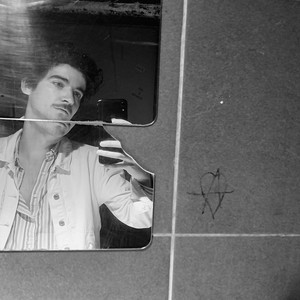
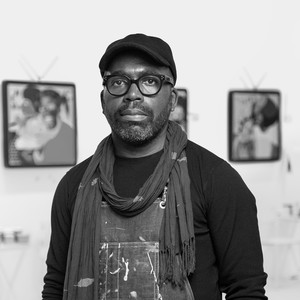
Black and white portrait of Derrick Adams

Derrick Adams celebrates and expands the dialogue around contemporary Black life and culture through scenes of normalcy and perseverance. He has developed an iconography of joy, leisure, and the pursuit of happiness with a multidisciplinary practice that encompasses paintings, sculptures, collages, performances, videos, and public projects. Adams synthesizes representational imagery with planar Cubist geometry to produce multifaceted figures and faces that address the richness of the Black experience. Born in Baltimore in 1970, Adams lives and works in New York. Photo: Emil Horowitz

See all Articles

Black-and-white portrait of Wyatt Allgeier

Wyatt Allgeier is a writer and an editor for Gagosian Quarterly. He lives and works in New York City.

See all Articles

Gagosian quarterly weekend reads

Get the best of the Quarterly in your inbox twice a month.

By subscribing you agree to our Privacy Policy.

Derrick Adams: View Master

Derrick Adams: View Master

On April 16, the Institute of Contemporary Art, Boston, opened the first midcareer survey of Derrick Adams’s multidisciplinary practice. Covering over twenty years of work, the exhibition, titled View Master, brings together the artist’s painting, sculpture, collage, performance, and video, as well as a vibrant new commission created for the museum’s façade. Ahead of the opening, Adams met with Tessa Bachi Haas, cocurator of the survey, to discuss his formative experiences with television, the impact of his work in arts education on his practice, and the importance of taking a more complex, more joyful, and more expansive approach to Black American life and culture.

Derrick Adams and Ekow Eshun

In Conversation
Derrick Adams and Ekow Eshun

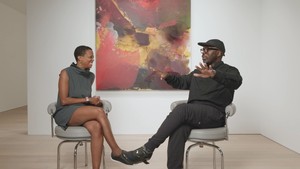
Join Gagosian for a conversation between Derrick Adams and Ekow Eshun, author, curator, and chair of the commissioning group for the Fourth Plinth in Trafalgar Square, London. The pair discuss Adams’s latest paintings depicting visions of Black Americana—featured in the exhibition Situation Comedy at Gagosian, Davies Street, London—within the context of British contemporary culture.

Gagosian Quarterly Fall 2023

Now available
Gagosian Quarterly Fall 2023

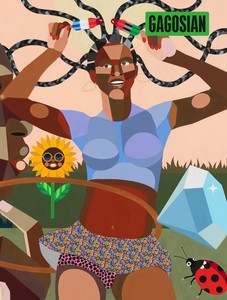
The Fall 2023 issue of Gagosian Quarterly is now available, featuring Derrick Adams’s Everything and a Ring (2023) on its cover.

Come As You Are: Derrick Adams

Come As You Are: Derrick Adams

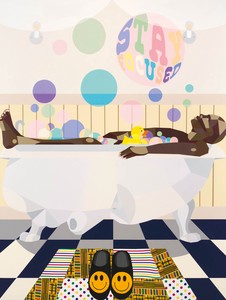
Jewels Dodson visited artist Derrick Adams at his New York studio as he prepared for an exhibition of new paintings in Los Angeles in the fall of 2023. She reports on these works and on Adams’s embrace of joy, humor, and contradiction.

Amanda Williams and Derrick Adams

In Conversation
Amanda Williams and Derrick Adams

On the occasion of her exhibition Amanda Williams: CANDYLADYBLACK at Gagosian in New York, the artist spoke with artist Derrick Adams about the way she uses color as a tool to examine the complex ways in which race informs our assignment of value to physical, social, and conceptual spaces. 

Engaging with the Past: An Interview with Jenny Saville

Engaging with the Past: An Interview with Jenny Saville

On March 28, a major exhibition of Jenny Saville’s work opened at Ca’ Pesaro–Galleria Internazionale d’Arte Moderna in Venice, bringing together nearly thirty paintings from the 1990s to the present. The exhibition is curated by Elisabetta Barisoni, head of the museums division at Venice’s Ca’ Pesaro, Museo Fortuny, and head of MUVE in Mestre. Saville’s monumental canvases are set in dialogue with the great Venetian artists of the past, creating a unique encounter between contemporary painting and the city’s artistic heritage. Here, the artist speaks with Stefania Ventra, professor with Ca’ Foscari University of Venice, about her early trips to Venice, the radicality of Titian’s painting, and depicting emotional truth.

A Tremendous Generosity: Jeff Koons on Marcel Duchamp

A Tremendous Generosity: Jeff Koons on Marcel Duchamp

Jeff Koons tells Alison McDonald about his appreciation for the pioneering artist and thinker Marcel Duchamp.

Peter Hujar & Paul Thek

The Art of Biography
Peter Hujar & Paul Thek

Andrew Durbin’s dual biography, The Wonderful World That Almost Was: A Life of Peter Hujar and Paul Thek, published by Farrar, Straus and Giroux, tracks the convergences and divergences in the lives of the two artists, from their first meeting in Coral Cables, Florida, in 1956 through their generative romantic and creative partnership in New York, Italy, Fire Island, and beyond. Ahead of the release, Durbin met with the Quarterly’s Wyatt Allgeier to speak about the development of the project, the sublime noncompliance of these two artists, and the motifs of love, death, and rebirth that weave through the telling of their story.

Fashion and Art: Daniel Roseberry

Fashion and Art: Daniel Roseberry

Daniel Roseberry, the creative director of Schiaparelli, met with the Quarterly’s Derek C. Blasberg at the maison’s historic headquarters at 21 place Vendôme, Paris, following the Schiaparelli Fall/Winter 2026–27 ready-to-wear show. Since taking the helm in 2019, Roseberry has been credited with advancing the heritage of the house through unpredictable sculptural designs that carry Elsa Schiaparelli’s Surrealist spirit into a new century. The pair discuss the much-anticipated exhibition Schiaparelli: Fashion Becomes Art, now on view at the Victoria & Albert Museum, London, as well as Roseberry’s early exposures to art, his continued dedication to drawing, and the enduring legacy of Elsa Schiaparelli’s daring vision.

Helter Skelter: Arthur Jafa and Richard Prince

Helter Skelter: Arthur Jafa and Richard Prince

Helter Skelter—an exhibition at Fondazione Prada’s Venetian venue, Ca’ Corner della Regina—marks the first creative dialogue between two visionaries of American art, Arthur Jafa and Richard Prince. The show explores the grit, grift, violence, and ingenuity of American culture through more than fifty works, including photography, video, and large-scale installations that interrogate themes of race, gender, media, and politics. In the interview below, Nancy Spector, the exhibition’s curator, speaks about the shared motifs—from apocalyptic sunsets to a fascination with “monstrosity”—that led her to pair these artists for the first time.

Theaster Gates: Dave, All My Relations

Theaster Gates: Dave, All My Relations

A conversation between Theaster Gates and Jessica Bell Brown, with an introduction by Sydney Stutterheim.

An Eye on the Market: Trading Beauty

An Eye on the Market: Trading Beauty

Valentina Castellani speaks with the Quarterly’s Alison McDonald about her new book, Trading Beauty: Art Market Histories from the Altar to the Gallery. The illustrated survey traces the evolution of the Western art market from the medieval era to the present day.