Eli Diner visits Jonas Wood in his Los Angeles studio as the artist prepares for an exhibition of new paintings in London.
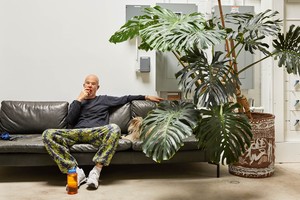
Jonas Wood in his studio, Los Angeles, 2024. Photo: Laure Joliet
Jonas Wood in his studio, Los Angeles, 2024. Photo: Laure Joliet
Eli Diner is a Los Angeles–based writer. His work has appeared in publications including Artforum, Book Forum, Frieze, and Texte zur Kunst. He has a gossip column in the Los Angeles Review of Books. His book The Renaissance will be out in 2025 from Apogee Graphics.
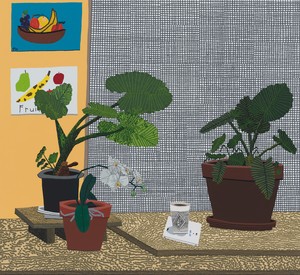
Jonas Wood shows me a small square photo of an arrangement of potted plants, some children’s drawings on the wall behind. A little blurry, it looks like it could have been shot off a TV playing a videotape. In fact, he found it, ages ago, on someone’s Instagram page: the picture jumped out from the endless flow of images because he thought it bore an uncanny resemblance to a painting he might make. It was weird, he said, so he grabbed a screenshot that years later finally became the basis for Still Life with Coffee and Minibook (2024). The fundamentals of the composition are unchanged, but the textures, of course, have been transformed, the softness of the original giving way to the naive directness and abrupt graphic contrasts of Wood’s visual language. Squiggly cartoon wood grain covers the multitiered stage where the plants sit; a flat gray backdrop in the photo has been turned into a window screen, rendered in an erratic sort of grid. There are other kinds of changes too. An empty pot in the source image has been planted with an arching white orchid; Wood swapped out the children’s artwork for art by his own kids, both still lifes with fruit. Between the plants he stuck a book with a coffee cup on top and cocked it at a conspicuous angle to all the vertical and horizontal lines, so that the book is something like the picture’s hinge.
That particular arrangement—a white take-out coffee cup sitting on top of a small white book—has appeared in Wood’s work a couple of times before: he did a drawing of it in 2012 and slipped it into a painting in 2013. The cup carries a logo of a steaming mug, and in both of those earlier works the featured book was a Van Gogh volume from the mid-century series Petite Encyclopédie de L’Art. In 2012, Wood and his wife, the artist Shio Kusaka, began adapting the format of the Petite Encyclopédie for a series they published on contemporary artists such as Tony Matelli and Anne Collier. It is Kusaka’s book from that series that shows up in Still Life with Coffee and Minibook.
Jonas Wood, Still Life with Coffee and Minibook, 2024, oil and acrylic on canvas, 60 × 66 inches (152.4 × 167.6 cm). Photo: Marten Elder
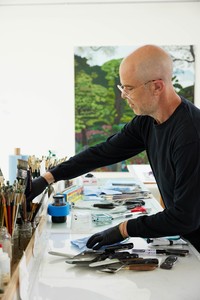
Jonas Wood in his studio, Los Angeles, 2024. Photo: Laure Joliet
The fact that collecting and collaging are so central to his practice strikes me as intrinsically related to [an] autobiographical impulse, extracting bits and pieces from a repository of memory to be rearranged in sometimes-imaginary scenes.
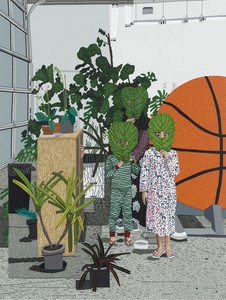
Culling, fitting together, and modifying pictorial sources is central to Wood’s practice. This painting, though, born of that low-key paranoiac awareness of watching and being watched on the Internet, of stealing and borrowing, is finally a family portrait—his wife’s book, his children’s art—and in that respect it captures how the work of assembling pictures can be for Wood a kind of self-disclosure, staging personally resonant moments and fragments of his life. More than anything else, he tells me, the body of work he has made for his exhibition at Gagosian in London in October is tied together by its autobiographical content. Of course, much of that content is inaccessible to the viewer, who couldn’t possibly know, for example, that the cityscape of brick buildings in Chelsea (2024) is based on photos Wood took out of a New York hotel window at a pivotal moment in his career. Other works exude unmistakable intimacy, such as Shio, Momo, and Kiki with Leaf Masks (2024), with his kids in their pajamas posing with their mother. But visiting the artist in his studio, as he walks me through the process of making his paintings, I’m given a view into the interplay of memory, association, and private symbolism that he invests in his work.
Wood almost always works from photographs, which he’s constantly amassing in a personal archive. He has thousands of images, some found and some he’s shot himself. It can be years before he turns to a particular photo, and of course, most he’ll never use. He reconfigures the printed-out images by hand, cutting and pasting to make subtle adjustments or compose an elaborate collage. Sometimes he makes drawings from the altered photographs before finally translating them into paint. The fact that collecting and collaging are so central to his practice strikes me as intrinsically related to that autobiographical impulse, extracting bits and pieces from a repository of memory to be rearranged in sometimes-imaginary scenes. Wood can tell you precisely where the constituent elements in a painting come from, and even as their meanings are set by these origins, they are nonetheless transformed when fitted together through his puzzlelike mode of composition.
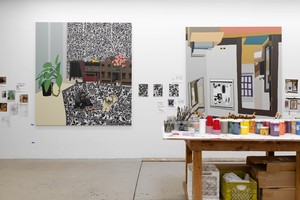
Jonas Wood’s studio in Los Angeles, showing, from left: Robot and Bear (2024, in progress) and 10 Pigeon Hill Road (2024, in progress). Photo: Marten Elder
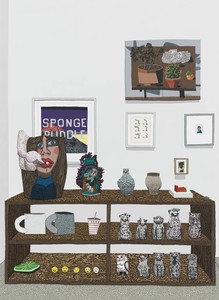
It is an approach in which memory is a malleable material, and maybe that’s why, in these paintings, distinctions seem to dissolve between family, art, and place. They bleed into or stand in for each other. There’s Wall of Fame (2024), for example, which, like Still Life with Coffee and Minibook, depicts his kids’ art, only here it’s a wall covered with a dense salon-style hanging. Much of his children’s art seems like it was made in tribute to their dad—pictures of Wood, and of Celtics players—and some of it reproduces his work, creating a looping effect of depictions of depictions of depictions. While Wall of Fame comprises a pretty faithful rendition of a wall in Wood’s studio, Shio Shrine (2024) takes greater liberties in its staging. Wood worked from a photograph he’d taken, of a shop in LA’s Chinatown crammed with ceramic vases, and subbed in Kusaka’s pottery. When he speaks about the work, he’s animated by the impossibility of the scene he has created, not so much because he has inserted his wife’s art into this improbable setting but because Kusaka made this work over the course of two decades and it’s never been assembled like this. A fantasy retrospective.
In a move that is the flipside of art and objects standing in for people, the two works in the show depicting human figures seem to dramatize how people get encoded as art. In Shio, Momo, and Kiki with Leaf Masks, Kusaka and the children, standing amid a profusion of potted plants and a large basketball sculpture, cover their faces with large leaves, like fig-tree leaves, holes cut out for the eyes. A playful gesture, the improvised leaf masks also have the effect of subsuming the family into Wood’s pictorial language (potted plants being a frequent motif in his work). It’s houseplants, too, in Self Portrait with Home Depot Cart, Joint, and Phone (2024) obscuring the figure of Wood, who peeks out from behind the titular orange cart loaded up with greenery and a stack of canvases. Here the self-veiling in art is emphasized by the fact that he is standing in front of a building painted in a camouflage pattern, which doesn’t give him much cover. The artist is hiding in plain sight.
Jonas Wood, Office Still Life, 2024, oil and acrylic on canvas, 88 × 64 inches (223.5 × 162.6 cm). Photo: Marten Elder
Jonas Wood, Shio, Momo, and Kiki with Leaf Masks, 2024, oil and acrylic on canvas, 93 × 70 inches (236.2 × 177.8 cm). Photo: Marten Elder
In a move that is the flipside of art and objects standing in for people, the two works in the show depicting human figures seem to dramatize how people get encoded as art.
Wood shows me where the photos that would be the source for Shio, Momo, and Kiki with Leaf Masks were taken (though, as you can imagine, a lot changed in the migration from photo to painting), just next to the location of Wall of Fame. It’s striking how often the studio appears in Wood’s work, though rarely is it obvious that it’s his studio. Only the title gives it away in Office Still Life (2024), which features an arrangement of work by a range of artists—Ed Ruscha, Laura Owens, Ruby Neri, Patrick Jackson, and others—mostly from LA and mostly people with whom Wood has a personal connection. And there’s Madison Still Life (2024), a depiction of wall-mounted metal shelves lined with potted plants. I’m taken to see the original shelves, in an outdoor area where the staff eats lunch, and now they’re crowded with even more plants. Wood built them to look like one of his paintings, a tableau to be photographed to be painted.
The prevalence of the studio as a subject for Wood probably shouldn’t be surprising. He has often been drawn to quotidian imagery—he began painting plants and basketball cards precisely because these things were close at hand—and his studio is a locus of work and family. He shares it with Kusaka, and the kids seem to spend a lot of time there; for a while, in fact, the family lived in an apartment upstairs, as their house was being renovated. But of course, the quotidian is hardly simple. It is the seed of memory, and is likewise protean. If this body of work comprises an autobiography that can’t be recognized widely, then the place where it is most visible is here, in the studio. It is autobiography articulated in an obsessive and meticulous process. It seems to me that more than in the final paintings or even Wood’s vast archive of source imagery, his autobiographical expression exists in the very transformation and transposition of imagery—composite memory, always in flux.
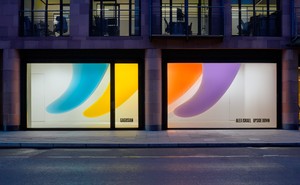
Jonas Wood, Gagosian, Grosvenor Hill, London, October 7–November 23, 2024
Jonas Wood, Gagosian, Burlington Arcade, London, October 7–November 23, 2024
Eli Diner is a Los Angeles–based writer. His work has appeared in publications including Artforum, Book Forum, Frieze, and Texte zur Kunst. He has a gossip column in the Los Angeles Review of Books. His book The Renaissance will be out in 2025 from Apogee Graphics.