Karen Wong charts the journey of Alexander Calder’s Quatre lances (1964) from its intended site at the Fondation Maeght, Saint-Paul-de-Vence, France, to the Centennial Hall in Monaco, and now to its permanent home in a new single-artwork museum designed by Renzo Piano at the Nouveau Musée National de Monaco. Wong examines the sculpture’s interaction with architecture and environment as part of a larger story of the artist’s relationship with architects.
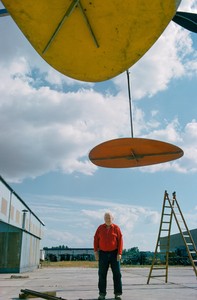
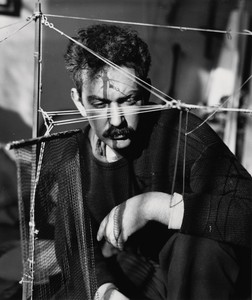
Alexander Calder with Quatre lances (1964) at Etablissements Biémont, Tours, France, 1967. Photo: Tony Vaccaro, courtesy Calder Foundation/Art Resource, New York
Alexander Calder with Quatre lances (1964) at Etablissements Biémont, Tours, France, 1967. Photo: Tony Vaccaro, courtesy Calder Foundation/Art Resource, New York
Karen Wong is a cultural producer and educator developing platforms to serve creatives by providing new opportunities, marketplaces, and business models. As the current chief brand officer and former deputy director of the New Museum, New York, Wong cofounded the initiatives IDEAS CITY, NEW INC, and ONX Studio.
When your legacy is defined by a single name—Duchamp, Picasso, Warhol—you have truly withstood the test of time. In the 1980s, popular artists received the “Hallmark” treatment, with their works reproduced as postcards, calendars, and tea towels. In this new century we’ve leaped from two dimensions to three, in a Disneyfication of art evident in such projects as Van Gogh: The Immersive Experience, a digital wallpaper environment where the artwork is made both anew and anodyne. While popularity is often treated skeptically, it is inseparable from relevance, and relevance is the thread that weaves history into the present. Except for Basquiat (Jean-Michel) and Kahlo (Frida), the mononymous club of famous dead artists is composed almost entirely of white men. Yet one stands apart: Calder, as in Alexander Calder, whose art practice was never overshadowed by personal drama. In a rapturous New York Times obituary from 1976, the British critic John Russell concludes, “We loved [Calder], and we shall go on doing it for ever and ever.” Calder and his inventive mobiles and stabiles—the former term coined by Marcel Duchamp and the latter by Jean Arp—continue to capture the public’s imagination, no doubt encouraged by the 388 international solo exhibitions (and counting) since Calder’s passing. While the art world and the Calder Foundation—established by his grandson, Alexander S. C. Rower, and the Calder family—celebrate his robust oeuvre, one group in particular has long loved Calder: architects.
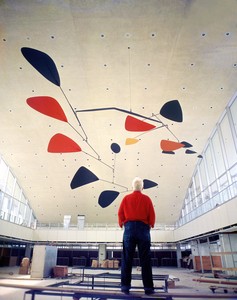
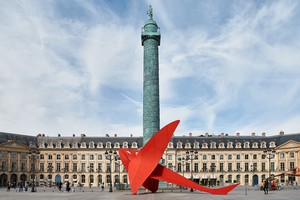
Skidmore, Owings & Merrill (SOM), an international firm whose heyday coincided with the US modernist movement in corporate spaces, collaborated with Calder on seven major projects between 1946 and 1974. In the early days, commissions were ambitious mobiles made of ordinary materials like sheet metal and wire. Each was more ambitious than the next, such as .125, boasting a span of forty-five feet and commissioned for the 1957 opening of Idlewild Airport’s (now JFK) International Arrivals Building, designed by SOM. These large atriums presented perfect environments for Calder’s mobiles, allowing the movements of people and air to generate kinetic energy for these hanging sculptural works. In 1969, when Calder and his team installed La Grande vitesse on a prominent SOM-designed civic plaza in Grand Rapids, Michigan, this fire-engine-red stabile made headlines. (The title, most immediately translated as “great speed,” could equally mean “grand rapids.”) It was the first public artwork funded by Art in Public Places, an initiative of the National Endowment for the Arts. Measuring four stories high and weighing forty-two tons, this compressed monumental stabile was both derided and beloved. Today the work is locally known as “the Calder” and is the official cultural logo for Grand Rapids, known as America’s Furniture City. While the partnership between SOM and Calder was a real-time collaboration, since the artist’s death firms such as Shigeru Ban, Diller Scofidio + Renfro, and OMA have all placed sculptures of his in renderings for future projects. Admiration for Calder and the ability to Photoshop his bold, organic forms into architectural renderings make his sculptures easy accomplices. Collaging his stabiles as iconic symbols of monumental yet accessible art evokes a sense of place. His bold forms, sometimes veering to the anthropomorphic, continually harmonize with spaces defined by right angles.
Alexander Calder reviewing the installation of .125 (1957) at Idlewild Airport (now John F. Kennedy International Airport), New York, 1957. Photo: courtesy Calder Foundation/Art Resource, New York
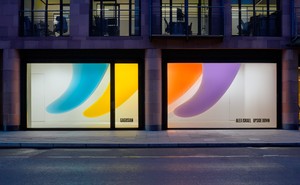
Calder’s versatility with scale is exemplified by his thousands of delicate smaller works, often featured in exhibitions of their own. A cottage industry has emerged around these exquisite presentations, frequently involving collaborations between blue-chip galleries and the Calder Foundation, and renowned architects are often enlisted to design them. In 2015, the Dominique Lévy Gallery, New York, asked father-and-son duo Santiago and Gabriel Calatrava to create an environment for forty-eight tiny maquettes, mobiles, and stabiles. The architects deftly designed a white box of biomorphic platforms emulating a lily pond, with upward-sprouting structures culminating in round, mirrored tabletops that reflected the artworks’ undersides like a pristine lake. Calder’s studios in Roxbury, Connecticut, and in the village of Saché, France, are studies in controlled chaos. The Calatrava pair set up a contrast: ethereal and heavenly, their ivory-white display was a clarion call to ghostly angels to dance among the works. A couple of years later, Annabelle Selldorf took on a similar assignment from Marc Glimcher at Pace’s 57th Street location for the exhibition Calder: Constellations. The beloved art-world architect approached the design by creating a calm environment in which the show’s moderately sized works could speak to one another. When installing these complex works, Selldorf expertly varied the heights of plinths and platforms, enhancing sight lines and sculptural forms as she composed her own Calder-verse.
Calder’s museum retrospectives have also been distinguished by the contributions of world-famous architects. The 2013–14 exhibition Calder and Abstraction: From Avant-Garde to Iconic, for example, at the Los Angeles County Museum of Art (LACMA), was designed by hometown favorite Frank Gehry. A kindred spirit of Calder’s in his urge toward unorthodoxy and experimentation, Gehry relished the challenge of creating a coherent presentation in the massive Resnick Pavilion, which was designed by the architect Renzo Piano and opened in 2010. The Gehry-designed exhibition space was distinguished by curved walls and intimate alcoves, the masterstroke lying in the elegant guardrails, which protected the loaned masterpieces and guided visitors through the installation. This acclaimed exhibition marked a full-circle moment for Calder’s legacy: in 1965, Calder had inaugurated LACMA’s then-new William Pereira–designed complex on Wilshire Boulevard with a rare fountain commission, Three Quintains.
Water and Piano are the common denominators of Calder’s Quatre lances (1964), a commission initially intended for a reflecting pool at the Fondation Maeght, Saint-Paul-de-Vence, a building designed by Josep Lluís Sert. For their museum of modern and contemporary art, a private collection housed in a public gallery (a first for France), Aimé and Marguerite Maeght worked closely with several artists, including Calder. Calder’s standing mobile, however, was deemed too large for the designated location, where a Braque mosaic had been tiled into the pool’s bottom. To complicate matters further, Aimé was also using the basin to store his oysters. So Quatre lances was shelved, though another Calder, Contreforts, a mighty black-painted stabile installed in the foundation’s sculpture gardens, has welcomed visitors there for the past sixty years.
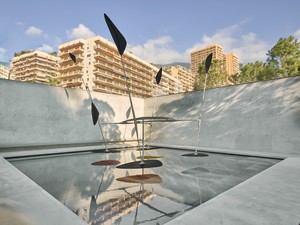
Alexander Calder, Quatre lances, 1964, Mareterra, Monaco. Photo: courtesy Nouveau Musée National de Monaco/François Fernandez, 2025
Two years later, Princess Grace of Monaco acquired Quatre lances on behalf of the principality and installed it on the esplanade of the city-state’s Hall du Centenaire. Harsh winds blowing in from the Mediterranean, though, proved inhospitable to the sculpture, and some of its components were damaged. The artwork’s inadequate installation had marred the piece, and in 2011, the Nouveau Musée National de Monaco and the Calder Foundation joined forces to restore Quatre lances and find it a permanent home. Finally, in 2018, longtime friends and colleagues Alexander S. C. Rower and Renzo Piano hatched a plan.
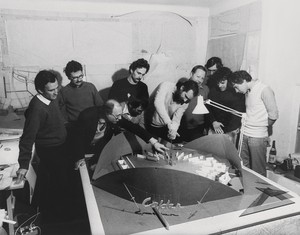
Piano is no stranger to Calder: in 1983, he undertook the challenge of transforming an arena in Turin, Italy, the Palazzo a Vela, into a colossal showcase of more than 450 Calder works. That presentation, Calder: Mostraretrospettiva, remains the largest Calder exhibition to date. More recently, Piano designed the 2019 show Calder Stories at the Centro Botín, a cultural compound in Santander, Spain, itself designed by Piano and Luis Vidal.
Since 2012, Piano’s firm has been part of an international design team developing Monaco’s new waterfront district, Mareterra. This mixed-use neighborhood combining a marina with retail and residential buildings sits near the plaza where Quatre lances was originally unveiled in 1966. It was Piano, an admirer of Calder’s work since childhood, who suggested placing the orphan sculpture at Mareterra, while Rower encouraged him to create an “outdoor museum” dedicated to the lone work. Sheltered by surrounding buildings in a prime inland location, the gallery opened in December 2024, its three-walled open-air design seamlessly connecting the U-shaped enclosure to a main thoroughfare of pedestrians and visitors. Cast entirely in concrete, smooth walls and a perimeter boardwalk surround a shallow reflecting pool. Nearby, planted pines cast painterly shadows, marking the passage of time. A concrete bench inset along the back wall provides a moment of respite, a place to contemplate the deceivingly simple work of stainless steel rods bolted to black steel plates. Five tall forms sway with the wind while four horizontal elements hover above the water. These panels’ undersides cast reflections on the water’s surface in white, yellow, red, and orange, an unexpected and dynamic splash of color. A sculpture in constant motion, Quatre lances has a sublime restlessness. The work’s unpredictable choreography changes with the seasons, and its emotive conversations with viewers connect the king of kinetics to land art, where shifts in weather and time create various optical effects.
Calder’s sculptures are both rational in their embrace of balance and form and instinctual in their gutsy display for flair and tranquility. Ultimately his art gives us ways to seek poetry and song. Alexander Calder’s family, friends, and colleagues continue to “love him for ever and ever” by keeping his flame bright so we hear his voice clearly from one generation to the next.
Karen Wong is a cultural producer and educator developing platforms to serve creatives by providing new opportunities, marketplaces, and business models. As the current chief brand officer and former deputy director of the New Museum, New York, Wong cofounded the initiatives IDEAS CITY, NEW INC, and ONX Studio.