
A Tremendous Generosity: Jeff Koons on Marcel Duchamp
Jeff Koons tells Alison McDonald about his appreciation for the pioneering artist and thinker Marcel Duchamp.
Winter 2025 Issue
Don Quaintance’s new book Duchamp in California: Walter Hopps Curates a Retrospective (Menil Collection/König, 2025) details the rich history of the Pasadena Art Museum and the consequential Marcel Duchamp retrospective that Walter Hopps curated there in 1963. Here Quaintance gives the backstory to the monograph and shares an excerpt from the book’s fourth chapter.
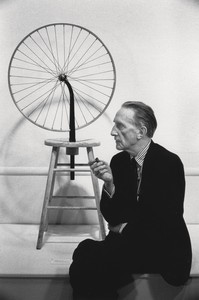
Marcel Duchamp with Bicycle Wheel, 1913/1951, at his retrospective, by or of Marcel Duchamp or Rrose Sélavy, Pasadena Art Museum, October 12, 1963. Photo: © Julian Wasser, courtesy Craig Krull Gallery, Santa Monica, California
Marcel Duchamp with Bicycle Wheel, 1913/1951, at his retrospective, by or of Marcel Duchamp or Rrose Sélavy, Pasadena Art Museum, October 12, 1963. Photo: © Julian Wasser, courtesy Craig Krull Gallery, Santa Monica, California
I first met the curator Walter Hopps in 1982 and subsequently worked closely with him as a graphic designer and researcher for over two decades. Initially I was almost unaware of his already legendary backstory in the art scenes of Los Angeles, New York, Washington, DC, and on an international stage. My book Duchamp in California: Walter Hopps Curates a Retrospective originated in 2012, when I visited the Pacific Asia Museum in Pasadena, California, to see 46 N. Los Robles: A History of the Pasadena Art Museum. Having previously studied installation views of the exhibitions that Hopps mounted in the Pasadena Art Museum’s spaces when he was the curator and then director there, from 1962 to 1966, I realized that the galleries were basically unchanged a half-century later. These visual flashbacks, coupled with my stepping into Hopps’s original curatorial stomping grounds, induced a desire to create a textual and graphic reconstruction of the 1963 Marcel Duchamp retrospective. Despite a celebrated and illustrious career, that show, which a youthful Hopps had mounted in these galleries at the age of thirty-one, was probably his most renowned curatorial achievement.
Early in my research I realized that the initial scheme fell short, missing the full scope of the remarkable cast of characters who convened and events that transpired in and around Pasadena in 1963. Obvious questions arose. Why did the work of such an influential artist take over five decades to be made thoroughly accessible to viewers? Why did Pasadena, a Waspy bastion of conservatism, host a coming-out party for a Dadaist radical? Why did Duchamp favor a venue far from the East Coast’s art power grid? My investigation led me through a historical record of photographs and documentation that proved extensive.
On October 6, 1963, Duchamp arrived in Pasadena for his first retrospective and spent nine days in a whirlwind of openings, cocktail parties, studio and gallery visits, chess matches (including one immortalized in a photograph with a nude Eve Babitz), and excursions to Mount Wilson Observatory, Ojai, Montecito, and overnight to Las Vegas. These calendar days provide the book’s chronological structure: each of nine chapters recounts the events of a single day, moment to moment, while five others describe the venue—a pseudo-Chinese temple—and the organization and installation of the show. By focusing on only one interlude in Duchamp’s dynamic lifetime, this brief slice of his story reveals the complexities and contradictions sustaining the artist’s still-lengthy shadow—even as the art world anticipates his latest grand-scale retrospective, commencing at the Museum of Modern Art, New York, in 2026, then traveling to Philadelphia and Paris.
Having just relocated to New York City from Paris in 1962, artist William Copley and his wife, Noma Copley, hosted a meeting in their sublet town house on East 69th Street on November 3 with Marcel Duchamp and the Pasadena Art Museum’s director Thomas Leavitt and curator Walter Hopps. For the last three, this was their first face-to-face encounter on the subject of the upcoming Duchamp retrospective, by or of Marcel Duchamp or Rrose Sélavy (October 6–November 3, 1963). The artist had first promised his participation eight months earlier. For Copley, Duchamp, and Hopps, the meeting turned into a serendipitous reunion from overlooked encounters a decade and a half earlier—back in California.
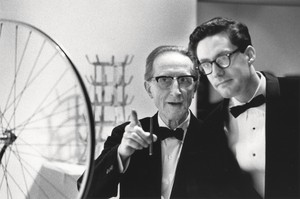
Marcel Duchamp and Walter Hopps at the private preview of by or of Marcel Duchamp or Rrose Sélavy, Pasadena Art Museum, October 7, 1963. Photo: © Julian Wasser, courtesy Craig Krull Gallery, Santa Monica, California
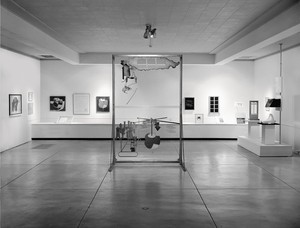
Installation view, by or of Marcel Duchamp or Rrose Sélavy, Pasadena Art Museum, 1963, featuring Ulf Linde’s Swedish replica of The Bride Stripped Bare by Her Bachelors, Even (Large Glass), 1915–23/1961 (center). Photo: Frank J. Thomas
Since first meeting Duchamp in New York in 1947, Copley had become lifelong friends with him, saying, “Our relationship was largely personal and amicable.” Not remembered by Copley in 1962, he also had met the adolescent Hopps previously, at Copley Galleries in Los Angeles in 1949, when Max Ernst’s first US retrospective there coincided with Hopps’s awakening to modern art. Copley had taken notice of an anonymous teenager’s visit: “There was no appreciation for the Ernst exhibition. Except for the ‘kids.’ They both spent a long time looking at the pictures, quietly, seriously, profoundly mesmerized by the fantasy of Max Ernst.”
Back then, Copley was unaware that those “kids” had been the teenage Hopps and probably his artist pal Craig Kauffman. When Hopps brought up his attending the Ernst show in 1949, Copley finally caught on that the mesmerized teenager had grown into the thirty-year-old Duchamp curator now sitting in his living room. The convoluted path that led to their reintroduction must have dumbfounded both men. By chance? To William and Walter, it often seemed that every entrance and exit circled back to Marcel.
Turning to Duchamp, Hopps recounted his high school brush with the artist at Walter and Louise Arensberg’s Hollywood home thirteen years earlier. Hopps recounted his 1962 conversation on 69th Street: “I said, ‘I’m glad we can finally finish our conversation,’ and didn’t explain any further, at first. Copley looked puzzled. Then I talked about the Arensbergs and my briefly meeting Duchamp there.” The artist’s amused, perhaps incredulous response must have put Hopps at ease. Duchamp later recalled the meeting at the Copleys’ by saying that he found the curator “very sympathetic.”
The Manhattan conversation not only sealed the personal rapprochement between the artist and the curator but also nailed down Duchamp’s relatively informal cooperation in a survey of his work. Deferential toward the artist’s taciturnity, Hopps would note, “This was the first retrospective of Marcel, but we never talked about that—not once.”
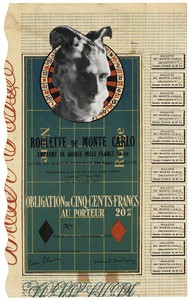
Marcel Duchamp, Monte Carlo Bond (No. 12), 1924, lithograph on paper with cut-and-pasted gelatin silver print and letterpress impression, 12 ¼ × 7 ½ inches (31.1 × 19.1 cm), The Museum of Modern Art, New York, Gift of the artist
Considering the two convivial, if somewhat baffling reunions that had taken place simultaneously, one between Hopps and Copley and the other between Hopps and Duchamp, no further cajoling was needed for the Copleys, who became the principal private lenders to the enterprise. William would hand-carry a numbered example of Duchamp’s Monte Carlo Bond (1924), one of six Copley loans to the exhibition. Still, Noma admitted to Hopps, “We are not enthusiastic about loaning because of our recent experience with the big Max Ernst,” a work that had been damaged on loan. She went on, “May I ask you to be very careful with the Disks Inscribed with Puns (1926) and The Brawl at Austerlitz (1921) because they are extremely frail.” The haul from the Copleys also included Nude with Black Stockings (1910), the original Pharmacy (1914), and Self-Portrait in Profile (1958). An elated Hopps told the Copleys, “Needless to say, at this point I am becoming very excited by the show.”
A few days after meeting at the Copleys’, Hopps went to Duchamp’s West 10th Street apartment and sat down alone with the artist to “Talk & Plan.” “Duchamp was extraordinarily cooperative,” Hopps observed; “the working method with him was that I would propose and he would review.” Duchamp’s friend the painter and scholar Marcel Jean felt that the artist’s general approach revealed a “cleverness and kind attention subtly blended with detachment. His mind seemed always ahead of his interlocutors’ thoughts.”
At a subsequent meeting in November 1962, the curator and the artist began to discuss loans. Duchamp had consistently been selective about exhibiting his early work and cautious not to misrepresent the strategic arc of his oeuvre. In a 1950 letter to Henri-Pierre Roché regarding some early drawings, the artist had objected that “the public would too easily ‘take advantage’ of these things from youth, which are only amusing in their relation to what came after.” Recognizing the retrospective’s broader context, Duchamp reversed course: In Pasadena he called the adolescent drawings “anecdotal things that make this exhibition more interesting.” Exchanges with Hopps revealed the artist’s change of heart as he gradually welcomed such a thoroughgoing exposure.
Besides suggesting works at the Philadelphia Museum of Art and the Yale University Art Gallery, Duchamp’s initial response about possible loans had specified only Network of Stoppages (1914) and a 1913 pencil drawing (belonging to his artist friend Jeanne Reynal) of The Bride Stripped Bare by Her Bachelors, Even, commonly called the Large Glass (1915–23). If his two suggestions seemed offhanded at first, they were in fact calculated: Unsurprisingly, both works relate to his magnum opus, the Large Glass, Reynal’s drawing to its genesis.
Network of Stoppages was a bridge between canvas painting and cerebral pursuits—nearly in a literal sense. To create this work, Duchamp turned his vertical Fauvist painting Young Man and Girl in Spring (1911) sideways, then added black strips to reduce the image area to the proportions of the Large Glass (if turned sideways), pencil outlines of which he superimposed onto the surface of the painting. Another overlay is a scientific-like diagram of the nine capillary tubes, the same as those attached to the Bachelors in the Large Glass.
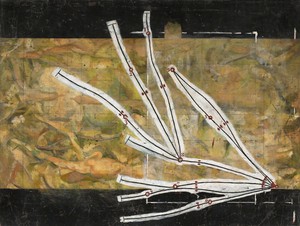
Marcel Duchamp, Network of Stoppages, 1914, oil and pencil on canvas, 58 ⅝ × 77 ⅝ inches (148.9 × 197.2 cm), The Museum of Modern Art, New York, Abby Aldrich Rockefeller Fund and gift of Mrs. William Sisler
Patricia O’Connell Matta bought Network of Stoppages from the Julien Levy Gallery and later consigned it to her second husband, the gallerist Pierre Matisse. Inopportunely, Matisse’s affair with O’Connell Matta had brought an acrimonious end, in 1949, to his marriage to Teeny Duchamp (now Duchamp’s wife), accompanied by residual ill feelings. Regarding the Network loan, Hopps disclosed, “Working very closely with Marcel, we tickled it out of Pierre Matisse.” To do so, on May 3, 1963, Hopps strode down New York’s 57th Street to the Fuller Building (an Art Deco landmark), crossed the long marble-patterned lobby, and pushed the fourth-floor elevator button for the tony Pierre Matisse Gallery. He also had heard that Matta might own another potential coup, the original of the Mona Lisa spoof L.H.O.O.Q. (1919), read phonetically in French as Elle a chaud au cul (She has a hot ass).
Unbeknownst to Hopps, Matisse had brought additional works to the gallery. Hopps saw not only L.H.O.O.Q. but also, lined up, Sieves, or Parasols (1914) and Study for Reproduction of 9 Malic Molds (1938), both studies for the Large Glass; and Tzanck Check (1919), which Duchamp used to pay his dentist, an example of his critique of art as commodity and, more generally, of the increasing monetization of the art market. Hopps must have felt justifiably buoyant. He firmly believed Network of Stoppages to be one of Duchamp’s masterworks and so asked Matisse to make a color transparency, with the idea of reproducing the work for the first time in color in the Pasadena catalogue.
Next, while still in New York, Hopps telephoned Reynal in Greenwich Village to borrow the Large Glass drawing she owned. A precocious fan of Cubism and Futurism and their relation to Duchamp’s paintings, Reynal would subsequently reminisce, “At the age of eleven I had seen Nude Descending a Staircase [1912] at the Armory Show.” Executed in pencil on tracing cloth and resembling a mechanical diagram, the 1913 drawing is the earliest complete delineation of the Large Glass.
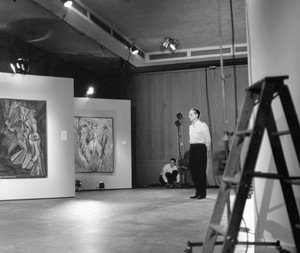
Marcel Duchamp with Nude Descending a Staircase (No. 2), 1912, and Portrait (Dulcinea), 1911, at his retrospective, by or of Marcel Duchamp or Rrose Sélavy, Pasadena Art Museum, during the filming of Jean-Marie Drot’s Game of Chess with Marcel Duchamp, November 6, 1963. Photo: Frank J. Thomas
Seeing Duchamp again on his New York trip, Hopps engaged in a friendly chess match, with predictable results: a checkmated curator. As consolation, the artist supplied the phone number of the composer Edgard Varèse, a Parisian friend who had moved to New York in 1915. His American wife, Louise Norton Varèse, was a renowned French translator who, under her flamboyant pseudonym “Dame Rogue,” had infamously declared in 1915, “Beauty for the eye, satire for the mind, depravity for the senses!” Duchamp had even coached Louise on obscene French slang: “Marcel taught me all the expressions no lady needs to know.” He also gifted her a large charcoal drawing, Study for Portrait of Chess Players (1911). Hopps thanked the couple for their “willingness to lend to our forthcoming retrospective.”
As the deadline for finishing the exhibition checklist approached, Duchamp—even more engaged in its completeness—brought up yet another drawing, Moonlight on the Bay at Basswood (1953), in the collection of the Chicagoan Frank Brookes Hubachek, Mary Reynolds’s brother. Reynolds and Duchamp had enjoyed a three-decade-long but highly discreet relationship, mostly in Paris. Following Reynolds’s death, Duchamp had developed a close bond with her brother.
Regarding Moonlight, “Duchamp was very keen that I include this drawing,” Hopps later recalled. Not understanding the work’s possible connection to the backdrop of the artist’s still-secret tableau Étant donnés (1946–66), the curator thought that nobody but the artist “would miss this little landscape.” Duchamp spent two weeks in August 1953 at the Hubachek retreat in Minnesota’s Quetico-Superior wilderness, then gave Moonlight to Marjorie and Frank Hubachek as a parting gift. The drawing’s charm derives from its improvised materials. Using a blue blotter pad, Duchamp added ink and pencil to create the trees, and as Hubachek outlined, “The moon and its reflection are by a child’s crayon. The white mist consists of Mennen’s talcum powder. The heavy brown shadows in the pine trees were made with a chocolate bar.”
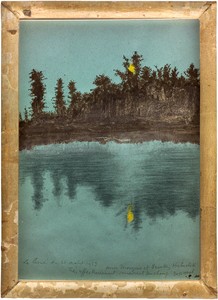
Marcel Duchamp, Moonlight on the Bay at Basswood, 1953, black ink, graphite pencil, wax crayon, talcum powder, and chocolate on blue blotting paper, 10 ⅜ × 7 ¼ inches (26.4 × 18.4 cm), Philadelphia Museum of Art, gift of Frank Brookes Hubachek, 1974
Requesting Moonlight on August 30, 1963, Hopps then added onto his loan appeal three other early works that Hubachek had inherited from Reynolds: the painting Garden and Chapel at Blainville and two drawings, Grandmother Sewing and its verso, Yvonne Duchamp as a Child (all 1902). Ever adept at sublimating sentimentality, Duchamp nonetheless must have been pleased to have all the previous gifts to his beloved partner together in Pasadena and another given to her esteemed brother.
The artist then came up with another idea for Hopps: “Duchamp wanted me to be in touch about French poet Pierre de Massot. It was a strange little collage that had to do with a French pissoir, Anagram for Pierre de Massot (1961).” Unafraid of acting puerile in pursuit of a pun, Duchamp teased an anagram out of Massot’s name: de Ma/Pissotièrre/j’aperçois/Pierre de Massot (from My/Urinal/I see/Pierre de Massot). Along with a textual hint of voyeurism, a Parisian street urinal made a not-subtle allusion to Duchamp’s urinal Fountain (1917), while likewise to his friend’s sexual proclivities, since such facilities often shielded anonymous same-sex encounters. Providentially for Hopps, a curatorial colleague in New York, David Hayes, had just purchased this work at auction. Hayes, without ado, lent the collage.
The Duchamps personally loaned numerous works to the retrospective, including two paintings, Nude Seated in a Bathtub and Bust Portrait of Chauvel (both 1910). As late as September 1963, the artist offered two more items, both chess related, telling Hopps, “I will bring myself one chess set I have just completed in Cadaqués,” Pocket Chess Set (1961–64), a wallet-sized board with magnets securing the tiny celluloid chess pieces. Duchamp also supplied a copy of his chess tome Opposition and Sister Squares Are Reconciled (1932), an elaborate treatise (or obsessive folly?) diagramming an obscure aspect of possible endgames. Duchamp admitted, “Even the chess champions don’t read the book, since the problem it poses is so rare as to be nearly Utopian.” This last word choice certainly characterized the impulse to mount a Duchamp retrospective in Pasadena, yet as Hopps had secured loan after loan, he could sense the exhibition taking concrete, fulsome shape.
True, some crucial loans had been denied. Most notable were the immovable Large Glass from the Philadelphia Museum of Art, Tu m’ (1918) from the Yale University Art Gallery, and To Be Looked at (from the Other Side of the Glass) with One Eye, Close to, for Almost an Hour (1918) from the Museum of Modern Art. The fragile glass Glider Containing a Water Mill in Neighboring Metals from the Arensberg Collection at the Philadelphia Museum of Art was prevented from revisiting its former Hollywood homestead or, more precisely, neighboring Pasadena.
On September 11, 1963, still on vacation in Spain, Duchamp confirmed his much-anticipated attendance in Pasadena. Hopps, subsequently reminiscing about the lengthy preparations, would wax euphorically about Duchamp’s approach: “I have never worked with any artist, young or older living artist, who was more intelligent. He had an extraordinary organizational mind. Simplicity, clarity, efficiency.”
Artwork © Association Marcel Duchamp/ADAGP, Paris/Artists Rights Society (ARS), New York, 2025
Don Quaintance, Duchamp in California: Walter Hopps Curates a Retrospective (Menil Collection/König, 2025)
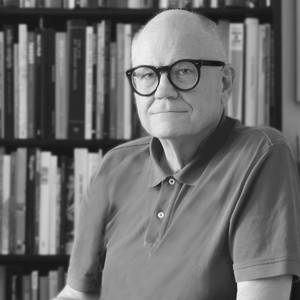
Don Quaintance is a graphic designer and art historian from Houston. He has designed three books on Marcel Duchamp, including Fountain (1989) and Marcel Duchamp: Étant donnés (2009), and is the author and designer of the new book Duchamp in California: Walter Hopps Curates a Retrospective (2025).
Jeff Koons tells Alison McDonald about his appreciation for the pioneering artist and thinker Marcel Duchamp.

The Spring 2026 issue of Gagosian Quarterly is now available, featuring Marcel Duchamp’s L.H.O.O.Q. (1964) on the cover.
Harry Thorne reflects on Brian O’Doherty’s recording of Marcel Duchamp’s heart.
The Summer 2023 issue of Gagosian Quarterly is now available, featuring Richard Avedon’s Marilyn Monroe, actor, New York, May 6, 1957 on its cover.
The Fall 2022 issue of Gagosian Quarterly is now available, featuring Jordan Wolfson’s House with Face (2017) on its cover.
Jacquelynn Baas profiles Isabelle Waldberg, writing on the sculptor’s many friendships and the influence of her singular creations.
The Spring 2020 issue of Gagosian Quarterly is now available, featuring Cindy Sherman’s Untitled #412 (2003) on its cover.
Ahead of Alex Israel’s exhibition of four new Fin sculptures at Gagosian, London, the artist spoke with Susan Casey, author of The Wave: In Pursuit of the Rogues, Freaks, and Giants of the Ocean (2010), about the ocean, surfing, and Los Angeles.
On July 9, Simon Hantaï: the last studio opens at Gagosian, Gstaad. Curated by Anne Baldassari, the show comprises sixteen of the artist’s dernier atelier (last studio) paintings of 1982–85. The exhibition is accompanied by an illustrated catalogue, copublished by Gagosian and Skira, which features an essay by Baldassari and an extensive portfolio of previously unpublished photographs by Édouard Boubat. Here, we share the introductory chapter from the publication.

Adam D. Weinberg has been working with Giuseppe Penone on an exhibition of the artist’s new sculptures, The Reflection of Bronze, that opens at Gagosian, New York, on April 22. The works explore the character and possibilities of bronze. Here, Weinberg considers Penone’s enduring engagement with the alloy and addresses the conceptual underpinnings of the exhibition’s three-room structure.
Laura Bruni writes about a major exhibition celebrating the work of the British sculptor Henry Moore at the Royal Botanic Gardens, Kew, London.
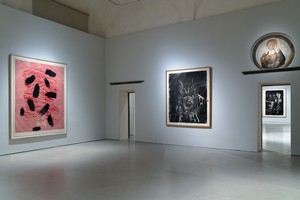
On the occasion of Baselitz: AVANTI! at the Museo Novecento in Florence, Italy, Holly EJ Black considers the roots and reverberations of Georg Baselitz’s printmaking.