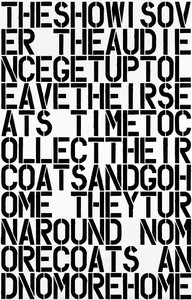
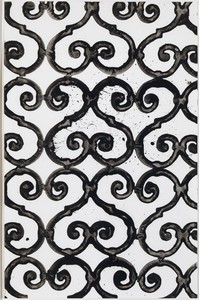
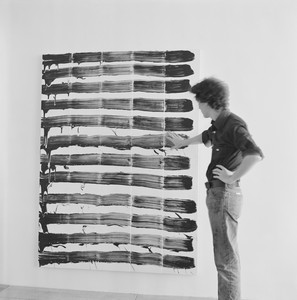
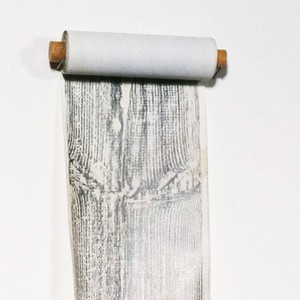
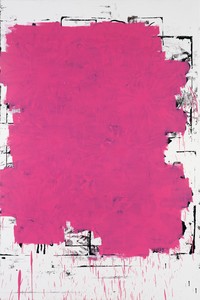
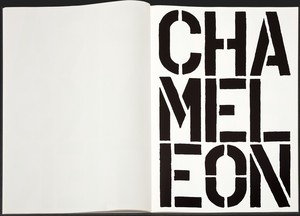
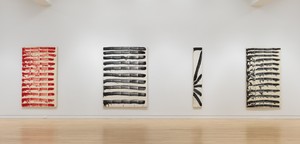
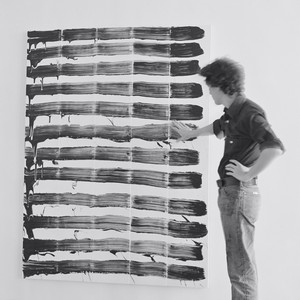
Christopher Wool was born in Chicago in 1955 and lives and works in New York and Marfa, Texas. He studied at Sarah Lawrence College in Bronxville, New York, then in 1973 enrolled in the New York Studio School. In 1986, he began using rollers to apply patterns in black enamel paint to white panels, introducing small flaws to create subtle visual and emotional effects. Later that same decade he was inspired by graffiti on a white truck to produce his first text paintings. By filtering words and phrases through a gridded composition—and sometimes also by omitting vowels, spacing, and punctuation—he slowed and altered their reading.
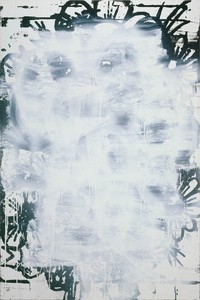
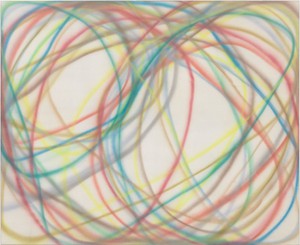
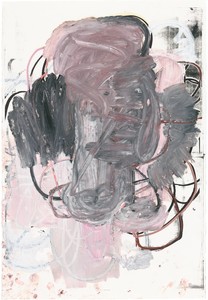
From the early 1990s through the present, Wool has used silkscreen printing to expand the visual language of his earlier pattern paintings. Transposing photographs of previous projects to screens, he transfers them to fresh canvases, then adds paint, sprayed enamel, or spray-painted line. In the past decade’s large-scale abstract “gray paintings,” which are made by wiping away sprayed enamel to generate layered compositions, Wool contrasts the clarity of his lines with the smeared haziness of their grounds, establishing an enigmatic mood.
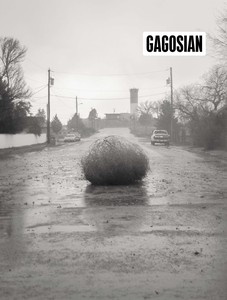
Wool’s attraction to the stark look of city life is also present in his photographic series Absent Without Leave (1993), the raw imagery of which is saturated with foreboding. The black-and-white photographs in a related set, East Broadway Breakdown (1994–95/2002), were taken at night on the streets of Manhattan’s Lower East Side and Chinatown. Reveling in their neighborhoods’ shadowy after-hours existences, each atmospheric sequence records a stripped-down nocturnal realm.
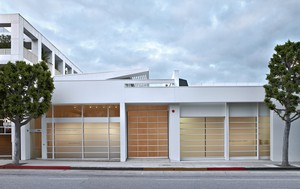
See Stop Run, a survey of Wool’s recent works organized in 2024 by the artist with curator Anne Pontégnie, occupied an entire floor of a space in New York’s Financial District. This allowed the city to permeate the exhibition—Wool’s largest since 2014—through wraparound windows, emphasizing the complexity of his process and the interconnectedness of his chosen mediums. A second part of the exhibition—complemented by three large outdoor sculptures—opened at the Brite Building, Marfa, Texas, in 2025, remaining on view for two years.