Georg Baselitz and the Possibilities of Print
On the occasion of Baselitz: AVANTI! at the Museo Novecento in Florence, Italy, Holly EJ Black considers the roots and reverberations of Georg Baselitz’s printmaking.
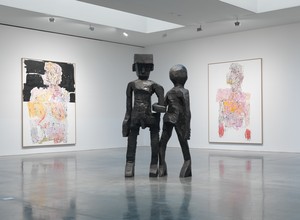
Installation view
Artwork © Georg Baselitz. Photo: Rob McKeever
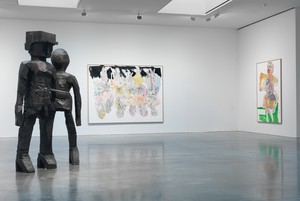
Installation view
Artwork © Georg Baselitz. Photo: Rob McKeever
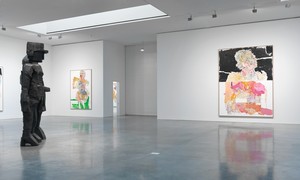
Installation view
Artwork © Georg Baselitz. Photo: Rob McKeever
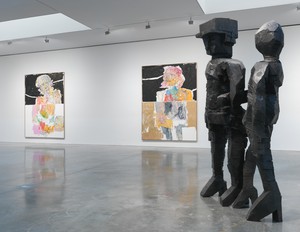
Installation view
Artwork © Georg Baselitz. Photo: Rob McKeever
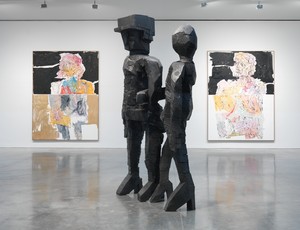
Installation view
Artwork © Georg Baselitz. Photo: Rob McKeever
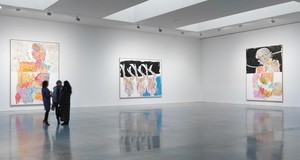
Installation view
Artwork © Georg Baselitz. Photo: Rob McKeever
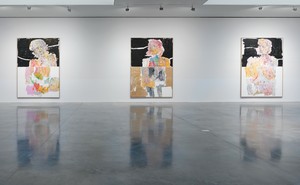
Installation view
Artwork © Georg Baselitz. Photo: Rob McKeever
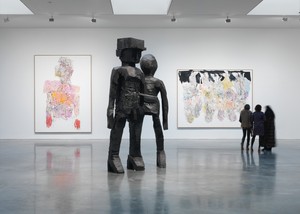
Installation view
Artwork © Georg Baselitz. Photo: Rob McKeever
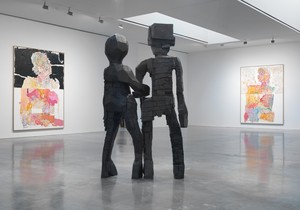
Installation view
Artwork © Georg Baselitz. Photo: Rob McKeever
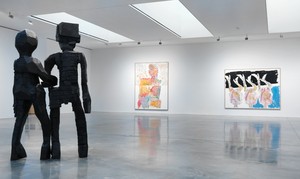
Installation view
Artwork © Georg Baselitz. Photo: Rob McKeever
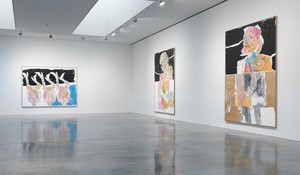
Installation view
Artwork © Georg Baselitz. Photo: Rob McKeever
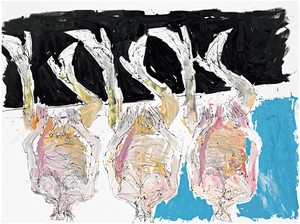
Georg Baselitz
Rechts oder links herum? (Right or Left Turn?), 2011
Oil on canvas, 118 ⅛ × 157 ½ inches (300 × 400 cm)
© Georg Baselitz
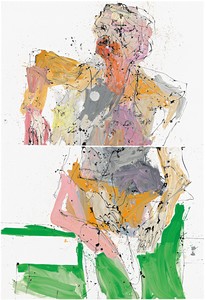
Georg Baselitz
In London war keiner zu Hause (Nobody Was at Home in London), 2011
Oil on canvas, 118 ⅛ × 80 ¾ inches (300 x 205 cm)
© Georg Baselitz
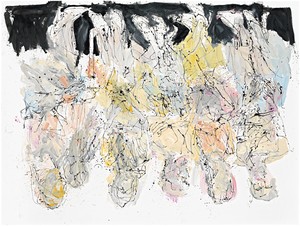
Georg Baselitz
Laß uns nach Dänemark fahren (Let’s Go to Denmark), 2011
Oil on canvas, 118 ⅛ × 157 ½ inches (300 × 400 cm)
© Georg Baselitz
I don’t want to create a monster, I want to make something which is new, exceptional, something that only I do . . . something that references tradition, but is still new.
—Georg Baselitz
Gagosian is pleased to present an exhibition of new paintings and sculpture by Georg Baselitz.
Baselitz’s challenging career is a constant process of counterpoint, marked by intense periods of creative activity culminating in a masterpiece or group of masterworks, followed by a startling renewal and rethinking of the subject. A traditional artisan, he produces paintings, drawings, prints, and wood sculptures, often on a monumental scale. Baselitz has consistently explored what it is to be German and a German artist, although his oeuvre owes as much to a broader range of influences, including art brut, the drawings and writings of Antonin Artaud, sixteenth-century German woodcuts, and African sculptures. While his chosen forms embody an aspiration for the latitude and grandeur of postwar abstraction, the tormented and fragmented motifs that characterize his early works express the burden of postwar economic and spiritual depression. With the reunification of Germany in 1990, the angst seemingly ebbed from his vision and, for the past two decades, Baselitz has infused his work with lightness and a sense of spontaneity.
In his new paintings, larger than anything he has done previously, Baselitz has revisited provocative aspects of his own history, such as the fractured paintings of 1966, reinterpreting them with the experience of hindsight. For the past decade, he has painted on the studio floor, crawling across the surface of the canvas as he works. While creating a fluid yet drip-free surface, this method denies him a total view while working; rather he must rely on intuition. Vast and rapidly painted, with swathes of bright, gossamer hues and explosive, meandering lines, these paintings are radical transubstantiations, part-recollection, part-ghost, of their rather opaque, weightier predecessors. In Beginging (2011), and Ist Franz Pforr in Rom? (2011), genderless, abject bodies surge with color and life, washed with swathes of translucent sky blue and orange, contrasting with black and white corollary that fills the other half of the canvas. The impulse to improve, clarify, and update is clearly evident while, conversely, the haunting, fleeting quality of the work reveals a mature artist’s meditations on time, presence, failure, and possibility.
Baselitz is also known for his roughly hewn and boldly painted wooden figures, which fuse traditional woodcarving techniques with primitivist and folk art impulses. In conceptual and formal contrast to the expressionist directness of working in wood, he has also explored large-scale bronze-casting. In Sing Song Zero, a double figure derived from a carved wooden form, the lyrical quality of the figures linked by the undulating curves of their arms is countered by the staccato hacks and scars of the original surface that have been rendered in a seamless cast surface.
On the occasion of Baselitz: AVANTI! at the Museo Novecento in Florence, Italy, Holly EJ Black considers the roots and reverberations of Georg Baselitz’s printmaking.
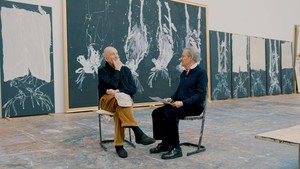
In conjunction with the exhibition The Painter in His Bed, at Gagosian, New York, Georg Baselitz and Richard Calvocoressi discuss the motif of the stag in the artist’s newest paintings.
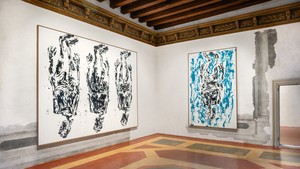
On the occasion of Georg Baselitz: Archinto at Museo di Palazzo Grimani, Venice, Artcore Films produced a short documentary featuring the artist. In the video, Baselitz details the origins of the project, how he approached the unique space, and his experiments in process and technique.
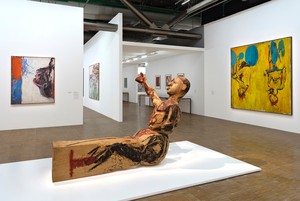
Richard Calvocoressi visits Georg Baselitz’s retrospective exhibition at the Centre Pompidou in Paris and reflects on both the historical specificity and timeless themes of the artist’s sixty-year career.
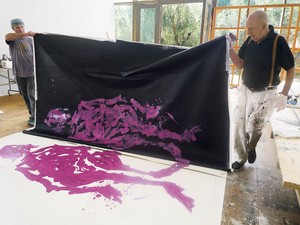
In celebration of five recent projects related to Georg Baselitz, Richard Calvocoressi, Max Hollein, and Katy Siegel speak with the artist and look at his prolific career.
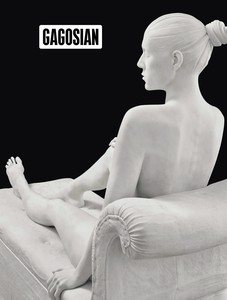
The Fall 2021 issue of Gagosian Quarterly is now available, featuring Damien Hirst’s Reclining Woman (2011) on its cover.

Richard Calvocoressi narrates a tour of an exhibition of new paintings by Georg Baselitz in San Francisco, describing the visual effect of these luminous compositions and explaining their relationship to earlier works by the artist.
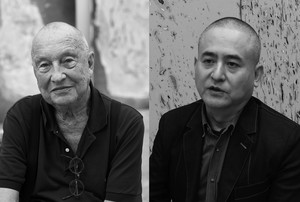
On the occasion of Georg Baselitz: Years later at Gagosian, Hong Kong, Zeng Fanzhi composed a written foreword for the exhibition’s catalogue and a video message to the German painter. Baselitz wrote a letter of thanks to the Chinese artist for his insightful thoughts.
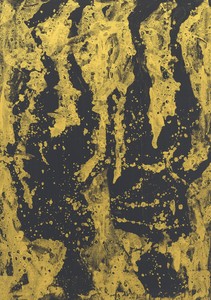
Richard Calvocoressi writes on the painter’s latest bodies of work, detailing the techniques employed and their historical precedents.
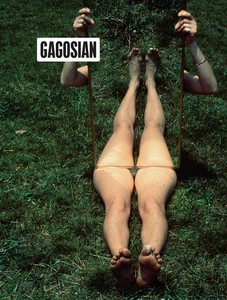
The Summer 2020 issue of Gagosian Quarterly is now available, featuring Joan Jonas’s Mirror Piece 1 (1969) on its cover.
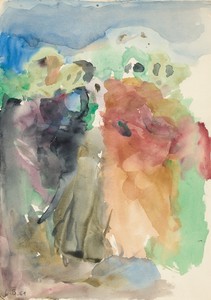
On the occasion of a career-spanning exhibition at the Gallerie dell’Accademia, Venice, Richard Calvocoressi tracks the evolution of Georg Baselitz’s development from his early education in East Germany to his revelatory trip to Florence, in 1965, and beyond.
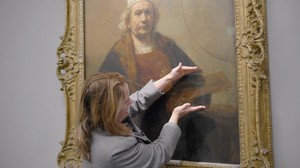
Jenny Saville reveals the process behind her new self-portrait, painted in response to Rembrandt’s masterpiece Self-Portrait with Two Circles.
The Summer 2019 issue of Gagosian Quarterly is now available, featuring a detail from Afrylic by Ellen Gallagher on its cover.
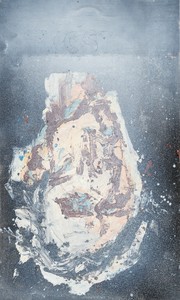
Georg Baselitz speaks with Sir Norman Rosenthal on the subject of his latest work. The two discuss these paintings, all depictions of self-portraits by artists from the past and present, and what it means to pay homage.
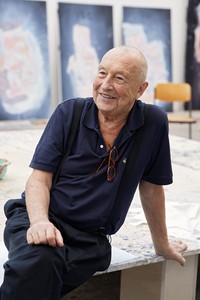
Morgan Falconer visits the artist’s studio outside Munich to learn more about his newest paintings, a series entitled Devotion.
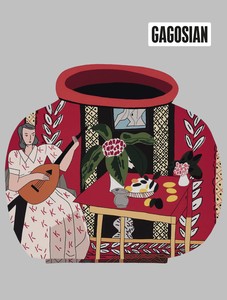
The Spring 2019 issue of Gagosian Quarterly is now available, featuring Red Pot with Lute Player #2 by Jonas Wood on its cover.