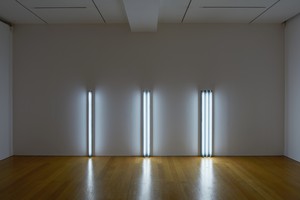
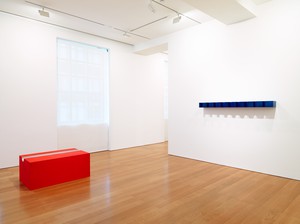
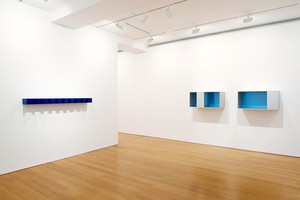
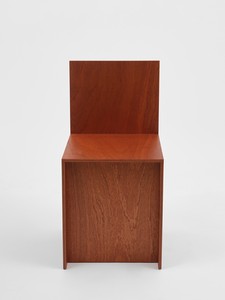
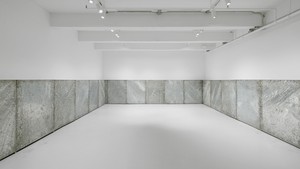
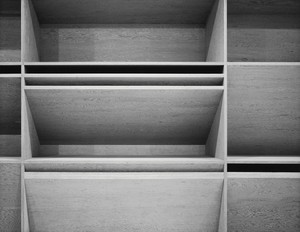
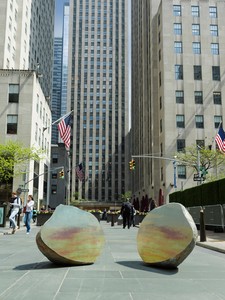
Gagosian Hong Kong is pleased to present 間 (jiān), a group exhibition of Minimalist works selected in response to Dan Flavin’s the nominal three (to William of Ockham) (1963).
“間” is a composite of the Chinese characters for “sun” and “door,” evoking a sliver of light between two pillars. It can be translated as “interval,” “gap,” “space,” or “pause.” This image-moment taps into the phenomenological aims of Minimalism, which uses simplified forms to communicate the primacy of intellect and bodily awareness over artistic content.
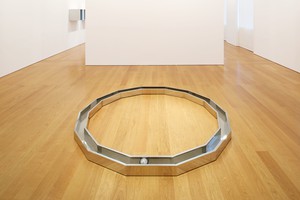
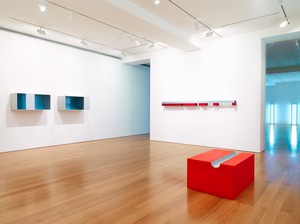
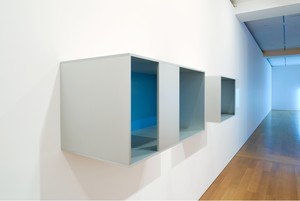
Emerging from de Stijl, Constructivism, and Suprematism, as well as American mass production, Minimal art locates the content of an artwork in the viewer, rather than in the object. Artists such as Dan Flavin, Donald Judd, and Walter De Maria, all included in this exhibition, pursued a pure objecthood informed by existentialist philosophy and theories of being and nonbeing.
In the early 1960s, Flavin’s interest in elementary forms and industrial materials led him to develop site-specific arrangements of commercial fluorescent lights. Circumventing the limits of the gallery, he used the standard lengths of the tube lights to set up nonhierarchical interrelationships, blurring distinctions between the aesthetics of art and industry. the nominal three (to William of Ockham) (1963) is made up of six identical lights, three subsets positioned in a numeric sequence across a single wall. Displayed as parallel vertical beacons, the lights can be read from left to right: one light, then two, then three, exemplifying Flavin’s calculated awareness of the empirical realities of rooms.