
Now available
Gagosian Quarterly Summer 2026
The Summer 2026 issue of Gagosian Quarterly is now available, featuring Ellen Gallagher’s Fast-Fish and Loose-Fish (2026) on the cover.
Jeff Koons’s New! New Too! (1983) features in Art Basel Unlimited 2025, an exhibition platform for exciting large-scale projects that transcend the limits of the standard booth.
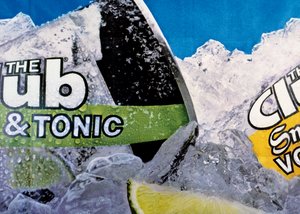
Rendered as a billboard-size lithograph, New! New Too! pays homage to its commercial source and recontextualizes the urgency of newness. The work reproduces at monumental scale an advertisement for The Club, a brand of ready-to-drink cocktails, with an image of a crisp blue sky, two cans resting in a field of ice, and the exclamatory phrase that gives the work its title. An early example of Koons’s career-long engagement with the readymade and consumer culture, New! New Too! is one of two large-scale advertisement-based works from the artist’s breakthrough series The New (1979–87), each of which prominently features the word new. Koons preserves the formal elements of the ad, eroding the distinctions between art and commodity while foregrounding the image’s aesthetic elements.
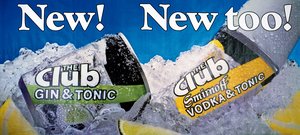
New! New Too!, 1983
Lithograph billboard mounted on cotton
123 × 272 inches (312.4 × 690.9 cm)
Jeff Koons’s New! New Too! (1983) installed at Art Basel Unlimited 2025. Artwork © Jeff Koons. Video: Pushpin Films
It is hard to imagine a time when Jeff Koons, the inarguable titan of contemporary art, was, well. . . . new. But in New York during the early 1980s, amid the fervent revival of Neo-Expressionist painting, Koons burst onto the scene as a thrillingly original artistic voice. As exemplified by his monumental lithographic billboard New! New Too! (1983), which scrupulously simulates an actual advertising campaign for some of the latest alcoholic beverages introduced to the market at the time, Koons’s groundbreaking series The New (1979–87) heralded a return to the Duchampian tradition of the readymade—one perfectly befitting the rampant consumerism and excessive materialism that characterized this “decade of decadence.”
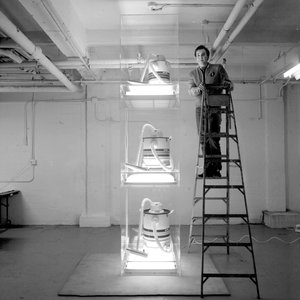
Jeff Koons in his West 16th Street studio with his newly completed New Shelton Wet/Dry Tripledecker (1981), New York, 1981. Artwork © Jeff Koons
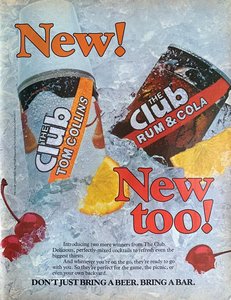
Vintage print advertisement for The Club canned cocktails, c. 1983
On the occasion of Art Basel Unlimited 2025, Gagosian presents New! New Too! to a European audience for the first time in over ten years. While this work was a centerpiece in several of Koons’s most important exhibitions, including his much-lauded retrospective that opened in June 2014 at the Whitney Museum of American Art in New York, and then traveled to the Centre Pompidou, Paris, and Guggenheim Museum, Bilbao, New! New Too! has only been publicly exhibited once since that show, making its inclusion in this year’s Unlimited presentation particularly notable.
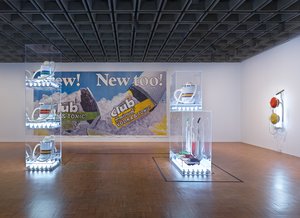
Installation view, Jeff Koons: A Retrospective, Whitney Museum of American Art, New York, New York, June 27–October 19, 2014. Artwork © Jeff Koons. Photo: Ronald Amstutz © Whitney Museum of American Art/Licensed by Scala/Art Resource, New York
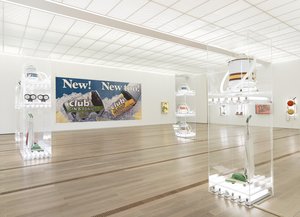
Installation view, Jeff Koons, Fondation Beyeler, Riehen/Basel, May 13–September 2, 2012. Artwork © Jeff Koons. Photo: courtesy Fondation Beyeler
New! New Too! is one of only two large-scale lithographs created for Koons’s series The New, which is among his most critically acclaimed and influential bodies of work. The New otherwise comprises an unusual mix of pieces: an iconic array of Plexiglas vitrine–encased vacuum cleaners as well as two fluorescent lightboxes, one of which is emblazoned with the series title.
I don’t seek to make consumer icons, but to decode why and how consumer objects are glorified.
Jeff Koons discusses his series The New inside his retrospective at the Whitney Museum of American Art, New York, 2014. Artwork © Jeff Koons. Video: courtesy Whitney Museum of American Art
In the catalogue essay for Koons’s 1992–93 exhibition at the San Francisco Museum of Modern Art, which traveled to the Walker Art Center, Minneapolis, curator Brian Wallis writes, “what was striking about these works was their direct, and seemingly unquestioning, appropriation of banal consumer objects, the key features being that the objects were unused and that their newness (value) was undiminished.” Works from The New series are highly coveted by institutions and held in the collections of the world’s most prestigious museums including the Museum of Modern Art, New York; Whitney Museum of American Art, New York; the Broad, Los Angeles; Tate, London; and National Galleries of Scotland, Edinburgh.
Koons first debuted works from this series in the street-facing windows of the New Museum of Contemporary Art in downtown Manhattan in May 1980. This unusual exhibition display, assuming the format of commodity products, was a clever nod to Andy Warhol’s window presentation for Bonwit Teller in New York nearly twenty years earlier.
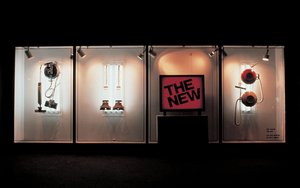
Jeff Koons’s window installation The New for the New Museum’s Window Series, New York, May 29–June 19, 1980. Artwork © Jeff Koons
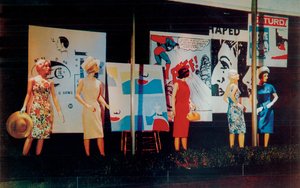
Five paintings by Andy Warhol in a Bonwit Teller window display designed by Clinton Hamilton, New York, April 1961. Artwork © The Andy Warhol Foundation for the Visual Arts, Inc./Artists Rights Society (ARS), New York. Photo: Nathan Gluck © Estate of Nathan Gluck. Courtesy of Luis De Jesus Los Angeles
In April 1961, Warhol installed five proto-Pop paintings as backdrops for women’s clothing; this knowing play on the adjacencies among the worlds of commerce and art would radically reroute the course of American art in the coming years as the 1960s Pop art movement exploded into the art world. Yet whereas Warhol’s presentation expressed ambiguity about art’s commodity status, as suggested by his hand-painted versions of advertisements and comic book imagery, Koons’s The New series signaled a new approach by consciously eroding the distinctions between art and commodity. Koons’s decision to take objects and images directly from the manufactured world, and to place them in museum windows using strategies of display for commercial goods, rather breathtakingly embodied the nouveau-riche fetishization of consumerism dominating the so-called “greed” decade during which these works were made.
New! New Too! features an example from a print advertising campaign for canned alcoholic cocktails by the brand The Club that were in circulation around 1983. The premise, replicated in Koons’s lithographic billboard, centers on two cans of tonic cocktails (one with gin, the other vodka) resting within a field of ice. Set against a crisp blue background, the scene takes on an almost glacial appearance, with the pair of beverages anthropomorphically serving as the ad’s protagonists, forever frozen in time.
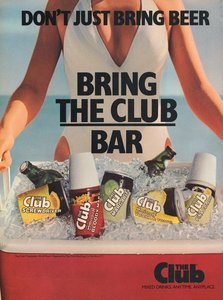
Vintage print advertisement for The Club canned cocktails, c. 1983
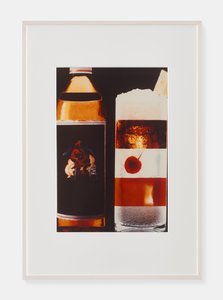
Richard Prince, Untitled, 1983, Ektacolor photograph, 24 × 20 inches (61 × 50.8 cm), edition 1/2 © Richard Prince. Photo: Prudence Cuming Associates Ltd
Like Richard Prince’s isolation of advertising images for Johnny Walker whiskey in his contemporaneous rephotographs from the early 1980s, here Koons focuses on the short but thoroughly effective declaration of “New! New Too!” Notably, all the advertisement-based works in The New series contain the word “new,” as seen in New Rooomy Toyota Family Camry (1983). New! New Too! is the best-known and most important example of The New advertisements, having been exhibited in the highly influential 1986 exhibition Damaged Goods: Desire and the Economy of the Object at the New Museum in New York, and most recently, in Brand New: Art and Commodity in the 1980s at the Hirshhorn Museum and Sculpture Garden in Washington, DC, in 2018.
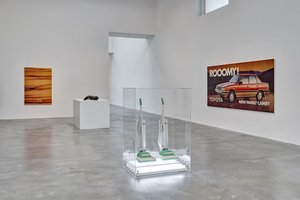
Jeff Koons’s New Rooomy Toyota Family Camry (1983; right) in Jeff Koons: Now, Newport Street Gallery, London, May 18–October 16, 2016. Artwork © Jeff Koons. Photo: Prudence Cuming Associates Ltd
What unites the varied pieces comprising The New series is how Koons takes objects and images out of circulation from the commercial world, sets them into suspension, and then returns them to the world of commerce in this new art context. New! New Too! poetically conveys the often-futile attempt to hold onto the present, and the deeply human yearning for immortality. The work therefore serves as an expression of desire as much as a statement of fact, as if declaring something’s newness might offset its eventual inconsequentiality.
Robert Rosenblum, famed American art historian, once compared the revolutionary nature of Koons’s work from the 1980s to that of art world titan Jasper Johns, declaring in 1993 that “Koons is certainly the artist who has most upset and rejuvenated my seeing and thinking in the last decade.” Beyond this shared conceptual influence, the subject matter in New! New Too! notably connects Koons to Johns, particularly in his cast-bronze Ballantine Ale beer cans.
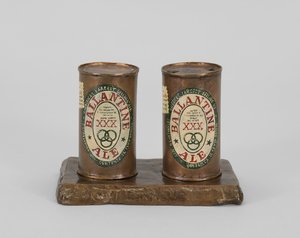
Jasper Johns, Painted Bronze, 1960 (cast and painted 1964), bronze and oil paint, in 3 parts, overall: 5 ½ × 8 × 4 ½ inches (14 × 20.3 × 11.4 cm), Whitney Museum of American Art, New York © Jasper Johns/Licensed by VAGA at Artists Rights Society (ARS), New York. Photo: Whitney Museum of American Art/Licensed by Scala/Art Resource, New York
The focus on a consumer beverage would importantly continue in Koons’s work, such as in the Luxury and Degradation series (1986), which explores how the marketing of alcohol as a coveted commodity in America is tied to cultural ideas around sex, wealth, success, leisure, and sophistication. This idea of consumer optimization—getting, and indeed becoming, the newest, latest, fastest, best—was first investigated by Koons in The New works, and particularly in the present example, which shrewdly points out the specious cultivation of desire for two almost indistinct commodities.
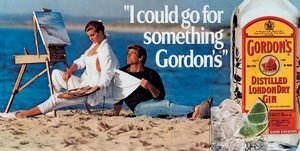
Jeff Koons, I Could Go for Something Gordon’s, 1986, oil inks on canvas, 45 × 86 ½ inches (114.3 × 219.7 cm), edition of 2 + 1 AP © Jeff Koons. Photo: Douglas M. Parker Studio
The new, like the perfect, is an endlessly receding horizon, which will always remain out of reach. It is this gap, between the wished for and the real, in which Jeff Koons’s work truly sits.
Still, there is an intriguing complexity to Koons’s work à la Warhol in being neither fully complicit in, nor entirely critical of, the seductive image world of consumer desire. The outward veneer of perfection in New! New Too! is aspirational and sexy, but still harbors a knowing sense of obsolescence underlying its breezy enthusiasm. As Frieze magazine critic Chris Wiley observes, “The new, like the perfect, is an endlessly receding horizon, which will always remain out of reach. It is this gap, between the wished for and the real, in which Jeff Koons’s work truly sits. . . . Scratch the perfect surfaces and you’ll find what makes his work so sad, and so good.”
The Summer 2026 issue of Gagosian Quarterly is now available, featuring Ellen Gallagher’s Fast-Fish and Loose-Fish (2026) on the cover.

In this video, Jenny Saville sits down inside her first major exhibition in Venice to discuss how the great Venetian artists of the past and the city’s heritage influence her work. The show brings together more than thirty canvases and works on paper from the 1990s to the present, tracing the development of her practice, which is deeply rooted in the history of painting.
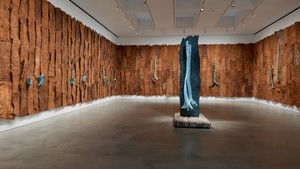
On the occasion of his exhibition The Reflection of Bronze at Gagosian, New York, Giuseppe Penone and curator Adam D. Weinberg sit down to discuss the genesis of, and their collaboration on, the show.
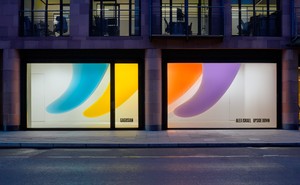
Ahead of Alex Israel’s exhibition of four new Fin sculptures at Gagosian, London, the artist spoke with Susan Casey, author of The Wave: In Pursuit of the Rogues, Freaks, and Giants of the Ocean (2010), about the ocean, surfing, and Los Angeles.
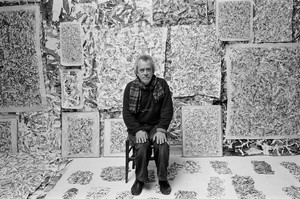
On July 9, Simon Hantaï: the last studio opens at Gagosian, Gstaad. Curated by Anne Baldassari, the show comprises sixteen of the artist’s dernier atelier (last studio) paintings of 1982–85. The exhibition is accompanied by an illustrated catalogue, copublished by Gagosian and Skira, which features an essay by Baldassari and an extensive portfolio of previously unpublished photographs by Édouard Boubat. Here, we share the introductory chapter from the publication.
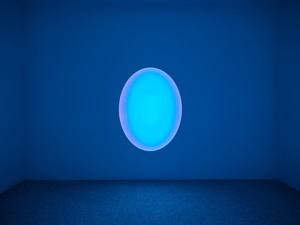
An exhibition at Gagosian, Hong Kong, brings together three of James Turrell’s Glasswork pieces along with site plans, photographs, and models of his Skyspaces and Roden Crater. Here, Alice Godwin explores the history of the Glassworks and their relationship to the artist’s wider practice.

On April 16, the Institute of Contemporary Art, Boston, opened the first midcareer survey of Derrick Adams’s multidisciplinary practice. Covering over twenty years of work, the exhibition, titled View Master, brings together the artist’s painting, sculpture, collage, performance, and video, as well as a vibrant new commission created for the museum’s façade. Ahead of the opening, Adams met with Tessa Bachi Haas, cocurator of the survey, to discuss his formative experiences with television, the impact of his work in arts education on his practice, and the importance of taking a more complex, more joyful, and more expansive approach to Black American life and culture.

Adam D. Weinberg has been working with Giuseppe Penone on an exhibition of the artist’s new sculptures, The Reflection of Bronze, that opens at Gagosian, New York, on April 22. The works explore the character and possibilities of bronze. Here, Weinberg considers Penone’s enduring engagement with the alloy and addresses the conceptual underpinnings of the exhibition’s three-room structure.

Jeff Koons tells Alison McDonald about his appreciation for the pioneering artist and thinker Marcel Duchamp.
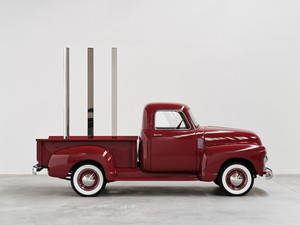
The Singular Experience at Gagosian’s Le Bourget gallery is the largest exhibition of Walter De Maria’s work in France in several decades. Organized by Donna De Salvo, senior adjunct curator at Dia Art Foundation, the exhibition marks the first time De Maria’s final sculpture, Truck Trilogy (2011–17), is being shown outside of the United States. Here, De Salvo speaks with artist Lucy Raven about her evolving kinship with De Maria and more.
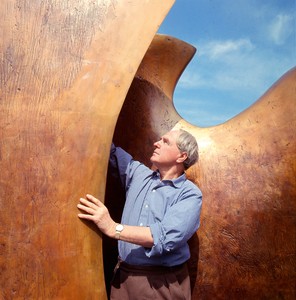
Laura Bruni writes about a major exhibition celebrating the work of the British sculptor Henry Moore at the Royal Botanic Gardens, Kew, London.
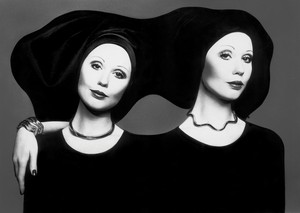
The exhibition Pomellato, Le Joaillier Révolutionnaire opened at Palais de Tokyo, Paris, on June 24. The Italian jewelry house’s trailblazing advertising campaigns—created by some of the most consequential names in photography—act as the narrative arc of the exhibition, curated by Alba Cappellieri. Here, Sarah Godfrey tracks Pomellato’s history, speaks with Cappellieri about what drew her to this project, and examines some of the key photographs from the show.


