Myth-Maker
Alexander Wolf explores the economic, social, and methodological concerns of Piero Golia’s art practice, revealing the real-world implications of the artist’s experiments with form and process.
Piero Golia’s Still Life (Rotating device) (2024) is featured in the Unlimited section at Art Basel 2025.
The installation offers an immersive escape from the surrounding world, a moment of reprieve from the bustling fair via the lush sensation of walking through heavy curtains onto soft carpet. Beyond this portal, viewers are confronted by a whirl of oversaturated color and the clanking sounds of a ball that continuously and unpredictably jumps around the roulette wheel, never coming to rest. An object of eternally unresolved expectation, Still Life (Rotating device) exists in a world that is so gamified as to offer no winner—only the opportunity to watch, reflect, and carry on.
Piero Golia’s Still Life (Rotating device) (2024) installed at Art Basel Unlimited 2025. Artwork © Piero Golia. Video: Pushpin Films

Still Life (Rotating device), 2024
Decommissioned roulette wheel, motor, and marble
38 × 64 × 64 inches (96.5 × 162.6 × 162.5 cm)
Piero Golia’s installation Still Life (Rotating device) (2024) suspends the euphoric moment when anything and everything is possible. Exhibited for the first time in the Unlimited sector of Art Basel 2025, the work centers on a decommissioned casino roulette wheel that has been modified so that it spins ceaselessly, never allowing its ball to fall upon a winning number. Through Golia’s singular vision, the anticipatory moment—before our hopes and dreams are realized (or abandoned) by fate—remains in continuous deferral.
Rather than exhibiting a single painting or sculpture at the prestigious presentation of monumental works at Art Basel Unlimited, the artist instead conceived of his immersive installation as a proposition: to create a conceptual “piece” of reality. Upon entering the space through crimson velour curtains and then experiencing the plush scarlet-hued rug and matching walls, the viewer is transported to an alternate world where time seems not to unfold linearly but to turn onto itself in an eternal loop.
Since moving to the United States from Italy, Golia began playing roulette regularly. He started in the casinos of Atlantic City, traveling from Chinatown in lower Manhattan, and later made frequent sojourns to Las Vegas from his Los Angeles home. Golia was drawn to both the meticulous construction of the game’s pieces, as well as its logic and strategy. The sumptuously lacquered roulette wheel is divided into numbered compartments which are further allocated into red and black color ways—all components that can be gambled upon to place a winning bet.

Piero Golia, Still Life (Rotating device), 2024 (detail) © Piero Golia. Photo: Josh White
Recurrence is the closest experience we can have of eternity.
Gambling is, in the artist’s mind, about discipline rather than pure luck; the patterns of the game can be rationalized, learned, and understood. This notion of making sense of repetitions likely stems from the artist’s early training in chemical engineering, a field of study that transforms raw materials into usable products. By engineering the roulette wheel so the ball remains in perpetual, but consistently erratic rotation, Golia subverts the principles of the game so that there are no winners or losers. As intended by the artist, this gesture grips the audience in a state of absolute potentiality.
For Golia, gambling—like art—explores the relationship between faith and chance, a theme that he has touched upon repeatedly throughout his career. He has made sculptures and paintings based on the material remains from actual car accidents, and has incorporated participatory or improvisational elements in works as varied as Luminous Sphere (2010), a light situated on the roof of the Standard Hotel in Los Angeles that turns on only when the artist is in town, and The Painter (2016), a robotic apparatus rigged to make painterly marks on a canvas based on the presence of a viewer moving through an exhibition space.

Piero Golia, Constellation Painting #5, 2011, resin and debris, 60 × 48 × 9 inches (152.4 × 121.9 × 22.9 cm) © Piero Golia. Photo: Josh White

Piero Golia, Luminous Sphere, 2010, installation view, The Standard, West Hollywood, California © Piero Golia. Photo: Josh White

Piero Golia, The Painter, 2016, motion-controlled robot, canvas, acrylic paint, tape, and plastic bins, overall dimensions variable © Piero Golia. Photo: Daniele Molajoli
In a 2008 interview, Golia referenced the French Enlightenment–era philosopher Blaise Pascal, who famously described the notion of faith as a gamble. While Pascal discusses risk in terms of religious belief, Golia links the concept to his art making; he often creates situations in which a live element can open up the work to unplanned outcomes. Speaking about his practice, Golia has noted, “it is only about chance. It’s the life of a gambler. If I make it, I make it big.” In staging an everlasting moment of anticipation in Still Life (Rotating device), the artist creates a perspective-altering impact for the viewer—monumental in its ability to transform our perception of the world around us. “Monumentality has something to do with time and eternity. Art should be monumental,” he has slyly asserted.

Jean Tinguely, Méta-matic No. 9, 1958, round rubber belt, steel rods, painted sheet metal, wire and wood pulleys, clothes pins, and electric motor, 35 ½ × 56 ⅝ × 14 ¼ inches (90.2 × 143.8 × 36.2 cm), Museum of Fine Arts, Houston © 2025 Artists Rights Society (ARS), New York/ADAGP, Paris
Although Golia acknowledges the influence of Italian artist Gino De Dominicis—whose work engages with themes of eternity and immortality—the present installation contains several elements that can be contextualized among iconic art historical works by Jean Tinguely and Jasper Johns, for instance. The kinetic element of Still Life (Rotating device) puts the work in dialogue with similarly dynamic examples from art history. From Tinguely’s mechanical Métamatics to Alexander Calder’s mobiles, the introduction of movable elements into the typically stationary domain of art takes on a poetic resonance in Golia’s work, which never ceases its motion.
The work’s subtitle of “Rotating device” might also invite comparisons with Johns’s motif-cum-strategy of the “device,” a key element of his acclaimed work from the 1960s. Just as Johns began taking a mechanical arm (like a ruler) as a device to autonomously manipulate paint in an arc-like or circular shape, Golia can be seen to set that concept into motion, creating the same blurred effect as in Johns’s painting but here kinetically charged in real time.

Jasper Johns, Device, 1961–62, oil on canvas with wood and metal attachments, 72 ⅛ × 48 ¾ × 4 ½ inches (180.7 × 123.8 × 11.4 cm), Dallas Museum of Art © Jasper Johns and Gemini G.E.L./Licensed by VAGA at Artists Rights Society (ARS), New York. Photo: courtesy Dallas Museum of Art
Yet it is perhaps most intriguing that Marcel Duchamp—the Dada progenitor of concept-based art and one of Golia’s artistic heroes—had himself become quite interested in the game of roulette exactly a century earlier, creating an entire work on the subject. By 1924, Duchamp had famously cast off the art world and reinvented himself in the casinos of Monaco, where he claimed to have devised a winning strategy for gambling at the roulette tables. Long interested in notions of chance, Duchamp was so confident in the guaranteed outcome that he began creating and selling bonds related to his gambling. Part artwork and part speculation, the Monte Carlo Bond (1924; reissued 1938) featured an image of Duchamp himself, covered in soap suds, positioned in front of a roulette wheel.

Marcel Duchamp, Monte Carlo Bond (No. 12), 1924, cut-and-pasted gelatin silver prints on lithograph with letterpress, 12 ¼ × 7 ½ inches (31.2 × 19.31 cm), Museum of Modern Art, New York © 2025 Artists Rights Society (ARS), New York/ADAGP, Paris/Estate of Marcel Duchamp. Photo: © The Museum of Modern Art/Licensed by SCALA/Art Resource, NY
Putting a new spin on Duchamp’s Monte Carlo Bond, in the present work Golia removes the prospective nature of gambling to instead explore the experience of unrelenting thrills and sustained desire. Similar notions of chance and speculation appear in several of Golia’s earlier works, such as Untitled (My Gold is Yours) (2013), which was exhibited in the 2013 Biennale di Venezia (where he represented his native country of Italy). In this participatory sculpture, Golia encased nearly two kilograms of gold dust within a massive concrete block. The audience eventually realized that they could procure these valuable fragments by chiseling the sculpture, thereby becoming actively involved in the transformation of the work’s physical form through the act of mining.

Piero Golia, Untitled (My Gold Is Yours), 2013, gold and concrete, 98 ¼ × 98 ¼ × 98 ¼ inches (249.4 × 249.4 × 249.4 cm), installation view, 55th Biennale di Venezia © Piero Golia
While in Venice, Golia allowed the public to shape the sculpture; for Art Basel Unlimited, however, he made a series of deliberate aesthetic decisions essential to constructing a specific environment. The entirely red room, accessed through a curtained entrance, evokes the portal-like “Red Room” from David Lynch’s iconic television series Twin Peaks. Within the show’s mythology, this crimson chamber functions as a liminal zone—a “waiting room” where good and evil intermingle and temporal logic breaks down. Whether this reference is intentional or merely coincidental, the atmospheric parallels between Golia’s scarlet installation and Lynch’s surreal, psychologically charged world are striking. Both conjure realms untethered from conventional space and time.
Golia’s piece is deeply romantic and poetic, and yet, his reference to the still life genre in the title is characteristic of his signature wit and humor. At first glance, the perpetual motion of the spinning wheel appears wholly incompatible with the classical still life, that venerable genre devoted to bowls of fruit, wilting flowers, and other objects steadfastly committed to inertia. Yet, the roulette wheel—ever in motion—ironically conjures a conceptual still life of its own, one predicated not on physical stasis but on a suspension of time itself. In this version, the fruit doesn’t rot, it waits . . . endlessly.
Though it holds us in time, Golia’s Still Life (Rotating device) does not tether us to any singular moment. Instead, it captures us in a unique temporal threshold—that charged pause of expectation—by embodying the emotional rapture of the game itself. Through this haunting installation, Golia masterfully stages the extravagant allure of imagined triumphs, the kind that flicker when one makes a gamble. Sensual and idealistic, Still Life (Rotating device) offers its audience a rare and otherwise impossible experience—one sculpted from the relentless passage of time itself, and held, if only for a moment, in exquisite suspension.

Piero Golia, Still Life (Rotating device), 2024 (detail) © Piero Golia. Photo: Josh White
Alexander Wolf explores the economic, social, and methodological concerns of Piero Golia’s art practice, revealing the real-world implications of the artist’s experiments with form and process.
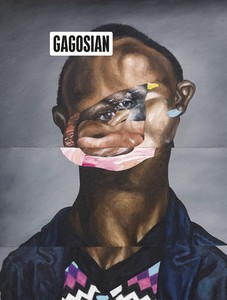
The Fall 2019 issue of Gagosian Quarterly is now available, featuring a detail from Sinking (2019) by Nathaniel Mary Quinn on its cover.
Andrew Berardini reflects on Piero Golia’s Intermission Paintings, relics from the first phase of the artist’s three-part sculptural performance The Comedy of Craft.

The Summer 2026 issue of Gagosian Quarterly is now available, featuring Ellen Gallagher’s Fast-Fish and Loose-Fish (2026) on the cover.

In this video, Jenny Saville sits down inside her first major exhibition in Venice to discuss how the great Venetian artists of the past and the city’s heritage influence her work. The show brings together more than thirty canvases and works on paper from the 1990s to the present, tracing the development of her practice, which is deeply rooted in the history of painting.
On the occasion of his exhibition The Reflection of Bronze at Gagosian, New York, Giuseppe Penone and curator Adam D. Weinberg sit down to discuss the genesis of, and their collaboration on, the show.
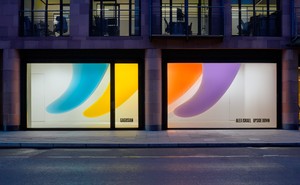
Ahead of Alex Israel’s exhibition of four new Fin sculptures at Gagosian, London, the artist spoke with Susan Casey, author of The Wave: In Pursuit of the Rogues, Freaks, and Giants of the Ocean (2010), about the ocean, surfing, and Los Angeles.
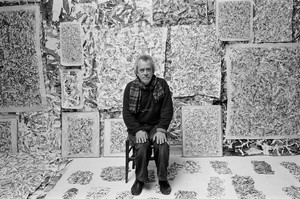
On July 9, Simon Hantaï: the last studio opens at Gagosian, Gstaad. Curated by Anne Baldassari, the show comprises sixteen of the artist’s dernier atelier (last studio) paintings of 1982–85. The exhibition is accompanied by an illustrated catalogue, copublished by Gagosian and Skira, which features an essay by Baldassari and an extensive portfolio of previously unpublished photographs by Édouard Boubat. Here, we share the introductory chapter from the publication.
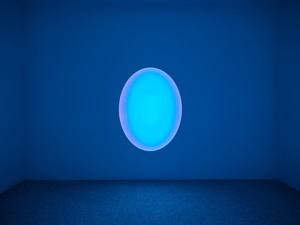
An exhibition at Gagosian, Hong Kong, brings together three of James Turrell’s Glasswork pieces along with site plans, photographs, and models of his Skyspaces and Roden Crater. Here, Alice Godwin explores the history of the Glassworks and their relationship to the artist’s wider practice.

On April 16, the Institute of Contemporary Art, Boston, opened the first midcareer survey of Derrick Adams’s multidisciplinary practice. Covering over twenty years of work, the exhibition, titled View Master, brings together the artist’s painting, sculpture, collage, performance, and video, as well as a vibrant new commission created for the museum’s façade. Ahead of the opening, Adams met with Tessa Bachi Haas, cocurator of the survey, to discuss his formative experiences with television, the impact of his work in arts education on his practice, and the importance of taking a more complex, more joyful, and more expansive approach to Black American life and culture.

Adam D. Weinberg has been working with Giuseppe Penone on an exhibition of the artist’s new sculptures, The Reflection of Bronze, that opens at Gagosian, New York, on April 22. The works explore the character and possibilities of bronze. Here, Weinberg considers Penone’s enduring engagement with the alloy and addresses the conceptual underpinnings of the exhibition’s three-room structure.

Jeff Koons tells Alison McDonald about his appreciation for the pioneering artist and thinker Marcel Duchamp.


