
Now available
Gagosian Quarterly Summer 2026
The Summer 2026 issue of Gagosian Quarterly is now available, featuring Ellen Gallagher’s Fast-Fish and Loose-Fish (2026) on the cover.
Gagosian is presenting Martin Kippenberger’s METRO-Net Transportabler U-Bahn Eingang (METRO-Net Transportable Subway Entrance) (1997) at Art Basel Unlimited 2025.
Kippenberger conceived of METRO-Net, his final series, as a globe-spanning subway system. Constructed at full scale, these fake subway entrances and ventilation shafts have been installed at sites worldwide—including Syros, Greece (1993), Dawson City, Canada (1995), Leipzig, Germany (1997), Münster, Germany (1997), New York (1997), and Los Angeles (1998)—establishing a conceptual network of interconnected transportation stations. Unveiled in 1997 at Documenta X in Kassel, Germany, shortly after the artist’s untimely death, METRO-Net Transportabler U-Bahn Eingang (METRO-Net Transportable Subway Entrance), comprises a stairway that has been constructed at an angle to the ground rather than descending straight down, and which leads to a large locked gate, presenting the illusion of access denied. The faux portal epitomizes Kippenberger’s characteristic blend of quixotic humor and critique of the grand promises of progress and globalization.
Martin Kippenberger’s METRO-Net Transportabler U-Bahn Eingang (METRO-Net Transportable Subway Entrance), (1997) installed at Art Basel Unlimited 2025. Artwork © Estate of Martin Kippenberger, Galerie Gisela Capitain, Cologne. Video: Pushpin Films

METRO-Net Transportabler U-Bahn Eingang (METRO-Net Transportable Subway Entrance), 1997
Steel and lacquer
11 feet 3 ⅛ feet × 24 feet 7 ¼ inches × 8 feet 4 inches
(343 × 750 × 254 cm)
In 1993, Martin Kippenberger inaugurated the first work in his METRO-Net World Connection project, an expansive and idealistic vision of a linked subway system that spanned the globe. As an extraordinarily rare example from this body of work, Gagosian’s presentation of METRO-Net Transportabler U-Bahn Eingang (METRO-Net Transportable Subway Entrance) (1997) at Art Basel Unlimited in 2025 marks a unique opportunity to join this important postwar artist’s network, both real and imagined. One of only two non-site-specific subway entrances he ever created (the other is in the permanent collection of the Museum of Modern Art in New York), Kippenberger’s Transportabler U-Bahn Eingang conveys a grand and poetic longing for interconnection. Yet it also maintains the artist’s characteristic cynicism regarding the feasibility of such utopian aspirations. Conceived shortly before Kippenberger’s untimely death in March 1997, this sculpture is one of the last ever pieces that he worked on in his lifetime.
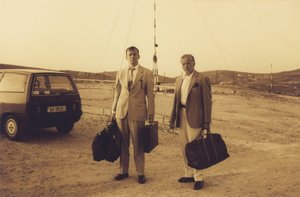
Martin Kippenberger and Michel Würthle, Syros, Greece, c. 1993. Photo: photographer unknown, courtesy Estate of Martin Kippenberger, Galerie Gisela Capitain, Cologne
In 1992, while on an extended retreat at the family home of his friend Michel Würthle on the Greek island of Syros, Kippenberger envisaged one of the most important, emblematic, and wide-ranging projects of his career. Rather than luxuriating in his coastal surroundings, the artist was inspired by the distant locale to develop the METRO-Net World Connection project. This elaborate endeavor comprised multiple full-scale simulated subterranean subway entrances and later, ventilation shafts, which the artist installed in sites ranging from the far-flung Arctic town of Dawson City, Canada, to the German city of Leipzig. Despite the optimistic tenor behind the concept of creating a global community through art, METRO-Net notably emerged from Kippenberger’s idea of “unsinnige Bauvorhaben” (“senseless building projects”) and contains one extremely unusual feature. All five of the subway entrances that Kippenberger built led to impenetrable locked gates or doors. This impasse powerfully represents the theoretical nature of Kippenberger’s concept, a passage that culminates in a dead end.
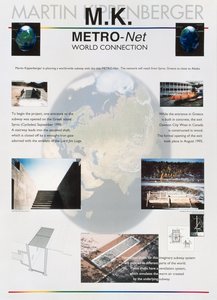
Martin Kippenberger and Lukas Baumewerd, METRO-Net Poster, 1995 © Lukas Baumewerd and Estate of Martin Kippenberger, Galerie Gisela Capitain, Cologne
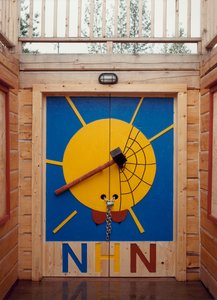
Padlocked doors of Martin Kippenberger’s METRO-Net Subway Entrance Dawson City (1995) in Dawson City, Canada. Artwork © Estate of Martin Kippenberger, Galerie Gisela Capitain, Cologne. Photo: © Albrecht Fuchs
Initially Kippenberger developed several permanent, site-specific entrances, customized using the architectural vernacular and local materials from the place in which each is situated. In September 1993, the first entrance opened on Würthle’s property in Syros. It comprised a concrete stairway leading underground to a cast iron gate marked with the emblem for the Lord Jim Lodge, a secret society cofounded in the mid-1980s by Kippenberger with fellow artists Wolfgang Bauer, Albert Oehlen, and Jörg Schlick.
Two years later, Kippenberger created a wood version of the METRO-Net subway entrance near a friend’s hotel in Dawson City, which featured not only the Lord Jim Lodge motif, but also the letters “NHN,” shorthand for the Lodge’s motto, “Nobody Helps Nobody.” In late 1995, Kippenberger began work on a third in-situ subway entrance for the Leipzig Trade Fairgrounds, which opened in 1997. Notably, none of the locations in which he built subway entrances have actual underground subways in operation, further emphasizing the strictly symbolic and artistic nature of his project.
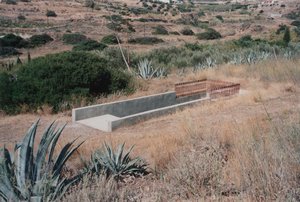
Martin Kippenberger’s METRO-Net Subway Entrance Syros (1993) in Syros, Greece. Artwork © Estate of Martin Kippenberger, Galerie Gisela Capitain, Cologne. Photo: Michel Würthle Archive, Berlin
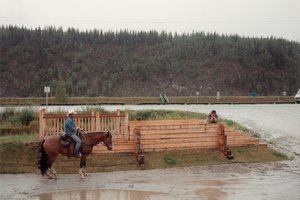
Martin Kippenberger’s METRO-Net Subway Entrance Dawson City (1995) in Dawson City, Canada. Artwork © Estate of Martin Kippenberger, Galerie Gisela Capitain, Cologne. Photo: © Albrecht Fuchs
You don’t have to go into a museum, it’s out there in the street. All these things make you want to piece together your own world, but one that’s fun.
In 1997, on the occasion of his forthcoming inclusion in Documenta X, the prestigious contemporary art exhibition in Kassel, Germany, Kippenberger developed a new, transportable version of the project that allowed for infinite installation possibilities. Meticulously planned, this iteration (the present work), unlike its predecessors, was entirely detached from the ground—granting access to Kippenberger’s imaginary underground network from any point in the world.
The Transportabler U-Bahn Eingang therefore marks an important evolution of Kippenberger’s initial concept. This imaginative and visually stunning work contains all the key components: a descending staircase, safety railings, and other conventions of public transport. At the bottom of the stairs is a padlocked chain and a plaque that reads “Eintritt verboten” (“Entry prohibited”). Beyond stands a grand ornamental locked gate adorned with the emblem of the Lord Jim Lodge, incorporating three symbols: the sun, breasts, and a hammer.
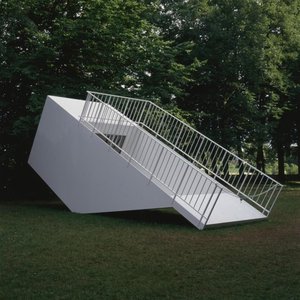
Martin Kippenberger, METRO-Net Transportable Subway Entrance, 1997, installation view, Documenta X, Kassel, Germany © Estate of Martin Kippenberger, Galerie Gisela Capitain, Cologne. Photo: Christofer Jägerfeld © documenta archiv
As seen in renderings, the artist initially imagined installing the sculpture on the water, partially submerged in Kassel’s Fulda River like a barge. With the help of engineers, Kippenberger successfully designed the construction to float; ultimately, however, by November 1996 the artist and Documenta staff agreed to instead place the work on a nearby river embankment. Exhibited in this manner, with no subterranean aspects, the sides and other previously unseen elements of the sculpture become fully visible, allowing the artist’s complete design and concept to be grasped.
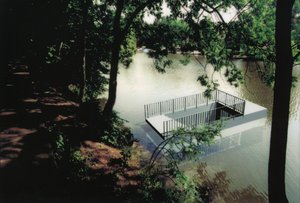
CAD simulation of the first version of Martin Kippenberger’s METRO-Net, Transportable Subway Entrance for Documenta X. Artwork © Lukas Baumewerd and Estate of Martin Kippenberger, Galerie Gisela Capitain, Cologne
Constructed in lacquered steel, Kippenberger’s Transportabler U-Bahn Eingang on view at Art Basel Unlimited closely resembles the first permanent sculpture from this project in Syros, with the added feature of being able to be installed indoors or outdoors, based on the owner’s preferences. The second, aluminum version of Transportabler U-Bahn Eingang from the METRO-Net project was first shown at New York’s Metro Pictures in 1997. However, due to size constraints, the work had to be crushed to fit into the gallery, and therefore, while approved, this METRO-Net Transportable Subway Entrance (Crushed) (1997) is not original to the artist’s initial plans.
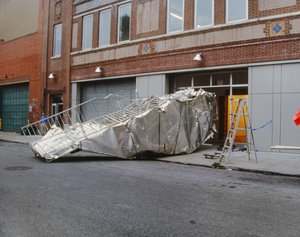
Martin Kippenberger’s METRO-Net Transportable Subway Entrance (Crushed) (1997) outside of Metro Pictures, New York, 1997. Artwork © Estate of Martin Kippenberger, Galerie Gisela Capitain. Photo: Elfie Semotan © Studio Semotan
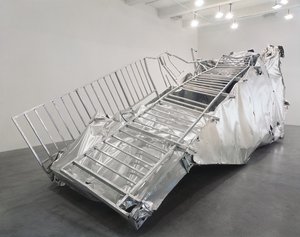
Martin Kippenberger, METRO-Net Transportable Subway Entrance (Crushed), 1997, aluminum, 9 feet 6 ¾ inches × 8 feet ½ inch × 27 feet 3 inches (291.5 × 245.1 × 829 cm), Museum of Modern Art, New York, installation view, Metro Pictures, New York, 1997 © Estate of Martin Kippenberger, Galerie Gisela Capitain, Cologne. Photo: photographer unknown, courtesy Estate of Martin Kippenberger, Galerie Gisela Capitain, Cologne
In addition to the subway entrances, Kippenberger also conceived of an adjacent aspect of the METRO-Net project: a set of oversize ventilation shafts, which would simulate the gusts of air and sounds made from trains passing underground. Initially planned for Tokyo, one of these was realized in 1998 at the famed Schindler House in Los Angeles, owned by the MAK Center for Art and Architecture. A fully above-ground iteration of the ventilation shaft was presented at the renowned Skulptur Projekte Münster in Germany in 1997.
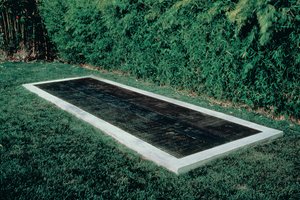
Martin Kippenberger, METRO-Net Transportable Ventilation Shaft, 1998, installation view, MAK Center for Art and Architecture, Schindler House, Los Angeles © Estate of Martin Kippenberger, Galerie Gisela Capitain, Cologne. Photo: Josh White
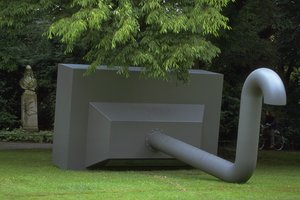
Martin Kippenberger, METRO-Net Transportable Ventilation Shaft, 1997, installation view, Skulptur Projekte Münster, 1997 © Estate of Martin Kippenberger, Galerie Gisela Capitain, Cologne. Photo: Roman Mensing www.romanmensing.de
Visionary and conceptual, the METRO-Net project is interpreted by some scholars as expressing utopian ambitions, in line with modernist architectural designs. The introduction of a transportable element for the subway entrance emblematizes Kippenberger’s own nomadic lifestyle. He traveled incessantly, and his work reflects this itinerancy; an example is his Hotel Drawings made on stationery from the countless hotels that he made his temporary home over the years.
Created at a time before the Internet established an online “global village,” Kippenberger’s project is ambitious, emphasizing the basic human longing to connect with others. In context, during the early 1990s, artists such as Rirkrit Tiravanija and Felix Gonzalez-Torres were concurrently creating participatory, community-oriented works, often staged in public spaces to foster social relations. Growing up in a divided Germany, however, Kippenberger was skeptical of grand promises of progress and unity. His “entrances” do not lead anywhere, forever remaining at an impasse.
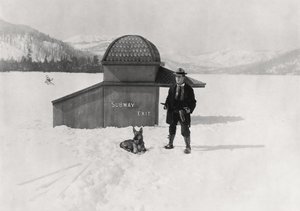
Postcard featuring a film still from The Frozen North (1922) starring Buster Keaton. Courtesy Cohen Film Collection LLC
As seen in the varied ephemera amassed by the artist while developing the METRO-Net series, Kippenberger drew inspiration from multiple cultural sources, weaving together cinematic and mythological allusions. For instance, he collected a postcard of Buster Keaton’s 1922 film The Frozen North, which, in its opening scene, features an isolated subway entrance emerging absurdly from deep snow in Alaska—a parallel to the METRO-Net’s concept of disconnected transport hubs in remote locations. He also amassed images of staircases leading to crypts in religious buildings, as well as drawings made after the iconic photograph of Marilyn Monroe from The Seven Year Itch (1955) standing in a billowing white halter dress over a subway grate. The imagery of stairways leading underground also evokes the Greek myth of Orpheus, who descended into the underworld to save his wife Eurydice.
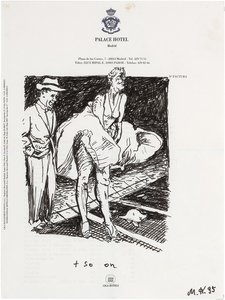
Martin Kippenberger, Untitled (Seven Year Itch), 1995, felt-tip pen on hotel stationary (Palace Hotel), 11 ¾ × 8 ¼ inches (29.7 × 21 cm), Kramlich Collection © Estate of Martin Kippenberger, Galerie Gisela Capitain, Cologne. Photo: courtesy Kramlich Collection
While Kippenberger was extensively involved in the design and planning for this work, he did not live to see its completion. As such, METRO-Net Transportabler U-Bahn Eingang assumes a symbolic dimension, allowing the enigmatic artist’s complex vision to live on by transporting our imaginations on journeys far and wide, perpetuating his network. With artists such as Richard Prince to Damien Hirst citing his tremendous influence on their work, Kippenberger’s impact on contemporary art is yet another way in which his ideas continue in his absence. METRO-Net Transportabler U-Bahn Eingang therefore serves as both a monument and a provocation—an important work in Kippenberger’s final major series that remains one of the most compelling artistic meditations on modern urban life and the anxieties it engenders.
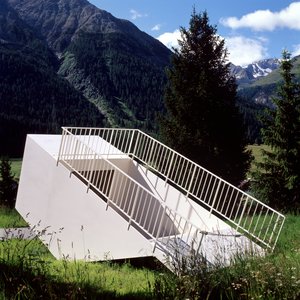
Martin Kippenberger, METRO-Net Transportable Subway Entrance, 1997, installation view, Zuoz, Switzerland © Estate of Martin Kippenberger, Galerie Gisela Capitain, Cologne. Photo: Patrizia Karda
The Summer 2026 issue of Gagosian Quarterly is now available, featuring Ellen Gallagher’s Fast-Fish and Loose-Fish (2026) on the cover.

In this video, Jenny Saville sits down inside her first major exhibition in Venice to discuss how the great Venetian artists of the past and the city’s heritage influence her work. The show brings together more than thirty canvases and works on paper from the 1990s to the present, tracing the development of her practice, which is deeply rooted in the history of painting.
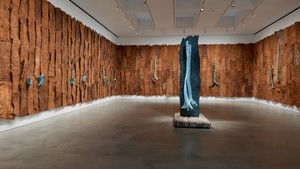
On the occasion of his exhibition The Reflection of Bronze at Gagosian, New York, Giuseppe Penone and curator Adam D. Weinberg sit down to discuss the genesis of, and their collaboration on, the show.
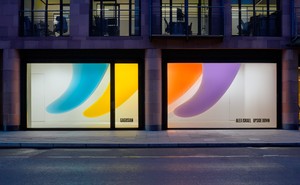
Ahead of Alex Israel’s exhibition of four new Fin sculptures at Gagosian, London, the artist spoke with Susan Casey, author of The Wave: In Pursuit of the Rogues, Freaks, and Giants of the Ocean (2010), about the ocean, surfing, and Los Angeles.
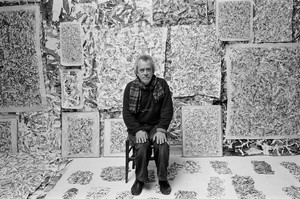
On July 9, Simon Hantaï: the last studio opens at Gagosian, Gstaad. Curated by Anne Baldassari, the show comprises sixteen of the artist’s dernier atelier (last studio) paintings of 1982–85. The exhibition is accompanied by an illustrated catalogue, copublished by Gagosian and Skira, which features an essay by Baldassari and an extensive portfolio of previously unpublished photographs by Édouard Boubat. Here, we share the introductory chapter from the publication.
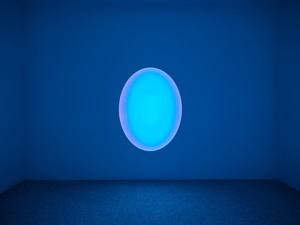
An exhibition at Gagosian, Hong Kong, brings together three of James Turrell’s Glasswork pieces along with site plans, photographs, and models of his Skyspaces and Roden Crater. Here, Alice Godwin explores the history of the Glassworks and their relationship to the artist’s wider practice.

On April 16, the Institute of Contemporary Art, Boston, opened the first midcareer survey of Derrick Adams’s multidisciplinary practice. Covering over twenty years of work, the exhibition, titled View Master, brings together the artist’s painting, sculpture, collage, performance, and video, as well as a vibrant new commission created for the museum’s façade. Ahead of the opening, Adams met with Tessa Bachi Haas, cocurator of the survey, to discuss his formative experiences with television, the impact of his work in arts education on his practice, and the importance of taking a more complex, more joyful, and more expansive approach to Black American life and culture.

Adam D. Weinberg has been working with Giuseppe Penone on an exhibition of the artist’s new sculptures, The Reflection of Bronze, that opens at Gagosian, New York, on April 22. The works explore the character and possibilities of bronze. Here, Weinberg considers Penone’s enduring engagement with the alloy and addresses the conceptual underpinnings of the exhibition’s three-room structure.

Jeff Koons tells Alison McDonald about his appreciation for the pioneering artist and thinker Marcel Duchamp.
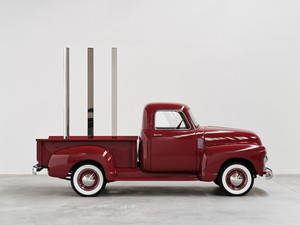
The Singular Experience at Gagosian’s Le Bourget gallery is the largest exhibition of Walter De Maria’s work in France in several decades. Organized by Donna De Salvo, senior adjunct curator at Dia Art Foundation, the exhibition marks the first time De Maria’s final sculpture, Truck Trilogy (2011–17), is being shown outside of the United States. Here, De Salvo speaks with artist Lucy Raven about her evolving kinship with De Maria and more.
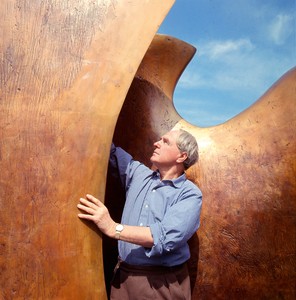
Laura Bruni writes about a major exhibition celebrating the work of the British sculptor Henry Moore at the Royal Botanic Gardens, Kew, London.
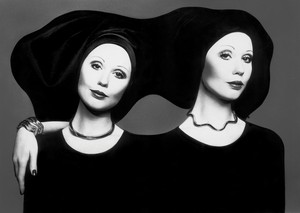
The exhibition Pomellato, Le Joaillier Révolutionnaire opened at Palais de Tokyo, Paris, on June 24. The Italian jewelry house’s trailblazing advertising campaigns—created by some of the most consequential names in photography—act as the narrative arc of the exhibition, curated by Alba Cappellieri. Here, Sarah Godfrey tracks Pomellato’s history, speaks with Cappellieri about what drew her to this project, and examines some of the key photographs from the show.


