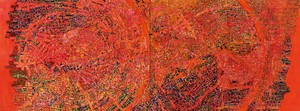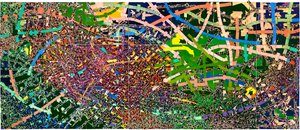
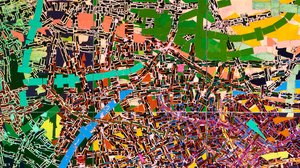
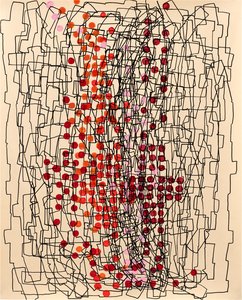
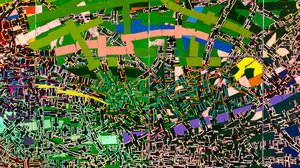
At Art Basel Unlimited 2025, Gagosian is presenting Rick Lowe’s Cavafy Remains (2024), a monumental collage painting that pays tribute to the Greek poet C. P. Cavafy (1863–1933).

Spanning 28 feet (8.5 meters), the collage painting pays tribute to C. P. Cavafy (1863–1933), a cosmopolitan Greek expatriate whose influential poetry bridged history, myth, and modernity. It was inspired in part by Lowe’s time in Athens working on the Victoria Square Project (2016–23), a collaborative social sculpture designed to facilitate interactions between Greek natives and immigrants and refugees. Cavafy Remains presents a complex, expansive network that evokes both typography and maps of urban infrastructure. The abstract work’s interplay of vivid colors and layered arcs and grids reflects the deep engagement with community that Lowe also realizes through the games of dominoes he plays with local residents. Cavafy Remains symbolizes the development and reconfiguration of communities, continuing Lowe’s exploration of connections between civic engagement and visual art.

#RickLowe
<p data-block-key="iu8rj"><i>Cavafy Remains</i>, 2024</p>

Rick Lowe

Cavafy Remains, 2024

Acrylic and paper collage on canvas

12 × 28 feet (365.8 × 853.4 cm)

Rick Lowe’s Cavafy Remains (2024) installed at Art Basel Unlimited 2025. Artwork © Rick Lowe. Video: Pushpin Films

In 2015, Rick Lowe first visited Greece, a country that had long held a fascination for the artist. While thousands of miles away from his adopted hometown of Houston in Texas, where he lives and works, the city of Athens—the birthplace of modern democracy—seemed a befitting setting for Lowe, who frequently explores the social dimensions of space in his work. A 2014 recipient of a MacArthur “genius” Fellowship, Lowe is best known for his “social sculpture,” a practice inspired by Joseph Beuys involving civic engagement and community-centered activism.

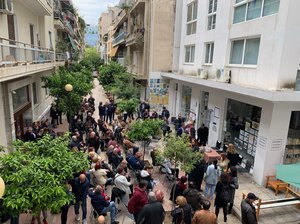
Lowe returned to Greece regularly, deepening his relationship to Athens and its people. In 2017, he inaugurated a new work in the Athenian neighborhood of Kypseli for Documenta 14. Made in collaboration with the artist Maria Papadimitriou, the multifaceted Victoria Square Project (2016–23) transformed a public space that had been the center of xenophobic tensions by making it the site of participatory creative endeavors—such as artistic collaborations, publishing projects, and even shared meals.

Responding to the complexities of the Greek refugee crisis around this time, Lowe sought to counter the feelings of displacement through cross-cultural dialogues conducted in the name of art. Intending the Victoria Square Project as an ongoing sociopolitical intervention, Lowe and his collaborators maintained a consistent presence in and around Victoria Square for eight years, specifically encouraging interactions that would have a lasting impact for Athenian residents.

Rick Lowe’s Victoria Square Project, Athens, 2016–23. Social sculpture conceived in collaboration with Maria Papadimitriou on the occasion of Documenta 14. Photo: courtesy Rick Lowe Studio

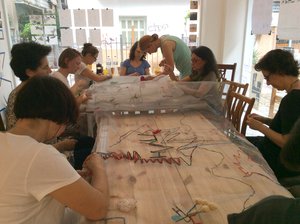
People working on Vassia A. Vanezi’s Weaving Together—The Grid of Memory (2017) as part of Victoria Square Project, Athens, July 2017. Artwork © Vassia A. Vanezi. Photo: courtesy Vassia A. Vanezi

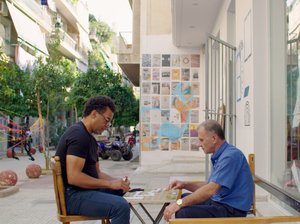
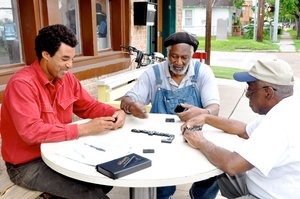
Film still featuring Rick Lowe (left) playing dominos in Athens, from A Space for Belonging: Refugees and Locals Share Meals and Dominoes in Victoria Square, Athens, RAVA Films, commissioned by A Blade of Grass (2018)

During this time, Lowe recognized important similarities between the cities of Athens and Houston. Most notably, he identified the shared temperate climate that made possible outdoor social activities such as playing dominoes on the street—a pastime that has figured prominently in his life and career since the early 1990s. Games of dominoes were a key component in the Victoria Square Project, and Lowe’s continued engagement with the community through this social activity became increasingly integrated into his series of abstract paintings.

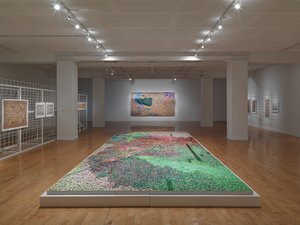
While preparing for his 2023 exhibition Hic Sunt Dracones (Here Lay Dragons): Mapping the Unknown: A Project by Rick Lowe at the prestigious Benaki Museum in Athens, Lowe had received a book of writings by the legendary twentieth-century Greek poet C. P. Cavafy (1863–1933). Its impact was immediate and profound, with Lowe pulling out actual pages of Cavafy’s Greek verse to be used as fragmented collage elements in his mixed-media paintings that were shown at the Benaki and concurrently at Gagosian’s Athens gallery, where his exhibition was titled Still Learning from Athens.

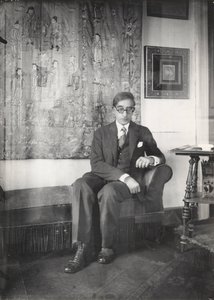
Constantine P. Cavafy, date unknown. Photo: Cavafy Archive Onassis Foundation

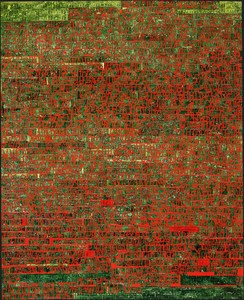
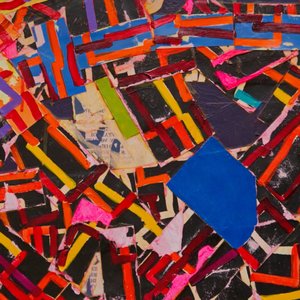
Detail of Rick Lowe’s Cavafy Remains (2024) showing collaged fragments of C. P. Cavafy’s text. Artwork © Rick Lowe Studio

Left with physical remnants of Cavafy’s writings from this painting series, Lowe was inspired to create a final monumental work as a testament to the enduring power of the culture, history, and people of Greece. Featured in Gagosian’s presentation in the Unlimited sector of Art Basel 2025, the magnificent painting Cavafy Remains (2024) literally and conceptually weaves together actual collaged fragments of Cavafy’s text with topographical forms more abstractly inspired by activities linked to Greece’s social fabric.

Rick Lowe, Cavafy Remains, 2024 (detail) © Rick Lowe Studio. Photo: Thomas Dubrock

In Cavafy Remains, an intricate entanglement of ribbonlike contours and vibrant linear elements unfurls across Lowe’s 28-foot-long composition. The overall effect is reminiscent of aerial perspectives in maps. Upon close viewing, however, one sees that these bands are composed of discrete rectangular segments, either painted or cut into collage pieces, which are used to create nodes of intersection. These four-sided motifs are a central component in Lowe’s oeuvre; they mark a visual language developed by the artist based on the shared activity of playing dominoes.

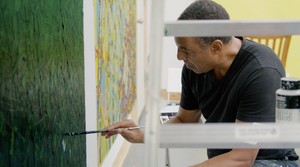
The flow and movement of the work is about connecting different parts of the painting—it’s almost like building a community. 

Rick Lowe

Rick Lowe discusses his painting process and its connection to dominoes and his community-based projects. Video: Pushpin Films. Cinematography: Neiman Catley

Dominoes were an important part of fostering relationships with residents of the Third Ward, the Houston neighborhood that Lowe transformed in his legendary community-building work titled Project Row Houses, which launched in 1993. Maps also figured significantly in Project Row Houses, as Lowe consulted and reimagined such diagrams for land use, real estate holdings, and urban planning while simultaneously critiquing their roles in furthering gentrification, displacement, and historical erasure. Notably, in 2020, Project Row Houses was named one of the “25 Most Influential Works of American Protest Art since World War II” by the New York Times.

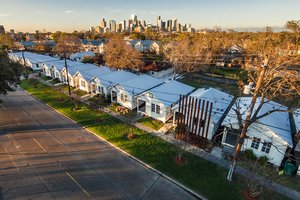
Rick Lowe, Project Row Houses, Houston, 1993–2018. Social sculpture conceived in collaboration with James Bettison, Bert Long, Jr., Jesse Lott, Floyd Newsum, Bert Samples, and George Smith. Photo: courtesy Rick Lowe Studio

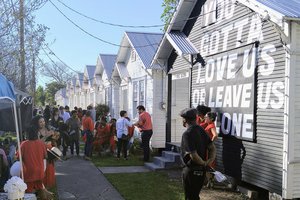
Untitled (2017) by Black Women Artists for Black Lives Matter, Project Row Houses, Houston, 2017. Photo: courtesy Rick Lowe Studio

Rick Lowe (left), Jesse Lott (center), and Aaron Adams (right) playing dominoes, Third Ward, Houston, c. 2010. Photo: Eric Hester/Project Row Houses

Since initiating his drawing and painting practice in the mid-2010s, Lowe has melded top-down perspectives of dominoes games with those of urban districts, creating maps of communities on both micro and macro levels alike. As curator Dieter Roelstraete has observed, “those familiar with Lowe’s world will be aware of the importance of dominoes as a social tool within it—as the social practitioner’s primary implement and/or bonding element.” At first, Lowe photographed the shapes as they appeared on a table after a game, but he soon evolved his mode of recording, instead tracing the patterns left behind.

Rick Lowe, Untitled (Domino Studies), 2023, paint marker and acrylic on paper, 31 × 25 inches (78.7 × 63.5 cm) © Rick Lowe Studio. Photo: Stathis Mamalakis

According to the artist, “this led to a fascination with the abstract forms that emerged from the multilayering. . . . one day I realized that the patterns were simply mapping knowledge of the time I spent with the people I played with. . . . I continued to make the work as an investigation into how mapping domino games could help me better understand the mapping related to my interest in urban development and other social and political realms.” While he noted the shared practice of playing dominoes in Houston and Athens, Lowe identified cultural differences in the formal layout of the game. While the game is played horizontally in the United States, in Greece it unfolds vertically—a detail that led Lowe to further evolve his painterly compositions in new and important ways.

For Lowe, paintings such as Cavafy Remains present “an opportunity to think about the issues of equity and urban planning in a more conceptual way.” Overlapping tracings of domino games are cut and arranged in different configurations, at times painted over scraps of Cavafy’s writing, creating an intricate network composed of countless celllike fragments of painted collage. Given the context of Lowe’s 2023 dual exhibitions at Gagosian’s Athens gallery and the Benaki Museum, in which he further explored the significance of both maps and Cavafy’s writings, the many material layers that exist in Cavafy Remains might symbolize the accretive process of memory, building upon past social and physical interactions.

Installation view, Hic Sunt Dracones (Here Lay Dragons): Mapping the Unknown: A Project by Rick Lowe, Benaki Museum / Pireos 138, Athens, June 1–July 30, 2023. Artwork © Rick Lowe Studio. Photo: Stathis Mamalakis

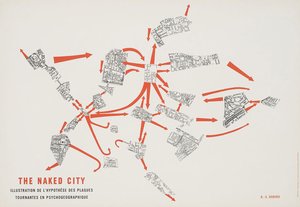
As seen in Cavafy Remains, Lowe’s work revels in the power of social exchange, whether Cavafy’s internationally celebrated poetry or the quotidian routines of daily life such as a shared game among friends. His mixed-media works—including the present example—incorporate collage elements into richly painted surfaces, disclosing the material traces of social events that are woven into complex psychogeographies. Just as the Situationists like Guy Debord sought to discover a city by way of unplanned routes and personal connections, Lowe charts his traversals through contemporary social spaces. Yet his practice differs due to his ongoing commitment to activism—truly dissolving the divide between art and life by making work that directly impacts people’s experiences in practical, tangible ways, such as building affordable housing, creating arts education programming, or standing up to racial injustice.

Guy Debord, The Naked City, 1957, lithograph, 13 ⅛ × 19 inches (33.3 × 48.3 cm), Frac Centre-Val de Loire, Orléans, France

Lowe’s long-standing interest in Aristotle—his first introduction to Greek culture—frames the importance of the social dimension of his practice, as exemplified by Cavafy Remains. “I felt that I had been learning from Athens for a long time even before ever having been there,” he once remarked. Political engagement was key in Aristotelian philosophy, and the mutual happiness among political and social communities was of the utmost importance in leading a virtuous and ideal life. This appreciation of the sociopolitical dimension is mirrored in Lowe’s work; his activism in daily life is understood as closely related to his painting practice, with one continually informing and being shaped by the other.

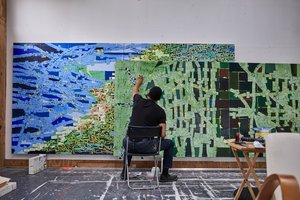
Rick Lowe working in his studio, Houston, 2023. Artwork © Rick Lowe Studio. Photo: Michael Starghill

Rick Lowe, Cavafy Remains, 2024 (detail) © Rick Lowe Studio. Photo: Thomas Dubrock

Rick Lowe, Dieter Roelstraete, Abigail Winograd

In Conversation
Rick Lowe, Dieter Roelstraete, Abigail Winograd

Gagosian and Museo di Palazzo Grimani, Venice, hosted a conversation between Rick Lowe; Dieter Roelstraete, curator of Neubauer Collegium for Culture and Society at the University of Chicago; and Abigail Winograd, commissioner and curator of the United States Pavilion at the 60th Biennale di Venezia. The trio discuss the exhibition The Arch within the Arc in the context of Lowe’s overall practice, as well as Gagosian’s recently published monograph on the artist.
Rick Lowe & Kevin Beasley

Rick Lowe & Kevin Beasley

Artists Rick Lowe and Kevin Beasley discuss their engagement with material and place, as well as the social potentials of abstraction.

Notes to Selves, Trains of Thought

Notes to Selves, Trains of Thought

Dieter Roelstraete, curator at the Neubauer Collegium for Culture and Society at the University of Chicago and coeditor of a recent monograph on Rick Lowe, writes on Lowe’s journey from painting to community-based projects and back again in this essay from the publication. At the Museo di Palazzo Grimani, Venice, during the 60th Biennale di Venezia, Lowe will exhibit new paintings that develop his recent motifs to further explore the arch in architecture.

Black Futurity: Lessons in (Art) History to Forge a Path Forward

Black Futurity: Lessons in (Art) History to Forge a Path Forward

Jon Copes asks, What can Black History Month mean in the year 2024? He looks to a selection of scholars and artists for the answer.

Rick Lowe, Tom Finkelpearl, and Eugenie Tsai

In Conversation
Rick Lowe, Tom Finkelpearl, and Eugenie Tsai

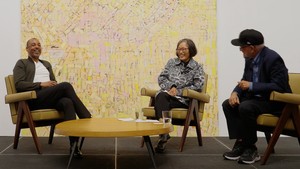
Join Gagosian for a conversation between Rick Lowe and his longtime friends Tom Finkelpearl, author and former commissioner of the New York City Department of Cultural Affairs, and Eugenie Tsai, senior curator of contemporary art at the Brooklyn Museum, New York, inside Lowe’s exhibition Meditations on Social Sculpture, at Gagosian, New York. The trio discusses their shared interest in transforming social structures and the evolution of Lowe’s new paintings from his ongoing community projects.

David Adjaye, Rick Lowe, and Thelma Golden

In Conversation
David Adjaye, Rick Lowe, and Thelma Golden

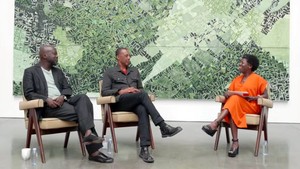
Rick Lowe and Sir David Adjaye join Thelma Golden, director and chief curator of the Studio Museum in Harlem, New York, for a conversation on the occasion of the exhibition Social Works at Gagosian, New York. The trio explore Adjaye and Lowe’s shared interests in architecture, community building, and the relationship between space and the Black body.

Rick Lowe: In the Studio

Behind the Art
Rick Lowe: In the Studio

Join Rick Lowe in his Houston studio as he speaks about his recent paintings, describing their connections to his long engagement with the activity of dominoes and to his community-based projects created in the tradition of social sculpture.

Social Works: Rick Lowe and Walter Hood

Social Works: Rick Lowe and Walter Hood

Rick Lowe and Walter Hood speak about Black space, the built environment, and history as a footing for moving forward as part of “Social Works,” a supplement guest edited by Antwaun Sargent for the Summer 2021 issue of the Quarterly.

Gagosian Quarterly Summer 2021

Now available
Gagosian Quarterly Summer 2021

The Summer 2021 issue of Gagosian Quarterly is now available, featuring Carrie Mae Weems’s The Louvre (2006) on its cover.

Gagosian Quarterly Summer 2026

Now available
Gagosian Quarterly Summer 2026

The Summer 2026 issue of Gagosian Quarterly is now available, featuring Ellen Gallagher’s Fast-Fish and Loose-Fish (2026) on the cover.

Jenny Saville a Ca’ Pesaro

Jenny Saville a Ca’ Pesaro

In this video, Jenny Saville sits down inside her first major exhibition in Venice to discuss how the great Venetian artists of the past and the city’s heritage influence her work. The show brings together more than thirty canvases and works on paper from the 1990s to the present, tracing the development of her practice, which is deeply rooted in the history of painting.

Francis Bacon: Reinventing Realism

Francis Bacon: Reinventing Realism

Francis Bacon lived and worked in Paris for a decade starting in the mid-1970s. The city and the art he encountered there provided a profound backdrop for his austere late style, which often brings together smooth, colorful backgrounds, spare architectural signifiers, and sculptural human forms. Here, three striking paintings from that period are considered by Sebastian Smee.