Flags
Gillian Pistell writes on the loaded symbol of the American flag in the work of postwar and contemporary artists.
Art Basel Unlimited 2026 includes Ed Ruscha’s A, B, C (1987), originally produced as part of the artist’s 1985 commission for the Miami-Dade Public Library, but retained for his own collection.
Ed Ruscha’s A, B, C is a trio of large semicircular canvases, each of which is painted with one of the titular letters, bringing written language—as form, symbol, and material—into the realm of painting. Ruscha produced A, B, C as part of a commission for the Miami-Dade Public Library—the artist’s first public project. The work reflects both his fascination with language and typography, and the function and architecture of the interior for which it was made.
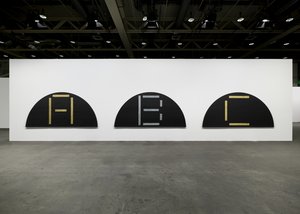
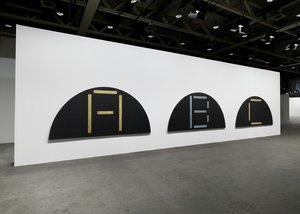
Ed Ruscha, A, B, C, 1987, installation view, Art Basel Unlimited 2026 © Ed Ruscha. Photos: Owen Conway
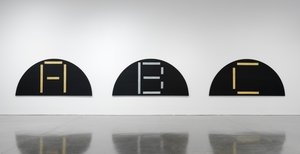
A, B, C, 1987
Acrylic on canvas, in 3 parts
Each: 66 × 137 inches (167.6 × 348 cm)
A, B, C (1987) was created by Ed Ruscha for his first public commission, received in 1985—to paint a series of murals for the main floor of the new, Philip Johnson–designed Miami-Dade County Public Library. “It was the first time in my life as an artist that I was faced with communicating with the public,” Ruscha recalled four years later, in 1989. “I realized that I could not approach this project like the works I paint for myself. I wanted to make people think about where they were, about the purpose of a library and about the function of language.” Comprising three half-moon-shaped lunettes that feature black grounds each inscribed with one of the three beginning letters of the alphabet, A, B, C urges viewers to contemplate the very foundations of language, the individual units that comprise the larger linguistic system that organizes human communication.
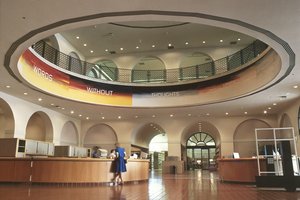
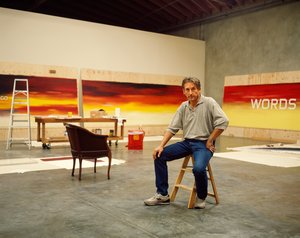
Ed Ruscha, Words Without Thoughts Never to Heaven Go, 1985–89, permanent installation, Miami-Dade Public Library © Ed Ruscha. Photo: Gary Regester
It was Ruscha’s foregrounding of language in his work—single letters, individual words, and longer phrases—that initially brought him to the attention of the project’s search committee. Composed of arts professionals from around the country and assembled by the Metro-Dade Art in Public Places Trust—the organization spearheading the commission—the committee sought an artist whose practice involved words and the visual expression of language, believing such work would not only reflect the library’s functional purpose, but also create a unique coupling of artwork and site. And indeed, for Ruscha, language is about more than verbal expression; it is a living material with a physical presence that can be decontextualized and manipulated, much like paint or clay. Some committee members questioned Ruscha’s appropriateness for the project, claiming his work was too cerebral and ambiguous for public art, which traditionally presented clear, easily accessible messages in beautiful, if not purely decorative, compositions. In the end, however—and after a second vote—Ruscha was awarded the commission, ultimately producing eight panels to encircle the rotunda as well as dozens of lunettes that were dispersed throughout the rest of the building; A, B, C comes from this latter body of work.
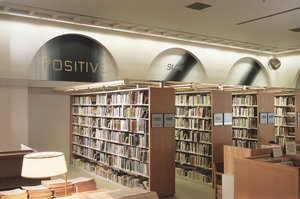
Ed Ruscha’s Positive, Sure, and Certain lunettes (all 1987) installed on the first floor of the Miami-Dade Public Library. Artwork © Ed Ruscha. Photo: Gary Regester
Text as the subject dominates Ruscha’s work—a radical concept when he introduced it in the early 1960s, and one that established him as among the most innovative artists of the decade. In paintings and drawings, Ruscha presents seemingly random words divorced from both context and meaning. He refined his keen eye for bold compositions and subjects in the late 1950s as a commercial art student at Chouinard Art Institute (now the California Institute of the Arts), where he took courses in lettering, design, and advertising, as well as short-term jobs as a typesetter and sign painter. This practical training compelled Ruscha to consider words not just as the building blocks of language, but as visual subjects. “Words have temperatures to me,” Ruscha once explained of his attraction to words. “When they reach a certain point and become hot words, then they appeal to me.”
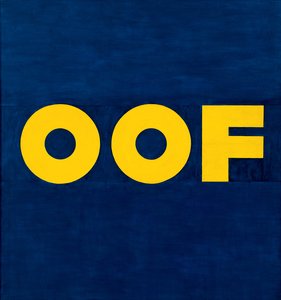
Ed Ruscha, OOF, 1963, oil on canvas, 71 ½ × 67 inches (181.5 × 170.2 cm), Museum of Modern Art, New York © Ed Ruscha
For the rotunda murals, Ruscha pictured the phrase “Words without thoughts never to heaven go,” a line spoken by Claudius in William Shakespeare’s Hamlet—the most analyzed and performed work in Western literature. Ruscha explained this choice in his proposal:
A philosophical thought of this nature, as subject matter in a mural painting, will be a striking and perfect embellishment for the library. . . . [My intent is] to separate the words by enough space as to cause the viewer to not only observe the thought as a whole, but to reflect for a moment on each word as an individual word and each picture as an individual picture. Thus the mural is a composite of eight separate yet harmonious pictures.
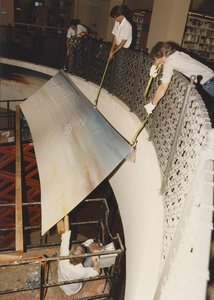
Fernando Garcia, Greg Colson, Ed Ruscha (top right), and Ron McPherson installing Words Without Thoughts Never to Heaven Go (1985–89) in the rotunda of the Miami-Dade Public Library, July 1985. Artwork © Ed Ruscha. Photo: courtesy Historical Records of the Miami-Dade Public Library System
Ruscha painted the words against the sunsets and sunrises of South Florida’s subtropical climate, floating among the clouds as if, in fact, on their way to heaven. The eight panels—one for each word plus a canvas of only sky to act as both connector and spacer—are equally successful as individual works of art as they are as an installation. They create an engaged viewer in both the intellectual and physical senses, by prompting him or her to rotate to read the complete sentence. Ruscha and his team installed the eight panels—ingeniously affixed to aluminum stretchers molded to fit the rotunda’s curved shape—shortly before the library’s grand opening in July 1985.
I wanted to make people think about where they were, about the purpose of a library and about the function of language.
Barbara Young interviews Ed Ruscha as Words Without Thoughts Never to Heaven Go (1985–89) opens to the public
In 1987, Ruscha received approval to move forward with the commission’s second phase—creating lunettes for the blind arches scattered throughout the library’s first and second floors. He painted a total of sixty-two such canvases, many of which feature groupings of words or phrases. A, B, C is one such group, as is Who, What, When, Where, Why, and How, and I, You, He, She, It, We, and They, among others. The lunettes feature black, white, and gray backgrounds, a palette that recalls the appearance of ink on paper and, consequently, reinforces their connection to the library setting. Importantly, they expand the interactive nature of the rotunda murals to the rest of the library, with each lunette becoming part of a linguistic scavenger hunt that encourages discovery and interpretation. Some placements reveal the artist’s whimsical, idiosyncratic logic—for instance, Here, There, and Everywhere are located around the corner from a bank of elevators, the evocation of movement in the former realized in the latter—while others court ambiguity and imagination.
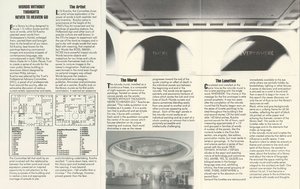
Miami-Dade Public Library’s brochure for Words Without Thoughts Never to Heaven Go (1985–89). Photo: courtesy Historical Records of the Miami-Dade Public Library System
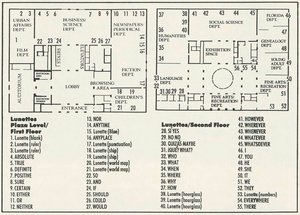
Installation diagram from the Miami-Dade Public Library’s brochure for Words Without Thoughts Never to Heaven Go (1985–89). Photo: courtesy Historical Records of the Miami-Dade Public Library System
In 1989, Ruscha drove all sixty-two lunettes from his studio in California to the library in Miami, stretching them on-site before overseeing their installation. Crucially, he did not have any preconceived notion of where each painting would hang. “There was not a fixed idea that couldn’t be changed,” he explained. “My intention was to make more so that I would have more editing possibilities.” Ultimately, he hung fifty-six of them; A, B, C were among the six lunettes that the artist decided to keep in his own collection.
Ruscha’s Miami-Dade Public Library project remains strikingly relevant today, nearly forty years after its unveiling. In this age of social media and rapid-fire communication, reminders about the importance of sincere reflection and critical thinking are perhaps more important than ever. Indeed, his choice of subject for the rotunda—“Words without thoughts never to heaven go”—seems, perhaps, an eerily prophetic exhortation, as libraries become battlegrounds for politics-driven culture wars. Ruscha’s paintings, both those connected with the commission and his greater oeuvre in general, remind us of the power of words—the danger they pose if wielded without thought, and the changes they can incite if carefully and considerately exercised. As the introductory letters of the alphabet, and therefore the first building block of language itself, A, B, C represents the very foundations of this urgent call to arms.
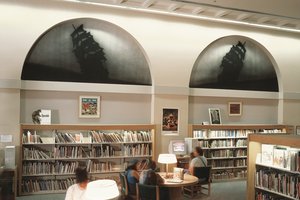
Ed Ruscha’s Ship (left) and Ship (right) lunettes (both 1987) installed on the first floor of the Miami-Dade Public Library. Artwork © Ed Ruscha. Photo: Gary Regester
Gillian Pistell writes on the loaded symbol of the American flag in the work of postwar and contemporary artists.
Jacoba Urist profiles the legendary collector.
Against the backdrop of the 2020 US presidential election, historian Hal Wert takes us through the artistic and political evolution of American campaign posters, from their origin in 1844 to the present. In an interview with Quarterly editor Gillian Jakab, Wert highlights an array of landmark posters and the artists who made them.
Lisa Turvey examines the range of effects conveyed by the blurred phrases in recent drawings by the artist, detailing the ways these words in motion evoke the experience of the current moment.
Gwen Allen recounts her discovery of cutting-edge artists’ magazines from the 1960s and 1970s and explores the roots and implications of these singular publications.
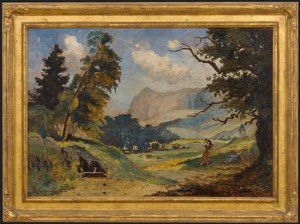
Ed Ruscha tells Viet-Nu Nguyen and Leta Grzan how he first encountered Louis Michel Eilshemius’s paintings, which of the artist’s aesthetic innovations captured his imagination, and how his own work relates to and differs from that of this “Neglected Marvel.”
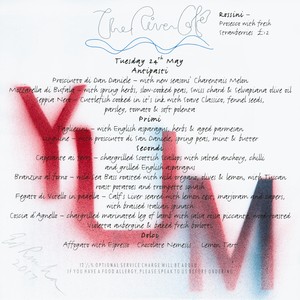
London’s River Café, a culinary mecca perched on a bend in the River Thames, celebrated its thirtieth anniversary in 2018. To celebrate this milestone and the publication of her cookbook River Café London, cofounder Ruth Rogers sat down with Derek Blasberg to discuss the famed restaurant’s allure.
The Fall 2019 issue of Gagosian Quarterly is now available, featuring a detail from Sinking (2019) by Nathaniel Mary Quinn on its cover.
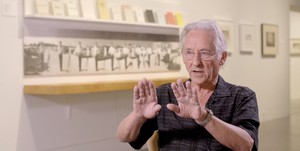
In conjunction with his exhibition VERY at Louisiana Museum of Modern Art in Humlebæk, Denmark, Ed Ruscha sat down with Kasper Bech Dyg to discuss his work.
An exhibition at Gagosian, Paris, is raising funds to aid in the reconstruction of the Cathédrale Notre-Dame de Paris following the devastating fire of April 2019. Gagosian directors Serena Cattaneo Adorno and Jean-Olivier Després spoke to Jennifer Knox White about the generous response of artists and others, and what the restoration of this iconic structure means across the world.
An exhibition at the Broad in Los Angeles prompts James Lawrence to examine how artists give shape and meaning to the passage of time, and how the passage of time shapes our evolving accounts of art.
Ed Ruscha sat down with Tom McCarthy and Elizabeth Kornhauser, curator at the Metropolitan Museum of Art, to discuss the nineteenth-century artist Thomas Cole, whose Course of Empire paintings inspired a series of works by Ruscha more than a century later.