Now available
Gagosian Quarterly Summer 2026
The Summer 2026 issue of Gagosian Quarterly is now available, featuring Ellen Gallagher’s Fast-Fish and Loose-Fish (2026) on the cover.
Art Fair
January 16–19, 2025
Marina Bay Sands Expo and Convention Centre, Singapore
Booth BC04
artsg.com
Gagosian is pleased to participate in the third edition of ART SG in Singapore with a selection of works by international contemporary artists including Derrick Adams, Amoako Boafo, Carol Bove, Edmund de Waal, Katharina Grosse, Simon Hantaï, Damien Hirst, Jamian Juliano-Villani, Sabine Moritz, Takashi Murakami, Albert Oehlen, Nam June Paik, Ed Ruscha, Mary Weatherford, Tom Wesselmann, Stanley Whitney, Jonas Wood, and Zeng Fanzhi. The works on view explore the possibilities of abstraction and figuration, symbol and text, probing the active intersection of natural and cultural influences in paintings, sculptures, and works on paper.
Working with color in conjunction with sculptural objects and materials, Carol Bove juxtaposes raw and painted steel components in Dim Memesis (2024). Adopting abstract formalism as a point of departure, she explores a previously overlooked opening in the narrative of art history by aligning a found metal fragment with a crumpled yellow tubular form of the same material, whose perfect finish lends a deceptive impression of malleability and lightness. Edmund de Waal’s tell it slant (2024) is an aluminum box that houses porcelain vessels and sheets of platinum and silver inscribed with text. The sculpture takes its title from a poem by Emily Dickinson, who used “slant” or imperfect rhymes to break up her work’s words and lines, forging links between disparate emotions; similarly, de Waal employs forms and the gaps between them to produce material verse.
In her abstract painting Lair III (2022), Sabine Moritz allies overlapping brushstrokes with chromatic contrasts, favoring the collision of shapes and hues over compositional harmony. Evoking repetition and difference as routes to hope and beauty, her work ponders the dynamics of transience, liminality, and decay. Albert Oehlen, too, makes use of outwardly dissonant marks and colors in his painting Untitled (2000), combining oil and spray paint to produce an erratic web of motifs in which spontaneous elements of visual chaos are balanced by the artist’s self-imposed rules and limitations. The resultant interrogation reveals some of the innumerable possibilities of painterly gesture and the infinite capacity of pictorial space.
Standing Buddha with Outstretched Hand (2005) by Nam June Paik, the “father of video art,” pairs a statue of Buddha with a stack of four television monitors. Each screen plays a looped closed-circuit image of the figure itself—one right-side up, one inverted, and two subject to electronic distortion. Visualizing the divergence of Eastern and Western cultures, the work prompts a consideration of the self in an era of screen-based pseudo-reality. Notably, the Buddha is raising his left hand in a gesture known as the vitarka mudra, signifying debate or discussion. In his canvas Still Life with Blowing Curtain (Red) (1998), Tom Wesselmann orchestrates a different type of juxtaposition, applying the bold visual energy of commercial culture to a classical painterly form. Depicting the titular arrangement in a saturated palette with clearly defined contours and interlocking positive and negative shapes, he makes use of several motifs—from the oranges to the vase of flowers—that recur throughout his oeuvre.
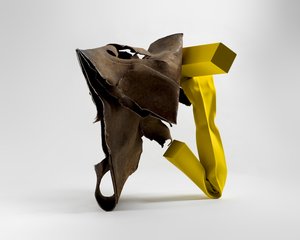
Carol Bove, Dim Memesis, 2024 © Carol Bove Studio LLC. Photo: Maris Hutchinson
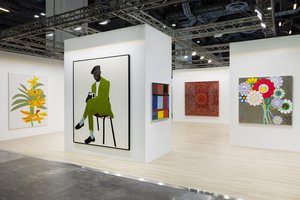
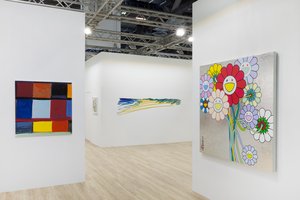
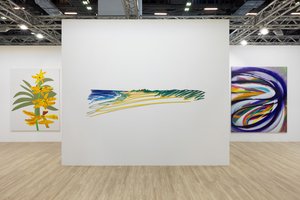
Gagosian’s booth at ART SG 2025. Artwork: © Amoako Boafo; © Katharina Grosse and VG Bild-Kunst, Bonn, Germany 2025; © Damien Hirst and Science Ltd. All rights reserved, DACS/Artimage 2025; © 2025 Takashi Murakami/Kaikai Kiki Co., Ltd. All rights reserved; © Albert Oehlen; © The Estate of Tom Wesselmann/Licensed by ARS/VAGA, New York; © Stanley Whitney; © Jonas Wood. Photos: Ringo Cheung
The Summer 2026 issue of Gagosian Quarterly is now available, featuring Ellen Gallagher’s Fast-Fish and Loose-Fish (2026) on the cover.

In this video, Jenny Saville sits down inside her first major exhibition in Venice to discuss how the great Venetian artists of the past and the city’s heritage influence her work. The show brings together more than thirty canvases and works on paper from the 1990s to the present, tracing the development of her practice, which is deeply rooted in the history of painting.
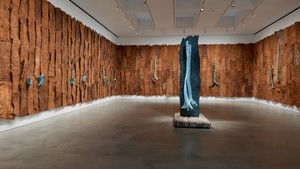
On the occasion of his exhibition The Reflection of Bronze at Gagosian, New York, Giuseppe Penone and curator Adam D. Weinberg sit down to discuss the genesis of, and their collaboration on, the show.
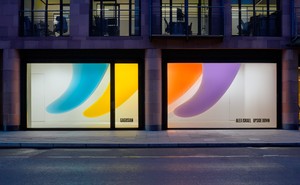
Ahead of Alex Israel’s exhibition of four new Fin sculptures at Gagosian, London, the artist spoke with Susan Casey, author of The Wave: In Pursuit of the Rogues, Freaks, and Giants of the Ocean (2010), about the ocean, surfing, and Los Angeles.
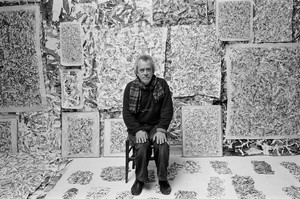
On July 9, Simon Hantaï: the last studio opens at Gagosian, Gstaad. Curated by Anne Baldassari, the show comprises sixteen of the artist’s dernier atelier (last studio) paintings of 1982–85. The exhibition is accompanied by an illustrated catalogue, copublished by Gagosian and Skira, which features an essay by Baldassari and an extensive portfolio of previously unpublished photographs by Édouard Boubat. Here, we share the introductory chapter from the publication.
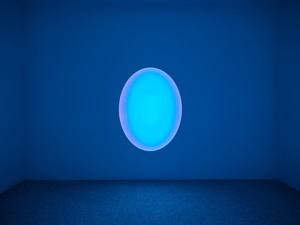
An exhibition at Gagosian, Hong Kong, brings together three of James Turrell’s Glasswork pieces along with site plans, photographs, and models of his Skyspaces and Roden Crater. Here, Alice Godwin explores the history of the Glassworks and their relationship to the artist’s wider practice.

On April 16, the Institute of Contemporary Art, Boston, opened the first midcareer survey of Derrick Adams’s multidisciplinary practice. Covering over twenty years of work, the exhibition, titled View Master, brings together the artist’s painting, sculpture, collage, performance, and video, as well as a vibrant new commission created for the museum’s façade. Ahead of the opening, Adams met with Tessa Bachi Haas, cocurator of the survey, to discuss his formative experiences with television, the impact of his work in arts education on his practice, and the importance of taking a more complex, more joyful, and more expansive approach to Black American life and culture.

Adam D. Weinberg has been working with Giuseppe Penone on an exhibition of the artist’s new sculptures, The Reflection of Bronze, that opens at Gagosian, New York, on April 22. The works explore the character and possibilities of bronze. Here, Weinberg considers Penone’s enduring engagement with the alloy and addresses the conceptual underpinnings of the exhibition’s three-room structure.

Jeff Koons tells Alison McDonald about his appreciation for the pioneering artist and thinker Marcel Duchamp.
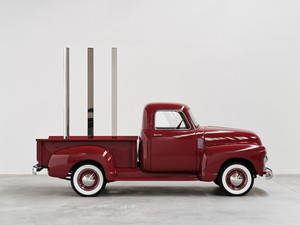
The Singular Experience at Gagosian’s Le Bourget gallery is the largest exhibition of Walter De Maria’s work in France in several decades. Organized by Donna De Salvo, senior adjunct curator at Dia Art Foundation, the exhibition marks the first time De Maria’s final sculpture, Truck Trilogy (2011–17), is being shown outside of the United States. Here, De Salvo speaks with artist Lucy Raven about her evolving kinship with De Maria and more.
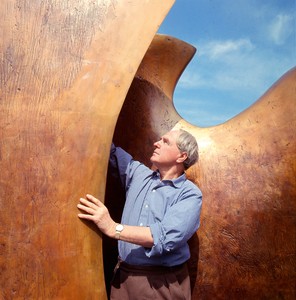
Laura Bruni writes about a major exhibition celebrating the work of the British sculptor Henry Moore at the Royal Botanic Gardens, Kew, London.
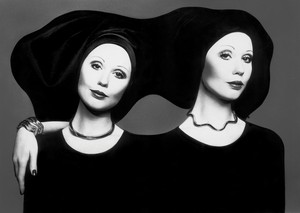
The exhibition Pomellato, Le Joaillier Révolutionnaire opened at Palais de Tokyo, Paris, on June 24. The Italian jewelry house’s trailblazing advertising campaigns—created by some of the most consequential names in photography—act as the narrative arc of the exhibition, curated by Alba Cappellieri. Here, Sarah Godfrey tracks Pomellato’s history, speaks with Cappellieri about what drew her to this project, and examines some of the key photographs from the show.