Visions of the Self: Jenny Saville on Rembrandt
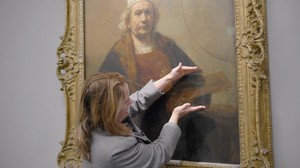
Jenny Saville reveals the process behind her new self-portrait, painted in response to Rembrandt’s masterpiece Self-Portrait with Two Circles.
April 21, 2017
Howard Hodgkin was one of the last century’s greatest painters. A recent show at London’s National Portrait Gallery persuasively argues that Hodgkin should also be canonized as one of its greatest portraitists. Absent Friends includes works that span from 1949 to 2016. In this affecting video interview, the show’s organizer and NPG senior curator Paul Moorhouse explains how, as Hodgkin evolved as an artist, he increasingly abstracted what people meant to him, representing people in his pictures through memories, evocations, and feelings. His viscerally intense works (like Absent Friends, the 2000–01 painting that gave the show its title), in which the aching feelings of presence, memory, and loss become increasingly palpable over time, argue most eloquently for Hodgkin as a sophisticated portraitist.
Artwork © Howard Hodgkin. Directed by Miriam Perez; Produced by PerryDuke
Jenny Saville reveals the process behind her new self-portrait, painted in response to Rembrandt’s masterpiece Self-Portrait with Two Circles.
A celebrated collaboration between Sir Howard Hodgkin and choreographer Mark Morris. Nancy Dalva takes us behind the scenes.
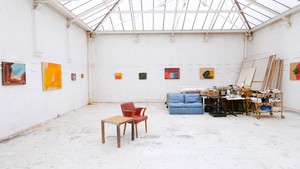
In Howard Hodgkin: From London to Hong Kong, we are welcomed into the celebrated painter’s London studio. Narrated by Robin Vousden.

In this video, Jenny Saville sits down inside her first major exhibition in Venice to discuss how the great Venetian artists of the past and the city’s heritage influence her work. The show brings together more than thirty canvases and works on paper from the 1990s to the present, tracing the development of her practice, which is deeply rooted in the history of painting.
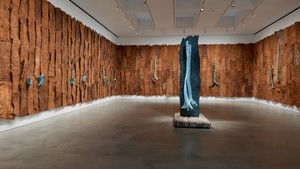
On the occasion of his exhibition The Reflection of Bronze at Gagosian, New York, Giuseppe Penone and curator Adam D. Weinberg sit down to discuss the genesis of, and their collaboration on, the show.
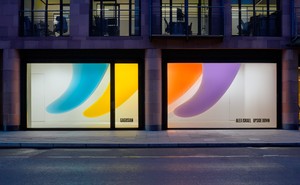
Ahead of Alex Israel’s exhibition of four new Fin sculptures at Gagosian, London, the artist spoke with Susan Casey, author of The Wave: In Pursuit of the Rogues, Freaks, and Giants of the Ocean (2010), about the ocean, surfing, and Los Angeles.
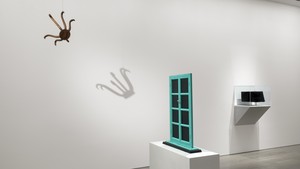
Marcel Duchamp is the inaugural exhibition of the gallery’s new ground-floor space in the historic building at 980 Madison Avenue. In this video, the Quarterly’s Alison McDonald discusses the artist’s most iconic readymades and their connection to New York City.

On April 16, the Institute of Contemporary Art, Boston, opened the first midcareer survey of Derrick Adams’s multidisciplinary practice. Covering over twenty years of work, the exhibition, titled View Master, brings together the artist’s painting, sculpture, collage, performance, and video, as well as a vibrant new commission created for the museum’s façade. Ahead of the opening, Adams met with Tessa Bachi Haas, cocurator of the survey, to discuss his formative experiences with television, the impact of his work in arts education on his practice, and the importance of taking a more complex, more joyful, and more expansive approach to Black American life and culture.

Jeff Koons tells Alison McDonald about his appreciation for the pioneering artist and thinker Marcel Duchamp.
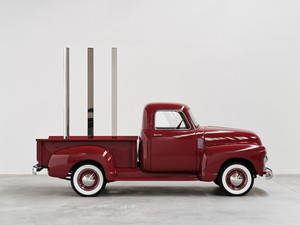
The Singular Experience at Gagosian’s Le Bourget gallery is the largest exhibition of Walter De Maria’s work in France in several decades. Organized by Donna De Salvo, senior adjunct curator at Dia Art Foundation, the exhibition marks the first time De Maria’s final sculpture, Truck Trilogy (2011–17), is being shown outside of the United States. Here, De Salvo speaks with artist Lucy Raven about her evolving kinship with De Maria and more.
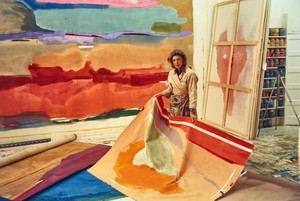
Helen Frankenthaler—the largest exhibition of the artist’s paintings to originate in Europe and her first institutional solo show at Kunstmuseum Basel in Switzerland—is now on view through August 23, 2026. Curated by Anita Haldemann, this monumental exhibition, spanning fifty paintings, offers a unique opportunity to examine Helen Frankenthaler’s immersive and atmospheric approach to color and abstraction. The presentation proposes a dialogue between Frankenthaler’s “paraphrases” of old master paintings and the original works on which her paintings are based. Here, Haldemann speaks with Filip Jakab about Frankenthaler’s transhistorical engagement, formal innovation, and enduring influence.
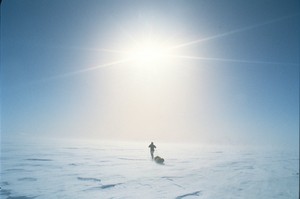
Ed Ruscha sits down with the author and explorer Erling Kagge to discuss existence.