Daniel Roseberry, the creative director of Schiaparelli, met with the Quarterly’s Derek C. Blasberg at the maison’s historic headquarters at 21 place Vendôme, Paris, following the Schiaparelli Fall/Winter 2026–27 ready-to-wear show. Since taking the helm in 2019, Roseberry has been credited with advancing the heritage of the house through unpredictable sculptural designs that carry Elsa Schiaparelli’s Surrealist spirit into a new century. The pair discuss the much-anticipated exhibition Schiaparelli: Fashion Becomes Art, now on view at the Victoria & Albert Museum, London, as well as Roseberry’s early exposures to art, his continued dedication to drawing, and the enduring legacy of Elsa Schiaparelli’s daring vision.
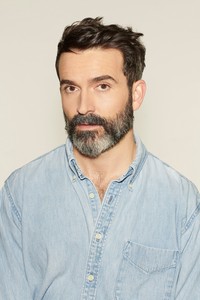
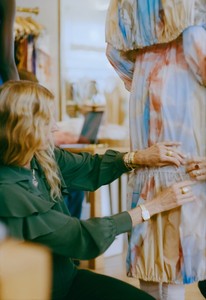
Daniel Roseberry. Photo: courtesy Schiaparelli
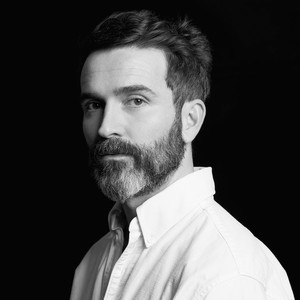
Daniel Roseberry. Photo: courtesy Schiaparelli
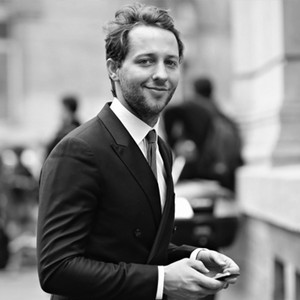
Derek C. Blasberg is a writer, fashion editor, and New York Times best-selling author. He has been with Gagosian since 2014, and is currently the executive editor of Gagosian Quarterly.
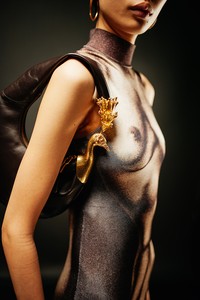
Daniel Roseberry was born in 1985 in Plano, Texas. In 2019, he took on the role of creative director at Maison Schiaparelli, the renowned Parisian couture house. During his tenure at Schiaparelli, Roseberry revived some of the House’s most influential codes while paying homage to Elsa Schiaparelli’s celebrated love of Surrealism. At the same time, he subverted many of these codes, contributing to a new aesthetic grammar through the frequent use of gold jewelry and metalwork, upcycled denim, and molded leather and metal breastplates and anatomical parts.
Derek C. BlasbergI reread the show notes from your Spring 2026 collection, which were incredibly articulate about how you interpret the relationship between fashion and art. That’s the whole concept of this series, and I admired how you didn’t shy away from the comparison.
Daniel RoseberryNot here. You can’t. It’s so intrinsic to the DNA of this brand. Refresh my memory, what did they say?
DCBFor the collection, you were thinking about the concept of art that you can live in, about fashion as a form of expression.
DROh yes.
DCBLet’s start at the beginning. As a young boy, were you an arty kid?
DRCompletely. Fashion didn’t even enter the chat until I was like thirteen, fourteen, maybe even fifteen. My dad’s side of the family brought the church into the conversation, but my mom, my grandma, and two of my uncles are all artists. Actually my dad’s mom was an artist too. I grew up in a home filled with art, much of it created by the family.
DCBWhat kind? Oil on canvas? Watercolor?
DRMy grandmother on my dad’s side was a sculptor who created pieces for state parks and libraries in Arizona, as well as amazing life-size bronze portraiture. My mom’s mom was a photorealistic watercolor artist based in Bellport[, Long Island]. She became a teacher at Brookhaven and studied with Martha Graham. My uncle is now a world-class ceramist on Long Island.
DCBI didn’t know about any of this, Daniel. I grew up in Missouri, and when I imagined your childhood in Texas, I thought the experience was nearer to mine—I knew you grew up in a religious family, struggled with gay identity, and found freedom when you came to New York. I can relate to all of that, but when I was growing up, I didn’t know a single person who supported themselves financially through creativity or art. You were surrounded by that.
DRWhat’s interesting, in my case, is the intense frisson between those two worlds. The world of “Art is God-given, art is your destiny, art is to be a good steward of what God has given you and to use your art to transcend.” And then the unspoken deal was implicit celibacy in exchange for God’s gifting you. That’s the way it was discreetly framed when I was growing up. I often felt like, “God’s given you so many gifts, Daniel, but the exchange is that this other part of you, your true self on a sexuality level, had to be sort of abandoned or given back to God.”
DCBThat’s a heavy deal.
DRYes, it was. And it was haunting for decades. Walking away from that deal was probably the hardest thing I’ve ever had to do.
DCBDid you even consider the deal?
DRAbsolutely. I almost went into the seminary to be a minister! I went to a seminary in Pennsylvania, I interviewed with the dean, and he took one look at me and—thank God, literally—he said, “You have to go to New York. [Entering this seminary] is not going to work. And you have to chase your dreams.” I’d been a missionary overseas for a year. I was on a track to join the Baptist church, and he was the one who permitted me to change my course. I was having a sort of slow-motion crisis at the time, which he could probably tell. And in this entire process, art had been a part of the ride.
DCBThen you came to New York, and then you discovered fashion.
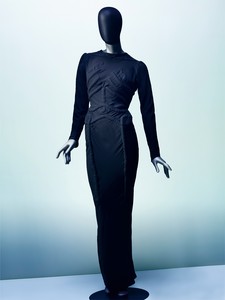
Schiaparelli Ready-to-Wear Fall/Winter 2026–27. Photo: Kuba Dabrowski
DRThe eureka moment was watching a Style.com documentary on a Michael Kors show.
DCBWith Tim Blanks?
DRYes, a doc on one of Kors’s collections. I still remember every bit of it. It was a biography—growing up on Long Island, the influence of his mother, going to Parsons, doing windows, getting scouted. I felt like, “Okay, this could be me. I can see myself in this.” That’s when my art changed course. Before, I wanted to be a Disney animator, but in that moment it shifted to fashion.
DCBWere you aware that art was playing a part in your life? Not to sound trite, but was it changing you, or rerouting you?
DRIt’s always been a little bit of the agony and the ecstasy. It’s been intrinsic to who I am—I was drawing before I could talk. But there were also the moments when it was so commingled with something more complex, and the religion and the church. I’m so grateful to be out of that dialogue.
DCBIn the show notes from the Fall/Winter 2026–27 collection you presented last night, you spoke a lot about Elsa as an artist, and about her collaborations with art and artists. For me, the most famous version of that was when she created the lobster dress in partnership with Salvador Dalí [in 1937]. Is that kind of commingling or art-fashion exchange a big part of your process, or how you work currently?
DRIt’s amusing to think about, because when I started here, the first question I was asked, which no one asks me anymore, was, “When’s the first collaboration going to be with an artist?”
DRThat’s what people wanted to know. Who’s the Schiaparelli woman and when’s the first artist collaboration? I really didn’t like either question. I feel like my medium, if we’re being generous, is the idea that the collaboration is more with pop culture than with contemporary fine artists. What I spend so much time with is music.
DCBFabulous soundtrack last night. Fantastic.
DRThank you! That’s such a labor, it’s such an offering to you in the audience, because it’s done explicitly with you in mind. Last season we did David Bowie into Lauryn Hill into Aaliyah, and Bowie narrating Peter and the Wolf. Someone came up to me at the end of the show—it was Kylie Jenner—and she said, “I could have stayed in that room all night. I didn’t want it to end.” That’s the highest compliment.
DCBYou’ve said that you allow yourself to think that your haute couture collections flirt with the idea of art. One question we ask in all these interviews is, “Do you think fashion can be art, do you think art can be fashion?”
DRThere’s this obsession with fashion not being able to be called art, which I think is interesting. In 2022, the Pompidou here in Paris launched a project in which they placed pieces from the Yves Saint Laurent archive among works in the permanent collections of five of France’s most prestigious museums.
DCBI remember that—they put three of YSL’s Mondrian dresses in front of [Piet] Mondrian works, for example.
DRYes, that one. I spoke to a director at the Pompidou and they told me that museum attendance went up 40 percent. That gave me goosebumps because I understood that the art industry can betray the concept of art a lot, and maybe it even loves to do that, but to say that fashion can’t be art is absurd when you think about the way other artists create their things. Absurd! So, a banana taped on the wall versus a hand-painted jacket with molded-resin beaks? I’m like, “Really? Is this the conversation?”
DCBWhich one is not art?
DRBoth are! For me, that’s the thing, the both/and. Often I feel that it’s old-fashioned to think that way.
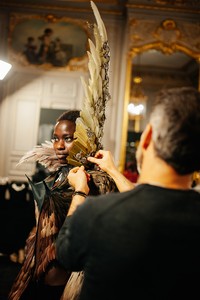
DCBIn January the artist Titus Kaphar was opening a show at the Gagosian here in Paris, and your office kindly allowed me to bring him as a guest to your Spring 2026 Couture show the same week. It was incredible to experience everything through his eyes. For example, feathers were a huge part of that collection, and when I see feathers, my mind goes to—will other designers do feathers? Is this a trend? What kind of feathers are these? I wonder are the feathers exotic, and would it be hard to travel with them? But when we were leaving the show, he turned to me and said, “I loved the feathers. They reminded me of paintbrush strokes.” And it sort of blew my mind. It gave me a whole other perspective on feathers as a material and the garment as a work of art.
Backstage at the Schiaparelli Haute Couture Spring/Summer 2026 collection. Photo: Kuba Dabrowski
DRWith everything at Schiaparelli, it’s an unending “A rose is a rose is a rose” kind of invitation to make everything touched by art, to make everything artistic. Whether it’s the heel of a boot in a ready-to-wear collection that looks like a [Claude] Lalanne claw or a feather jacket that will cost six figures at a couture show, there’s a desire, a calling, for us to bring art into the conversation. I was thinking about it this morning: The fact that this house was shuttered after the war meant that there were decades of contamination we didn’t go through, and that Schiaparelli is so pure. Creating here, you still feel like these are museum-bound pieces, the way you see Schiaparelli in an archive at the Metropolitan Museum of Art or whatever.
DCBThe concept of fashion as commerce is more removed here than at other brands.
DRYes. Once you become an eight-, twelve-, eighteen-billion dollar brand, you are by nature putting out an amount of product that has no business in a museum; of course this is a business, and we want to be successful. But I’m also happy to work in a way that keeps it special.
DCBMy first introduction to your work was through an artistic lens: We met when you were still working for Thom Browne, but you started your career here during covid, and one of the first things you did was release a video of yourself sketching and drawing in Washington Square Park, shot during lockdown.
DROh yes.
DCBDo you still draw and sketch often? Is that still your process?
DREvery day. Every day.
DCBWhen did you start drawing?
DRAccording to family legend, when I was nine months old I drew a football. This was before I could talk! I’m told I’d taken a pen out of my dad’s chest pocket, they put me down, and I drew a football.
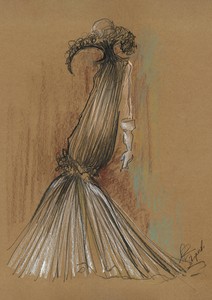
Daniel Roseberry’s drawing for the Schiaparelli Haute Couture Spring/Summer 2026 collection. Photo: courtesy Schiaparelli
DCBIt was a purse! They only thought it was a football.
DRYeah, it was an envelope clutch. Ha! I’ve been drawing all the time, and my mom taught me how to draw. And what’s really cool is that my first job was making art for a children’s psychiatrist’s waiting room. The psychiatrist was a member of the church, and he saw my drawings and said, “Please make art for my waiting room that the kids can look at while they’re waiting to come in and see me.”
DCBWhat did you draw?
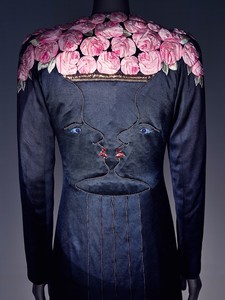
DRI did so many things. I did portraits of big cats, leopards, and lions, and there was a portrait of Audrey Hepburn too.
DCBYour first commission.
DRThe first! And I’m still doing it. I’m probably one of the last designers who really draws to design and hands off sketches to be executed. Every couture dress we design, including red-carpet ones, comes from me.
DCBDo you give the sketches to the celebrities who wear the dresses?
DRI will, yeah.
DCBI love that. Of course, Karl Lagerfeld used to send sketches. I remember once going into Chloë Sevigny’s closet, and she had framed sketches from when Alber Elbaz was the designer at Yves Saint Laurent, including the dress he designed for her at the Oscars when she was nominated for Boys Don’t Cry [1999]. It’s so cool to see the sketches because there’s a link to the art and also hand-drawn craft.
DRTotally!
DCBThe obvious transition here is the Schiaparelli show at the Victoria & Albert in London, which is up now.
DRThe V&A is meant to ask the question, “Can fashion be art, can art be fashion?” But it is also declarative, in the sense that it says Elsa Schiaparelli was the first to really ask the question.
DCBThat’s interesting. When this topic of fashion and art comes up, I normally begin with the Ballets Russes inviting Coco Chanel and Pablo Picasso to create costumes and sets, beginning in 1916. But to your point, Picasso didn’t design a Chanel. They worked together, but not to create a collection.
DRThat was costumes and sets.
DCBSo Elsa was the first.
DRIt’s true. And her collaborations were complex designs—her lobster dress was the first time a dress was not just a dress. The dress was messaging something completely at odds with what a dress is about. Same with the Skeleton Dress and her other art-as-fashion creations. Everyone who came after that—I’m talking about Rei Kawakubo, Martin Margiela, Yves Saint Laurent, anyone who has asked that question—they’re all her children. To me that’s why she matters so much.
DCBThat was her legacy.
Elsa Schiaparelli, Paris, 1938. Photo: Time Life Pictures/Getty Images
DRWe hope the exhibition effectively conveys this as a moment. The beauty of a house, and the beauty of the Schiaparelli name, is wrapped up in how seismic the house’s origin was. We’re a small house, but we’re punching so far above our weight because of the legacy.
DCBThe exhibition includes designs from both her and you, is that correct?
DRYes. It’s divided into four sections, and the last one explores her lasting influence and her outsize design legacy.
DCBThe garments on display are owned by the museum, or do you have a large archive?
DRWe don’t have an archive at all. Schiaparelli doesn’t because Elsa gave it all away.
DCBReally!?
DRYes! She gave nearly her entire personal archive to the Musée des Arts Décoratifs here in Paris, to the Philadelphia Museum of Art, and to the Metropolitan Museum of Art in New York, which has a lot, too. The exhibition has been called in from all four corners of the globe.
DCBWhy would she give her archive away?
DRI don’t know if there was anyone to give it to, and she needed to give it to someone.
DCBInterestingly, she gave it to museums, places that would have treated her designs like works of art.
DRExactly.
DCBBut I met Marisa Berenson, her granddaughter, who would have taken it!
DRI’ve never asked Marisa that question.
DCBWhat have you asked her?
DRI sometimes wonder what it’s like for her to be the only person who really knew her grandma and to see what’s happening today. Last night she said to me, “She’d be so proud.”
DCBI’d like to think she would be. You’ve been a stellar steward of her legacy.
DRNot too long ago, I found an interview she gave later in her life, when she was in her fifties or sixties. It was when miniskirts and white tights were all the rage, so the mod era of the Swinging ’60s or whatever. And she was not happy. She was saying she didn’t get it. It was interesting to see someone who had been so elastic in her younger years, and so confrontational, sort of like not get it.
DCBSuddenly she was rigid. I wonder if that’s why she felt disconnected.
DRFor me, it served as a reminder to all of us, especially in this industry, to stay young. Stay flexible. It’s to her credit that the language of this brand is more elastic and more flexible—you can bend it to your will.
Derek C. Blasberg is a writer, fashion editor, and New York Times best-selling author. He has been with Gagosian since 2014, and is currently the executive editor of Gagosian Quarterly.
Daniel Roseberry was born in 1985 in Plano, Texas. In 2019, he took on the role of creative director at Maison Schiaparelli, the renowned Parisian couture house. During his tenure at Schiaparelli, Roseberry revived some of the House’s most influential codes while paying homage to Elsa Schiaparelli’s celebrated love of Surrealism. At the same time, he subverted many of these codes, contributing to a new aesthetic grammar through the frequent use of gold jewelry and metalwork, upcycled denim, and molded leather and metal breastplates and anatomical parts.