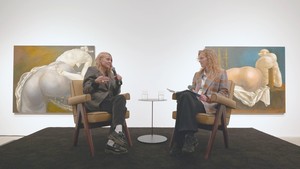
Swiss Institute, New York, is staging an exhibition that places the paintings of Louise Bonnet and the sculptures and videos of Elizabeth King in dialogue. Ahead of the exhibition’s opening this May, Stefanie Hessler—the show’s curator and the Institute’s director—met with the two artists to discuss animacy, gesture, and the liminal space between life and lifelikeness.
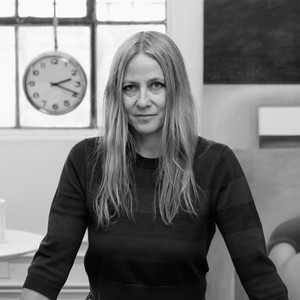
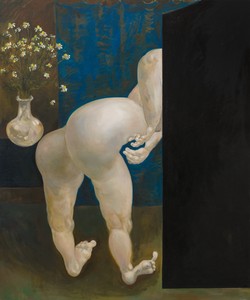
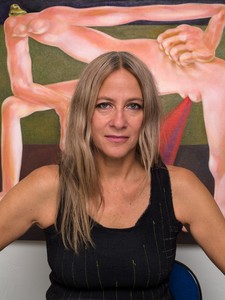
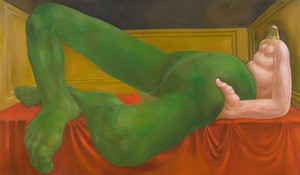
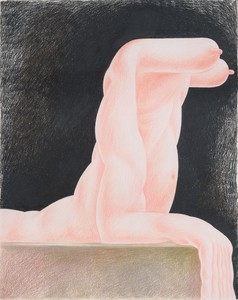
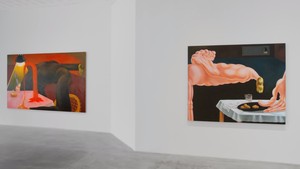
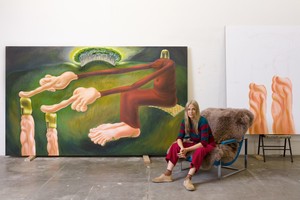
Through softly luminous portraits of bulging, distorted figures, Louise Bonnet probes the experience of what it means to inhabit a body. Her protagonists walk a line between beauty and ugliness, between absurdist, knockabout comedy and extreme psychological and physiological tension. Inhabiting sparse landscapes and boxed in by the edges of the canvas or the page, they act out dramas of profound discomfort that plumb the depths of the artist’s subconscious. Photo: Jeff McLane
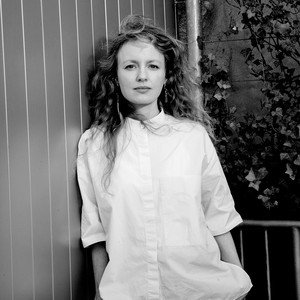
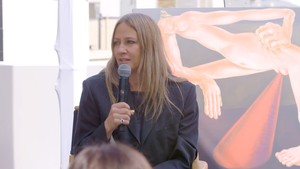
Stefanie Hessler is the director of Swiss Institute, New York. Her work centers artists and ideas through new commissions, transdisciplinary collaborations, and experimental formats. At SI, Hessler cocurated Spora, which invited artists to transform the institution through “environmental institutional critique,” as well as solo shows with artists. Photo: Lila Barth
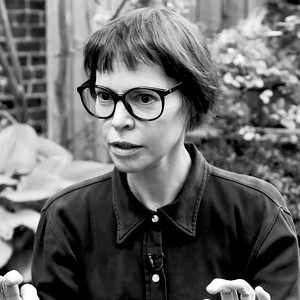
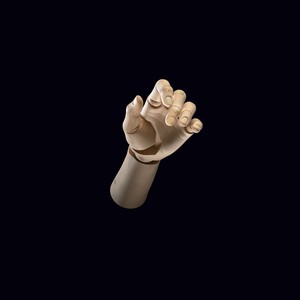
Elizabeth King works in wood, porcelain, and bronze, and often animates her precisely movable sculptures on stop-motion film. Her work is in permanent collections of the Hirshhorn Museum, Washington, DC; Los Angeles County Museum of Art; Museum of Fine Arts, Houston; Virginia Museum of Fine Arts, Richmond; and Metropolitan Museum of Art, New York, among others. She is the author of Attention’s Loop: A Sculptor’s Reverie on the Coexistence of Substance and Spirit (Abrams, 1999) and coauthor, with W. David Todd, of Miracles and Machines: A Sixteenth-Century Automaton and Its Legend (Getty Publications, 2023). Photo: Olympia Stone
Stefanie HesslerThe title of the exhibition is De Anima, and through pairings of both of your works we’ve been exploring the increasingly blurry boundaries of life and nonlife in relation to art, technology, and gender. The presentation will examine notions of life and lifelikeness at a moment of heightened pressure on ontological, epistemological, and ethical questions concerning animacy, the quality of being alive. Elizabeth, your sculptures and animations in search of the perfect, most lifelike forms and movements, as well as your research into automata, make us think of today’s automatic chatbots that pass as all too human but that lack life or life force. And Louise, your paintings show bodies suspended between too-abundant-with and emptied-of life, falling off couches or performing a gesture until it becomes second nature. The exhibition is a result of this ongoing conversation among you two and myself. Louise, is there a certain aspect of these discussions that you’d like to revive here?
Louise BonnetI think about the Jaquet-Droz automata [automata built by a Swiss watchmaking family in the eighteenth century] all the time. Elizabeth, you told us the story of two of those automatons: one is playing an instrument, so everyone’s supposed to look at that one, but then there’s another one that’s seemingly “off,” since it isn’t its turn to perform, but it’s actually active in very subtle ways that you don’t really notice, shifting a little bit, like it’s waiting. There’s something about that dynamic that’s been a recurring interest.
Elizabeth KingYes! The harpsichord player waits while the draftsman and writer perform. Encountering them, you realize she’s been moving too, almost imperceptibly. I certainly didn’t know this before I went to see these Enlightenment automata in [the Musée d’art et d’histoire de] Neuchâtel. I knew I was going to see a demonstration; I didn’t know that one of them was going to be waiting, actively waiting, before she herself performed. The shock of discovering this, but then the amazement at how she’d been animated to do these very minimal, almost unconscious movements, reinforced some of the things I’ve tried to have my sculptures do in stop-motion film. I have no idea how Pierre and Henri-Louis Jaquet-Droz, and their colleague Jean-Frédéric Leschot, cut those automata’s cams. They would have had to be very, very slow curves. I’d love to look inside the figures to see the shapes that generate such exquisitely minimal, liminal sorts of motions.
SHAnd of course you’ve been working toward finding the perfect, lifelike joint or body part and sculpting that, and then also thinking about the perfect movement that feels as lifelike as possible in the animations.
EKYes. And not just any gestures, but certain kinds of gestures that are more ambiguous. They might be gestures that signal the relationship of body to mind, as opposed to our age-old habit of separating those and putting the mind first. The whole robotics world is still discussing artificial life in terms of that old dichotomy. I’ve always felt that they can’t be pried apart. The kinds of motions that I want to capture are crafted around that. I loved your word “animacy,” Steffi. I actually looked it up—it’s a word that I didn’t know, from linguistics. In the case of a ladder falling on a man, the ladder appears animate. There can be an interesting switch in agency between the object and the subject of a verb.
SHAnd I think that also relates, Louise, to your work. The figures in your paintings feel both too alive and also like they’re being constrained—by tights, by clothing, by architecture, furniture, and so on.
LBAs I’ve been working on the paintings for the show I’ve been thinking a lot about “tells”—the things your body does against your will, the small, usually overlooked or unconscious movements we make. I’m making new paintings that are oriented around pants or jackets: a body putting pants on, a body putting a jacket on, but the jacket or the pants aren’t there. So you see the figures doing something, and you might not know exactly what they’re doing, but I think it makes your own body react, because it knows that gesture. I found this old army manual that includes photos showing how various uniforms are correctly supposed to be worn, like “This is for parachuting,” or whatever. I thought those pictures were great because they show soldiers or army personnel modeling the uniforms, and positioning their bodies in the movement that would be required along with whatever they are wearing. For the parachuting outfit, for example, the person is just standing a bit awkwardly on a very colorfully lit set, with their arms up, and it removes the crucial thing it’s all for, which is plummeting to earth—possibly to your death, in this case. I took cues from that. I’m putting my figures in a sort of theater—it’s as if AI or aliens made a handbook to show other aliens what it is to put pants on, but they didn’t understand that the pants are actually the point. So there’s no pants, but there’s everything else.
EKThat’s fantastic.
LBI’ve also been reading a lot of books about spies and spy craft, tells and misdirections, specifically using the body. During World War II, for example, when the British were parachuting spies into occupied France, these people had seconds to hide the parachute and then just walk away, as if they’d always lived there, so they had to be completely ready to look and seem French. They were given garlic chocolate to chew so they’d smell right, and had to know and remember things like, for example, never to put their hands in their pockets because French people never put their hands in their pockets. You’d get caught if you did stuff like that. I’m interested in movements that are mostly unconscious, or so rote that they become unconscious, and what they communicate.
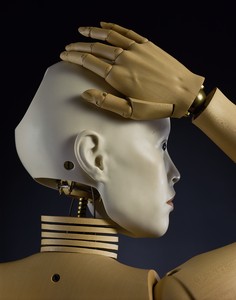
SHThe garlic chocolate is essentially doing the same thing as the movement in your work, Liz, and how you photograph your sculptures. I know you’re very specific about how they’re shown. I think, for example, of the ear in one of your sculptures, and how there are the lines on the skin behind the ear, which are so delicate and really make the work feel alive, even though we know it’s not. So there’s something about the simulation, the coming as close as possible and pushing toward that boundary, be it through the sculptural form, the gesture, or what you ingest.
EKWell, anything made of wood, let’s say, or of clay, or of paint, has physical and visual properties that insist on themselves, regardless of what they depict. I wonder if I can make an image that elicits responses that are reflexive and innate in us, despite the fact that we can see with our eyes that these are things made of clay. I was struck by a word that Ben Lerner used when he was writing [in the New York Review of Books] about Ed Atkins’s work: he used the word “obligation.” If we think something is alive, it draws from us a sense of obligation—a feeling we don’t have in front of a photograph, or anything we feel isn’t sentient. It’s not unlike when you’re looking at someone who you think is asleep, and then you realize their eye is just a slit open and they’re watching you. Your cover is blown! Now it’s a two-way street.
SHI’m rereading Iris Marion Young’s essay “Throwing Like a Girl” [1980]. She was examining the ways girls move differently before puberty, when girls’ and boys’ bodies aren’t really that different. And she asserted that the difference in movement is due not to biological reasons but to conditioning. The women are more inhibited in their movement; the supposed fact that girls can’t throw very well is not because of any physiological reasons but because of the way we’ve been trained to think of our own bodies and agency in space. Could we talk about your work in terms of gender and conditioning?
I’m interested in movements that are mostly unconscious, or so rote that they become unconscious, and what they communicate.
Louise Bonnet
EKLouise, you paint both the male and the female figure, yes?
LBI really don’t totally think of them as fully either one, but I think that, since they’re me, really, in the end—in the way that in dreams it’s always you—they’re more female-looking because that’s what I know; I’m working from the inside out.
EKIt’s interesting, in the history of automata and androids and cyborgs, they’re mostly female. Most of the literature involves a woman being made by a man. Here I am doing it too, god knows, though I’m a woman making a woman. Maybe it’s just what you say, Louise: you just work from the inside out. It goes with all the other kinds of things you can’t really control, like the size of the work you make, how big or small it is. And then everything that comes with how you make something, the gestures you yourself make, what you do with your body. In my younger years I wasn’t really aware of the extent to which I was working from the inside out. I didn’t want people to know these were self-portraits. As Adrian Piper said about her work, “Just because it’s a self-portrait doesn’t mean it’s about me.”
LBThat’s good, yes.
EKBut at the same time, the sculptures’ heads are hollow, and I’m literally working inside the head, making the nostrils go all the way through—so I’m bound to still be in there somewhere when the work is finished.
LBDo you think you’re making a space for you to be in?
EKMaybe. People ask me if I played with dolls when I was a kid, and no, I hated dolls. I was into making forts. I spent hours dreaming about them, constructing them mentally, building them out of cardboard, woodpiles, snow, leaves. And they were always intimate, one- or two-person forts. In art school I made sculptures that borrowed forms from architecture and were intimate to the single body. I made a sculpture where you closed a miniature theater around your head. But then the head itself became a kind of architecture to me, a container with windows and apertures and contents, with an inside and an outside. We’re always trying to figure out what it is we are, and what makes us alive. When someone dies, you see that they’re no longer there. Presence and absence come into play in all these ways while I’m working.
SHIt also reminds me, Louise, that you once said the reason you don’t really paint faces is that you don’t want your figures to be looking at you.
LBIt’s true. I think the notion of obligation from earlier is interesting here, because I make sure I don’t have that with the figures I’m painting. I don’t want them to know I’m there.
EKNo wonder you’re reading spy novels.
LBYes, that’s true. When I was a kid—but I think all kids do this—I really, really loved spying. I’d go into my neighbor’s house and hide.
EKYou wanted to know what was going on in there.
LBIt’s true. I always liked to be there but no one knew I was there.
EKI love that you don’t want to be seen by your work. This is how alive it becomes for you. You were spying when you were a kid, and me, I was hiding. Both of us were involved with places where inside and outside mattered.
The body is a piece of architecture with parts, each part doing its different thing. My mother suffered from polio and was paralyzed when I was three. So I don’t remember her walking—my memory is always that she moved with the help of machinery. And it’s the same sort of machinery we see robots made out of. With a robot you start with nothing, with stuff, and you make something that you hope might come to life. But with a person you start with a live body and round up the same machinery, joints, mechanical braces and things, to try to keep that person moving. Where the human ends and the machine begins in the AI world is a constantly changing boundary.
LBI read about the British SOE [Special Operations Executive] faking a plane accident and parachuting a corpse, a dead guy, as a plant, to carry false information into Nazi territory. He had to seem real, and as if he were a high-ranking person in the British army, so they had to make him an identity card with his photo on it. It became a big problem because it was impossible to take a picture of him where he looked remotely alive—they had to find somebody who looked like him to photograph, because they couldn’t take a picture where he didn’t look like he was absolutely dead.
SHThat’s interesting as well, that there’s this inner knowledge or sense of what’s living and what isn’t.
EKAnd we can’t pinpoint it. What’s the difference between a dead eye and a live eye? It looks exactly the same. During the Renaissance there was much discussion about painting and whether one could stand in front of a portrait and feel that it had captured the soul or the breath of a person. What was the nature of that skill? I feel like a lot of the AI stuff today is trying to do that too, but they don’t have very good images yet. It’s all functional or cybernetic. I haven’t seen any robots that pass a sort of breathing-likeness test. But the great painters, the great sculptors, did something that we still haven’t outdone in terms of capturing what it is to be alive. Rembrandt’s Lucretia [1666]—such a raw, emotional face. I find in your work, Louise, the way you paint the body—it’s corpuscular and full of pulse, and all those subtle things to do with the surface tension of flesh, with nerves right under the skin. Those things feel very much alive for me in your work.
LBThat’s very nice! Thank you.
SHI agree. What distinguishes lifelikeness from life? There have been so many attempts, of course, at defining life, and there’s still no consensus as to what life is, and whether, for instance, a virus is alive or not. But there’s something about emotional presence—something that transcends its reality.
EKPeople say, “Well, why don’t you get your sculpture to move animatronically, instead of just using stop-motion? Why not use silicone?” I know I’m not going to fool anybody, nor do I want to. I want the tension between what a thing depicts and what it is.
LBI feel the same way. Not making it realistic makes you feel it more, paradoxically.
Through softly luminous portraits of bulging, distorted figures, Louise Bonnet probes the experience of what it means to inhabit a body. Her protagonists walk a line between beauty and ugliness, between absurdist, knockabout comedy and extreme psychological and physiological tension. Inhabiting sparse landscapes and boxed in by the edges of the canvas or the page, they act out dramas of profound discomfort that plumb the depths of the artist’s subconscious. Photo: Jeff McLane
Stefanie Hessler is the director of Swiss Institute, New York. Her work centers artists and ideas through new commissions, transdisciplinary collaborations, and experimental formats. At SI, Hessler cocurated Spora, which invited artists to transform the institution through “environmental institutional critique,” as well as solo shows with artists. Photo: Lila Barth
Elizabeth King works in wood, porcelain, and bronze, and often animates her precisely movable sculptures on stop-motion film. Her work is in permanent collections of the Hirshhorn Museum, Washington, DC; Los Angeles County Museum of Art; Museum of Fine Arts, Houston; Virginia Museum of Fine Arts, Richmond; and Metropolitan Museum of Art, New York, among others. She is the author of Attention’s Loop: A Sculptor’s Reverie on the Coexistence of Substance and Spirit (Abrams, 1999) and coauthor, with W. David Todd, of Miracles and Machines: A Sixteenth-Century Automaton and Its Legend (Getty Publications, 2023). Photo: Olympia Stone