Alice Godwin and Alison McDonald explore the history of Roy Lichtenstein’s mural of 1989, contextualizing the work among the artist’s other mural projects and reaching back to its inspiration: the Bauhaus Stairway painting of 1932 by the German artist Oskar Schlemmer.
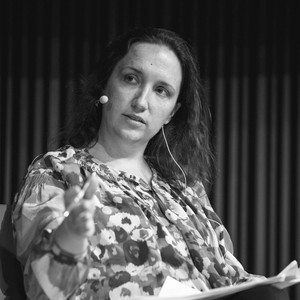
Alice Godwin is a British writer based in Copenhagen, whose focus is the Nordic contemporary art world. An art history graduate from the University of Oxford and the Courtauld Institute of Art, she contributes to publications such as ArtReview, Frieze, the New York Times, and Wallpaper.
Alison McDonald is the chief creative officer at Gagosian and has overseen marketing and publications at the gallery since 2002. During her tenure she has worked closely with Larry Gagosian to shape every aspect of the gallery’s extensive publishing program.
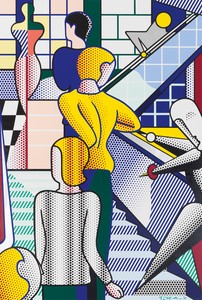
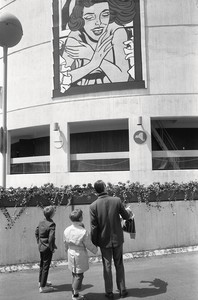
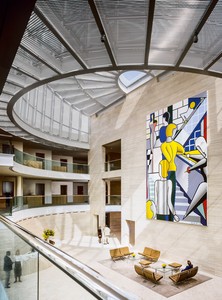
Soaring over twenty-six feet high, Roy Lichtenstein’s magnificent Bauhaus Stairway Mural from 1989 stands as a testament to his signature Pop style of Benday dots, bold colors, and simplified forms, devices well suited to making a visual impact at a monumental scale. In contrast to the heroic or public themes of the Mexican muralists of the 1920s and the Works Progress Administration artists of Depression-era America, Lichtenstein’s murals fizz with the imagery of Pop and the pastiches of art history that also define his paintings. Over the years, he completed ten mural-sized installations (eleven if we include Super Sunset Billboard from 1967, which was later destroyed), producing these large-scale artworks from early to late in his career, from New York World’s Fair Mural(Girl in Window) of 1964 to Times Square Mural of 1994 (installed posthumously in 2002). He also made preparatory studies for four unrealized murals, ranging in date from 1968 to 1997. Having conceptualized working at large scale in the mid-1960s, Lichtenstein approached mural projects in a variety of ways, sometimes enlarging a single image, as in New York World’s Fair Mural (Girl in Window) and University of Düsseldorf Brushstroke Mural (1980), other times combining an accumulation of images from across his practice, as in Greene Street Mural (1983) and Mural with Blue Brushstroke (1986). As Camille Morineau writes, he made his murals “a fairly systematic exploration of enlarging his own ‘tropes,’ as well as a tangential investigation of large genre paintings.”1
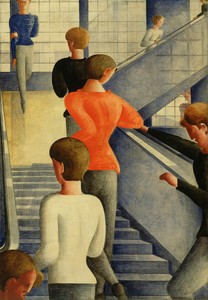
Bauhaus Stairway Mural, commissioned for the atrium of the I. M. Pei–designed headquarters of the Creative Artists Agency (CAA) in Beverly Hills, pays homage to just such a painting, Bauhaus Stairway (Bauhaustreppe, 1932), which curator Diane Waldman has described as arguably the best single work by the German artist Oskar Schlemmer.2 Schlemmer was a teacher at the revolutionary Bauhaus school in Weimar and later in Dessau, Germany, founded by Walter Gropius in 1919. The Bauhaus was devoted to a new type of artistic education that united the fine and the applied arts—a mission that resonated profoundly with Lichtenstein’s intermingling of “high” and “low” art forms. Alongside other famed staff, including Marcel Breuer, Vasily Kandinsky, Paul Klee, and László Moholy-Nagy, Schlemmer taught stage design, mural painting, and sculpture. A pioneer of abstract art, he was also a choreographer, most famously as the creator of the Triadisches Ballett (Triadic ballet) of 1922; he designed stage sets for Igor Stravinsky and Arnold Schoenberg operas in Berlin; and throughout the 1930s, he was known for his site-specific murals.
Facing mounting political pressure from the Nazi party, the Bauhaus left its purpose-built building in Dessau, designed for the school by Gropius, in 1932. Schlemmer, who had left the school three years earlier, painted Bauhaus Stairway on hearing the news of its closing. According to Christina Eliopoulos, Archives Fellow for Research and Reference at New York’s Museum of Modern Art (MoMA), the painting’s present home, Schlemmer wanted, “to memorialize and pay tribute to the artists, students, and teachers who were part of this movement and who were coming under imminent attack from the Nazis during that time.”3
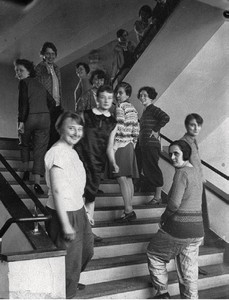
Showcasing the distinctive glass-fronted staircase of the Bauhaus’s modernist building, and its students moving up the steps, Schlemmer’s painting represents the Bauhaus in its ideal form. It was inspired by a photograph taken by Schlemmer’s fellow Bauhaus teacher T. Lux Feininger, the son of the artist Lyonel Feininger. Here, the staircase banister expresses both stability and progressive movement upward at a time of turmoil, while the stylized figures reflect Schlemmer’s belief in humanity as an organic as well as mechanical creation. Schlemmer made several paintings on this subject, including Treppenszene (Staircase scene, 1932), in the Hamburg Kunsthalle—among his last before the establishment of the Third Reich, in 1933, and his labeling as a degenerate artist by that regime, in 1937.
MoMA acquired Bauhaus Stairway after the founding director of the museum, Alfred H. Barr, saw it in a show at the Württembergischer Kunstverein during a visit to Stuttgart in 1933. Barr admired the painting and was shocked when the show was forced to close a few days later following a harsh review in the Nazi newspaper the National-Sozialistiches Kurier. The critic wrote menacingly, “This exhibition is doubtless the last chance the public will have to see painted Kunstbolschewismus [Bolshevik art] at large.”4 Within days of coming to power, the Nazi regime had begun to attack modern art and architecture, censor artworks, lock galleries, and eject modernists from the academies. Barr was a great admirer of the Bauhaus—indeed, the interdisciplinary nature of the school had served as a model for MoMA on its founding, in 1929—and he quickly persuaded a wealthy colleague, the architect Philip Johnson, to purchase Bauhaus Stairway for the museum. Since the opening of MoMA’s own purpose-built building in 1939, it has mostly hung in the stairwell there—a stairwell itself inspired by Gropius’s Bauhaus.
Oskar Schlemmer, Bauhaustreppe (Bauhaus Stairway), 1932, oil on canvas, 63 ⅞ × 45 inches (162.3 × 114.3 cm), The Museum of Modern Art, New York; gift of Philip Johnson. Digital image: The Museum of Modern Art/Licensed by SCALA/Art Resource, New York
Lichtenstein was a native New Yorker who often cited art history, translating, distilling, even poking fun at art movements and individual artworks by filtering them through his distinctive Pop aesthetic. He knew museum collections well, particularly those in New York, and certainly encountered Schlemmer’s painting at MoMA and understood the complexities of its history. In 1988, a year before creating the CAA mural, he made a smaller version of Bauhaus Stairway as a painting—though it still sits at 94 inches tall. That work and a study for it are part of the MoMA collection, where they speak quite directly to Schlemmer’s original. As Deborah Solomon wrote last fall in the New York Times, “It is not surprising that Lichtenstein was drawn to Schlemmer, who rejected the hot, romantic ethos of twentieth-century German Expressionism in much the same way that Lichtenstein rejected the emotive ethos of Abstract Expressionism a half-century later. . . . One of Lichtenstein’s enduring themes was the absurdity of utopian visions, and so the Schlemmer painting was perfect grist for his dot-pattern mill. Lichtenstein often seemed divided between admiration for his avant-garde predecessors and an opposing desire to parody their work.”5 Reimagining Bauhaus Stairway on a grand scale in Pop terms, and with the context of Hollywood emanating from the mural’s destined home in the CAA building, Lichtenstein drew parallels between the writers, directors, actors, and musicians entering these Los Angeles offices and the artists and students who filled the stairway at the Bauhaus so many generations earlier. He also tinkered playfully with the composition, his dry sense of humor responding to the mural’s destined long-term location. As Solomon notes, “Revealingly, in lieu of the male dancer that Schlemmer has positioned in the upper left of his painting, balancing en pointe, Lichtenstein has substituted an Oscar statuette. He thereby flattened the radical lessons of the Bauhaus into a race for an Academy Award.”6 Perhaps the Oscar is also a punning homage to Oskar Schlemmer—too much of a stretch, maybe, but the artist did have a playful spirit.
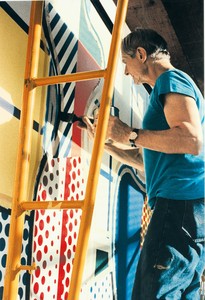
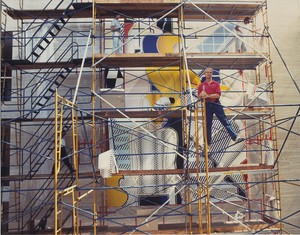
The painting of a mural is involved, requiring planning and preparation far more extensive than those for traditionally scaled canvases. This kind of execution suited Lichtenstein’s sensibilities. For Bauhaus Stairway Mural, he brought three assistants from New York to spend five weeks with him at CAA. To ensure the availability of the proper art supplies for the duration of the project, one of these assistants drove from New York to Los Angeles carrying materials that might be challenging to source at short notice. By the time everyone had arrived, the expansive canvas—backed with a layer of material to facilitate separating the work from the wall in the future if need be—was already installed but had not yet been primed. (It is amusing to wonder how many gallons of gesso it took to cover the canvas completely.) A projector was set on scaffolding across from the canvas, so that Lichtenstein could draw the composition from the projected image it cast. (Once the machine was aligned, an assistant needed to steady it for hours while Lichtenstein drew out the planned lines, as any shift or movement would misalign the projection.) Rob McKeever, a member of the Bauhaus Stairway Mural crew, recently recalled:
Once the image was scaled up, Lichtenstein would make a drawing directly on the canvas. Then we would apply tape to delineate the sections, we would paint to fill the colors in after that, then move the tape and apply black to fill the lines in. The dots on the murals would either be silk-screened or we would use a stencil (depending on the size, silk-screens were hard to align, so stencils tended to be easier), which was often the most challenging part. Overall it was a pretty straightforward process and Roy was working alongside us every step of the way.7
Lichtenstein made several important murals in the 1980s, including Greene Street Mural, at Leo Castelli’s Greene Street Gallery (1983), and installations at AXA Equitable Center, New York (1984–86), and the Tel Aviv Museum of Art in 1989. It is interesting to note that Tel Aviv Museum of Art Mural was made in the same year Lichtenstein painted the CAA mural: it combines a variety of motifs from across the artist’s career, including a portion of Bauhaus Stairway. Morineau writes,
When Lichtenstein cites himself it is always clear, as seen in the Tel Aviv Museum of Art Mural, where Oskar Schlemmer’s stairway is paired with a sort of abstract double, to good effect: few people know that Tel Aviv is home to the largest collection of Bauhaus and International Style buildings in the world, all located in the city center. Incidentally, Lichtenstein’s citations in the Tel Aviv mural and others focus on political artists and well-known mural artists—[Pablo] Picasso, [Fernand] Léger, [Marc] Chagall, Schlemmer—as well as on the loss of utopia, be it modern or contemporary. . . . [Schlemmer’s] Bauhaus Stairway was gifted by Philip Johnson in 1942 to MoMA, where it was enthroned at the top of the stairs until 1983. It was Johnson who commissioned Lichtenstein’s first mural in 1962 and who donated his wonderful painting Girl with Ball to MoMA. Each mural thus responded to a context where Lichtenstein tackled issues full throttle, regardless of how contentious they were.8
Roy Lichtenstein with Bauhaus Stairway Mural (1989), in progress at the Creative Artists Agency, Beverly Hills, California, October 4, 1989. Photo: Betty Freeman, courtesy The Roy Lichtenstein Foundation Archives
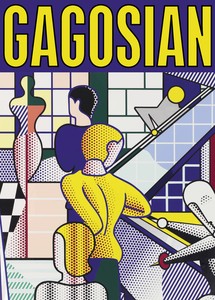
After seeing Bauhaus Stairway Mural in its most recent display, at Gagosian in Chelsea in 2023, David Whelan described his visual experience for the Brooklyn Rail: “At a distance, the various parts appear locked into place, but as you approach, the composition begins to move. Lichtenstein’s elongated curves took my vision for a ride before plunging into fields of Benday dots, which produce a buzzing after-image that carries across the picture plane. Besides Lichtenstein’s dramatic optical effects, what held my attention most were moments in the composition where the artist went off-script, deviating from Schlemmer’s original painting.”9 The conical forms of the legs and arms in Schlemmer’s painting, for example, recall his designs for the stage—voluminous multicolored costumes that might force performers to modify their movements and test the relationship between body and space. Lichtenstein’s figures in the lower-right-hand and upper-left-hand corners of the mural seem to reference these costumes and Schlemmer’s volumetric rendering of the figure, as well as his interest in mechanical movement. But Lichtenstein injects Schlemmer’s vision of the Bauhaus with his own, electric Pop palette, bold outlines, and the two-dimensional modeling techniques of hatching and Benday dots.
Speaking generally of Lichtenstein’s murals, Morineau writes, “The culture and life of museums and the history and politics of place are, more or less, directly evoked here. But also, more surprisingly, is the recurring religious metaphor of ascension, which may have helped to structure the compositions of Lichtenstein’s three largest murals (Mural with Blue Brushstroke, Bauhaus Stairway Mural, and Tel Aviv Museum of Art Mural).”10 Waldman writes, “The subject of a stairway filled with people seems eminently suitable, and even manages to evoke something of the Bauhaus’s utopian belief in merging art and life. Here, this utopian ideal is joined with Lichtenstein’s democratizing aesthetic of replication, thus making art accessible to all and maintaining the connection between high art and consumer culture that underlies all his work.”11
1 Camille Morineau, “There Will Be Mural Painting,” Roy Lichtenstein: Greene Street Mural (New York: Gagosian, 2015), p. 79.
2 Diane Waldman, Roy Lichtenstein, exh. cat. (New York: Solomon R. Guggenheim Museum, 1993), p. 271.
3 Christina Eliopoulos, in “UNIQLO ArtSpeaks: Christina Eliopoulos on Oskar Schlemmer’s Bauhaus Stairway,” MoMA post on Facebook #ArtSpeaks playlist, March 5, 2021. Available online at www.facebook.com/watch/?v=463274168200158 (accessed March 26, 2024).
4 Hugh Eakin, Picasso’s War: How Modern Art Came to America (New York: Crown, 2022), p. 266.
Alice Godwin is a British writer based in Copenhagen, whose focus is the Nordic contemporary art world. An art history graduate from the University of Oxford and the Courtauld Institute of Art, she contributes to publications such as ArtReview, Frieze, the New York Times, and Wallpaper.
Alison McDonald is the chief creative officer at Gagosian and has overseen marketing and publications at the gallery since 2002. During her tenure she has worked closely with Larry Gagosian to shape every aspect of the gallery’s extensive publishing program.